Social Media and Online Conduct Policy Template

Free Word download β€’ Edit online β€’ Save & share with Drive β€’ Export to PDF

2 pagesβ€’20–25 min to fillβ€’Difficulty: Standard
Learn more ↓
FreeSocial Media and Online Conduct Policy Template

At a glance

What it is
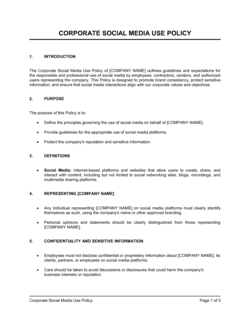
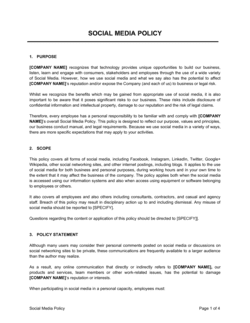
A Social Media and Online Conduct Policy is an internal HR and operations document that defines acceptable and prohibited employee behavior on social media platforms, online forums, and other public digital channels β€” both during work hours and in personal use that may affect the organization. This free Word download gives you a ready-to-edit template you can tailor to your company's industry, brand standards, and culture, then distribute digitally or include in your employee handbook.
When you need it
Use it when onboarding new employees, updating your employee handbook, responding to a social media incident, or building HR infrastructure for a growing team. Any organization with employees who have a public online presence needs a written policy before an incident occurs, not after.
What's inside
Purpose and scope, personal vs. professional use distinctions, brand voice and disclosure requirements, confidentiality rules, prohibited content categories, monitoring and enforcement provisions, disciplinary consequences, and a policy acknowledgment section employees sign to confirm receipt.

What is a Social Media and Online Conduct Policy?

A Social Media and Online Conduct Policy is an internal HR document that defines the standards of behavior expected of employees when using social media platforms, online forums, review sites, and other public digital channels β€” whether during work hours or in personal use that could affect the organization. It covers who may speak officially on behalf of the company, what confidential information may never be shared online, which categories of content are prohibited, and what disciplinary consequences apply when the rules are broken. By establishing clear written expectations, the policy gives the organization a defensible foundation for enforcement while helping employees understand exactly where the line sits between acceptable personal expression and conduct that creates legal, reputational, or regulatory risk for the business.

Why You Need This Document

The absence of a social media policy is rarely noticed until something goes wrong β€” and when it does, the damage is immediate and public. A single employee post disclosing a client name, leaking unreleased product information, or making discriminatory comments can surface on a competitor's radar, appear in a regulatory inquiry, or go viral before HR is even aware of it. Without a written policy that employees have acknowledged, disciplinary action β€” including termination β€” is far harder to defend in an employment tribunal or wrongful dismissal claim. Organizations in regulated industries face an additional layer of exposure: a healthcare employee discussing a patient case, or a financial adviser posting unauthorized investment commentary, can trigger statutory penalties that dwarf the cost of drafting and distributing a policy. This template gives you a complete, customizable starting point that closes those gaps in under two hours, with a built-in acknowledgment process that creates the paper trail you need if enforcement ever becomes necessary.

Which variant fits your situation?

If your situation is…Use this template
Creating a standalone policy employees acknowledge separatelySocial Media and Online Conduct Policy
Embedding social media rules inside a broader employee handbookEmployee Handbook
Controlling how employees use company-owned devices and networksComputer and Internet Use Policy
Governing how confidential information may be shared externallyConfidentiality Policy
Addressing a specific employee social media incident through disciplineEmployee Written Warning
Regulating employee use of email and messaging platformsEmail and Electronic Communications Policy
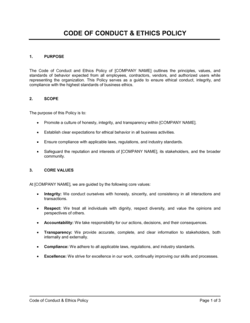
Setting conduct standards more broadly across all workplace behaviorCode of Conduct

Common mistakes to avoid

❌ Claiming monitoring rights over personal accounts

Why it matters: In many jurisdictions, including EU member states and several US states, monitoring employees' private accounts constitutes an invasion of privacy and can expose the company to regulatory fines and unfair dismissal claims.

Fix: Limit monitoring explicitly to company-owned accounts, devices, and networks. Include a sentence confirming the company does not access personal accounts.

❌ Omitting a disclosure and disclaimer requirement

Why it matters: Employees who discuss the company or its products on personal channels without identifying their employer relationship can create implied endorsements and FTC compliance risk.

Fix: Require a standard disclaimer β€” 'views are my own and do not represent [COMPANY NAME]' β€” whenever employees identify themselves as employees in a public online discussion.

❌ No tracked acknowledgment process

Why it matters: Without a signed or electronically confirmed record, employees can credibly claim they never received the policy, making disciplinary action and termination far harder to defend.

Fix: Require acknowledgment within a set number of days of hire and upon each material update. Store records in your HRIS or personnel files.

❌ Prohibiting legally protected online activity

Why it matters: Employees in the US have NLRA rights to discuss wages, benefits, and working conditions publicly. Overbroad clauses that prohibit this expose the company to NLRB complaints.

Fix: Have HR or employment counsel review prohibited content categories to ensure no clause restricts protected concerted activity or other statutory rights before the policy is distributed.

The 9 key sections, explained

Purpose and scope

Personal vs. professional use distinctions

Authorized spokespersons and brand accounts

Confidentiality and information security

Prohibited content and behavior

Disclosure and transparency requirements

Monitoring and enforcement

Disciplinary consequences

Policy acknowledgment and training

How to fill it out

  1. 1

    Define scope and insert your company name

    Replace all [COMPANY NAME] placeholders and confirm the policy applies to full-time employees, part-time staff, contractors, and interns β€” anyone who could post on behalf of or in connection with the organization.

    πŸ’‘ Specify the platforms explicitly (LinkedIn, X, Instagram, TikTok, Facebook, Reddit) rather than using 'all social media' β€” platform lists make the policy harder to misinterpret.

  2. 2

    Name your authorized spokespersons

    Identify by role (not just name) who may post to official company channels and who approves content before it goes live. Include a process for urgent or time-sensitive posts.

    πŸ’‘ If your organization uses a social media scheduling tool, name it here β€” it creates a natural audit trail and makes approval workflows concrete.

  3. 3

    Cross-reference your confidentiality definitions

    Either define confidential information in the policy itself or explicitly reference the employee's NDA or confidentiality agreement. Link the two documents so there is no ambiguity about what cannot be shared.

    πŸ’‘ List three to five concrete examples of confidential information β€” unreleased products, client contracts, salary data β€” so employees understand the standard in practice.

  4. 4

    Customize the prohibited content list

    Review the default prohibited content categories and add any industry-specific prohibitions β€” for example, client case details for healthcare or legal firms, or non-public financial data for regulated financial services companies.

    πŸ’‘ Avoid prohibiting content that constitutes legally protected activity in your jurisdiction β€” employees have the right to discuss wages and working conditions in most countries.

  5. 5

    Set your monitoring scope

    Confirm the policy only claims monitoring rights over company-owned accounts, networks, and devices. Remove or revise any language suggesting surveillance of personal accounts to reduce legal risk.

    πŸ’‘ Have HR or legal review the monitoring section before distribution β€” this is the clause most likely to be challenged in jurisdictions with strong employee privacy laws.

  6. 6

    Calibrate the disciplinary scale

    Confirm the disciplinary consequences allow for immediate termination in severe cases while retaining flexibility for less serious first offenses. Remove fixed-sequence language if present.

    πŸ’‘ Cross-reference your general disciplinary policy or employee handbook so the social media policy is consistent with your broader HR framework.

  7. 7

    Add the acknowledgment and set a distribution process

    Finalize the acknowledgment section with a signature line or electronic confirmation step. Establish how you will distribute the policy, track completions, and store signed copies.

    πŸ’‘ Store acknowledgments in each employee's personnel file or your HRIS β€” you will need them if you ever enforce the policy through termination or a legal dispute.

  8. 8

    Schedule a review date

    Add a policy version number, effective date, and a next-review date β€” typically 12 months out. Social media platforms and regulations evolve quickly and policies need regular updates.

    πŸ’‘ Assign a named owner (e.g., HR Director or General Counsel) who is responsible for triggering the annual review and distributing updates to all staff.

Frequently asked questions

What is a social media and online conduct policy?

A social media and online conduct policy is a written set of rules that governs how employees may use social media platforms and online channels β€” both on company time and in personal use that could affect the organization. It covers what employees can and cannot post, who may speak officially on behalf of the company, how confidential information must be protected, and what disciplinary consequences apply to violations. Most organizations include it in their employee handbook or distribute it as a standalone document employees must acknowledge.

Why do businesses need a social media policy?

Without a written policy, employees have no clear standard for what constitutes acceptable online behavior in connection with their employment. A single employee post disclosing confidential client data, making discriminatory comments, or posting as the company without authorization can result in lost clients, regulatory fines, and reputational damage that takes years to repair. A documented policy also provides the legal foundation for disciplinary action or termination when violations occur.

Does a social media policy apply to employees' personal accounts?

Yes, but only in limited circumstances. A well-drafted policy applies to personal accounts when an employee identifies themselves as a company representative, discusses the company or its clients, or posts content that could be traced back to their employment. It should never claim rights to monitor or control purely personal content unrelated to work β€” doing so creates privacy law exposure and is generally unenforceable.

Can employers discipline employees for social media posts?

Generally yes, where the post violates a clear written policy and does not constitute legally protected activity. Disciplinary action is most defensible when the policy was distributed and acknowledged before the violation, the prohibited conduct is specifically described, and the consequence is proportionate to the severity. Employers should be careful not to discipline employees for discussing wages or working conditions, which is protected activity in many jurisdictions.

What should a social media policy prohibit?

Standard prohibitions include: disclosing confidential company or client information, making harassing or discriminatory statements about colleagues, posting defamatory content about competitors, creating unauthorized endorsements, and impersonating the company or another employee. The prohibited list should be specific enough to be actionable but avoid restricting legally protected speech, including discussions of wages and working conditions.

How often should a social media policy be updated?

At minimum once per year, or immediately following a significant platform change, a high-profile social media incident, or a relevant change in employment or privacy law. Policies that reference specific platforms by name need updates as platforms emerge and decline. Assign a named policy owner β€” typically the HR Director or General Counsel β€” and set a calendar reminder for the annual review.

Do employees need to sign the social media policy?

Yes. A signed or electronically acknowledged confirmation that the employee received and read the policy is essential for enforcement. Without it, employees can credibly claim they were unaware of the rules, making disciplinary action difficult to defend β€” particularly if termination is involved. Acknowledgment should be collected at hire and again whenever the policy is materially updated.

What is the difference between a social media policy and a code of conduct?

A code of conduct covers the full range of workplace behavior standards β€” ethics, conflicts of interest, professional conduct, and compliance obligations β€” across all contexts. A social media policy is focused specifically on online behavior and digital communication. Most organizations use both: the code of conduct sets the broad ethical framework, and the social media policy provides the operational detail for online conduct specifically.

Can a social media policy restrict what employees post on their own time?

Only in limited, clearly defined circumstances. Employers can restrict personal online activity that discloses confidential information, creates a hostile work environment, or constitutes a direct conflict of interest. They generally cannot restrict purely personal speech unrelated to work. The policy should be drafted narrowly enough to survive a legal challenge while covering the behaviors that genuinely create risk for the business.

How this compares to alternatives

vs Code of Conduct

A code of conduct covers the full range of employee behavior standards β€” ethics, conflicts of interest, professional conduct β€” across all contexts both on and offline. A social media policy addresses the specific rules and risks of digital and online channels. Most organizations need both; the social media policy is typically incorporated into or distributed alongside the code of conduct.

vs Employee Handbook

An employee handbook is a comprehensive collection of all HR policies β€” onboarding, compensation, leave, conduct, and more. A social media policy is a single-topic document that can be distributed as a standalone acknowledgment or embedded within the handbook. Standalone distribution is useful when you need employees to sign a separate acknowledgment for audit or compliance purposes.

vs Non-Disclosure Agreement

An NDA is a legally binding contract creating enforceable confidentiality obligations, typically signed at hire or before sensitive disclosures. A social media policy is an internal conduct document that reinforces those obligations in an online context. The two documents work together β€” the NDA creates the legal obligation; the social media policy explains exactly how it applies to online channels.

vs Acceptable Use Policy

An acceptable use policy governs how employees may use company-owned technology assets β€” computers, networks, email, and internet access. A social media policy focuses specifically on behavior across social platforms, including personal device use. Companies with a significant online presence or a large workforce typically need both documents operating in parallel.

Industry-specific considerations

Healthcare

HIPAA prohibitions on sharing patient information online must be explicitly cross-referenced; even anonymized case descriptions on personal accounts can constitute a violation.

Financial Services

FINRA and SEC regulations govern what registered representatives may post about investment products β€” the policy must prohibit any unauthorized financial commentary and require compliance pre-approval for relevant content.

Professional Services

Client confidentiality obligations and attorney-client or accountant-client privilege require strict prohibitions on discussing engagements, even in general terms, on public channels.

Retail and Hospitality

High employee turnover and a large frontline workforce make acknowledgment tracking and brief onboarding training critical; policies should include examples relevant to customer-facing roles.

Template vs pro β€” what fits your needs?

PathBest forCostTime
Use the templateSmall businesses and startups building their first HR policy libraryFree1–2 hours to customize and distribute
Template + professional reviewCompanies in regulated industries (healthcare, financial services) or those with 50+ employees where monitoring and discipline clauses carry higher legal stakes$200–$600 for an employment lawyer or HR consultant review3–5 business days
Custom draftedLarge enterprises with complex union environments, international workforces, or industry-specific compliance obligations that require bespoke language$1,000–$3,500+2–4 weeks

Glossary

Social Media
Any web-based or mobile platform where users create and share content publicly or within a network β€” including LinkedIn, X (Twitter), Facebook, Instagram, TikTok, YouTube, and Reddit.
Online Conduct
The totality of an employee's behavior across digital channels, including posts, comments, direct messages sent from identifiable accounts, and forum participation.
Authorized Spokesperson
An employee explicitly designated to post or comment on behalf of the company on official accounts or in response to media inquiries.
Disclosure Requirement
The obligation for employees who mention their employer on personal channels to clearly identify that their views are their own and not the company's.
Confidential Information
Non-public data about the company's finances, strategy, clients, personnel, or operations that employees may not share on any platform without explicit authorization.
Endorsement
A public statement, post, or review β€” paid or unpaid β€” that could be interpreted as a company recommendation of a product, service, or individual.
Monitoring
The employer's systematic review of activity on company-owned accounts, networks, or devices to ensure policy compliance β€” distinct from surveillance of private personal accounts.
Disciplinary Action
A formal response to a policy violation ranging from a written warning to termination, applied proportionately based on the severity and recurrence of the breach.
Policy Acknowledgment
A signed or electronically confirmed statement from an employee confirming they have read, understood, and agree to comply with the policy.
Brand Voice
The consistent tone, language, and messaging standards the company uses across all external communications, including official social media accounts.

Part of your Business Operating System

This document is one of 3,000+ business & legal templates included in Business in a Box.

  • Fill-in-the-blanks β€” ready in minutes
  • 100% customizable Word document
  • Compatible with all office suites
  • Export to PDF and share electronically

Create your document in 3 simple steps.

From template to signed document β€” all inside one Business Operating System.
1
Download or open template

Access over 3,000+ business and legal templates for any business task, project or initiative.

2
Edit and fill in the blanks with AI

Customize your ready-made business document template and save it in the cloud.

3
Save, Share, Send, Sign

Share your files and folders with your team. Create a space of seamless collaboration.

Save time, save money, and create top-quality documents.

β˜…β˜…β˜…β˜…β˜…

"Fantastic value! I'm not sure how I'd do without it. It's worth its weight in gold and paid back for itself many times."

Managing Director Β· Mall Farm
Robert Whalley
Managing Director, Mall Farm Proprietary Limited
β˜…β˜…β˜…β˜…β˜…

"I have been using Business in a Box for years. It has been the most useful source of templates I have encountered. I recommend it to anyone."

Business Owner Β· 4+ years
Dr Michael John Freestone
Business Owner
β˜…β˜…β˜…β˜…β˜…

"It has been a life saver so many times I have lost count. Business in a Box has saved me so much time and as you know, time is money."

Owner Β· Upstate Web
David G. Moore Jr.
Owner, Upstate Web

Run your business with a system β€” not scattered tools

Stop downloading documents. Start operating with clarity. Business in a Box gives you the Business Operating System used by over 250,000 companies worldwide to structure, run, and grow their business.

Free Forever PlanΒ Β·Β No credit card required