Smoking Policy Template

Free Word download β€’ Edit online β€’ Save & share with Drive β€’ Export to PDF

1 pageβ€’20–25 min to fillβ€’Difficulty: Standard
Learn more ↓
FreeSmoking Policy Template

At a glance

What it is
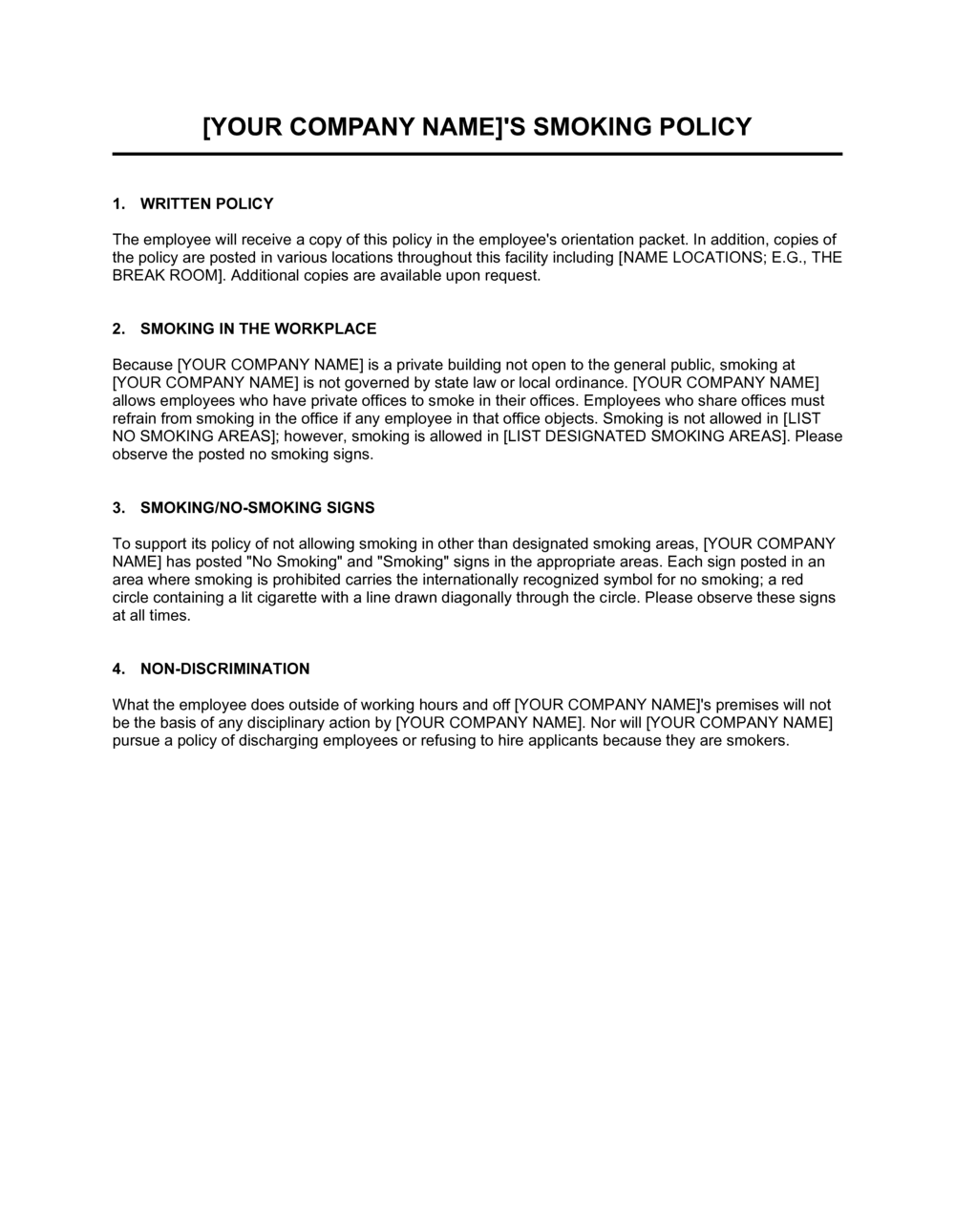
A Smoking Policy is a formal workplace document that establishes where smoking and tobacco use are permitted on company premises, how violations are handled, and what support resources are available to employees who wish to quit. This free Word download lets you customize designated areas, prohibited zones, and enforcement steps, then distribute it as PDF or include it in your employee handbook.
When you need it
Use it when onboarding new employees, updating your employee handbook, responding to a workplace complaint about tobacco exposure, or ensuring compliance with local smoke-free workplace legislation.
What's inside
Policy purpose and scope, definitions of tobacco and vaping products, designated smoking areas, prohibited locations, employee obligations, visitor and contractor rules, enforcement and disciplinary procedures, and cessation support resources.

What is a Smoking Policy?

A Smoking Policy is a formal workplace document that defines where tobacco and vaping use is permitted on company premises, what areas are strictly prohibited, how violations are investigated and disciplined, and what cessation resources the employer makes available to staff. It applies to all employees, contractors, and visitors, covering every indoor space and specifying setback distances from entrances and air intakes for any outdoor areas where smoking may be allowed. Because most jurisdictions mandate written smoke-free workplace rules and require specific signage, the policy serves both as an internal conduct standard and as documented evidence of regulatory compliance.

Why You Need This Document

Without a written smoking policy, employees make their own assumptions about where smoking is acceptable β€” typically just outside the nearest door, directly in the path of colleagues entering the building. Complaints about secondhand smoke exposure follow, and without a formal policy the employer has no documented standard to enforce or defend. Regulatory inspectors in most US states, Canadian provinces, and UK local authorities will ask to see a written smoke-free policy during a workplace inspection; the absence of one can trigger a formal notice and financial penalty. A published policy with individual acknowledgements also closes the most common disciplinary appeal β€” that the employee did not know the rules β€” before it is raised. This template gives you a complete, editable starting point that covers the ten core sections every compliant smoking policy needs, from prohibited zones to cessation support, so you can move from blank page to distributed policy in under two hours.

Which variant fits your situation?

If your situation is…Use this template
Complete ban on all tobacco and vaping across the entire propertySmoke-Free Campus Policy
Office building with a designated outdoor smoking zoneSmoking Policy with Designated Areas
Multi-site retail or hospitality businessMulti-Location Smoking Policy
Healthcare or school campus requiring zero-tolerance enforcementTobacco-Free Campus Policy
Policy update to include e-cigarettes and vaping devicesTobacco and Vaping Policy
Construction or industrial site with outdoor work areasWorksite Smoking Policy

Common mistakes to avoid

❌ Omitting e-cigarettes and vaping from the definitions

Why it matters: Employees assume vaping is permitted if the policy only mentions cigarettes and tobacco. Secondhand aerosol exposure complaints follow, and the employer has no written basis to discipline.

Fix: Update the definitions section to explicitly cover all electronic nicotine delivery devices and heated tobacco products. Review definitions annually as new product categories emerge.

❌ No specified distance from building entrances

Why it matters: Without a numerical setback, employees smoke immediately outside the door, exposing non-smokers to secondhand smoke and potentially violating local ordinances that mandate specific distances.

Fix: State the setback in metres or feet β€” at minimum match the local legal requirement, and consider adding an extra buffer of 2–3 metres to reduce complaints.

❌ Applying the policy to employees but not contractors and visitors

Why it matters: Non-employee smokers in prohibited areas create the same health and compliance exposure as employees, and staff quickly notice the inconsistency, eroding the policy's credibility.

Fix: Extend scope explicitly to all persons on company premises and assign responsibility to a named role (reception, facilities) for briefing visitors on arrival.

❌ Leaving break entitlement undefined

Why it matters: Non-smoking employees who observe colleagues taking frequent unscheduled smoking breaks raise formal grievances about unequal treatment β€” a morale and potential legal problem.

Fix: State clearly in the policy whether smoking breaks are included within standard break allowances, and ensure line managers apply the rule uniformly across all staff.

❌ Publishing the policy without distributing it or collecting acknowledgements

Why it matters: A policy employees have never seen cannot be enforced. Disciplinary action for a smoking violation will be challenged if the employer cannot prove the employee knew the rules.

Fix: Distribute the policy to all employees upon publication, collect a signed or LMS-recorded acknowledgement from each individual, and include it in every new-hire onboarding pack.

❌ Never reviewing or updating the policy

Why it matters: Smoke-free legislation has expanded significantly in most jurisdictions over the past decade, often adding e-cigarettes and new setback requirements. An outdated policy may reference repealed rules or miss newly prohibited areas.

Fix: Schedule an annual policy review in the HR calendar, and trigger an unscheduled review whenever local smoke-free workplace law changes in any jurisdiction where the company operates.

The 10 key sections, explained

Purpose and policy statement

Scope and applicability

Definitions

Prohibited areas

Designated smoking areas

Employee obligations and smoking breaks

Enforcement and disciplinary procedure

Contractors and visitors

Cessation support and resources

Policy review and updates

How to fill it out

  1. 1

    Confirm the applicable local legislation

    Before completing the template, identify the smoke-free workplace laws that apply to your city, state, or province. These set mandatory minimum distances from entrances and may require specific signage.

    πŸ’‘ Search '[your state/province] smoke-free workplace act' plus the current year β€” many jurisdictions have updated rules to cover e-cigarettes and vaping since 2020.

  2. 2

    Define the scope and list all covered locations

    Enter every office, facility, vehicle, and off-site location the policy will govern. If your company has multiple sites with different layouts, create a schedule or annex listing each location.

    πŸ’‘ Include company-sponsored off-site events explicitly β€” a team day at an external venue creates the same duty-of-care obligations as your own premises.

  3. 3

    Specify prohibited areas with exact distances

    List every indoor space and add a numerical setback distance from all building entrances, windows, and air intakes. Check local law for the minimum required distance β€” typically 5 to 10 metres in most jurisdictions.

    πŸ’‘ Err on the side of a larger setback than the legal minimum. A buffer beyond the regulatory floor reduces complaints and shows demonstrable good faith if the policy is ever challenged.

  4. 4

    Designate and describe the smoking area(s)

    Identify the specific outdoor location(s) where smoking is permitted, confirm it meets setback requirements, and add details on signage and waste disposal. If no compliant location exists, note that the site is smoke-free.

    πŸ’‘ Walk the site physically before finalising the location β€” check prevailing wind direction so smoke does not drift back into building entrances or outdoor seating areas.

  5. 5

    Clarify break entitlements

    State explicitly whether smoking breaks are drawn from existing break allowances or are additional. Align this with your general break policy so the treatment of smokers and non-smokers is consistent.

    πŸ’‘ If your jurisdiction mandates a specific number of paid breaks, confirm that absorbing smoking breaks into that allowance is legally permissible before publishing the policy.

  6. 6

    Set the disciplinary escalation steps

    Align the enforcement section with your existing disciplinary procedure β€” same stages, same documentation process, same appeal rights. The smoking policy should reference the main disciplinary policy rather than create a parallel process.

    πŸ’‘ Name the role responsible for issuing each stage of warning (line manager, HR) so there is no ambiguity about who acts when a violation is reported.

  7. 7

    Add cessation resources with real contact details

    Enter the actual phone number or URL for your EAP, the dollar amount of any nicotine replacement therapy subsidy, and the number of paid cessation leave hours available. Placeholder text must be replaced before distribution.

    πŸ’‘ Contact your EAP provider for a one-page cessation resource sheet you can attach to the policy β€” it costs nothing and significantly increases uptake.

  8. 8

    Distribute, post, and record acknowledgement

    Send the finalised policy to all employees, post it on the intranet and in common areas, and record that each employee has read and understood it β€” either via a signed acknowledgement form or an LMS completion record.

    πŸ’‘ For new hires, include the smoking policy in the onboarding pack and collect the acknowledgement on day one, before the employee has had a chance to form habits on-site.

Frequently asked questions

What is a workplace smoking policy?

A workplace smoking policy is a formal document that defines where employees, contractors, and visitors may or may not smoke on company premises, how violations are handled, and what support the employer provides to those who want to quit. It protects non-smoking employees from secondhand smoke exposure, helps the employer comply with local smoke-free workplace laws, and sets a consistent standard that managers can enforce fairly.

Is a smoking policy legally required?

In most US states, Canadian provinces, the UK, and EU member states, employers are legally required to have a written smoke-free workplace policy and to display no-smoking signage. The specific requirements β€” mandatory setback distances, covered product categories, and required notice periods β€” vary by jurisdiction. Even where a written policy is not explicitly mandated, having one in place is considered standard practice and significantly reduces employer liability.

Does a smoking policy need to cover e-cigarettes and vaping?

Yes. Most smoke-free workplace laws enacted or updated after 2016 extend to electronic cigarettes and vaping devices, and many jurisdictions explicitly include them in the definition of prohibited tobacco products. Even where local law has not yet been updated, including vaping in your policy definitions is best practice β€” aerosol from vaping devices is not harmless, and employees have a reasonable expectation of protection from it.

Can an employer ban smoking entirely on company property?

Yes, in most jurisdictions. A fully smoke-free campus policy β€” banning all tobacco and vaping use anywhere on the property, including outdoor areas β€” is legally permissible in most of the US, Canada, the UK, and the EU. Some jurisdictions with strong privacy protections limit an employer's ability to restrict off-duty smoking, but on-premises rules are generally enforceable regardless of those protections.

Are smokers entitled to additional breaks?

No legal entitlement to extra smoking breaks exists in most jurisdictions. Employers are generally free to specify that smoking breaks are drawn from standard break allowances. The key is to apply this rule consistently β€” if non-smokers are not permitted equivalent additional personal breaks, granting smokers extra unscheduled time away from work creates an inequity that can give rise to formal grievances.

How should smoking policy violations be handled?

Violations should be addressed under the same progressive disciplinary procedure used for other policy breaches β€” verbal warning, written warning, final written warning, and potential termination for repeated offences. The smoking policy should reference the main disciplinary policy rather than create a separate process. Consistent, documented enforcement is essential: selective enforcement is one of the most common grounds on which disciplinary action for a smoking violation is overturned.

What should be included in the cessation support section?

At minimum, include the contact details for your EAP and any referral service it offers for smoking cessation. If the company provides a nicotine replacement therapy subsidy, state the dollar amount and how to claim it. If paid leave for cessation programme attendance is available, specify the number of hours per year. Generic language promising 'support' without listing actual resources is widely perceived as performative and reduces trust in the policy overall.

How often should a smoking policy be reviewed?

An annual review is standard practice. Trigger an additional unscheduled review whenever local smoke-free workplace legislation changes in any jurisdiction where the company operates, when the company opens a new site, or when a significant enforcement issue or employee complaint reveals a gap in the current policy. Document the review date and any changes made, and redistribute the updated policy with a new acknowledgement request.

Does the smoking policy apply to company vehicles?

Yes. Company vehicles should be explicitly named as smoke-free in the policy. Most jurisdictions that regulate smoking in enclosed workplaces extend that prohibition to employer-provided vehicles, particularly where more than one person uses the vehicle. Even where not legally required, banning smoking in company vehicles protects non-smoking employees who drive the same vehicle and preserves the asset's condition and resale value.

How this compares to alternatives

vs Drug and Alcohol Policy

A drug and alcohol policy governs the use of intoxicating substances that impair performance and safety, typically with testing provisions and immediate-suspension consequences. A smoking policy focuses on tobacco and vaping use in designated areas and is enforced through a standard progressive discipline process. Both belong in the employee handbook, but they address distinct risk categories and have different enforcement mechanics.

vs Health and Wellness Policy

A health and wellness policy sets out the employer's broader approach to employee wellbeing β€” fitness programmes, mental health support, nutritional initiatives, and preventive care. A smoking policy is a narrower, compliance-driven document focused specifically on tobacco use and location-based rules. The smoking policy's cessation support section can cross-reference the wellness policy for broader stop-smoking resources.

vs Employee Code of Conduct

A code of conduct covers the full range of expected employee behaviours β€” ethics, professionalism, use of company property, and interpersonal standards. A smoking policy is a specific operational document covering one behavioural category in detail. The code of conduct typically references the smoking policy by name rather than reproducing its content.

vs Disciplinary Policy

A disciplinary policy establishes the company's overarching framework for addressing all forms of misconduct β€” stages, investigation procedures, appeal rights, and documentation requirements. A smoking policy relies on and references that framework but does not replicate it. The two documents work together: the smoking policy defines the rule, and the disciplinary policy governs how breaches are processed.

Industry-specific considerations

Healthcare

Hospitals and clinics typically operate fully smoke-free campuses covering all outdoor areas, with strict enforcement for staff, patients, and visitors and a strong cessation programme embedded in employee health benefits.

Retail and Hospitality

Customer-facing sites require clear signage at entrances, designated areas positioned well away from queuing zones and outdoor dining, and a visitor-briefing protocol at reception or the host stand.

Construction and Trades

Outdoor worksites require defined smoking zones away from flammable materials, safety hazards, and areas where non-smoking trades workers must pass, with contractor induction covering the rules on day one.

Manufacturing

Fire risk and chemical exposure make strict no-smoking rules essential near production floors; designated areas must account for shift patterns and be positioned to avoid interference with loading and logistics traffic.

Professional Services

Office-based firms in leased buildings must align their policy with building-owner rules and local ordinances, clearly designating any permitted outdoor areas and addressing client and visitor compliance during on-site meetings.

Education

Schools and universities typically operate tobacco-free campuses by law or institutional mandate, requiring enforcement procedures that cover students, staff, and external contractors alike.

Template vs pro β€” what fits your needs?

PathBest forCostTime
Use the templateSmall and medium businesses needing a straightforward policy for a single site or a small number of locationsFree1–2 hours
Template + professional reviewMulti-site businesses, unionised workplaces, or employers in jurisdictions with complex or recently updated smoke-free legislation$200–$500 for an HR consultant or employment lawyer review1–3 days
Custom draftedLarge enterprises with operations across multiple jurisdictions, healthcare or education campuses with zero-tolerance mandates, or businesses facing an active complaint or regulatory inquiry$500–$2,000+1–2 weeks

Glossary

Tobacco Products
Any product containing tobacco intended for smoking, chewing, or inhaling, including cigarettes, cigars, pipe tobacco, and chewing tobacco.
Electronic Cigarette (E-Cigarette)
A battery-powered device that heats a liquid to produce an aerosol for inhalation, commonly called vaping β€” typically covered alongside tobacco in modern policies.
Designated Smoking Area (DSA)
A specific outdoor location formally approved by the employer where smoking is permitted, marked with signage, and equipped with appropriate receptacles.
Smoke-Free Zone
Any indoor or outdoor area where all forms of smoking and tobacco use are prohibited, including building entrances, car parks, and company vehicles.
Secondhand Smoke
Tobacco smoke exhaled by a smoker or emitted from a burning cigarette that is inhaled involuntarily by people nearby, classified as a health hazard in most jurisdictions.
Progressive Discipline
A staged enforcement process that escalates consequences for repeated policy violations β€” typically verbal warning, written warning, then termination.
Cessation Support
Employer-provided resources to help employees quit smoking, such as nicotine replacement therapy subsidies, counseling referrals, or EAP access.
EAP (Employee Assistance Program)
A confidential employer-sponsored program offering counseling, referrals, and support services, including smoking cessation coaching.
Scope of Policy
The defined boundaries of who and what the policy applies to β€” employees, contractors, visitors, and all company-owned or leased premises.
Smoking Break
An unscheduled or scheduled pause in work for the purpose of smoking; the policy should specify whether these count against standard break allowances.

Part of your Business Operating System

This document is one of 3,000+ business & legal templates included in Business in a Box.

  • Fill-in-the-blanks β€” ready in minutes
  • 100% customizable Word document
  • Compatible with all office suites
  • Export to PDF and share electronically

Create your document in 3 simple steps.

From template to signed document β€” all inside one Business Operating System.
1
Download or open template

Access over 3,000+ business and legal templates for any business task, project or initiative.

2
Edit and fill in the blanks with AI

Customize your ready-made business document template and save it in the cloud.

3
Save, Share, Send, Sign

Share your files and folders with your team. Create a space of seamless collaboration.

Save time, save money, and create top-quality documents.

β˜…β˜…β˜…β˜…β˜…

"Fantastic value! I'm not sure how I'd do without it. It's worth its weight in gold and paid back for itself many times."

Managing Director Β· Mall Farm
Robert Whalley
Managing Director, Mall Farm Proprietary Limited
β˜…β˜…β˜…β˜…β˜…

"I have been using Business in a Box for years. It has been the most useful source of templates I have encountered. I recommend it to anyone."

Business Owner Β· 4+ years
Dr Michael John Freestone
Business Owner
β˜…β˜…β˜…β˜…β˜…

"It has been a life saver so many times I have lost count. Business in a Box has saved me so much time and as you know, time is money."

Owner Β· Upstate Web
David G. Moore Jr.
Owner, Upstate Web

Run your business with a system β€” not scattered tools

Stop downloading documents. Start operating with clarity. Business in a Box gives you the Business Operating System used by over 250,000 companies worldwide to structure, run, and grow their business.

Start freeΒ Β·Β No credit card required