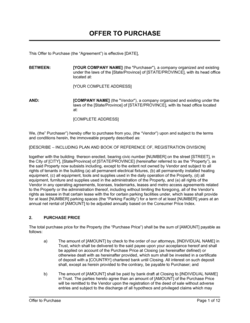
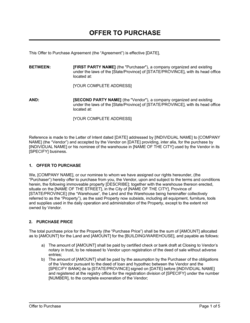
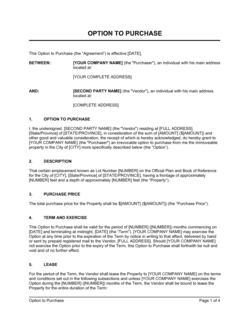
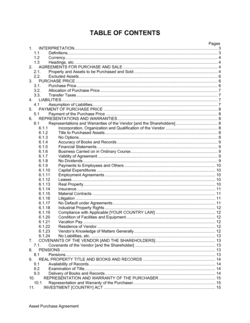
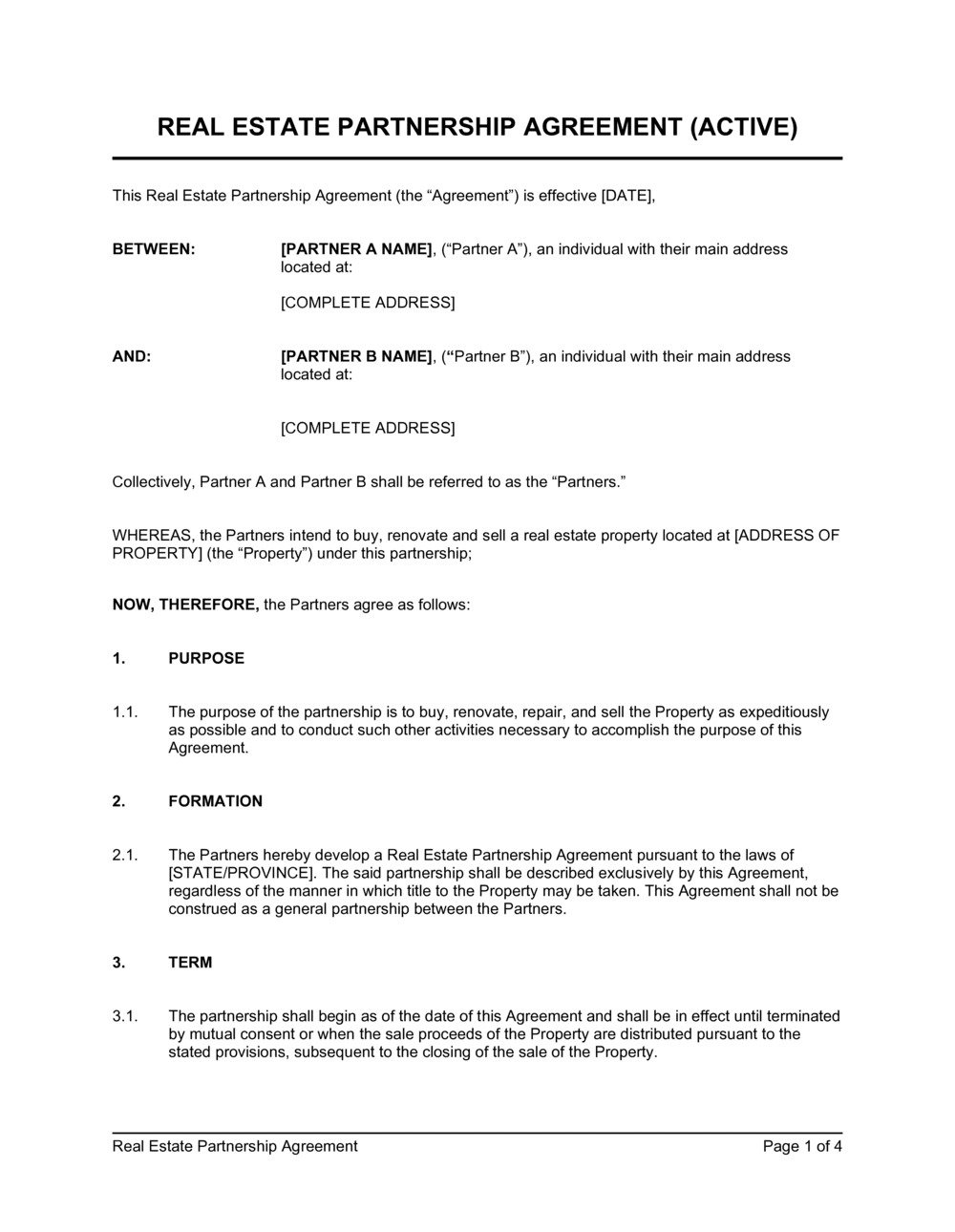
Active Real Estate Partnership Agreement Template

Free Word download • Edit online • Save & share with Drive • Export to PDF

4 pages25–35 min to fillDifficulty: ComplexSignature requiredLegal review recommended
Learn more ↓
FreeActive Real Estate Partnership Agreement Template

At a glance

What it is
An Active Real Estate Partnership Agreement is a legally binding contract between two or more parties who jointly acquire, manage, and operate real property as active participants in the partnership. This free Word download covers capital contributions, profit and loss allocation, day-to-day management duties, decision-making authority, dispute resolution, and exit procedures — giving every partner a clear, enforceable framework before the first dollar is invested.
When you need it
Use it whenever two or more individuals or entities plan to co-invest in real property and each partner will take an active role in managing, developing, or operating the asset. It is especially critical before closing on a property, refinancing, or bringing in a new co-investor to an existing portfolio.
What's inside
Partner identification and capital contributions, ownership percentages, management roles and voting rights, profit and loss allocations, property acquisition and disposition procedures, buyout and right-of-first-refusal clauses, default and dispute resolution provisions, and governing law.

What is an Active Real Estate Partnership Agreement?

An Active Real Estate Partnership Agreement is a legally binding contract between two or more individuals or entities who jointly acquire, manage, and operate real property — with each partner taking a material role in the asset's day-to-day management and strategic decisions. Unlike passive investment structures where one party simply contributes capital and receives returns, every partner in an active arrangement is involved in decisions ranging from tenant selection and lease negotiation to capital expenditures and eventual disposition. The agreement defines each partner's capital contribution, ownership percentage, management authority, profit and loss allocation, and the procedures governing transfers, buyouts, and dissolution — establishing an enforceable framework before any money is invested or property is acquired.

Why You Need This Document

Buying real estate with a partner on a handshake agreement is one of the most reliable ways to turn a profitable investment into an expensive legal dispute. Without a written partnership agreement, courts apply default partnership rules that may contradict every assumption the partners made at the outset — allocating liability, profits, and decision-making authority in ways none of them intended. Disagreements over who must fund an emergency repair, whether a partner can sell their interest to an outsider, or how to value a buyout routinely escalate into partition actions and litigation costing $50,000–$200,000 and lasting years, all while the property sits frozen and generating losses. A clear, signed partnership agreement eliminates these failure modes at the outset: it documents who owns what, who decides what, how cash flows, and how any partner can exit cleanly. This template gives active real estate co-investors a professionally structured, fully editable starting point that covers every material term — so the relationship is defined by the document, not the courts.

Which variant fits your situation?

If your situation is…Use this template
One partner contributes capital only while another manages the propertyPassive Real Estate Partnership Agreement
Short-term property flip or development project with a defined end dateReal Estate Joint Venture Agreement
Multi-member LLC holding and operating real estateReal Estate LLC Operating Agreement
Two parties sharing ownership of a single residential propertyCo-Ownership Agreement
Investor lending funds secured against a real estate assetReal Estate Loan Agreement
Partnership purchasing commercial property with tenants in placeCommercial Real Estate Purchase Agreement
Partnership managing a portfolio of rental properties across multiple addressesProperty Management Agreement

Common mistakes to avoid

❌ No capital call procedure

Why it matters: When an unexpected repair, vacancy, or debt service shortfall requires additional funding, partners without a defined obligation will dispute who must contribute and on what timeline, potentially forcing a fire sale or default.

Fix: Include a capital call clause specifying the notice period (typically 15–30 days), each partner's pro-rata obligation, and the consequences of failing to fund — such as dilution or a forced buyout at a discount.

❌ Omitting a buyout price formula

Why it matters: When a partner wants to exit or a dispute arises, an undefined valuation method turns a straightforward transaction into protracted litigation, with each side commissioning competing appraisals.

Fix: Specify the buyout methodology upfront — independent MAI appraisal, average of two appraisals, or an agreed capitalization-rate formula — and state who pays the appraisal costs.

❌ No succession provision for death or incapacity

Why it matters: A deceased partner's interest passes to their estate, which becomes an involuntary co-owner. Title companies will not insure transactions while probate is open, effectively freezing the asset for months or years.

Fix: Include a clause requiring each partner to maintain a valid will or trust designating a successor, and granting surviving partners a right to purchase the deceased's interest from the estate within 180 days at fair market value.

❌ Setting governing law in a state unconnected to the property

Why it matters: Courts in most jurisdictions apply the law of the property's physical location for title, lien, foreclosure, and landlord-tenant matters — overriding a contractual choice-of-law clause — creating inconsistent legal treatment across the agreement.

Fix: Select the state where the property is located as the governing law. If the partnership owns properties in multiple states, elect governing law for the partnership entity separately from property-specific matters.

❌ No minimum cash reserve requirement

Why it matters: Distributing all available cash to partners leaves the partnership with no liquidity cushion. A single large expense — a boiler replacement, an insurance deductible, a tenant improvement allowance — can then trigger an emergency capital call or loan default.

Fix: Require the partnership to maintain a minimum operating reserve of 3–6 months of projected operating expenses and debt service before any distributions are made.

❌ Vague management authority with no spending threshold

Why it matters: A managing partner who can legally commit the partnership to any expenditure without consent can incur debt, sign long-term leases, or undertake renovations that materially change the investment thesis — without recourse for minority partners.

Fix: Set an explicit dollar threshold above which all major decisions require partnership approval, and list by category the decisions that always require unanimous written consent regardless of cost.

The 10 key clauses, explained

Parties, Recitals, and Partnership Formation

In plain language: Identifies every partner by legal name and entity type, states the purpose of the partnership, and confirms when and where the partnership is formed.

Sample language
This Active Real Estate Partnership Agreement ('Agreement') is entered into as of [DATE] by and between [PARTNER 1 FULL LEGAL NAME], a [ENTITY TYPE] ('Partner 1'), and [PARTNER 2 FULL LEGAL NAME], a [ENTITY TYPE] ('Partner 2'), collectively the 'Partners,' for the purpose of acquiring, actively managing, and operating certain real property described in Schedule A.

Common mistake: Using informal names or trade names instead of registered legal entity names. Enforcement actions and title transfers require the exact legal name, and a mismatch can delay closings or void title insurance.

Capital Contributions and Ownership Percentages

In plain language: States each partner's initial cash or property contribution and the resulting ownership percentage, along with procedures for future capital calls.

Sample language
Partner 1 shall contribute $[AMOUNT] in cash on or before [DATE], representing a [X]% ownership interest. Partner 2 shall contribute [PROPERTY / $AMOUNT], representing a [Y]% ownership interest. Capital calls require [X] days' written notice; failure to fund within [X] days constitutes a default under Section [X].

Common mistake: Omitting a capital call procedure. When an unexpected expense arises — an emergency roof replacement, a vacancy-driven debt service shortfall — partners without a defined funding obligation will dispute who must contribute and on what timeline.

Active Management Roles and Authority

In plain language: Designates the managing partner, defines their day-to-day authority, sets the dollar threshold above which all partners must approve decisions, and lists decisions that always require unanimous consent.

Sample language
Partner 1 is designated Managing Partner and may execute contracts and expenditures up to $[THRESHOLD] without prior approval. Decisions exceeding $[THRESHOLD], refinancing, lease execution above [TERM], and property disposition require approval of Partners holding at least [X]% of ownership interests. The following actions require unanimous written consent: [LIST].

Common mistake: Setting the unilateral spending threshold too high or omitting it entirely. A managing partner who can legally commit the partnership to a $500,000 renovation without consent has effectively eliminated the other partners' governance rights.

Profit and Loss Allocation

In plain language: Sets the percentage of net income and net losses allocated to each partner, specifies any preferred return, and states the order of distributions (waterfall).

Sample language
Net profits and losses shall be allocated [X]% to Partner 1 and [Y]% to Partner 2 after payment of a [X]% per annum preferred return on unreturned capital to [PARTNER NAME]. Distributions shall be made [quarterly / annually] at the Managing Partner's discretion, subject to maintaining a minimum cash reserve of $[AMOUNT].

Common mistake: Aligning profit allocation exactly to ownership percentage without a preferred return when one partner contributed significantly more capital. This routinely leads to disputes once the property generates income.

Property Acquisition and Disposition

In plain language: Establishes the criteria and voting threshold for acquiring new properties or selling existing ones, including required due diligence steps and authorized signatories on purchase contracts.

Sample language
New property acquisitions require approval of Partners holding at least [X]% of interests and completion of an independent appraisal and environmental phase-I report. Disposition of any partnership property requires [X] days' written notice to all Partners and approval of Partners holding at least [X]% of interests.

Common mistake: Not specifying who signs purchase and sale agreements on behalf of the partnership. Title companies and escrow agents will refuse to proceed without documentary authority — triggering last-minute disputes at closing.

Transfer Restrictions, Right of First Refusal, and Buyout

In plain language: Restricts a partner from transferring their interest to a third party without first offering it to the remaining partners, and sets the buyout price methodology.

Sample language
No Partner may transfer, assign, or encumber their interest without prior written consent of all Partners. A Partner wishing to transfer ('Selling Partner') shall provide written notice with the proposed price and terms. Remaining Partners have [30] days to elect to purchase the interest at the same price. Buyout price shall be determined by [independent appraisal / agreed formula].

Common mistake: Failing to define the buyout price methodology. When partners disagree on value — which is almost always — an undefined pricing mechanism produces litigation rather than a clean exit.

Default, Cure Period, and Remedies

In plain language: Defines what constitutes a partner default (e.g., failure to fund a capital call, bankruptcy, material breach), allows a cure period, and specifies the non-defaulting partners' remedies including forced buyout or dilution.

Sample language
A Partner is in default upon: (a) failure to fund a capital call within [X] days of notice; (b) filing for bankruptcy or insolvency protection; or (c) material breach of this Agreement not cured within [30] days of written notice. Upon uncured default, the non-defaulting Partners may elect to purchase the defaulting Partner's interest at [X]% of fair market value as determined by independent appraisal.

Common mistake: No cure period before triggering remedies. Courts routinely refuse to enforce immediate forfeiture clauses as disproportionate, effectively rendering your default remedy unenforceable when you need it most.

Dispute Resolution

In plain language: Establishes the process for resolving partner disputes — typically negotiation first, then mediation, then binding arbitration — and designates the seat and rules.

Sample language
Any dispute arising under this Agreement shall first be submitted to good-faith negotiation for [30] days. If unresolved, the dispute shall be submitted to mediation administered by [AAA / JAMS] in [CITY]. If mediation fails, the dispute shall be resolved by binding arbitration under [AAA / JAMS] Commercial Rules in [CITY, STATE], except that either party may seek injunctive relief in any court of competent jurisdiction.

Common mistake: Omitting a dispute resolution clause and relying on litigation by default. Real estate partnership disputes litigated through court can take 2–4 years and cost $50,000–$200,000 in legal fees — arbitration typically resolves in 6–12 months.

Dissolution and Winding Up

In plain language: Sets the conditions that trigger dissolution (unanimous vote, sale of all properties, or a partner's death/incapacity), the winding-up procedure, and the order in which proceeds are distributed.

Sample language
The Partnership shall dissolve upon: (a) unanimous written consent of all Partners; (b) sale or transfer of all partnership property; or (c) as required by applicable law. On dissolution, the Managing Partner shall wind up affairs, pay all debts and obligations, and distribute remaining proceeds to Partners in proportion to their [capital accounts / ownership percentages] after payment of a preferred return.

Common mistake: No succession provision for a partner's death or incapacity. Without one, a deceased partner's estate becomes an involuntary co-owner — creating title complications, probate delays, and operational paralysis.

Governing Law and Entire Agreement

In plain language: Specifies the jurisdiction whose law governs the agreement and confirms that this document supersedes all prior representations, emails, and verbal understandings.

Sample language
This Agreement is governed by the laws of the State of [STATE] without regard to its conflict-of-law principles. This Agreement constitutes the entire understanding between the Partners and supersedes all prior oral or written representations, agreements, and negotiations relating to the subject matter hereof.

Common mistake: Choosing a governing state with no meaningful connection to where the property is located. Many states apply the law of the property's situs regardless of the contract's choice-of-law clause — particularly for title, lien, and foreclosure matters.

How to fill it out

  1. 1

    Identify all partners by legal name and entity type

    Enter every partner's full registered legal name — individual or entity — and their state or country of formation. Attach a Schedule A listing the target property's legal description and address.

    💡 Pull the exact entity name from the secretary of state registry, not a DBA or trade name. Title insurance and deed recordings require a precise match.

  2. 2

    Define capital contributions and resulting ownership percentages

    For each partner, specify the dollar amount or property value being contributed and the corresponding ownership percentage. Confirm that percentages sum to 100% and that non-cash contributions are appraised before execution.

    💡 If one partner is contributing sweat equity or services instead of cash, assign a documented dollar value upfront — courts will not enforce a vague 'work in exchange for ownership' arrangement.

  3. 3

    Designate the managing partner and set authority thresholds

    Name the managing partner, list their specific day-to-day powers, and set a clear dollar threshold above which full partnership approval is required. Enumerate the decisions that always require unanimous consent.

    💡 Set the unilateral spending threshold at a level you would be comfortable seeing spent without your knowledge — typically 1–3% of the property's value per decision.

  4. 4

    Set the profit and loss allocation and distribution waterfall

    Enter each partner's profit and loss percentage, specify any preferred return and its rate, and define the distribution schedule (quarterly, annually, or upon sale). Confirm the minimum cash reserve the partnership must maintain before distributing.

    💡 If one partner bears more financial risk, consider a preferred return of 6–8% on their contributed capital before applying the general profit split — this is standard in institutional real estate partnerships.

  5. 5

    Draft the transfer and buyout provisions

    Specify the right-of-first-refusal period (typically 30–60 days), define the buyout price methodology (independent appraisal or agreed formula), and list any third-party transferees who are pre-approved (e.g., a partner's wholly owned LLC).

    💡 Include a shotgun clause as a backstop for irreconcilable deadlocks: any partner may offer to buy the other's interest at a stated price, and the other must either accept or buy at the same price.

  6. 6

    Define default triggers and remedies

    List specific events of default — missed capital calls, bankruptcy, material breach — include a 30-day written cure period, and state the non-defaulting partners' remedies clearly (forced buyout at a stated discount, dilution, or dissolution).

    💡 A 20–30% discount to fair market value on a defaulting partner's forced buyout is a common and generally enforceable deterrent; deeper discounts are more frequently challenged as punitive.

  7. 7

    Select dispute resolution rules and governing law

    Choose arbitration or mediation-then-arbitration as the primary mechanism, designate the administering body (AAA or JAMS), and select governing law in the state where the property is located.

    💡 For properties in states with specific real estate partnership statutes — California, Texas, Florida, New York — confirm that the governing law and dispute forum align with local requirements before signing.

  8. 8

    Sign before acquiring or contributing any property

    All partners must execute the agreement before any capital is transferred or property is acquired. Have each partner initial each page and retain a fully executed copy in a secure location.

    💡 Use a timestamped e-signature platform to record execution — this eliminates disputes about who signed what and when, and most jurisdictions accept electronic signatures for partnership agreements.

Frequently asked questions

What is an active real estate partnership agreement?

An active real estate partnership agreement is a legally binding contract between two or more parties who jointly own and actively manage real property. Unlike a passive investment structure, every partner in an active partnership participates in management decisions — acquiring properties, overseeing operations, dealing with tenants, and executing dispositions. The agreement sets out each partner's capital contribution, ownership percentage, management authority, profit share, and exit rights before any money changes hands.

What is the difference between an active and a passive real estate partnership?

In an active real estate partnership, all partners participate materially in the day-to-day management of the property. In a passive partnership, one partner (the operator or sponsor) manages the asset while others contribute capital and receive returns without taking part in operations. The distinction matters for tax purposes: active partners may deduct real estate losses against ordinary income if they meet IRS material participation tests, while passive investors are limited to offsetting passive income only.

Do I need a lawyer to create a real estate partnership agreement?

For straightforward two-partner domestic arrangements involving a single property, a high-quality template reviewed by a real estate attorney is typically sufficient. Engage a lawyer directly when the deal involves multiple properties, out-of-state partners, complex preferred return structures, development financing, or partners contributing non-cash assets. A 1–3 hour attorney review for a template-based agreement typically costs $500–$1,500 and is generally worthwhile given the dollar values involved in real estate transactions.

How should profits and losses be split in a real estate partnership?

Profit and loss allocation should reflect each partner's economic contribution and risk exposure, not simply their ownership percentage. A common structure gives a capital-heavy partner a preferred return of 6–8% per year on contributed capital before any general profit split, after which net profits are divided according to agreed percentages. All allocations must be documented in the partnership agreement and, in the US, reported on Schedule K-1 for each partner's individual tax return.

Can one partner force the sale of a jointly owned property?

Generally, a single partner cannot force a sale unilaterally unless the agreement includes a drag-along (forced sale) clause granting that right to majority partners. Without such a clause, a partner seeking to exit must either sell their interest subject to the right of first refusal or petition a court for a partition action — a costly and time-consuming process that often results in a court-ordered sale at below-market value. A well-drafted agreement avoids this by including drag-along rights, buyout procedures, and a shotgun clause as resolution mechanisms.

What happens to the partnership if one partner dies?

Without a succession provision, the deceased partner's interest passes to their estate, which becomes an involuntary co-owner. Title companies will not insure new financing or sales while probate is pending, which can freeze the asset for 6–24 months. A properly drafted agreement should grant surviving partners a right to purchase the estate's interest within a defined period at fair market value and require each partner to maintain estate planning documents designating a successor.

Is a real estate partnership agreement the same as an LLC operating agreement?

No. A real estate partnership agreement governs an unincorporated general or limited partnership between individuals or entities. An LLC operating agreement governs a limited liability company, which provides members with personal liability protection that a general partnership does not. Many real estate investors form an LLC to hold property and use an operating agreement instead of a partnership agreement — primarily to insulate personal assets from property-level liabilities. Consult a lawyer to determine which structure is appropriate for your situation.

What is a right of first refusal in a real estate partnership?

A right of first refusal (ROFR) gives existing partners the option to purchase a departing partner's ownership interest before it can be sold to an outside third party. When a partner receives a bona fide offer, they must notify all other partners in writing with the full terms. Remaining partners then have a defined window — typically 30–60 days — to match the offer. If they decline or fail to respond, the selling partner may proceed with the third-party sale under the same terms.

What governing law should I use in a real estate partnership agreement?

In most cases, select the state where the property is physically located as the governing law. Courts routinely apply the law of the property's situs for title, lien, foreclosure, and landlord-tenant matters regardless of a contractual choice-of-law clause. If the partnership holds properties in multiple states, consider electing governing law for the partnership entity separately (typically the state of formation) while acknowledging that local property law governs each asset.

How this compares to alternatives

vs Real Estate Joint Venture Agreement

A joint venture agreement governs a single project with a defined end date and is dissolved once the project closes or the property is sold. An active real estate partnership is an ongoing entity designed to acquire, manage, and operate property over the long term. Use a joint venture for a one-off flip or development deal; use a partnership agreement for a continuing investment relationship with multiple properties or a long-term hold strategy.

vs Real Estate LLC Operating Agreement

An LLC operating agreement governs a limited liability company, giving members personal liability protection that a general partnership does not provide. An active real estate partnership agreement governs an unincorporated partnership where general partners may be personally liable for partnership debts. Many investors form an LLC and use an operating agreement specifically to limit personal exposure — particularly important when the property carries mortgage debt or potential tenant liability.

vs Property Management Agreement

A property management agreement is a service contract between an owner and a third-party manager hired to operate the property for a fee. It creates no ownership interest and does not govern equity, profit sharing, or partner rights. An active real estate partnership agreement governs co-owners who both hold equity and take active roles in managing the asset — no third-party manager relationship is implied.

vs Co-Ownership Agreement

A co-ownership agreement documents shared title to a property — typically as tenants in common — without establishing a formal partnership or business entity. It addresses cost sharing and use rights but does not govern profit distributions, capital calls, management authority thresholds, or partner buyouts in the same structured way a partnership agreement does. For any active investment arrangement where partners share revenue and management duties, a full partnership agreement provides significantly stronger protection.

Industry-specific considerations

Residential Real Estate

Partners co-own single-family rentals, small multifamily buildings, or fix-and-flip properties, with active roles split between capital contribution, renovation management, and tenant relations.

Commercial Real Estate

Office, retail, and industrial acquisitions require active partners to negotiate leases, oversee tenant improvements, manage debt covenants, and coordinate with property managers and lenders.

Real Estate Development

Development partnerships pair capital partners with developer-operators managing entitlement, construction draw schedules, contractor relationships, and sale or lease-up of the completed asset.

Hospitality and Short-Term Rentals

Active partners managing vacation rentals or boutique hotels split operational duties — booking platforms, cleaning schedules, maintenance, and guest relations — alongside shared equity ownership.

Jurisdictional notes

United States

Real estate partnerships are typically governed by the Uniform Partnership Act (UPA) or Revised Uniform Partnership Act (RUPA) as adopted in each state, with significant variation in default rules. Property-specific laws — recording requirements, landlord-tenant statutes, transfer taxes — are determined by the state and county where the property sits, regardless of the governing law clause. In California, non-compete clauses are unenforceable, and real estate syndications involving more than 35 partners may trigger SEC registration requirements.

Canada

Each province has its own Partnership Act governing formation, liability, and dissolution — Ontario's Partnership Act and British Columbia's Partnership Act differ in key respects. Land transfer taxes and deed registration requirements vary significantly by province and municipality, with additional non-resident speculation taxes in Ontario and British Columbia affecting foreign partners. Quebec civil law governs partnerships under the Civil Code of Quebec rather than common-law partnership principles, and partnership agreements for Quebec properties should be reviewed by a Quebec-licensed notary.

United Kingdom

UK general partnerships are governed by the Partnership Act 1890, which imposes unlimited joint and several liability on all partners for partnership debts — making liability-limiting provisions and insurance particularly important. Limited partnerships under the Limited Partnerships Act 1907 offer liability protection for limited partners but require at least one general partner with unlimited exposure. Stamp Duty Land Tax (SDLT) in England, Land Transaction Tax (LTT) in Wales, and Land and Buildings Transaction Tax (LBTT) in Scotland apply on property acquisitions and must be factored into the partnership's financial model.

European Union

Partnership law is not harmonized across the EU — each member state maintains its own framework, ranging from Germany's GbR (civil law partnership) to France's SCI (société civile immobilière), a dedicated real estate holding structure. Real estate partnerships involving non-EU partners or cross-border property holdings may trigger GDPR compliance obligations for tenant data and financial records. Anti-money laundering (AML) regulations across member states require identification and documentation of all beneficial owners of real estate-holding entities, typically at a 25% ownership threshold.

Template vs lawyer — what fits your deal?

PathBest forCostTime
Use the templateTwo-partner arrangements involving a single domestic property with straightforward cash contributions and an equal or agreed splitFree1–3 hours
Template + legal reviewMulti-partner deals, properties with existing tenants or debt, cross-state co-investors, or structures involving preferred returns and waterfalls$500–$1,500 for a real estate attorney review3–7 days
Custom draftedDevelopment partnerships, institutional co-investors, syndicated deals, complex waterfall structures, or partnerships spanning multiple properties in multiple states$3,000–$10,000+2–6 weeks

Glossary

Active Partner
A partner who participates materially in the day-to-day management, operations, or development of the partnership's real property.
Capital Contribution
The cash, property, or services each partner commits to the partnership at formation or in subsequent calls, forming the basis of their ownership interest.
Profit and Loss Allocation
The percentage of net income and net losses distributed to each partner, which may differ from ownership percentage if the agreement specifies a preferred return.
Right of First Refusal (ROFR)
A contractual right giving existing partners the option to purchase a departing partner's interest before it can be sold to a third party.
Capital Call
A demand by the partnership for partners to contribute additional funds, typically triggered by unexpected expenses, debt service shortfalls, or a new acquisition.
Preferred Return
A minimum rate of return — often 6–8% annually — that certain partners receive on their contributed capital before profits are split among all partners.
Forced Sale (Drag-Along Right)
A provision allowing a majority partner to compel minority partners to join in the sale of the partnership's property on the same terms.
Tag-Along Right
A minority partner's right to participate in a sale of the partnership interest initiated by the majority partner on the same economic terms.
Tenancy in Common
A form of co-ownership where each partner holds a distinct, transferable undivided share of the property without right of survivorship.
Dissolution
The winding up of the partnership's affairs, including liquidating assets, paying debts, and distributing remaining proceeds to partners in proportion to their interests.
Managing Partner
The partner designated with authority to execute day-to-day operational decisions, sign contracts below a defined dollar threshold, and interface with tenants and service providers.

Part of your Business Operating System

This document is one of 3,000+ business & legal templates included in Business in a Box.

  • Fill-in-the-blanks — ready in minutes
  • 100% customizable Word document
  • Compatible with all office suites
  • Export to PDF and share electronically

Create your document in 3 simple steps.

From template to signed document — all inside one Business Operating System.
1
Download or open template

Access over 3,000+ business and legal templates for any business task, project or initiative.

2
Edit and fill in the blanks with AI

Customize your ready-made business document template and save it in the cloud.

3
Save, Share, Send, Sign

Share your files and folders with your team. Create a space of seamless collaboration.

Save time, save money, and create top-quality documents.

★★★★★

"Fantastic value! I'm not sure how I'd do without it. It's worth its weight in gold and paid back for itself many times."

Managing Director · Mall Farm
Robert Whalley
Managing Director, Mall Farm Proprietary Limited
★★★★★

"I have been using Business in a Box for years. It has been the most useful source of templates I have encountered. I recommend it to anyone."

Business Owner · 4+ years
Dr Michael John Freestone
Business Owner
★★★★★

"It has been a life saver so many times I have lost count. Business in a Box has saved me so much time and as you know, time is money."

Owner · Upstate Web
David G. Moore Jr.
Owner, Upstate Web

Run your business with a system — not scattered tools

Stop downloading documents. Start operating with clarity. Business in a Box gives you the Business Operating System used by over 250,000 companies worldwide to structure, run, and grow their business.

Start free · No credit card required