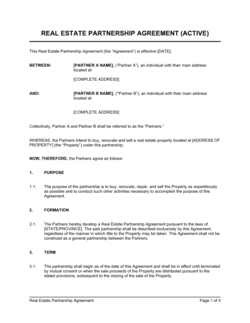
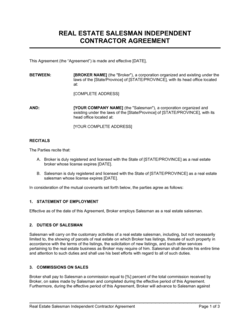
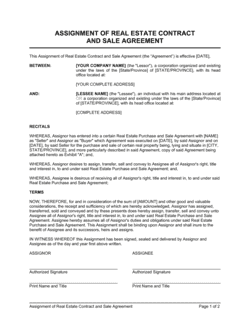
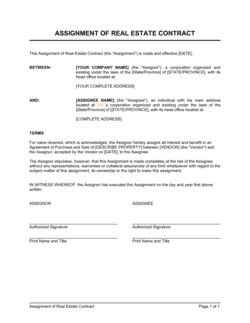
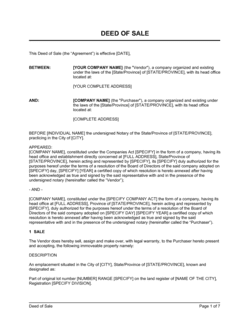
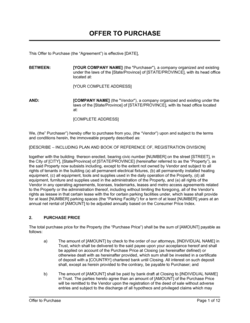
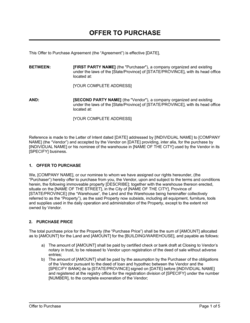
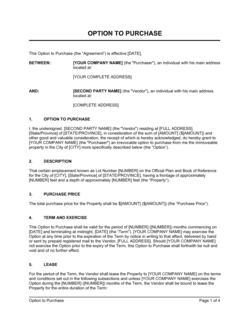
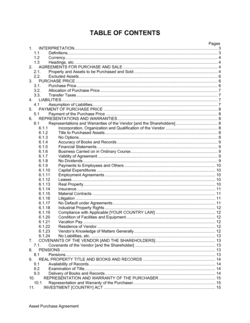
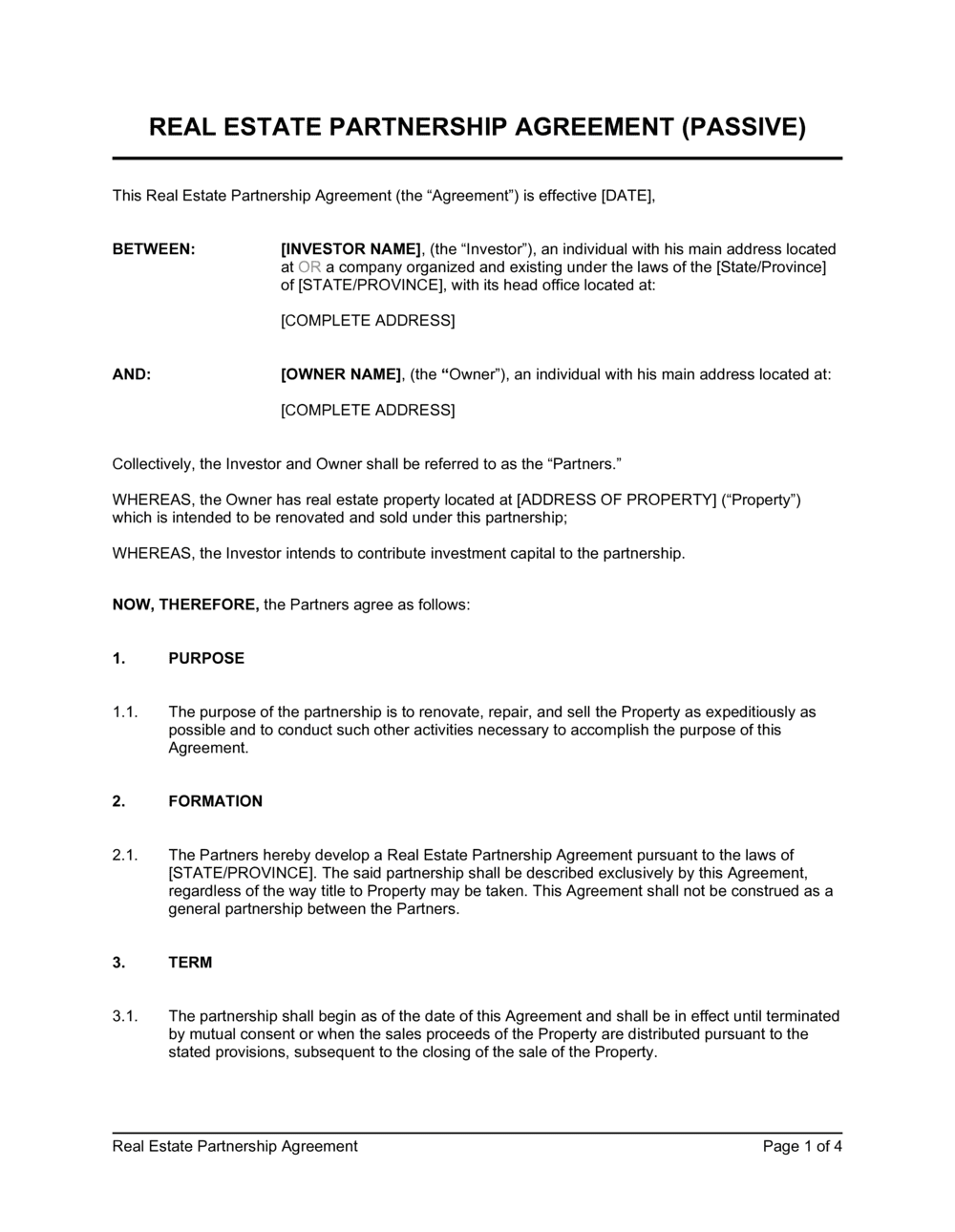
Passive Real Estate Partnership Agreement Template

Free Word download • Edit online • Save & share with Drive • Export to PDF

4 pages25–35 min to fillDifficulty: ComplexSignature requiredLegal review recommended
Learn more ↓
FreePassive Real Estate Partnership Agreement Template

At a glance

What it is
A Passive Real Estate Partnership Agreement is a legally binding contract between one or more passive investors — who contribute capital but take no active role in management — and an active managing partner who identifies, acquires, and operates real estate assets. This free Word download covers capital contributions, ownership percentages, profit and loss allocations, decision-making authority, distributions, and exit provisions in a single structured document you can edit online and export as PDF.
When you need it
Use it whenever a capital-providing investor and a hands-on operator join forces to acquire or develop real estate without forming a full LLC or limited partnership entity, or as a governing document alongside an existing entity structure. It is particularly important before any funds are transferred or any property is placed under contract.
What's inside
Party identification and roles, capital contribution schedule, ownership and profit-sharing percentages, management authority and restrictions, distribution waterfall, reporting obligations, transfer and buyout rights, and dissolution terms.

What is a Passive Real Estate Partnership Agreement?

A Passive Real Estate Partnership Agreement is a legally binding contract that establishes the terms of a co-investment arrangement between a capital-contributing investor — who plays no active role in managing the property — and an operating partner who sources, acquires, manages, and eventually disposes of the real estate asset. The agreement defines each party's ownership percentage, the capital contribution schedule, the distribution waterfall, the managing partner's authority and fees, and the process for resolving disputes, transferring interests, and exiting the investment. It functions as the primary governing document for the economic relationship between the parties, whether they hold the property directly, through an LLC, or through a limited partnership structure.

Why You Need This Document

Without a written passive real estate partnership agreement, the terms of your investment exist only in emails, verbal discussions, and assumptions — none of which hold up when the property underperforms, a partner wants to exit, or a dispute arises over how distributions are calculated. A passive investor who has wired capital with no signed agreement has no enforceable claim to a specific return, no right to financial reporting, and no mechanism to remove a managing partner who is mismanaging the asset. The managing partner, conversely, has no contractual authority to make decisions without the investor second-guessing every expense. Courts in the absence of a written agreement will often default to equal partnership rules under state law, overriding the economic deal the parties actually intended. This template closes those gaps before the first dollar is transferred — protecting both the passive investor's capital and the managing partner's operational authority with a single, clearly structured document.

Which variant fits your situation?

If your situation is…Use this template
Structuring a formal real estate syndication with multiple passive investorsReal Estate Syndication Operating Agreement
Two equal partners both actively managing a jointly owned propertyReal Estate Partnership Agreement (Active Partners)
Single investor contributing equity to a fix-and-flip projectReal Estate Joint Venture Agreement
Passive investor lending capital at a fixed return rather than taking equityReal Estate Private Lending Agreement
Forming an LLC to hold the property and govern all partnersLLC Operating Agreement
Short-term co-investment on a single commercial property acquisitionCo-Investment Agreement
Investor contributing property rather than cash as their partnership interestReal Estate Contribution Agreement

Common mistakes to avoid

❌ No minimum hold period before forced sale

Why it matters: Without a hold-period clause, a managing partner can sell the property immediately after acquisition to collect the acquisition fee, leaving the passive investor with a taxable gain and no meaningful return on a deal that never had time to perform.

Fix: Insert a minimum hold period of at least 2–3 years, after which a sale requires written notice and a defined buy-sell process if the parties disagree on terms.

❌ Vague capital contribution schedule

Why it matters: Open-ended language like 'investor shall fund as needed' is frequently unenforceable in court, leaving the managing partner unable to compel required capital calls and forcing the deal into default or personal funding.

Fix: Specify exact dollar amounts, delivery dates, wire instructions or escrow details, and the consequence — dilution or buyout at a formula price — if a capital call is not met.

❌ Passive investor granted operational veto rights

Why it matters: Giving the passive investor approval rights over routine decisions can reclassify them as an active partner under IRS rules, eliminating passive loss treatment and potentially triggering SEC securities registration requirements.

Fix: Limit passive investor consent rights to material decisions only — sale, refinancing above a stated threshold, and capital improvements above a stated threshold — and document this clearly in the management authority clause.

❌ No definition of 'available cash' in the distribution clause

Why it matters: Without a precise definition, each distribution event triggers a dispute over whether reserves for taxes, debt service, and capital expenditures should be deducted before or after calculating distributable cash.

Fix: Define 'available cash' explicitly as gross operating revenues minus operating expenses, debt service, and a defined reserve amount — and reference this definition in every distribution provision.

❌ Choosing governing law that conflicts with property location

Why it matters: Courts in the state where the property is located will typically apply local real property and landlord-tenant law regardless of the contract's choice-of-law clause, creating an unenforceable conflict.

Fix: Set governing law to the state or province where the property is physically located, or — for multi-state portfolios — specify governing law for real property matters separately from commercial dispute provisions.

❌ No removal mechanism for a defaulting managing partner

Why it matters: Without a contractual removal process, the passive investor's only recourse against a non-performing or fraudulent managing partner is expensive litigation — during which the asset may deteriorate or be mismanaged further.

Fix: Include a specific default-and-cure clause with a 30-day notice period and an explicit mechanism for the passive investor to remove and replace the managing partner upon an uncured material default.

The 10 key clauses, explained

Parties, roles, and recitals

In plain language: Identifies all partners by legal name, designates each as either managing partner or passive investor, and states the purpose of the partnership and the target property or portfolio.

Sample language
This Passive Real Estate Partnership Agreement ('Agreement') is entered into on [DATE] between [MANAGING PARTNER LEGAL NAME] ('Managing Partner') and [PASSIVE INVESTOR LEGAL NAME] ('Passive Investor') for the purpose of acquiring, holding, and operating the real property located at [PROPERTY ADDRESS] ('Property').

Common mistake: Describing the property by street address only. If the legal description differs — which is common with subdivided lots or commercial parcels — the wrong parcel may be captured by the agreement.

Capital contributions and ownership percentages

In plain language: States the exact dollar amount or property value each partner contributes, when contributions are due, and what ownership percentage each contribution purchases.

Sample language
Passive Investor shall contribute $[AMOUNT] on or before [DATE] in exchange for a [X]% ownership interest. Managing Partner shall contribute $[AMOUNT] and operational expertise in exchange for a [Y]% ownership interest. Total capitalization: $[TOTAL].

Common mistake: Leaving the contribution schedule open-ended with language like 'as needed.' Courts have found this unenforceable for subsequent capital calls, leaving the managing partner unable to compel additional investment when required.

Management authority and passive investor restrictions

In plain language: Grants the managing partner exclusive authority over day-to-day operations, leasing, and routine maintenance while listing specific major decisions — sale, refinancing, capital improvements above a threshold — that require passive investor approval.

Sample language
Managing Partner shall have sole authority over routine property management, tenant relations, and expenditures under $[THRESHOLD]. The following actions require written consent of the Passive Investor: sale or transfer of the Property, refinancing exceeding $[AMOUNT], or capital improvements exceeding $[THRESHOLD].

Common mistake: Granting the passive investor operational veto rights on routine decisions. This can reclassify the investor as an active partner under SEC and tax rules, triggering securities registration requirements and self-employment tax exposure.

Distribution waterfall

In plain language: Defines the priority sequence for distributing available cash — first returning contributed capital, then paying the preferred return, then splitting residual profits between the parties.

Sample language
Distributions shall be made in the following order: (1) Return of Passive Investor's contributed capital; (2) Preferred Return of [X]% per annum on unreturned capital to Passive Investor; (3) remaining proceeds split [A]% to Passive Investor and [B]% to Managing Partner.

Common mistake: Omitting a definition of 'available cash' — failing to clarify whether distributions are calculated before or after reserves for repairs, taxes, and debt service leads to disputes on every distribution event.

Managing partner compensation and promote

In plain language: Establishes the managing partner's fees — acquisition fee, asset management fee, and construction management fee — separate from the promote earned on profits above the preferred return threshold.

Sample language
Managing Partner shall receive: (a) an Acquisition Fee of [X]% of purchase price at closing; (b) an Asset Management Fee of [X]% of gross revenues per month; and (c) a Promote of [X]% of net profits above the Preferred Return threshold.

Common mistake: Failing to specify whether management fees are paid before or after the distribution waterfall. Fees paid from gross revenue before the waterfall effectively reduce the passive investor's return — this must be explicit, not implied.

Reporting and accounting obligations

In plain language: Requires the managing partner to provide periodic financial statements, tax documents, and property reports to the passive investor, with defined timelines and formats.

Sample language
Managing Partner shall deliver to Passive Investor: (a) monthly rent roll and operating statements within [15] days of month-end; (b) annual audited financials within [90] days of fiscal year-end; (c) Schedule K-1 within [30] days of tax filing.

Common mistake: No reporting clause at all, or reporting 'upon request' only. Passive investors have no visibility into asset performance without a mandatory reporting schedule — disputes over undisclosed expenses are far more common without it.

Transfer restrictions and right of first refusal

In plain language: Prohibits either partner from transferring their interest without the other's consent and grants existing partners the right to purchase a departing partner's interest at the offered price before any third-party sale.

Sample language
Neither party may transfer, assign, or encumber their interest without the prior written consent of the other party. If either party receives a bona fide third-party offer, the non-transferring party shall have [30] days to match the offer and acquire the interest ('Right of First Refusal').

Common mistake: No transfer restriction clause at all — allowing the managing partner's interest to be transferred to an unqualified operator, or the passive investor's interest sold to an unknown third party without the existing partner's knowledge.

Exit events and forced sale

In plain language: Specifies the conditions under which the property will be sold, the process for agreeing on a sale price, and whether the managing partner can compel a sale after a defined hold period.

Sample language
The Managing Partner may initiate a sale of the Property after a minimum hold period of [X] years by providing [60] days' written notice. If the parties cannot agree on the sale terms within [30] days, either party may trigger a buy-sell procedure under Section [X].

Common mistake: No minimum hold period, allowing the managing partner to force a sale immediately after acquisition to collect the acquisition fee — leaving the passive investor with a taxable event and no meaningful return.

Default, removal, and dispute resolution

In plain language: Defines what constitutes a default by either party, the cure period allowed before remedies are triggered, the process for removing a managing partner who is in default, and whether disputes go to arbitration or litigation.

Sample language
A party is in default upon failure to perform any material obligation and failure to cure within [30] days of written notice. In the event of Managing Partner's default, Passive Investor may remove the Managing Partner and appoint a replacement by written notice. All disputes shall be resolved by binding arbitration in [CITY, STATE].

Common mistake: No removal mechanism for a defaulting managing partner. Without one, the passive investor's only remedy is filing suit — which is expensive, slow, and may produce a judgment that is difficult to enforce against the asset.

Governing law and entire agreement

In plain language: States which state or country's laws govern the agreement and confirms that the written contract supersedes all prior negotiations, term sheets, and verbal promises.

Sample language
This Agreement shall be governed by the laws of [STATE / PROVINCE / COUNTRY]. This Agreement constitutes the entire agreement between the parties with respect to the subject matter hereof and supersedes all prior representations, negotiations, and understandings.

Common mistake: Choosing a governing law with no connection to where the property is located. Courts in the property's state often apply local real property law regardless of the contract's choice-of-law clause, creating a conflict.

How to fill it out

  1. 1

    Identify all parties with their legal names and roles

    Enter the full legal name of every managing partner and passive investor — individuals use full legal name; entities use the registered legal entity name. Clearly designate each party's role in the opening recitals.

    💡 If the managing partner is an LLC or corporation, verify the registered name in the state's entity database before execution — a mismatch voids signature authority.

  2. 2

    Describe the property with its full legal description

    Include the street address, county, and the legal description as it appears on the deed or title commitment. For portfolios, attach a Schedule A listing each property.

    💡 Pull the legal description from the preliminary title report, not from a tax record — assessor records frequently contain outdated or abbreviated descriptions.

  3. 3

    Define capital contributions and the contribution schedule

    Enter the exact dollar amount each partner commits, the date or milestone by which it must be delivered, and the ownership percentage it purchases. Address capital call procedures for future funding needs.

    💡 Tie the passive investor's contribution to a specific wire instruction or escrow account — open-ended 'deliver to managing partner' language increases the risk of commingling.

  4. 4

    Set the distribution waterfall with defined thresholds

    Specify the preferred return percentage, whether it accrues or compounds, the order of distributions, and the promote split above the preferred return. Define 'available cash' to include or exclude reserves.

    💡 Use a numeric example in a Schedule to illustrate how $100,000 of distributable cash flows through the waterfall — this eliminates interpretive disputes at exit.

  5. 5

    Scope the managing partner's authority and consent thresholds

    List every action the managing partner can take without consent and every action requiring passive investor approval. Set a specific dollar threshold for expenditures that trigger the approval requirement.

    💡 Set the approval threshold at 10–15% of the property's annual operating budget rather than a fixed dollar amount — this scales with the asset without requiring amendment.

  6. 6

    Establish the reporting schedule

    Enter specific delivery deadlines for monthly operating reports, annual financials, and tax documents. Name the format (PDF, QuickBooks export) and the delivery method (email to a named address).

    💡 Include a provision that the passive investor may request a property inspection and books-and-records review no more than once per calendar year — this preserves transparency without disrupting operations.

  7. 7

    Define the hold period and exit mechanics

    Set a minimum hold period before a forced sale can be triggered, the process for agreeing on a sale price, and the buy-sell procedure if the parties disagree.

    💡 A 3–5 year minimum hold period is market standard for most value-add and stabilized acquisition strategies — match it to the investment thesis in your underwriting model.

  8. 8

    Execute before any funds are transferred or property is contracted

    Both parties must sign the agreement — and any required notarized acknowledgments — before the passive investor wires capital or the managing partner places the property under contract.

    💡 Use a timestamped e-signature platform and store the executed copy in a shared, neutral location such as a cloud drive both parties can access — do not rely solely on email chains.

Frequently asked questions

What is a passive real estate partnership agreement?

A passive real estate partnership agreement is a legally binding contract between a capital-contributing investor — who takes no active role in managing the property — and an operating partner who handles acquisition, management, and disposition. It defines ownership percentages, the distribution waterfall, management authority, reporting obligations, and exit rights. It functions as the governing document for the investment relationship, regardless of whether a separate LLC or limited partnership entity is formed to hold the asset.

What is the difference between a passive and active real estate partner?

A passive partner contributes capital and receives a share of profits but has no authority over day-to-day property decisions. An active or managing partner executes the investment strategy — sourcing the deal, arranging financing, overseeing operations, and handling disposition. The distinction matters for tax purposes: passive partners may claim passive activity losses only against passive income, while active partners are subject to self-employment tax on their management income. Misclassifying an active partner as passive can trigger IRS penalties.

Do I need a separate LLC to use a passive real estate partnership agreement?

Not necessarily. A partnership agreement can govern the relationship between parties who hold title jointly or through a nominee arrangement. However, forming an LLC or limited partnership to hold the property is strongly advisable in most cases — it limits each partner's personal liability to their invested capital and provides a cleaner ownership and tax structure. The partnership agreement then serves as the governing document for the entity or sits alongside the operating agreement.

What is a preferred return in a real estate partnership?

A preferred return is a minimum annual return — typically 6–8% of invested capital — paid to the passive investor before the managing partner receives any profit share above their management fees. It compensates the passive investor for the illiquidity and risk of the investment. The preferred return may be cumulative (accruing unpaid amounts to future periods) or non-cumulative, depending on what the parties negotiate. Most institutional passive investment structures include a cumulative preferred return.

What is a promote or carried interest?

A promote — also called carried interest — is the managing partner's disproportionate share of profits above the preferred return threshold, typically 20–30% of net profits. It is the primary economic incentive for the managing partner to maximize the property's performance. For example, after the passive investor receives their preferred return and capital back, the managing partner might receive 30% of remaining profits while the passive investor receives 70% — even though the passive investor contributed 90% of the capital.

Is a passive real estate partnership agreement a securities offering?

It can be, depending on how the arrangement is structured and marketed. Under US securities law, a passive investment interest in a real estate partnership — particularly where multiple investors are involved — may constitute a security requiring registration or an exemption such as Regulation D. One-on-one arrangements between a single active and passive partner are generally lower risk, but any offering to multiple investors should be reviewed by a securities attorney before funds are accepted.

What happens if the managing partner wants to sell the property before I'm ready?

The agreement governs this scenario through its exit provisions. A well-drafted agreement includes a minimum hold period, a required notice period before initiating a sale, and a buy-sell mechanism — sometimes called a shotgun clause — that lets either party trigger a forced buyout at a stated price when they cannot agree. Without these clauses, a managing partner with majority authority may be able to force a sale at any time, leaving the passive investor with little recourse beyond litigation.

How are taxes handled in a passive real estate partnership?

Partnerships are typically pass-through entities for tax purposes — profits, losses, depreciation, and other tax items flow through to each partner's individual return in proportion to their ownership percentage. Each partner receives a Schedule K-1 annually. Passive investors may use allocated losses only against other passive income unless the real estate professional exception applies. The managing partner's fees and promote may be treated as self-employment income. Tax treatment varies by jurisdiction and entity structure — consult a CPA before finalizing the agreement.

What should I look for before signing a passive real estate partnership agreement?

Review six key areas before signing: the capital contribution schedule and capital call mechanics; the distribution waterfall and preferred return terms; the managing partner's fee structure and promote split; the reporting obligations and your access to financial records; the minimum hold period and exit provisions; and the default and removal clause. Pay particular attention to whether the managing partner's fees are deducted before or after the waterfall — this significantly affects your actual return.

Do I need a lawyer to prepare this agreement?

For straightforward two-party arrangements involving a single domestic property and a clear deal structure, a high-quality template is a practical starting point. Engage a real estate attorney when the deal involves multiple passive investors, a securities exemption is required, the property is in a complex jurisdiction, or the investment exceeds $500K. A template review by a real estate attorney typically costs $500–$1,500 and is worthwhile for any transaction with material capital at risk.

How this compares to alternatives

vs LLC Operating Agreement

An LLC operating agreement governs the internal affairs of a limited liability company formed to hold the property and applies to all members — it is an entity-level document. A passive real estate partnership agreement governs the relationship between partners directly and can operate with or without a separate entity. The two documents are complementary when an LLC holds the asset: the operating agreement controls the entity, while the partnership agreement may document the investment terms between the partners who own the LLC.

vs Joint Venture Agreement

A joint venture agreement typically contemplates two or more parties with shared decision-making authority over a specific project. A passive real estate partnership agreement is structurally different: one party is exclusively active and one is exclusively passive. If both parties will be involved in management decisions, a joint venture agreement is more appropriate than a passive partnership structure.

vs Real Estate Purchase Agreement

A real estate purchase agreement governs the transaction between a buyer and seller for the acquisition of a specific property — it does not address the internal relationship between co-investors. A passive real estate partnership agreement governs what happens after acquisition: how profits are split, who manages the asset, and how the investment is eventually unwound. Both documents are needed in a typical deal.

vs Private Lending Agreement

A private lending agreement structures capital as debt — the investor receives a fixed interest rate and return of principal on a defined schedule, with no equity upside or ownership stake. A passive real estate partnership agreement structures capital as equity — the investor shares in profits and losses and holds an ownership interest. The choice between debt and equity has significant tax, risk, and return implications that should be evaluated before structuring any deal.

Industry-specific considerations

Residential Real Estate

Fix-and-flip projects, buy-and-hold rental properties, and small multifamily acquisitions where a local operator partners with an out-of-market capital investor.

Commercial Real Estate

Office, retail, and industrial acquisitions where institutional or high-net-worth passive investors contribute equity alongside an experienced commercial operator managing leasing and asset management.

Real Estate Development

Ground-up development and value-add renovation projects where a developer brings in passive equity to bridge the gap between senior debt and required project capitalization.

Professional Services

Attorneys, accountants, and financial advisors who invest surplus professional income passively in real estate alongside operator clients, requiring clear documentation of passive status for liability and tax purposes.

Jurisdictional notes

United States

Passive investment interests in real estate partnerships may qualify as securities under the Howey test — consult a securities attorney before accepting capital from multiple passive investors. Tax treatment of passive losses is governed by IRC §469; passive investors may only deduct allocated losses against passive income unless the real estate professional exception under §469(c)(7) applies. State-level rules on partnership formation, transfer taxes, and landlord-tenant law vary significantly and should be reviewed for the state where the property is located.

Canada

Passive real estate partnerships in Canada are governed by provincial partnership legislation — each province (Ontario, BC, Alberta, Quebec) has its own Partnership Act. Quebec operates under the Civil Code rather than common law, requiring French-language documents for provincially regulated transactions. Passive income from real estate partnerships is generally included in income rather than eligible for capital gains treatment unless structured through a corporation. Securities laws may apply to multi-investor structures in each province under provincial securities commissions.

United Kingdom

Real estate partnerships in the UK are commonly structured as limited partnerships under the Limited Partnerships Act 1907, which requires at least one general partner with unlimited liability. Passive investors seeking limited liability should ensure the limited partnership is properly registered at Companies House. Stamp Duty Land Tax (SDLT) applies to property transfers and partnership interest transfers in England and Northern Ireland; Land and Buildings Transaction Tax applies in Scotland. HMRC treats partnership income as flowing through to individual partners' self-assessment returns.

European Union

Real estate partnership structures vary significantly across EU member states — Germany uses the GmbH & Co. KG structure, France uses the Société Civile Immobilière (SCI), and Spain uses the Sociedad de Responsabilidad Limitada. Cross-border passive investment in EU real estate may trigger withholding tax obligations and local property registration requirements. GDPR applies to the processing of partner personal data in any agreement documentation. Anti-money laundering regulations across EU member states require enhanced due diligence for real estate transactions above certain thresholds.

Template vs lawyer — what fits your deal?

PathBest forCostTime
Use the templateTwo-party arrangements with a single domestic property, a straightforward deal structure, and investment under $250KFree30–60 minutes
Template + legal reviewDeals involving $250K–$1M in passive equity, out-of-state properties, or first-time passive investors who need comfort on waterfall mechanics$500–$1,500 for a real estate attorney review3–7 days
Custom draftedMulti-investor structures, potential securities exemption requirements, commercial assets above $1M, or cross-border investment arrangements$2,500–$8,000+2–4 weeks

Glossary

Passive Investor
A partner who contributes capital to the partnership but has no authority over day-to-day management decisions or property operations.
Managing Partner
The active partner responsible for identifying, acquiring, operating, and eventually disposing of the real estate asset on behalf of the partnership.
Capital Contribution
The cash or property each partner commits to the venture, as specified in the agreement, which determines their initial ownership percentage.
Distribution Waterfall
The contractual sequence in which cash distributions are allocated — typically returning investor capital first, then a preferred return, then splitting remaining profits.
Preferred Return
A minimum annual return — commonly 6–8% of invested capital — paid to passive investors before the managing partner receives any profit share.
Promote (Carried Interest)
The managing partner's share of profits above the preferred return threshold, typically 20–30%, earned as compensation for deal execution and management.
Capital Account
A running ledger for each partner that tracks their initial contribution, subsequent investments, allocated profits and losses, and distributions received.
Right of First Refusal
A contractual right giving existing partners the first opportunity to purchase another partner's interest before it can be sold to a third party.
Forced Sale Provision
A clause — also called a drag-along right — that allows the managing partner or a majority to compel all partners to sell the property under agreed conditions.
Accredited Investor
An individual or entity meeting SEC-defined income or net-worth thresholds ($200K annual income or $1M net worth excluding primary residence) required for participation in many private real estate offerings.
Cash-on-Cash Return
Annual pre-tax cash flow received by an investor divided by the total cash invested, expressed as a percentage — a common metric for evaluating passive real estate returns.
Exit Strategy
The agreed plan for ultimately realizing investment value, such as a sale of the property, refinance and return of capital, or buyout of the passive partner's interest.

Part of your Business Operating System

This document is one of 3,000+ business & legal templates included in Business in a Box.

  • Fill-in-the-blanks — ready in minutes
  • 100% customizable Word document
  • Compatible with all office suites
  • Export to PDF and share electronically

Create your document in 3 simple steps.

From template to signed document — all inside one Business Operating System.
1
Download or open template

Access over 3,000+ business and legal templates for any business task, project or initiative.

2
Edit and fill in the blanks with AI

Customize your ready-made business document template and save it in the cloud.

3
Save, Share, Send, Sign

Share your files and folders with your team. Create a space of seamless collaboration.

Save time, save money, and create top-quality documents.

★★★★★

"Fantastic value! I'm not sure how I'd do without it. It's worth its weight in gold and paid back for itself many times."

Managing Director · Mall Farm
Robert Whalley
Managing Director, Mall Farm Proprietary Limited
★★★★★

"I have been using Business in a Box for years. It has been the most useful source of templates I have encountered. I recommend it to anyone."

Business Owner · 4+ years
Dr Michael John Freestone
Business Owner
★★★★★

"It has been a life saver so many times I have lost count. Business in a Box has saved me so much time and as you know, time is money."

Owner · Upstate Web
David G. Moore Jr.
Owner, Upstate Web

Run your business with a system — not scattered tools

Stop downloading documents. Start operating with clarity. Business in a Box gives you the Business Operating System used by over 250,000 companies worldwide to structure, run, and grow their business.

Start free · No credit card required