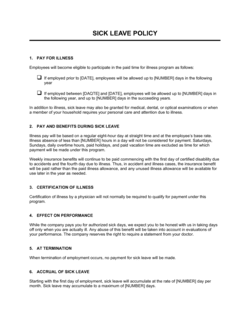
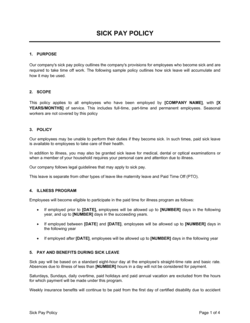
Confusion Regarding Sick Leave Policy Template

Free Word download β€’ Edit online β€’ Save & share with Drive β€’ Export to PDF

1 pageβ€’20–25 min to fillβ€’Difficulty: Standard
Learn more ↓
FreeConfusion Regarding Sick Leave Policy Template

At a glance

What it is
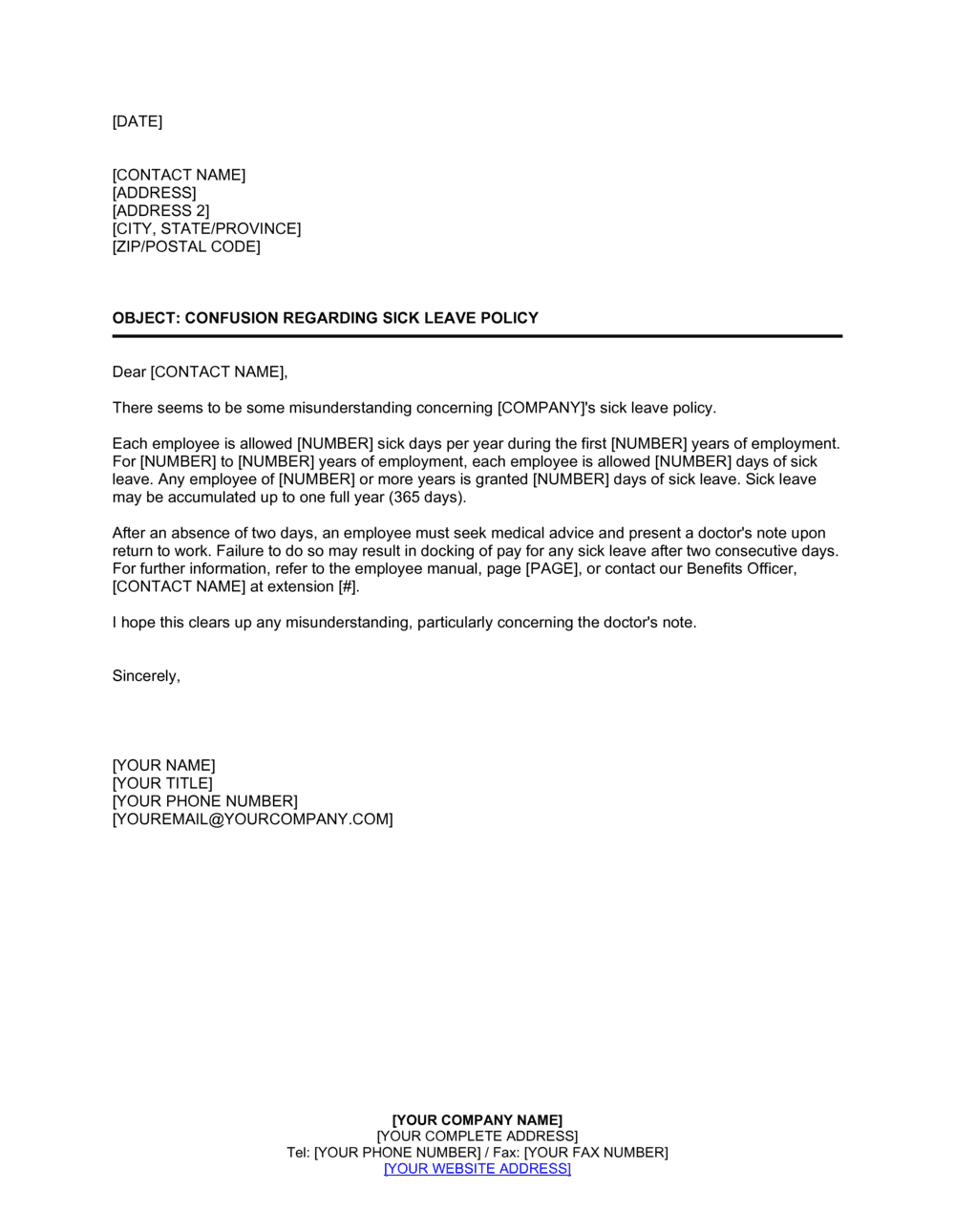
A Confusion Regarding Sick Leave Policy letter is a formal internal communication an employer or HR manager sends to address employee misunderstandings about the company's sick leave rules. This free Word download provides a structured template you can edit online and distribute as a PDF or printed memo to clarify accrual rates, usage procedures, documentation requirements, and any recent policy changes.
When you need it
Use it when employees are misapplying sick leave entitlements, when a policy update has generated questions, or when HR needs a consistent written record that the correct policy was communicated to all staff.
What's inside
An opening acknowledgment of the confusion, a clear restatement of sick leave entitlements and accrual rules, step-by-step usage and notification procedures, documentation requirements, consequences for misuse, and a designated HR contact for follow-up questions.

What is a Confusion Regarding Sick Leave Policy Letter?

A Confusion Regarding Sick Leave Policy letter is a formal internal communication an employer or HR manager sends to clarify how the company's sick leave rules work when employees are misapplying or misunderstanding them. It restates the entitlement in plain language β€” covering accrual rates, permitted uses, notification deadlines, documentation requirements, and carryover rules β€” and serves as a written record that the correct policy was communicated to all relevant staff. Unlike a disciplinary warning, this document is remedial in tone: its purpose is to close the information gap before violations escalate, not to punish employees who may simply have been working from the wrong assumptions.

Why You Need This Document

When sick leave rules are unclear, the consequences compound quickly: employees take leave they have not yet accrued, fail to notify managers in time to arrange coverage, or use sick days for purposes the policy does not permit. Each incident creates a separate HR conversation, inconsistent enforcement, and potential exposure if a dispute reaches a labor board or arbitration panel. A written clarification letter cuts off that cycle by giving every employee the same authoritative information at the same time β€” and creating a timestamped record that the policy was communicated. Without it, a manager's verbal explanation becomes a credibility contest in any formal dispute, while a documented letter is evidence. This template gives you a structured, professionally worded starting point you can adapt to your specific policy in under an hour.

Which variant fits your situation?

If your situation is…Use this template
Employees are misusing sick leave as general personal timeConfusion Regarding Sick Leave Policy
A policy change needs to be formally communicated to all staffEmployee Policy Update Letter
A specific employee has violated the sick leave policyEmployee Warning Letter
Creating or revising the full sick leave policy from scratchSick Leave Policy
An employee has exhausted sick leave and needs accommodation optionsLeave of Absence Request Form
Documenting an employee's repeated unexcused absencesAttendance Warning Letter

Common mistakes to avoid

❌ Using vague accrual language

Why it matters: Phrases like 'employees earn sick leave over time' or 'leave is awarded annually' leave employees unable to calculate their actual balance, which is the root cause of most sick leave disputes.

Fix: State the exact accrual rate β€” for example, '1.5 hours per bi-weekly pay period' β€” and include a worked example showing the balance after 3, 6, and 12 months.

❌ Omitting the notification deadline

Why it matters: Without a specific time requirement, employees notify managers at noon for a 7 a.m. shift, leaving the team short-staffed for hours. This causes operational disruption and manager frustration.

Fix: Set a clock-time deadline tied to the start of the employee's scheduled shift β€” for example, 'no later than 30 minutes before your scheduled start time' β€” and state the required contact method.

❌ Failing to address carryover rules

Why it matters: Employees who assume their sick leave accumulates indefinitely file unexpected claims at year-end or upon resignation, creating unbudgeted payroll liability and HR disputes.

Fix: State the carryover cap and the exact date unused hours above the cap lapse. Confirm in writing whether sick leave balances are paid out upon termination.

❌ Conflating sick leave with general PTO in the letter

Why it matters: When the clarification letter treats sick and vacation leave as interchangeable, employees learn they can use sick leave to extend holidays β€” the opposite of what the letter is trying to correct.

Fix: Clearly state that sick leave and vacation are separate banks governed by separate rules, and list the specific circumstances in which one can substitute for the other.

The 10 key sections, explained

Opening acknowledgment

Summary of sick leave entitlement

Permitted uses of sick leave

Notification procedure

Documentation requirements

Carryover and expiry rules

Consequences of misuse

Interaction with other leave types

Return-to-work procedure

HR contact and next steps

How to fill it out

  1. 1

    Identify the source of confusion

    Before editing the template, note the specific misunderstanding you are addressing β€” accrual timing, permitted uses, notification method, or carryover rules. This shapes which sections you emphasize.

    πŸ’‘ Survey your HR ticket log or manager complaints from the past 30 days to pinpoint the two or three most common points of confusion. Address those explicitly in the opening section.

  2. 2

    Enter your company name, date, and recipient scope

    Fill in your legal business name, the letter date, and who is receiving it β€” all staff, a specific department, or a defined employee group.

    πŸ’‘ If the letter applies to all employees but the policy differs between full-time and part-time staff, state both sets of rules in parallel rather than sending two separate letters.

  3. 3

    State the exact sick leave entitlement and accrual rate

    Enter the precise number of sick leave hours or days per year, the accrual frequency (per pay period, per month, or front-loaded annually), and any waiting period before new hires can use sick leave.

    πŸ’‘ Cross-reference your current employee handbook to confirm the figures match. Discrepancies between the letter and the handbook will generate more confusion, not less.

  4. 4

    Define permitted uses and exclusions

    List the circumstances under which sick leave may be used. Explicitly state what it cannot be used for β€” such as planned personal errands or extending holidays β€” to close the loophole employees are most likely exploiting.

    πŸ’‘ Check your jurisdiction's employment standards legislation before finalizing permitted uses. Several US states and Canadian provinces mandate sick leave use for family care, domestic violence, and preventive care.

  5. 5

    Spell out the notification and documentation requirements

    Enter the specific deadline for notifying a manager, the required communication channel, and the number of consecutive days that triggers a medical certificate requirement.

    πŸ’‘ Use clock times rather than vague language. '30 minutes before your shift starts' is enforceable; 'as soon as possible' is not.

  6. 6

    Add carryover cap and expiry date

    Enter the maximum hours that roll over to the next year and the date unused hours above the cap will lapse. If your policy pays out unused sick leave on termination, note that explicitly.

    πŸ’‘ If your jurisdiction prohibits sick leave balance payout on termination, state this in the letter to prevent expectation disputes at offboarding.

  7. 7

    Insert the HR contact details

    Enter the full name, email address, and phone number of the HR representative who will handle follow-up questions. Set a realistic response-time commitment β€” 2 business days is standard.

    πŸ’‘ Name a backup contact as well. If the primary HR contact is on leave when an employee submits a question, an unanswered query can restart the cycle of confusion.

  8. 8

    Distribute and document receipt

    Send the letter via email or HR system so delivery is timestamped. For multi-location or shift-based teams, post a printed copy in the break room or common area and note the distribution in your HR records.

    πŸ’‘ Request a read receipt or require employees to acknowledge receipt in your HRIS. This record is valuable if a sick leave dispute later goes to arbitration or a labor board.

Frequently asked questions

What is a sick leave policy clarification letter?

A sick leave policy clarification letter is a formal internal document an employer sends to employees to address misunderstandings about how sick leave works. It restates the entitlement, accrual rate, permitted uses, notification procedure, and documentation requirements in plain language. It serves as both a communication tool and a written record that the correct policy was communicated to all affected staff.

When should an employer send a sick leave clarification letter?

Send one when a pattern of sick leave misuse or misunderstanding emerges β€” for example, when employees routinely fail to notify managers correctly, or when a recent policy update has generated a spike in HR inquiries. It is also appropriate after onboarding a large cohort of new hires, after a statutory change to sick leave entitlements in your jurisdiction, or as part of an annual HR policy refresh.

Is a sick leave policy clarification letter legally binding?

The letter itself is not a standalone contract, but it functions as documented evidence that employees were informed of the policy's terms. In most jurisdictions, this documentation is valuable if a sick leave dispute later proceeds to a labor board hearing, arbitration, or employment tribunal. The underlying policy β€” not just the letter β€” is what creates enforceable rights and obligations.

What details should a sick leave policy clarification include?

At minimum: the sick leave entitlement and accrual rate, permitted and excluded uses, the notification procedure with a specific deadline and contact method, documentation requirements (when a doctor's note is needed), carryover and expiry rules, the interaction with other leave types, return-to-work steps after extended absence, and the HR contact for follow-up questions. Missing any of these leaves a gap that will generate the next round of confusion.

Can this letter substitute for a full sick leave policy?

No. A clarification letter is a communication document β€” it explains and restates an existing policy. The authoritative source of sick leave rules should be a standalone sick leave policy or an employee handbook section. The clarification letter should reference that document and direct employees to it for complete terms, rather than attempting to replicate the full policy in a single letter.

How should I distribute the sick leave clarification letter?

Deliver it through a channel that creates a timestamped record β€” company email, your HRIS, or an intranet acknowledgment portal. For shift-based or field workers without regular computer access, post a printed copy in common areas and note the distribution date in HR records. Requiring an employee acknowledgment or read receipt is best practice, especially if disciplinary action for misuse is a possibility.

What happens if an employee continues to misuse sick leave after receiving this letter?

Once you have documented that the correct policy was communicated, you have grounds to proceed through your company's progressive discipline process β€” typically a verbal warning, followed by a written warning, and escalating consequences for repeat violations. The clarification letter forms part of the disciplinary record. Consult your employment standards legislation or an HR advisor before moving to termination, as requirements vary by jurisdiction.

Do sick leave rules differ between full-time and part-time employees?

In most jurisdictions, part-time employees accrue sick leave on a pro-rated basis relative to their scheduled hours, while full-time employees accrue at the standard rate. Some statutory minimums apply equally regardless of hours worked. Your clarification letter should explicitly state the entitlement for both groups to avoid the assumption that only full-time staff are covered.

Should the letter mention specific employees who misused sick leave?

No. A general clarification letter should never name individual employees or reference specific incidents. Doing so converts the letter into a disciplinary document, exposes the employer to privacy concerns, and alienates the majority of employees who were following the rules correctly. Address individual violations through a separate, private disciplinary process using the appropriate warning letter template.

How this compares to alternatives

vs Employee Warning Letter

An employee warning letter is a disciplinary document issued to a specific individual who has already violated a policy. A sick leave clarification letter is a proactive, company-wide communication intended to prevent violations by ensuring everyone understands the rules. Use the clarification letter first; issue the warning letter only after a violation occurs following documented policy communication.

vs Sick Leave Policy

A sick leave policy is the authoritative governing document that defines entitlements, rules, and procedures in full legal and operational detail. A clarification letter summarizes and restates the policy in plain language for a specific audience at a specific moment. The policy belongs in the employee handbook; the clarification letter is sent when the policy is not being followed correctly.

vs Employee Handbook

An employee handbook covers all workplace policies in one comprehensive reference document, including sick leave. A sick leave clarification letter is a targeted communication addressing a specific gap in employee understanding. Handbooks are distributed at onboarding; clarification letters are sent reactively when a particular policy is generating confusion or misuse.

vs Leave of Absence Letter

A leave of absence letter governs extended, planned, or statutory leave β€” such as medical, family, or parental leave β€” and typically involves a formal approval process. A sick leave clarification letter addresses the day-to-day accrual and usage rules for short-term sick days. The two documents serve different leave scenarios and should not be substituted for each other.

Industry-specific considerations

Healthcare

Shift-based staffing means sick leave notification deadlines are critical; many healthcare employers require notice at least one hour before the shift to arrange coverage.

Retail and hospitality

High turnover and variable scheduling mean sick leave accrual and carryover rules need to address part-time and seasonal workers explicitly.

Professional services

Client-facing roles require clarity on how sick leave interacts with billable hours tracking and project deadline obligations.

Manufacturing

Production-line roles require same-day notification procedures and often mandate a return-to-work medical clearance to satisfy occupational health and safety requirements.

Template vs pro β€” what fits your needs?

PathBest forCostTime
Use the templateHR managers and small business owners addressing routine sick leave confusion in a domestic, single-location workforceFree30–60 minutes to complete and distribute
Template + professional reviewEmployers operating across multiple states or provinces where sick leave entitlements differ by jurisdiction$150–$400 for an HR consultant or employment lawyer review1–2 days
Custom draftedLarge employers with unionized staff, complex shift structures, or a history of sick leave grievances requiring legally precise language$500–$1,500 for an employment lawyer draft3–7 days

Glossary

Sick Leave Accrual
The rate at which an employee earns sick leave hours over time, typically expressed as a set number of hours per pay period or per month worked.
Sick Leave Balance
The total unused sick leave hours an employee has accumulated and is eligible to use at a given point in time.
Carryover
The portion of unused sick leave an employee is permitted to carry from one accrual period (usually a calendar or fiscal year) into the next.
Documentation Requirement
An employer's rule that an employee provide a medical certificate or doctor's note to validate a sick leave absence, typically triggered after a defined number of consecutive days.
Notification Procedure
The specific steps an employee must follow to inform their manager or HR of a sick day, including timing (e.g., before their shift starts) and the method of contact.
Misuse of Sick Leave
Using sick leave for purposes not covered by the policy β€” such as taking planned personal time off β€” which can result in disciplinary action.
PTO (Paid Time Off)
A consolidated leave bank that combines sick, vacation, and personal days into a single pool, in contrast to policies that track each leave type separately.
Intermittent Leave
Sick leave taken in separate, non-consecutive blocks of time rather than as one continuous absence, often associated with a chronic condition.
Return-to-Work Clearance
A medical or HR sign-off confirming an employee is fit to resume duties after an extended sick leave absence.
Leave Entitlement
The total amount of sick leave an employee has the right to take under company policy or applicable employment law in a given period.

Part of your Business Operating System

This document is one of 3,000+ business & legal templates included in Business in a Box.

  • Fill-in-the-blanks β€” ready in minutes
  • 100% customizable Word document
  • Compatible with all office suites
  • Export to PDF and share electronically

Create your document in 3 simple steps.

From template to signed document β€” all inside one Business Operating System.
1
Download or open template

Access over 3,000+ business and legal templates for any business task, project or initiative.

2
Edit and fill in the blanks with AI

Customize your ready-made business document template and save it in the cloud.

3
Save, Share, Send, Sign

Share your files and folders with your team. Create a space of seamless collaboration.

Save time, save money, and create top-quality documents.

β˜…β˜…β˜…β˜…β˜…

"Fantastic value! I'm not sure how I'd do without it. It's worth its weight in gold and paid back for itself many times."

Managing Director Β· Mall Farm
Robert Whalley
Managing Director, Mall Farm Proprietary Limited
β˜…β˜…β˜…β˜…β˜…

"I have been using Business in a Box for years. It has been the most useful source of templates I have encountered. I recommend it to anyone."

Business Owner Β· 4+ years
Dr Michael John Freestone
Business Owner
β˜…β˜…β˜…β˜…β˜…

"It has been a life saver so many times I have lost count. Business in a Box has saved me so much time and as you know, time is money."

Owner Β· Upstate Web
David G. Moore Jr.
Owner, Upstate Web

Run your business with a system β€” not scattered tools

Stop downloading documents. Start operating with clarity. Business in a Box gives you the Business Operating System used by over 250,000 companies worldwide to structure, run, and grow their business.

Start freeΒ Β·Β No credit card required