- Release of Claims
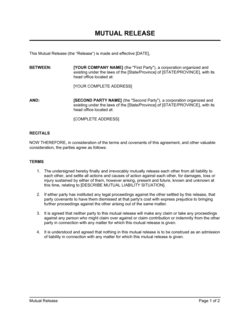
- A contractual waiver in which one or both parties give up the right to pursue any legal claims arising from the original agreement or the circumstances of its termination.
- Mutual Release
- A release given by both parties simultaneously, each discharging the other from liability — as opposed to a unilateral release signed by only one party.
- Effective Date
- The specific calendar date on which the termination takes legal effect and obligations under the original agreement cease.
- Consideration
- Something of value exchanged between the parties to make the termination and release legally binding — such as a final payment, waiver of amounts owed, or the mutual exchange of releases.
- Surviving Obligations
- Provisions of the original agreement that remain in force even after termination — typically confidentiality, non-solicitation, indemnification, and dispute-resolution clauses.
- Indemnification
- A contractual obligation by one party to compensate the other for losses, damages, or legal costs arising from specified events that occurred during the term of the original agreement.
- Unknown Claims
- Potential claims that a party does not know about at the time of signing; a broad release may waive these, and some jurisdictions (notably California) require explicit language to release unknown claims.
- Representations and Warranties
- Statements of fact made by each party at the time of signing — for example, that they have authority to execute the agreement and are not aware of unresolved claims.
- Governing Law
- The jurisdiction whose laws will be used to interpret the agreement and resolve any disputes that arise from it.
- Integration Clause
- A provision stating that the termination agreement is the complete and final expression of the parties' intent, superseding all prior negotiations, representations, and side agreements.
- Revocation Period
- A window — typically 7 or 21 days under US employment law — during which an employee may rescind a signed release of employment-related claims before it becomes irrevocable.