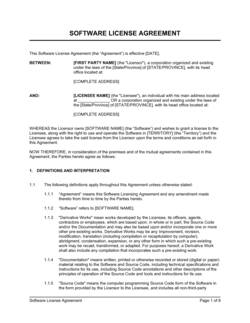
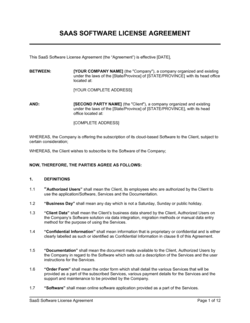
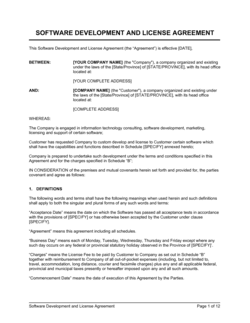
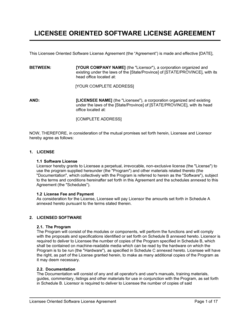
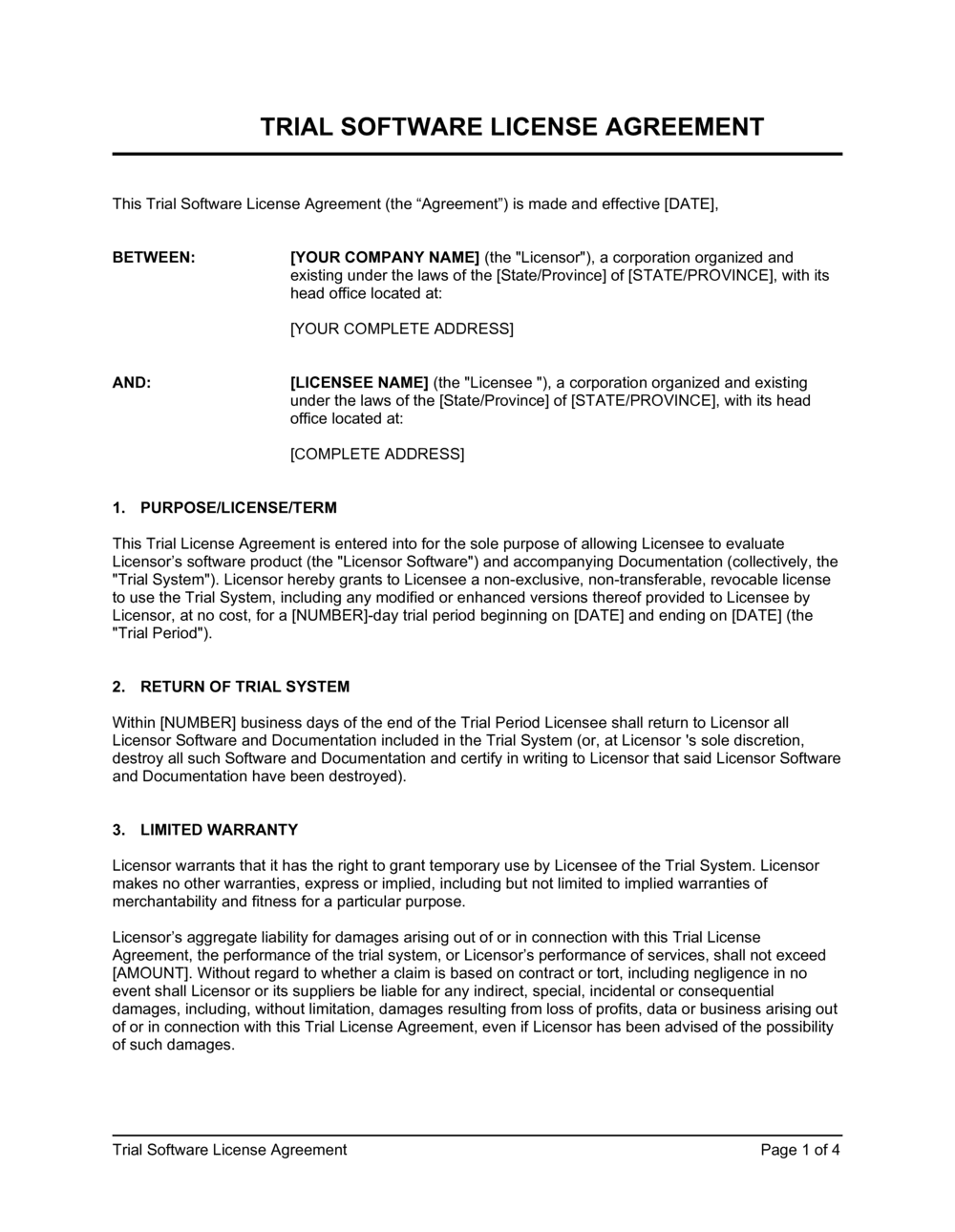
Trial Software License Agreement Template

Free Word download • Edit online • Save & share with Drive • Export to PDF

4 pages25–35 min to fillDifficulty: ComplexSignature requiredLegal review recommended
Learn more ↓
FreeTrial Software License Agreement Template

At a glance

What it is
A Trial Software License Agreement is a legally binding contract that grants a prospective customer a limited, non-commercial right to use a software product for a defined evaluation period — typically 14 to 90 days — before committing to a paid license. This free Word download covers the scope of permitted use, IP ownership, data handling, confidentiality, and automatic license expiry in a single document you can edit online and export as PDF.
When you need it
Use it whenever you offer a prospect access to your software — SaaS, desktop, or on-premise — for evaluation purposes before a purchase decision. It is equally appropriate for negotiated enterprise pilots and self-serve free trials where enforceable boundaries on use and data are required.
What's inside
Grant of trial license, permitted and prohibited uses, evaluation period and expiry, IP ownership and restrictions on reverse engineering, confidentiality, data handling and privacy obligations, warranty disclaimers, limitation of liability, termination rights, and governing law. An optional conversion-to-paid clause is included for SaaS and subscription contexts.

What is a Trial Software License Agreement?

A Trial Software License Agreement is a legally binding contract that grants a prospective customer a limited, non-commercial right to access and evaluate a software product for a defined evaluation period — typically 14 to 90 days — before committing to a paid license. It establishes the boundaries of permitted use, confirms the licensor's ownership of all intellectual property, sets confidentiality obligations on both sides, governs the handling of any data entered during evaluation, and terminates automatically when the evaluation period ends. Unlike an informal "try before you buy" arrangement, a properly executed trial license agreement gives the licensor enforceable protections against reverse engineering, unauthorized copying, benchmark disclosure, and production use of software provided at no cost.

Why You Need This Document

Offering software for evaluation without a signed trial agreement is one of the most common and costly oversights in software sales. Without one, a prospect who deploys your software across their organization has no contractual obligation to stop, no prohibition on reverse engineering your code, and no duty to keep your pricing, architecture, or roadmap confidential after the evaluation ends. Data entered into the trial environment may be subject to GDPR, CCPA, or PIPEDA obligations that the licensor unwittingly inherits with no contractual framework to manage them. Conversion to a paid license stalls when neither party has a clear path from trial expiry to commercial agreement. A well-drafted trial software license agreement closes all of these gaps in under 30 minutes — defining exactly who can access the software, for how long, for what purpose, and on what terms — so your sales team can run evaluations at scale without accumulating unmanaged legal exposure with every new prospect.

Which variant fits your situation?

If your situation is…Use this template
Cloud-based SaaS product with self-serve signup and automatic expirySaaS Trial License Agreement
Negotiated enterprise pilot with a named corporate customerEnterprise Software Evaluation Agreement
Customer converts from trial to paid subscriptionSoftware License Agreement
Ongoing commercial SaaS subscription after conversionSaaS Subscription Agreement
On-premise perpetual license after successful evaluationSoftware Perpetual License Agreement
Sharing confidential product information before any access is grantedNon-Disclosure Agreement
Custom development or integration work during the trial periodSoftware Development Agreement

Common mistakes to avoid

❌ No seat or device limit in the grant clause

Why it matters: Without a defined limit, an enterprise prospect can deploy the software to hundreds of users under a free trial license, creating a de facto production environment with no revenue to the licensor.

Fix: Define the maximum number of named users, seats, or devices in the grant clause and enforce the limit technically through your access control system.

❌ Vague or open-ended evaluation period

Why it matters: Trials with no clear expiry date extend indefinitely, stalling conversion conversations and leaving the licensor with ongoing IP exposure and support obligations for non-paying users.

Fix: State a specific number of days from activation as the evaluation period and include automatic expiry language — access terminates by operation of the agreement, with no notice required.

❌ No data handling clause

Why it matters: Prospects frequently enter real business or personal data into trial environments. Without a data clause, the licensor has no contractual basis to retain, use, or delete that data — and may inadvertently become a data processor subject to GDPR, CCPA, or PIPEDA.

Fix: Include an explicit data handling clause confirming data ownership, specifying a deletion or return timeline of 30 days post-expiry, and referencing any applicable data processing addendum.

❌ Confidentiality survival period limited to the trial length

Why it matters: A confidentiality obligation that expires when the trial does leaves trade secrets, pricing, and technical architecture exposed to disclosure the day after the evaluation ends.

Fix: Set the confidentiality survival period to a minimum of two years post-termination, independent of the trial duration — and longer for highly sensitive IP or regulated industries.

❌ Carrying over a paid-license liability cap into the trial agreement

Why it matters: If the paid license caps liability at 12 months of fees and trial fees are zero, the formula resolves to a zero-dollar cap — which may not be what either party intended and creates ambiguity in disputes.

Fix: Replace any fee-based formula with a fixed nominal dollar amount (e.g., $100) in the trial agreement's limitation of liability clause.

❌ No conversion clause for the path to paid

Why it matters: A customer who completes a trial and pays, but has no executed commercial agreement, may be accessing the software without any valid current license — exposing both parties to contractual and compliance gaps.

Fix: Include a conversion clause that either automatically converts the trial to a paid license upon payment or triggers execution of the commercial agreement within a defined window after the trial expires.

The 10 key clauses, explained

Parties and recitals

In plain language: Identifies the licensor (software owner) and licensee (prospective customer) as legal entities and states the purpose of the agreement — a non-commercial evaluation of the software.

Sample language
This Trial Software License Agreement ('Agreement') is entered into as of [EFFECTIVE DATE] between [LICENSOR LEGAL NAME], a [STATE/COUNTRY] [ENTITY TYPE] ('Licensor'), and [LICENSEE LEGAL NAME], a [STATE/COUNTRY] [ENTITY TYPE] ('Licensee'). Licensor desires to grant Licensee a limited right to evaluate the Software as described herein.

Common mistake: Using a trade name or product brand instead of the licensor's registered legal entity. If a dispute arises, enforcing IP restrictions against the correct rights-holder becomes unnecessarily complicated.

Grant of trial license

In plain language: Specifies exactly what the licensee can do: access the software, install it on a defined number of devices or seats, and use it for internal evaluation only — nothing broader.

Sample language
Subject to the terms of this Agreement, Licensor hereby grants Licensee a limited, non-exclusive, non-transferable, royalty-free license to install and use the Software solely for Licensee's internal evaluation purposes during the Evaluation Period on no more than [NUMBER] authorized devices or named users.

Common mistake: Omitting a seat or device count limit. Without one, enterprise prospects may deploy the software organization-wide under a trial license, creating a de facto free production environment.

Evaluation period and expiry

In plain language: States the exact start and end dates of the trial, or a duration triggered by activation, and confirms that access automatically terminates at expiry unless converted to a paid license.

Sample language
The Evaluation Period commences on [START DATE / the date of first access] and expires [NUMBER] days thereafter ('Expiry Date'). All rights granted herein terminate automatically on the Expiry Date. Licensee shall immediately cease use of the Software and destroy or return all copies upon expiry.

Common mistake: Leaving the end date open-ended or subject to mutual written agreement. Vague expiry terms allow trials to extend indefinitely, undermining revenue conversion and creating ongoing IP exposure.

Permitted and prohibited uses

In plain language: Explicitly lists what the licensee may and may not do — prohibiting production use, sublicensing, reverse engineering, benchmarking disclosure, and any commercial exploitation of the software.

Sample language
Licensee shall not: (a) use the Software for production, commercial, or revenue-generating activities; (b) sublicense, sell, or transfer the Software; (c) reverse engineer, decompile, or disassemble the Software; (d) publish benchmark or performance results without Licensor's prior written consent; or (e) modify or create derivative works of the Software.

Common mistake: Forgetting to prohibit benchmark disclosure. Prospective customers sometimes publish performance comparisons using trial builds — without a restriction, the licensor has no contractual basis to stop them.

Intellectual property ownership

In plain language: Confirms that the licensor retains all ownership of the software, documentation, and any modifications, and that the trial grant creates no implied license or ownership rights.

Sample language
The Software and all copies thereof are and shall remain the exclusive property of Licensor. No title or ownership is transferred to Licensee. All rights not expressly granted in this Agreement are reserved to Licensor. Licensee acknowledges that no implied license arises from any conduct or course of dealing.

Common mistake: Relying solely on copyright notice rather than an explicit IP reservation clause. Courts in several jurisdictions recognize implied licenses from conduct — a written reservation eliminates that risk.

Confidentiality

In plain language: Requires the licensee to keep the software, documentation, pricing, and any non-public information disclosed during the trial strictly confidential for a defined period.

Sample language
Licensee agrees to hold in strict confidence all Confidential Information of Licensor and to use such information solely in connection with the evaluation. Licensee shall not disclose Confidential Information to any third party without Licensor's prior written consent. This obligation survives termination for [THREE (3)] years.

Common mistake: Setting the confidentiality survival period to match the trial length — typically 14 to 90 days. Trade secrets and competitive information need protection well beyond the evaluation window, typically two to five years.

Data handling and privacy

In plain language: Allocates responsibility for any personal or business data entered into the software during the trial, including how it is stored, who owns it, and what happens to it at expiry.

Sample language
Any data submitted by Licensee to the Software during the Evaluation Period ('Evaluation Data') remains the property of Licensee. Licensor shall process Evaluation Data solely to operate the trial environment and shall delete or return all Evaluation Data within [30] days of the Expiry Date upon written request.

Common mistake: No data handling clause at all. If a prospect enters real production data into a trial environment and the licensor retains it after expiry, GDPR, CCPA, and similar frameworks impose significant penalties on both parties.

Warranty disclaimer and 'as is' provision

In plain language: States clearly that trial software is provided without warranties of any kind — no guarantee of fitness, accuracy, security, or uninterrupted access — limiting the licensor's exposure for bugs or downtime.

Sample language
THE SOFTWARE IS PROVIDED 'AS IS' FOR EVALUATION PURPOSES ONLY. LICENSOR DISCLAIMS ALL WARRANTIES, EXPRESS OR IMPLIED, INCLUDING ANY IMPLIED WARRANTIES OF MERCHANTABILITY, FITNESS FOR A PARTICULAR PURPOSE, OR NON-INFRINGEMENT. LICENSOR DOES NOT WARRANT THAT THE SOFTWARE WILL OPERATE WITHOUT ERROR OR INTERRUPTION.

Common mistake: Including a limited warranty for the trial period that mirrors the paid product's SLA. This contradicts the 'as is' disclaimer and may create implied support obligations the licensor cannot practically meet for free trials.

Limitation of liability

In plain language: Caps the total damages either party may recover under the agreement — typically at zero or a nominal amount, reflecting the no-cost nature of the trial.

Sample language
IN NO EVENT SHALL LICENSOR BE LIABLE FOR ANY INDIRECT, INCIDENTAL, SPECIAL, OR CONSEQUENTIAL DAMAGES ARISING OUT OF THIS AGREEMENT. LICENSOR'S TOTAL LIABILITY FOR ANY CLAIM UNDER THIS AGREEMENT SHALL NOT EXCEED [ONE HUNDRED US DOLLARS ($100.00)].

Common mistake: Carrying over the paid license's liability cap (e.g., 12 months of fees) into the trial agreement. Since trial fees are zero, the cap should be explicitly nominal — otherwise the formula produces a meaningless result.

Termination and conversion

In plain language: Describes how either party may terminate early, what obligations survive termination, and the conditions under which the trial converts to a paid commercial license.

Sample language
Either party may terminate this Agreement at any time on [FIVE (5)] days' written notice. Upon termination or expiry, Licensee shall promptly uninstall and destroy all copies of the Software. If Licensee elects to convert to a paid license, the parties shall execute Licensor's then-current [SUBSCRIPTION / LICENSE] Agreement and the terms herein shall be superseded thereby.

Common mistake: No conversion clause at all. Without one, a paying customer who used a trial technically has no contractual basis for continued use after the expiry date — even if they have paid — until a new agreement is fully executed.

How to fill it out

  1. 1

    Enter the parties' full legal names and entity types

    Replace every placeholder with the registered legal name of the licensor and licensee — not trade names, product names, or brand names. Include the entity type (LLC, Inc., Ltd.) and jurisdiction of incorporation for each.

    💡 Cross-reference your corporate registry filing to confirm the exact legal name before execution — mismatches between contract and registration create enforcement ambiguity.

  2. 2

    Set the evaluation period with a specific start trigger and duration

    Decide whether the clock starts on the effective date, the date of first access, or a specific activation event. Enter the exact duration in days and confirm the Expiry Date or the calculation formula produces a definite end date.

    💡 Activation-triggered start dates are more reliable than fixed calendar dates for self-serve SaaS trials — they account for delays between signing and first login.

  3. 3

    Define the seat and device limits

    Enter the maximum number of named users, seats, or devices authorized under the trial grant. For enterprise pilots, list the specific authorized user names or job titles in a Schedule A if the count is small.

    💡 If your software enforces seat limits technically, align the contractual limit exactly with the technical limit — discrepancies between what the contract says and what the system allows create grey areas.

  4. 4

    Review and tailor the prohibited uses list

    Read through every prohibition in the permitted and prohibited uses clause and confirm each applies to your software and deployment model. Add any industry-specific restrictions — for example, prohibiting use with regulated patient data for healthcare software in trial.

    💡 The benchmark disclosure prohibition is easy to overlook and critically important in competitive markets — confirm it is present before signing.

  5. 5

    Set the confidentiality survival period

    Choose a post-termination confidentiality period appropriate to the sensitivity of the information disclosed — typically two to five years for SaaS products, longer for highly sensitive technical IP.

    💡 If your software contains patentable methods or trade secrets, consult a lawyer before setting a survival period shorter than three years.

  6. 6

    Complete the data handling obligations

    Enter the specific timeframe within which the licensor will delete or return evaluation data after expiry — 30 days is standard. Confirm whether the licensee will receive a data export before deletion, and state this explicitly.

    💡 For any trial involving EU or UK prospects, ensure the data handling clause references your applicable privacy policy and any data processing addendum by name.

  7. 7

    Set the liability cap at a nominal dollar amount

    Replace the liability cap placeholder with a specific dollar amount — typically $0 to $100 — reflecting the no-cost nature of the trial. Confirm the cap applies to both direct and indirect damages and that the disclaimer uses ALL CAPS formatting.

    💡 ALL CAPS formatting for warranty disclaimers and liability caps is legally required in several US states to be enforceable — the template uses this format by default.

  8. 8

    Execute before granting access

    Both parties must sign before the licensee is given login credentials, a license key, or any other means of accessing the software. Post-access signatures raise a 'fresh consideration' problem and may void restrictive clauses.

    💡 For self-serve trials, a clickwrap mechanism where the user actively checks an acceptance box — not just a browse-wrap notice — is more consistently enforced than a browsewrap.

Frequently asked questions

What is a trial software license agreement?

A trial software license agreement is a legally binding contract between a software licensor and a prospective customer that grants limited, temporary rights to access and evaluate the software before a purchase decision. It defines the scope of permitted use, the evaluation period, IP ownership, confidentiality obligations, and what happens when the trial ends — protecting both parties during the pre-commercial phase of the relationship.

Is a trial software license agreement legally binding?

Yes, when properly executed — either by wet signature, e-signature, or a legally compliant clickwrap mechanism — a trial software license agreement is generally enforceable as a binding contract. Courts in the US, UK, and EU have consistently upheld well-drafted trial license terms, including IP restrictions, confidentiality obligations, and disclaimer clauses. Enforceability depends on proper execution before access is granted and on terms being reasonably specific rather than one-sided boilerplate.

What is the difference between a trial license and a free license?

A trial license is time-limited and scoped to evaluation use only — it expires automatically and cannot be used for production or commercial purposes. A free (freemium) license is typically perpetual, covers ongoing limited use, and is governed by a standard commercial license agreement with feature restrictions rather than a time constraint. A trial agreement is the right document for a time-bounded evaluation; a software license agreement is the right document for a perpetual free tier.

Can a trial software license agreement protect my IP?

Yes, and this is one of its primary functions. An explicit IP reservation clause confirms the licensor retains all rights not expressly granted, prohibitions on reverse engineering prevent code extraction, and confidentiality obligations prevent disclosure of technical architecture or trade secrets encountered during the evaluation. Without a signed agreement, the licensor may have only copyright law — and no contractual basis — to enforce these protections against a prospect.

Do I need a signature for a self-serve free trial?

A wet or e-signature is ideal, but for self-serve trials, a clickwrap agreement — where the user actively checks a box or clicks a clearly labeled 'I accept' button before accessing the software — is generally enforceable in the US, UK, and EU. Browse-wrap agreements, where terms are linked in a footer without any active acceptance step, are much harder to enforce and should be avoided. Courts consistently distinguish between active acceptance (enforceable) and passive notice (frequently not).

How long should a software trial period be?

Trial periods typically run 14 to 30 days for self-serve SaaS products and 30 to 90 days for enterprise pilots requiring procurement approval, security review, and integration testing. The right length depends on your product's complexity and the buyer's decision cycle. Whatever duration you choose, state it as a specific number of days in the contract and build in automatic expiry — open-ended trials consistently convert at lower rates than time-bounded ones.

What happens to data after the trial expires?

The trial agreement should specify exactly what happens: typically, the licensee's data is deleted within 30 days of expiry unless the licensee requests an export in writing before that deadline. For trials involving EU or UK data subjects, GDPR and UK GDPR impose specific deletion and portability obligations regardless of what the contract says — the agreement should reference your privacy policy and any data processing addendum to ensure consistency.

Can a trial software agreement automatically convert to a paid license?

Yes — a conversion clause can provide that the trial automatically rolls into a paid subscription on expiry unless the licensee cancels in writing before a defined date. This is common for SaaS products and requires advance notice to the licensee, typically 7 to 14 days before expiry, to be enforceable in consumer-facing contexts. For B2B agreements, automatic conversion with clear advance notice is generally enforceable, but consider the jurisdiction's requirements — some EU member states require explicit opt-in for automatic renewals even in B2B contexts.

Do I need a lawyer to use this template?

For straightforward SaaS trials involving a single jurisdiction and standard evaluation terms, a high-quality template is typically sufficient for most small to mid-size software vendors. Legal review is strongly recommended when the trial involves regulated industries (healthcare, financial services, government), enterprise prospects with significant negotiating power, cross-border data transfers subject to GDPR or other frameworks, or software containing patentable methods or sensitive trade secrets.

What is the difference between a trial license agreement and an NDA?

A non-disclosure agreement restricts disclosure of confidential information but does not grant any rights to access or use the software itself. A trial license agreement grants limited access rights and typically includes confidentiality obligations as one of its clauses. In practice, many enterprise software evaluations require both documents — an NDA signed before any product demonstrations or technical disclosures, followed by a trial license agreement executed before hands-on access is granted.

How this compares to alternatives

vs Software License Agreement

A standard software license agreement governs ongoing commercial use — it includes pricing, support obligations, SLAs, and renewal terms that are inappropriate for a no-cost evaluation. A trial agreement is scoped to evaluation only, disclaims all warranties, and terminates automatically. Use the trial agreement first; execute the commercial license when the customer converts.

vs SaaS Subscription Agreement

A SaaS subscription agreement is the commercial governing document for a paying subscriber — it covers uptime commitments, support tiers, payment terms, and data processing obligations at a commercial level. A trial agreement covers the same product but under no-cost, time-limited, evaluation-only terms with a full 'as is' disclaimer. The two documents should be executed sequentially, not used interchangeably.

vs Non-Disclosure Agreement

An NDA governs disclosure of confidential information — it does not grant any right to access or use software. A trial software license agreement grants limited access rights and incorporates confidentiality obligations as one of its clauses. In enterprise sales, both documents are typically used: an NDA before demos and technical disclosures, followed by a trial license before hands-on access.

vs Software Development Agreement

A software development agreement governs the creation of custom software by a developer for a client — it addresses deliverables, milestones, IP ownership of newly created work, and payment. A trial license agreement governs access to existing software for evaluation only. If a prospect requests customization or integration work during a trial, a separate development agreement is required.

Industry-specific considerations

SaaS / Technology

Self-serve clickwrap trials with automatic expiry, seat-based access limits, and data deletion obligations aligned to GDPR and CCPA requirements.

Healthcare / MedTech

HIPAA Business Associate Agreement references, prohibitions on entering real patient data during evaluation, and enhanced IP protections for FDA-regulated software.

Financial Services / Fintech

Prohibitions on using trial software for live transaction processing, enhanced confidentiality covering client and trading data, and SOC 2 audit right references for enterprise prospects.

Professional Services

Negotiated enterprise pilots with named-user lists, benchmark disclosure restrictions, and conversion terms tied to firm-wide rollout pricing agreed before trial commencement.

Jurisdictional notes

United States

Warranty disclaimers and limitation of liability clauses must appear in conspicuous language — typically ALL CAPS — to be enforceable under the UCC and most state contract laws. Clickwrap acceptance is broadly enforceable across federal circuits; browse-wrap is not. California, Texas, and New York courts apply heightened scrutiny to one-sided limitation clauses. CCPA applies if trial users include California consumers whose data is processed during evaluation.

Canada

PIPEDA (and Quebec Law 25 for provincially regulated entities) applies to any personal data collected during a trial involving Canadian residents, requiring a lawful basis for processing and a clear retention and deletion policy. Ontario and BC courts have enforced clickwrap trial terms as binding agreements when the acceptance mechanism is clear and prominent. Quebec requires contracts to be available in French for consumers; B2B agreements in English are generally acceptable.

United Kingdom

UK GDPR applies to any personal data processed during a trial involving UK data subjects — a Data Processing Addendum or equivalent clause is required if the licensor processes personal data on the licensee's behalf. The Unfair Contract Terms Act 1977 and Consumer Rights Act 2015 limit the extent to which liability can be excluded, particularly for negligence causing loss. Clickwrap acceptance is enforceable if the terms are clearly presented before acceptance.

European Union

GDPR Article 28 requires a Data Processing Agreement for any trial where the licensor processes personal data on behalf of the licensee. The EU AI Act may impose additional obligations if the trial software uses AI or machine learning components. Several member states — including France, Germany, and the Netherlands — apply consumer protection rules even to some B2B trial agreements. Automatic renewal and conversion clauses require explicit advance notice to comply with local commercial codes in Austria, Germany, and Belgium.

Template vs lawyer — what fits your deal?

PathBest forCostTime
Use the templateSaaS vendors running standard self-serve or SMB trials in a single jurisdiction with no regulated dataFree30 minutes
Template + legal reviewEnterprise software vendors running negotiated pilots, cross-border trials, or evaluations involving personal data subject to GDPR or CCPA$400–$9002–4 days
Custom draftedHealthcare, financial services, or government software vendors with complex regulatory obligations, patentable IP, or high-value enterprise pilots$2,000–$6,000+1–3 weeks

Glossary

Evaluation Period
The defined calendar window — typically 14 to 90 days from activation — during which the prospective licensee may access the software under trial terms.
Grant of License
The contractual clause conveying specific, limited rights to use the software — defined by scope, duration, number of users, and permitted purpose.
Permitted Use
The specific activities the licensee is authorized to perform with the software during the trial, typically limited to internal evaluation and excluding production or commercial use.
Reverse Engineering
The process of analyzing software to reconstruct its source code, architecture, or algorithms — prohibited in virtually all software license agreements.
Intellectual Property (IP) Reservation
A clause confirming that all rights in the software not explicitly granted remain with the licensor, preventing any implied license from arising.
Confidential Information
Non-public technical, commercial, or operational information disclosed in connection with the trial — including the software itself, documentation, and performance data.
Warranty Disclaimer
A clause stating that trial software is provided 'as is' with no warranties of fitness, merchantability, or uninterrupted operation — limiting the licensor's liability for trial-period defects.
Limitation of Liability
A cap on the maximum damages either party can recover under the agreement, typically expressed as a dollar amount (often zero or a nominal sum for a no-cost trial).
Automatic Expiry
A mechanism — technical, contractual, or both — that terminates the trial license and disables software access at the end of the evaluation period without requiring affirmative notice.
Conversion Clause
An optional provision that specifies the terms under which a trial automatically or electively converts to a paid commercial license, including pricing, notice period, and data portability.
Data Handling Obligations
Contractual commitments governing how each party collects, stores, processes, and deletes any personal or business data generated or shared during the trial period.

Part of your Business Operating System

This document is one of 3,000+ business & legal templates included in Business in a Box.

  • Fill-in-the-blanks — ready in minutes
  • 100% customizable Word document
  • Compatible with all office suites
  • Export to PDF and share electronically

Create your document in 3 simple steps.

From template to signed document — all inside one Business Operating System.
1
Download or open template

Access over 3,000+ business and legal templates for any business task, project or initiative.

2
Edit and fill in the blanks with AI

Customize your ready-made business document template and save it in the cloud.

3
Save, Share, Send, Sign

Share your files and folders with your team. Create a space of seamless collaboration.

Save time, save money, and create top-quality documents.

★★★★★

"Fantastic value! I'm not sure how I'd do without it. It's worth its weight in gold and paid back for itself many times."

Managing Director · Mall Farm
Robert Whalley
Managing Director, Mall Farm Proprietary Limited
★★★★★

"I have been using Business in a Box for years. It has been the most useful source of templates I have encountered. I recommend it to anyone."

Business Owner · 4+ years
Dr Michael John Freestone
Business Owner
★★★★★

"It has been a life saver so many times I have lost count. Business in a Box has saved me so much time and as you know, time is money."

Owner · Upstate Web
David G. Moore Jr.
Owner, Upstate Web

Run your business with a system — not scattered tools

Stop downloading documents. Start operating with clarity. Business in a Box gives you the Business Operating System used by over 250,000 companies worldwide to structure, run, and grow their business.

Start free · No credit card required