1
Define your subscription model and pricing tiers
Start by documenting your current or intended pricing architecture — tiers, included features, billing cadence (monthly vs. annual), and the customer segment each tier targets.
💡 Annual billing at a 15–20% discount improves cash flow and reduces churn simultaneously — model both annual and monthly mix in your revenue section.
2
Catalog all revenue streams and set recognition rules
List every source of revenue — subscription, usage-based, professional services, marketplace take rates — and specify when each is recognized. Separate recurring from non-recurring to keep ARR clean.
💡 Exclude onboarding and implementation fees from ARR even when they are contractually tied to a subscription. Investors apply strict ARR definitions and will adjust your number if you do not.
3
Build the cost structure and calculate gross margin
List all COGS line items: hosting, third-party APIs, payment processing fees, and the fully-loaded cost of customer support and success headcount. Divide gross profit by revenue to get your gross margin percentage.
💡 Model COGS at three ARR milestones ($1M, $5M, $10M) to show how gross margin scales — investors want to see the path to 75%+ margins at scale.
4
Populate the key SaaS metrics table
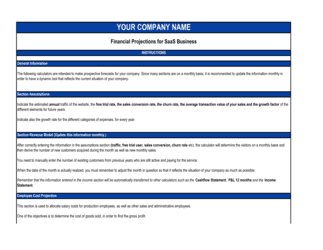
Enter current values for MRR, ARR, logo churn, revenue churn, NRR, CAC by channel, LTV, LTV:CAC ratio, and CAC payback period. If you are pre-revenue, use market benchmarks and label them as targets.
💡 An LTV:CAC ratio below 3:1 signals an unsustainable acquisition model regardless of growth rate. Flag it and explain your path to improvement.
5
Document the customer acquisition strategy by segment
For each customer segment, specify the primary acquisition channel, the sales motion, the average sales cycle length, average ACV, and estimated CAC. Avoid blending segments into a single average.
💡 If your SMB and enterprise motions share the same CAC estimate, the model is almost certainly wrong — enterprise deals cost materially more to close.
6
Map the retention and expansion mechanics
Describe the specific programs and triggers that reduce churn and drive expansion revenue — onboarding milestones, health scores, upgrade prompts, QBR cadence, and renewal playbook.
💡 Quantify each retention lever: reducing time-to-first-value from 14 days to 7 days in your onboarding flow typically reduces 30-day churn by 15–25% for self-serve products.
7
Build the three-scenario ARR growth model
Project ARR for 3 years under base, upside, and downside scenarios. For each, specify new ARR added per month, monthly churn rate, and expansion MRR rate. Show the arithmetic, not just the output.
💡 Run a sensitivity table showing how a 1-percentage-point change in monthly churn affects Year 3 ARR — this single table answers 80% of investor model questions before they ask.
8
Document strategic assumptions and risks with mitigations
List the five to seven assumptions the model depends on most heavily, the risk that would invalidate each, and a concrete mitigation step. This section turns the document from a forecast into a decision-making tool.
💡 Frame risks as 'If [assumption] is wrong by 20%, the impact is [specific metric change]' — this converts vague risks into manageable variables.