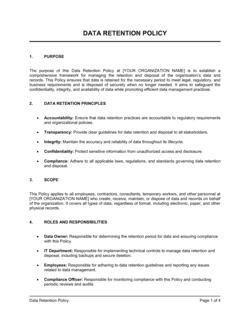
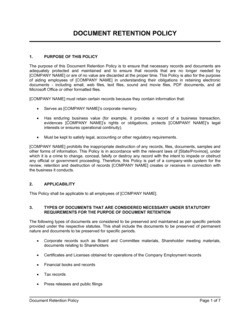
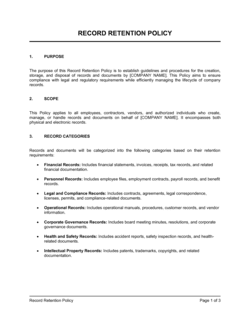
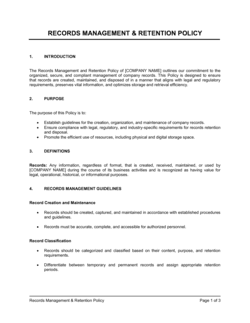
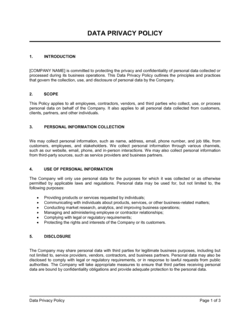
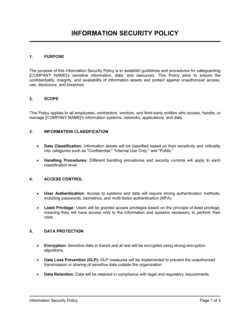
Retention Policy Template

Free Word download β€’ Edit online β€’ Save & share with Drive β€’ Export to PDF

6 pagesβ€’20–30 min to fillβ€’Difficulty: Standard
Learn more ↓
FreeRetention Policy Template

At a glance

What it is
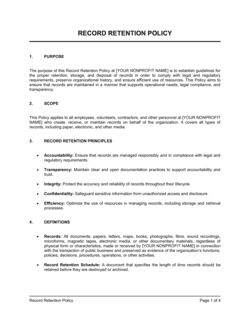
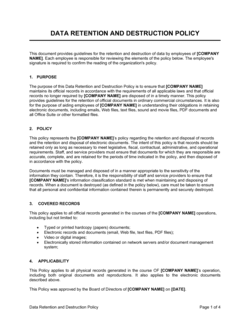
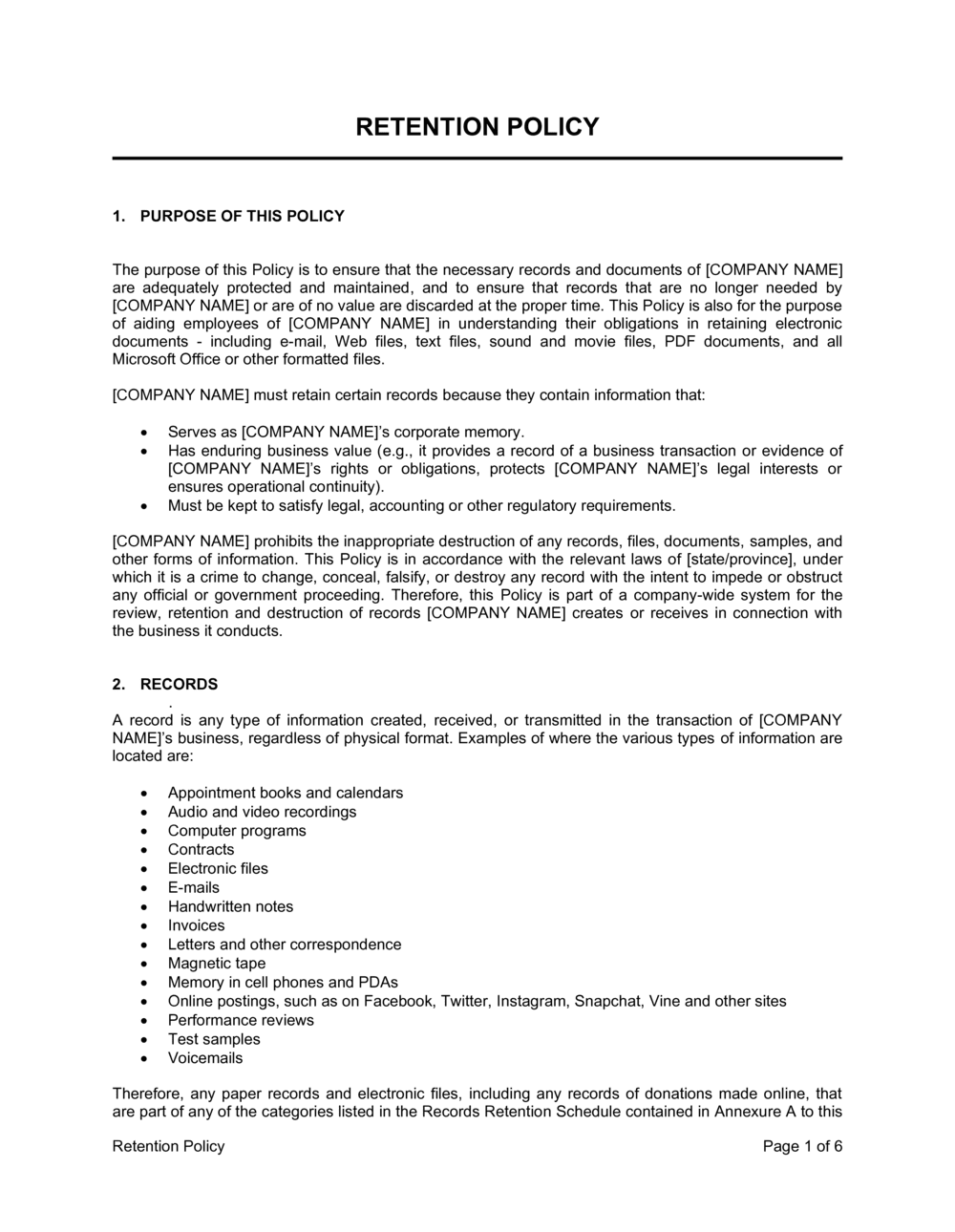
A Retention Policy is an internal governance document that defines how long each category of business record must be kept, who is responsible for managing it, and how it must be destroyed or archived at the end of its retention period. This free Word download gives you a structured, editable template you can tailor to your industry and jurisdiction, then export as PDF for staff distribution or regulatory review.
When you need it
Use it when your business handles contracts, financial records, HR files, customer data, or regulatory submissions β€” and needs a written standard to manage storage costs, reduce legal exposure, and satisfy auditor or regulator requests. It is also required before implementing any document management system or data governance program.
What's inside
A purpose and scope statement, a complete record category schedule with retention periods and triggers, ownership and responsibility assignments, storage and security requirements, destruction procedures, legal hold provisions, and employee acknowledgment guidance.

What is a Retention Policy?

A Retention Policy is an internal governance document that defines how long each category of business record must be kept, who is responsible for managing it, and how it must be securely destroyed or permanently archived when its retention period ends. It applies to every medium the organization uses β€” paper files, emails, cloud documents, database records, and archived backups β€” and covers every department from finance and HR to legal and IT. A properly structured retention policy includes a complete record category schedule with trigger dates, custodian assignments, storage requirements, a legal hold procedure, and documented destruction methods.

Why You Need This Document

Operating without a written retention policy exposes your business on three fronts simultaneously. Regulators β€” the IRS, OSHA, HIPAA enforcement, and state data protection authorities β€” can impose penalties when required records are missing or cannot be produced within a defined window. Courts treat the destruction of records after litigation is reasonably anticipated as spoliation, which can result in sanctions, adverse jury instructions, or outright default judgments. And without a policy setting clear end dates, organizations default to keeping everything indefinitely β€” inflating storage costs and dramatically broadening the scope of records that must be reviewed and produced in any future discovery proceeding. This template gives you a structured, auditor-ready starting point that you can tailor to your specific record categories, applicable statutory minimums, and industry requirements β€” turning a compliance gap into a documented, defensible program.

Which variant fits your situation?

If your situation is…Use this template
Managing digital records and cloud-stored data specificallyData Retention Policy
Setting HR-specific retention rules for employee files and performance recordsHR Records Retention Policy
Documenting financial and accounting record retention for tax complianceFinancial Records Retention Schedule
Creating a high-level privacy governance document covering data collection and deletionPrivacy Policy
Issuing a directive to preserve specific records during active litigationLegal Hold Notice
Building a broader records and information management frameworkInformation Management Policy
Establishing rules for disposing of physical and digital records securelyDocument Destruction Policy

Common mistakes to avoid

❌ Using creation date instead of trigger date

Why it matters: A contract created in Year 1 but not expiring until Year 5 has only 2 years remaining under a 7-year-from-creation schedule β€” leaving you exposed if a dispute arises post-expiry.

Fix: Define a specific trigger event for each record category β€” contract expiry, employee termination, or fiscal year-end β€” and start the retention clock from that event.

❌ Setting a single retention period for all records

Why it matters: A flat 7-year rule over-retains low-risk records, inflating storage costs and litigation discovery exposure, while potentially under-retaining regulated categories like HIPAA medical records (6-year minimum) or OSHA logs (5 years).

Fix: Research the statutory minimum for each record category and assign an individual period. Group by regulatory regime to simplify the schedule.

❌ No legal hold provision

Why it matters: Destroying records on schedule after litigation is reasonably anticipated constitutes spoliation. Courts can sanction the organization, draw adverse inferences, or issue default judgments.

Fix: Add a legal hold section defining who issues holds, how custodians are notified, and how normal destruction is suspended and later reinstated.

❌ Assigning custodianship to named individuals rather than roles

Why it matters: When the named custodian leaves, there is no clear owner β€” records pile up unmanaged or get destroyed prematurely by a successor who doesn't know the policy exists.

Fix: Use job titles exclusively in the custodian column. Update the title only when the role is restructured, not when an individual changes.

❌ Omitting electronic records and cloud-stored data

Why it matters: Regulators and courts treat emails, instant messages, cloud files, and database records with the same legal weight as paper. A policy covering only physical records creates a compliance gap covering most of the organization's actual records.

Fix: Explicitly list electronic record types β€” emails, cloud documents, CRM data, and archived chat logs β€” with their own retention periods and approved deletion methods.

❌ Publishing the policy once with no review date

Why it matters: Regulatory retention minimums change, new record types emerge, and the business acquires new entities β€” a static policy drifts out of compliance within 12–24 months.

Fix: Set a mandatory annual review date in the policy itself, assign the review to a named role, and calendar it in the compliance team's annual task list before the policy is published.

The 9 key sections, explained

Purpose and scope

Definitions

Retention schedule

Ownership and responsibilities

Storage and security requirements

Legal hold procedure

Destruction procedures

Employee training and acknowledgment

Policy review and update schedule

How to fill it out

  1. 1

    Define the scope of records covered

    Identify every record type your organization creates or receives β€” contracts, financial records, HR files, correspondence, emails, customer data, and regulatory submissions. List them before building the schedule.

    πŸ’‘ Walk through each department and ask what records they produce. Operations, finance, HR, and legal each have distinct record types that often get missed in a top-down drafting approach.

  2. 2

    Research the statutory minimums for your industry and jurisdiction

    Look up the minimum retention periods required by applicable laws β€” IRS guidelines (generally 3–7 years for tax records), FLSA (3 years for payroll), HIPAA (6 years for medical records), and any state-level requirements.

    πŸ’‘ Build a reference table of statutory minimums before entering any retention periods in the schedule. Your policy periods must equal or exceed these floors β€” never fall below them.

  3. 3

    Build the retention schedule table

    Create a row for each record category. Columns should include: record category, retention period, trigger event, storage location, custodian, and disposition method. Enter each period as a number of years from the trigger date β€” not from the creation date.

    πŸ’‘ Group records by department first, then by regulatory regime. This makes the schedule easier for custodians to use without reading the whole table.

  4. 4

    Assign custodians and a policy administrator

    For each record category, name the department or specific role responsible for maintaining and ultimately destroying that record type. Designate one policy administrator β€” typically in legal, compliance, or operations β€” to own the schedule overall.

    πŸ’‘ Use job titles, not individual names, so the assignment survives staff turnover without requiring a policy amendment.

  5. 5

    Specify storage locations and access controls

    For each record type, state where it must be stored and who may access it. Name the approved systems explicitly β€” shared drive path, cloud platform, physical cabinet location β€” rather than leaving it to individual judgment.

    πŸ’‘ Cross-reference your IT security policy so that encryption and access-control requirements are consistent across both documents.

  6. 6

    Draft the legal hold and destruction procedures

    Write the step-by-step process for issuing a legal hold, notifying custodians, and lifting the hold. Separately, define the approved destruction methods for physical and electronic records and require a Certificate of Destruction for each batch.

    πŸ’‘ The legal hold and destruction sections are the highest-risk parts of the policy β€” have in-house counsel or an experienced compliance advisor review these two sections before finalizing.

  7. 7

    Set the training and review requirements

    Define when employees must complete training (within 30 days of hire and annually), how completion is recorded, and what acknowledgment form they must sign. Set the policy review date β€” typically 12 months from the effective date.

    πŸ’‘ Calendar the first annual review now, before you publish the policy. Policies that have no scheduled review date are almost never updated.

  8. 8

    Publish and distribute to all custodians

    Export the completed policy as a PDF, post it in your document management system, and email it directly to each designated custodian with a summary of their specific responsibilities.

    πŸ’‘ Include a one-page quick-reference card with each custodian's record categories, retention periods, and the name of the policy administrator β€” this reduces the support burden significantly.

Frequently asked questions

What is a retention policy?

A retention policy is an internal governance document that specifies how long each category of business record must be kept, who is responsible for managing it, and how it must be disposed of at the end of its retention period. It applies to physical documents, electronic files, emails, and data stored in cloud systems. A well-drafted retention policy reduces storage costs, limits litigation discovery exposure, and demonstrates regulatory compliance.

Why does a business need a retention policy?

Without a written retention policy, employees make ad hoc decisions about what to keep and what to delete β€” creating gaps that regulators and opposing counsel will exploit during audits and litigation. A policy also prevents the opposite problem: indefinitely retaining records that should have been destroyed, which increases storage costs and broadens the scope of data that must be produced in discovery. Most industry regulations and tax authorities require organizations to retain specific record types for defined minimum periods, and a written policy is the primary evidence of compliance.

How long should different types of business records be kept?

Retention periods vary by record type and jurisdiction. Common benchmarks: tax returns and supporting documents β€” 7 years from filing; contracts β€” 7 years after expiry; payroll records β€” 3 to 7 years depending on jurisdiction; employee personnel files β€” 7 years after termination; corporate formation documents β€” permanent; HIPAA-covered medical records β€” 6 years from creation or last effective date. These are general guidelines; verify the statutory minimum for each record type under applicable law before finalizing your schedule.

What is the difference between a retention policy and a data retention policy?

A retention policy covers all business records β€” physical and electronic β€” including contracts, HR files, financial records, and correspondence. A data retention policy focuses specifically on digitally stored data and typically addresses privacy law requirements such as GDPR, CCPA, or HIPAA, including rules on anonymization and automated deletion. Many organizations maintain both: a broad organizational retention policy and a more detailed data retention policy governing personal data systems.

Who is responsible for implementing a retention policy?

Responsibility is typically shared. A policy administrator β€” usually in legal, compliance, or operations β€” owns the policy itself, maintains the retention schedule, and coordinates training. Individual record custodians β€” department heads or designated staff β€” are responsible for managing and disposing of records in their category. Senior management or the board approves the policy. IT is responsible for implementing automated deletion and access controls in line with the schedule.

How often should a retention policy be reviewed?

Annual review is the standard practice. The policy should also be reviewed and updated within 30 to 60 days of any regulatory change affecting applicable retention minimums, after a merger or acquisition that brings new record types into scope, or when a new document management system is deployed. Treat the review date as a firm compliance deadline, not an optional reminder.

Does a small business need a formal retention policy?

Yes β€” even a sole proprietor faces IRS record-keeping requirements of at least 3 years for most tax records and 7 years for records related to claimed losses. Businesses with employees must retain payroll records under the FLSA. Businesses handling personal data face CCPA or GDPR obligations. A one-page retention schedule tailored to the business's actual record types is sufficient for most small businesses and significantly reduces regulatory risk.

What happens if records are destroyed before the retention period ends?

Premature destruction of records can result in regulatory penalties, adverse inferences in litigation β€” where a court instructs the jury to assume the destroyed records would have been unfavorable β€” and in extreme cases, sanctions or default judgments. The risk is highest when destruction occurs after litigation is reasonably anticipated. A documented retention policy with a legal hold procedure provides the best defense against a spoliation allegation.

How this compares to alternatives

vs Privacy Policy

A privacy policy is an external-facing document disclosing to users how their personal data is collected, used, and deleted. A retention policy is an internal governance document defining how all company records β€” not just personal data β€” are managed. The two documents must be consistent, but they serve different audiences and legal purposes.

vs Information Security Policy

An information security policy governs how data is protected from unauthorized access, breach, and misuse across its lifecycle. A retention policy governs how long data is kept and how it is destroyed at the end of that lifecycle. Both are required for a complete data governance framework and should cross-reference each other.

vs Document Destruction Policy

A document destruction policy focuses specifically on the approved methods, authorization process, and documentation requirements for disposing of records. A retention policy is broader β€” it covers the full lifecycle from creation through storage, legal hold, and final disposition. The destruction policy is often embedded as a section within the broader retention policy.

vs Records Management Policy

A records management policy is an enterprise-wide framework covering classification, indexing, version control, and access β€” the full information lifecycle. A retention policy is a focused sub-component addressing how long records are kept and how they are disposed of. Organizations building a complete records program typically implement both, with the retention policy adopted first.

Industry-specific considerations

Healthcare

HIPAA mandates a 6-year minimum for medical records and business associate agreements, with many state laws extending that to 10 years for patient records.

Financial Services

SEC and FINRA rules require broker-dealers to retain trade confirmations, account records, and correspondence for 3 to 6 years, with the first 2 years in an accessible format.

Manufacturing

OSHA injury logs must be retained for 5 years; product liability exposure often drives companies to retain design records and quality-control documentation for the life of the product plus 10 years.

Professional Services

Law firms, accounting firms, and consultancies retain client engagement files for 7 to 10 years after matter closure to address malpractice statutes of limitation and regulatory audits.

Retail and E-commerce

Customer transaction records, returns data, and consumer privacy consent logs require careful retention scheduling under CCPA and state consumer protection laws.

Technology / SaaS

Cloud-stored customer data, system logs, and support tickets must align the retention policy with GDPR deletion rights and data minimization obligations β€” automated deletion workflows are essential.

Template vs pro β€” what fits your needs?

PathBest forCostTime
Use the templateSmall to mid-size businesses establishing a baseline retention schedule for standard record categoriesFree2–4 hours
Template + professional reviewBusinesses in regulated industries β€” healthcare, financial services, or those handling significant personal data β€” or companies that have recently undergone a merger or acquisition$300–$1,000 for a compliance advisor or legal review3–5 business days
Custom draftedEnterprises with complex multi-jurisdiction records programs, international data transfers, or active litigation requiring coordinated legal hold management$2,000–$8,000 for a records management consultant or outside counsel3–6 weeks

Glossary

Retention Period
The minimum or maximum length of time a specific category of record must be kept before it may be destroyed or archived.
Retention Schedule
A table or matrix listing every record category the organization manages, paired with its retention period and destruction trigger.
Trigger Date
The event that starts the retention clock β€” such as contract expiry, employee termination, or fiscal year-end β€” rather than the date the record was created.
Legal Hold
A suspension of normal destruction schedules for records relevant to active or reasonably anticipated litigation, regulatory investigation, or audit.
Disposition
The final action taken on a record at the end of its retention period β€” typically secure destruction, permanent archiving, or transfer to a regulatory body.
Record Custodian
The individual or department responsible for maintaining, protecting, and disposing of a specific category of records according to the policy.
Vital Records
Records essential to the organization's continued operation during or after a disruption β€” such as incorporation documents, key contracts, and insurance policies.
Personally Identifiable Information (PII)
Any data that can identify a specific individual, including names, addresses, social security numbers, and email addresses, subject to privacy law protections.
Audit Trail
A chronological log documenting who accessed, modified, or destroyed a record β€” used to demonstrate compliance during regulatory reviews.
Statutory Minimum
The shortest retention period mandated by applicable law for a given record type β€” the policy must meet or exceed this floor.
Archive
Long-term, low-access storage for records that have passed their active retention period but must be preserved for legal, historical, or regulatory reasons.

Part of your Business Operating System

This document is one of 3,000+ business & legal templates included in Business in a Box.

  • Fill-in-the-blanks β€” ready in minutes
  • 100% customizable Word document
  • Compatible with all office suites
  • Export to PDF and share electronically

Create your document in 3 simple steps.

From template to signed document β€” all inside one Business Operating System.
1
Download or open template

Access over 3,000+ business and legal templates for any business task, project or initiative.

2
Edit and fill in the blanks with AI

Customize your ready-made business document template and save it in the cloud.

3
Save, Share, Send, Sign

Share your files and folders with your team. Create a space of seamless collaboration.

Save time, save money, and create top-quality documents.

β˜…β˜…β˜…β˜…β˜…

"Fantastic value! I'm not sure how I'd do without it. It's worth its weight in gold and paid back for itself many times."

Managing Director Β· Mall Farm
Robert Whalley
Managing Director, Mall Farm Proprietary Limited
β˜…β˜…β˜…β˜…β˜…

"I have been using Business in a Box for years. It has been the most useful source of templates I have encountered. I recommend it to anyone."

Business Owner Β· 4+ years
Dr Michael John Freestone
Business Owner
β˜…β˜…β˜…β˜…β˜…

"It has been a life saver so many times I have lost count. Business in a Box has saved me so much time and as you know, time is money."

Owner Β· Upstate Web
David G. Moore Jr.
Owner, Upstate Web

Run your business with a system β€” not scattered tools

Stop downloading documents. Start operating with clarity. Business in a Box gives you the Business Operating System used by over 250,000 companies worldwide to structure, run, and grow their business.

Free Forever PlanΒ Β·Β No credit card required