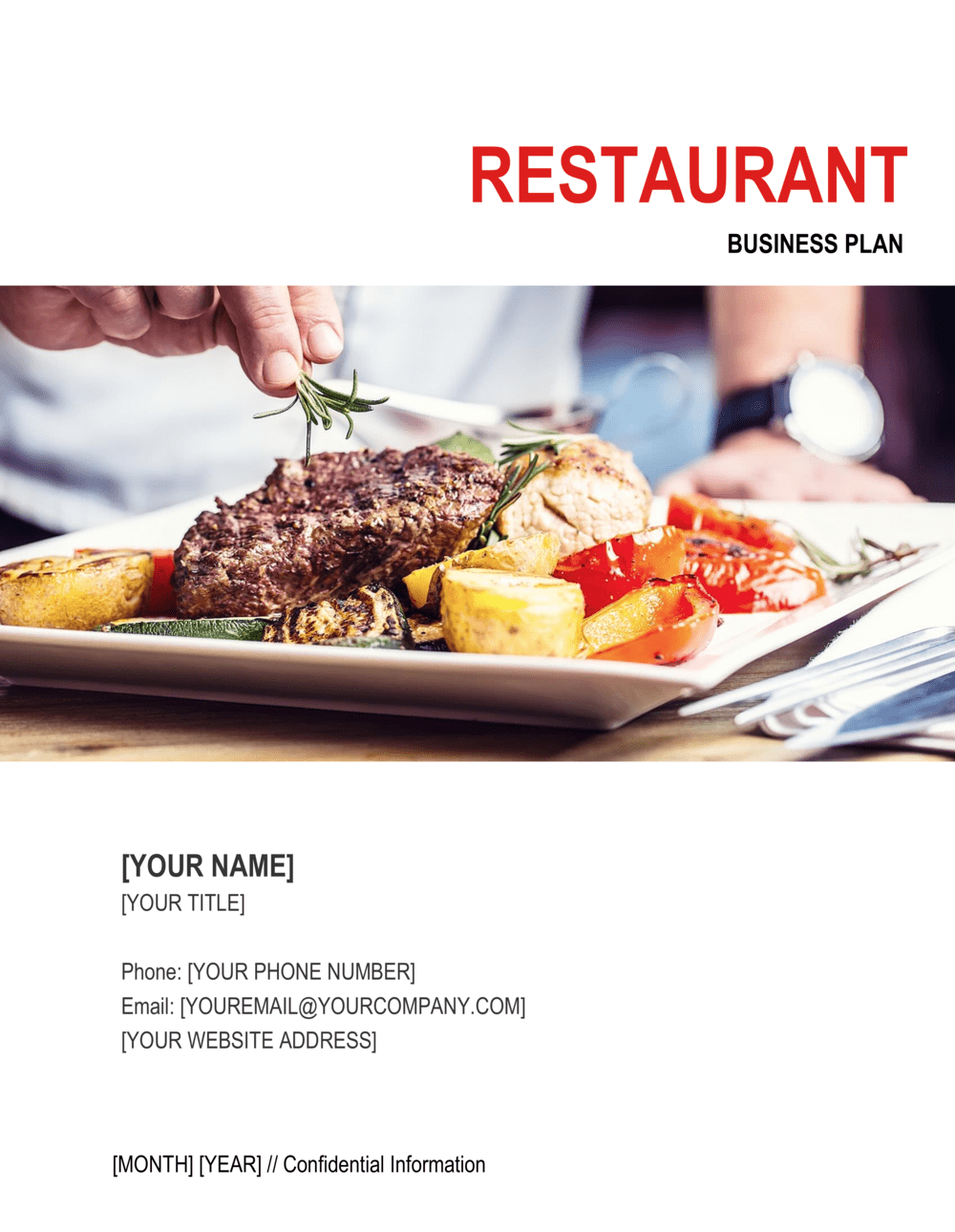
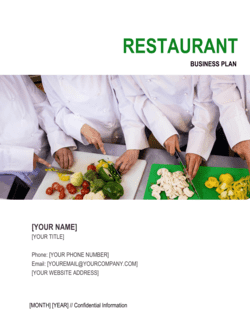
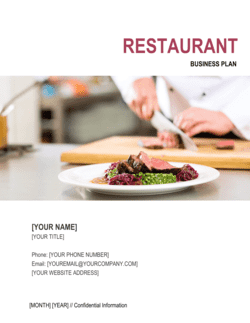
Restaurant Business Plan 6 Template

Free Word download β€’ Edit online β€’ Save & share with Drive β€’ Export to PDF

32 pagesβ€’2h 40m – 3h 35m to fillβ€’Difficulty: Expert
Learn more ↓
FreeRestaurant Business Plan 6 Template

At a glance

What it is
A Restaurant Business Plan is a structured document that maps your restaurant concept, target market, menu strategy, operational model, staffing plan, and 3–5 year financial projections into a single investor- and lender-ready file. This free Word download gives you a complete framework you can edit online and export as PDF to share with banks, investors, or franchise partners.
When you need it
Use it when opening a new restaurant, applying for an SBA or bank loan, seeking outside investors, or expanding an existing location into a new market or concept. Landlords and franchise systems also request a formal plan before approving a lease or territory.
What's inside
Executive summary, restaurant concept and brand positioning, market and competitive analysis, menu overview with cost structure, marketing and customer acquisition strategy, operations and staffing plan, management team profiles, and a full financial model covering P&L, cash flow, and startup capital requirements.

What is a Restaurant Business Plan?

A Restaurant Business Plan is a structured document that translates a restaurant concept into a concrete operational and financial blueprint β€” covering everything from cuisine type and target customer through menu cost engineering, staffing model, and a monthly cash flow projection for the first three years. It combines market evidence, competitive analysis, and a bottoms-up financial model to demonstrate that the concept is viable, the location is defensible, and the team can execute. Unlike a general business plan, it is built around food service-specific metrics: food cost percentage, prime cost, covers per service, table turn rate, and a detailed startup capital schedule that accounts for build-out, equipment, and a working capital reserve.

Why You Need This Document

Without a written restaurant business plan, you cannot access the three most common sources of startup capital β€” SBA loans, commercial bank financing, and outside investment β€” because all three require a formal plan with auditable financial projections before approving funds. Beyond financing, the planning process itself forces you to confront the numbers that determine whether the concept survives: if your food cost runs 38% instead of 30%, does the business still reach break-even? If you open at 50% capacity for the first three months, does your working capital reserve hold? Operators who skip this step routinely discover these gaps after signing a lease and spending build-out capital, at which point there is no low-cost way to fix them. This template gives you the structure to answer every lender and investor question before you are asked, and to make the decisions that determine profitability while they are still decisions rather than consequences.

Which variant fits your situation?

If your situation is…Use this template
Opening a fast-casual or quick-service restaurantRestaurant Business Plan (QSR)
Launching a fine dining or tasting-menu conceptFine Dining Business Plan
Starting a food truck or mobile food businessFood Truck Business Plan
Opening a coffee shop or cafΓ©Coffee Shop Business Plan
Applying for an SBA 7(a) loan specificallyBank Loan Business Plan
Early-stage concept validation before full planningOne-Page Business Plan
Expanding an existing restaurant into a franchise modelFranchise Business Plan

Common mistakes to avoid

❌ Projecting full-capacity revenue from Month 1

Why it matters: New restaurants rarely exceed 60–70% of projected volume in the first six months. Overstating early revenue produces a cash flow model that runs out of money before the business has time to stabilize.

Fix: Build a ramp schedule starting at 40–50% capacity utilization in Month 1, increasing 5–10 percentage points per month through Month 6, with full-run-rate assumptions beginning in Year 2.

❌ Omitting a working capital reserve from startup costs

Why it matters: Most restaurant failures in the first year result from running out of cash during the ramp period, not from a flawed concept. Without a reserve, one slow month or a delayed equipment delivery can be fatal.

Fix: Include a minimum 90-day working capital buffer β€” typically 20–25% of total startup costs β€” as a non-negotiable line item in the use-of-funds table.

❌ No food cost data in the menu section

Why it matters: A menu without cost analysis tells lenders and investors you have not stress-tested profitability. A restaurant that looks viable on revenue can still fail if food cost runs at 42% instead of 32%.

Fix: Calculate and state the food cost percentage for each menu category and the blended food cost across the full menu before presenting the plan to any external audience.

❌ Using national industry benchmarks in place of local market research

Why it matters: A lender financing a restaurant in a specific trade area will verify local demographics and competition independently. National averages that contradict local conditions undermine the plan's credibility.

Fix: Source all market data from the specific trade area β€” a 0.5-mile and 1-mile radius pull β€” using census, local business directories, and in-person observation.

The 10 key sections, explained

Executive Summary

Restaurant Concept and Brand

Market and Location Analysis

Competitive Analysis

Menu Overview and Pricing Strategy

Marketing and Customer Acquisition Plan

Operations and Staffing Plan

Management Team

Financial Projections

Startup Capital Requirements and Use of Funds

How to fill it out

  1. 1

    Define your concept and target customer before writing anything else

    Write a two-sentence concept statement that identifies the cuisine, service format, and specific guest you are designing for. Every other section β€” menu, staffing, marketing, location β€” flows from this anchor.

    πŸ’‘ Test your concept statement on three people outside the industry. If they cannot immediately picture the restaurant, it needs more specificity.

  2. 2

    Research your trade area with local data

    Pull demographic and competition data for a 0.5-mile and 1-mile radius around your target location using census data, Yelp, and Google Maps. Count competing concepts by price tier and cuisine type.

    πŸ’‘ A trade area with no direct competitors can mean an underserved market or no viable customer base β€” your analysis should distinguish between the two.

  3. 3

    Build the menu with food cost for each category

    List menu categories and two to three representative items per category. Calculate the food cost percentage for each using current supplier pricing. Confirm the blended food cost lands in the 28–35% range before finalizing prices.

    πŸ’‘ Price beverages to offset food cost variance β€” beverage margins of 70–80% give you room to absorb protein price swings.

  4. 4

    Build the financial model from covers up

    Start with realistic daily cover counts at 50% capacity utilization in Month 1, ramping to 70% by Month 6. Multiply covers by average check to get revenue, then apply your food cost and labor cost percentages to generate the P&L.

    πŸ’‘ Model a 70%-of-plan downside scenario. If the restaurant cannot survive six months at 70% of projected volume, the capital structure is too thin.

  5. 5

    Itemize every startup cost line by line

    List build-out, equipment, furniture and fixtures, POS setup, permits and licenses, pre-opening payroll, staff training, grand opening marketing, and a working capital reserve of at least three months of fixed costs.

    πŸ’‘ Get contractor bids before finalizing build-out costs β€” estimates from comparable projects are not a substitute for a real quote on your specific space.

  6. 6

    Write the management team section around operational track records

    For each key person, lead with the most relevant quantified achievement β€” covers managed per week, concepts opened, or revenue overseen β€” rather than job title history.

    πŸ’‘ If the team has a gap (no experienced GM or chef yet), name the role, the planned hire date, and the compensation budget. Acknowledging gaps honestly builds more credibility than pretending they do not exist.

  7. 7

    Write the executive summary last

    Pull the strongest data point from each section β€” concept, market opportunity, average check, break-even timeline, funding ask β€” and compress into one to two pages. It should stand alone as a compelling summary.

    πŸ’‘ Send the executive summary and financials to a restaurant operator or accountant for a 30-minute review before approaching any lender or investor.

Frequently asked questions

What is a restaurant business plan?

A restaurant business plan is a structured document that defines your restaurant concept, target market, menu and pricing strategy, staffing model, and 3-year financial projections. It serves as the primary document for securing bank loans, attracting investors, negotiating leases, and aligning your team around a concrete operational and financial strategy before opening.

What sections should a restaurant business plan include?

A complete restaurant business plan covers ten sections: executive summary, restaurant concept and brand, market and location analysis, competitive analysis, menu overview with food cost data, marketing and customer acquisition plan, operations and staffing plan, management team profiles, financial projections (P&L, cash flow, balance sheet), and startup capital requirements with a use-of-funds breakdown. Plans typically run 20–30 pages plus a financial model appendix.

How long does it take to write a restaurant business plan?

Most first-time operators spend 30–60 hours over two to four weeks completing a thorough plan. The financial model β€” covers, food cost, labor, and startup budget β€” accounts for roughly half that time. Using a structured template reduces the formatting and organizational work significantly, letting you focus on the market research and cost modeling that requires original analysis.

Do I need a business plan to open a restaurant?

You are not legally required to have one, but in practice you will need it for any SBA or bank loan, most landlord lease applications for commercial food service space, franchise system approval, and any outside investor conversation. Beyond financing, a written plan forces you to stress-test your food cost structure, staffing model, and break-even timeline before you spend capital on build-out.

What financial projections should a restaurant business plan include?

Include a monthly P&L for Year 1 and annual P&L for Years 2 and 3, a cash flow statement on the same cadence, a projected balance sheet, and a startup capital schedule with itemized costs and funding sources. Key metrics to highlight: food cost percentage, prime cost, average check, covers per day, break-even monthly revenue, and EBITDA margin by Year 3. Build the revenue line from covers times average check β€” never from a top-line assumption.

What is a realistic food cost percentage for a restaurant?

The industry target for food cost is 28–35% of food revenue, varying by concept type. Fine dining typically runs 30–35% due to premium ingredients. Fast-casual concepts target 28–32%. Beverage programs run 18–25%, which is why most operators use beverage margins to offset food cost variance. A blended prime cost β€” food plus labor β€” should target 55–65% of total sales for the business to generate viable EBITDA.

How much does it cost to open a restaurant?

Startup costs vary widely: a food truck runs $75,000–$150,000; a fast-casual build-out in leased space typically costs $250,000–$500,000; a full-service restaurant with a full kitchen build-out runs $500,000–$1,500,000 or more depending on market and scope. The business plan's startup capital section should itemize every cost β€” construction, equipment, FF&E, pre-opening expenses, working capital reserve β€” so lenders and investors can evaluate the ask against the deployment plan.

Can I use a restaurant business plan template, or do I need a consultant?

A high-quality template handles the structure for most independent operators and franchise applicants. Consider hiring a hospitality business plan consultant ($2,000–$8,000) when applying for SBA loans above $500,000, seeking institutional investors, or entering a highly competitive market where a professional financial model and market study are required to be taken seriously. For most single-unit openings, a completed template with a local accountant's review of the financial model is sufficient.

What makes a restaurant business plan fail with lenders?

The three most common lender rejection triggers are: revenue projections built at full capacity from opening month with no ramp schedule, a startup budget that omits a working capital reserve, and a management team section with no documented food service operations experience. Lenders also look hard at whether the food cost and prime cost percentages are realistic for the concept β€” a full-service restaurant projecting a 20% food cost draws immediate skepticism.

How this compares to alternatives

vs General Business Plan

A general business plan covers any industry and lacks the restaurant-specific sections β€” food cost engineering, covers and table turn modeling, FOH/BOH staffing ratios, and pre-opening cost schedules β€” that lenders and investors require for food service concepts. A restaurant business plan uses the same overall structure but replaces generic operational sections with hospitality-specific metrics and benchmarks.

vs One-Page Business Plan

A one-page plan is a concept validation tool for early ideation or internal alignment. It does not include the financial model, market data, or operational detail that SBA lenders, commercial landlords, or outside investors require. Use the one-page version to pressure-test the concept before committing to the full 25–30 page plan.

vs Food Truck Business Plan

A food truck plan covers a lower-capital, mobile operation with different cost structures β€” no build-out, no lease, lower staffing β€” and different revenue mechanics such as event bookings and location routing. A restaurant plan addresses a fixed-location, higher-capital operation where lease terms, build-out costs, and FOH service model are central to the financial case.

vs Coffee Shop Business Plan

A coffee shop plan is optimized for high-transaction-volume, low-average-check operations with minimal kitchen build-out and a beverage-dominant COGS structure. A restaurant plan addresses full menu development, commercial kitchen equipment, FOH service staffing, and a higher average check that changes the revenue, cost, and capacity math substantially.

Industry-specific considerations

Full-Service Restaurants

Covers per service, table turn rate, beverage attach rate, and FOH labor as a percentage of sales are the critical metrics that drive plan credibility with lenders.

Fast-Casual and QSR

Transaction count per hour, average ticket, throughput capacity, and digital ordering channel mix drive both the revenue model and the technology stack decisions in the operations section.

Hospitality and Hotel Food and Beverage

Hotel F&B plans must integrate with occupancy forecasts, banquet and events revenue, and brand standards compliance alongside standalone restaurant economics.

Franchise and Multi-Unit Operations

Franchise business plans require franchisor-specific financial templates, royalty and marketing fund cost line items, and territory exclusivity justification backed by trade area demographic data.

Template vs pro β€” what fits your needs?

PathBest forCostTime
Use the templateIndependent operators opening a single location and applying for SBA loans under $500KFree3–5 weeks (30–60 hours)
Template + professional reviewFirst-time operators who need a local accountant or restaurant consultant to validate the financial model before a lender meeting$500–$2,500 for a financial model review and advisory session4–6 weeks
Custom draftedMulti-unit expansions, institutional investors, franchise system development, or SBA loans above $500K requiring a formal market study$3,000–$10,000 for a professional hospitality business plan writer5–8 weeks

Glossary

Food Cost Percentage
The cost of ingredients for a dish divided by its selling price, expressed as a percentage β€” industry target is typically 28–35%.
Prime Cost
The sum of food cost and labor cost as a percentage of total sales β€” the single most important profitability metric in restaurant operations.
Covers
The number of individual meals or guests served in a given period, used to measure volume and calculate revenue per service.
Table Turn Rate
The number of times a table is occupied and vacated during a single service period, directly affecting revenue capacity per square foot.
Average Check
Total revenue divided by the number of covers in a period β€” a key metric for revenue forecasting and menu pricing strategy.
Build-Out Cost
Capital expenditure required to convert a raw or previously occupied space into a functioning restaurant, including construction, fixtures, and equipment.
Break-Even Point
The monthly revenue level at which total sales exactly cover all fixed and variable costs, producing zero net profit or loss.
COGS (Cost of Goods Sold)
The direct cost of food and beverage ingredients consumed to generate sales revenue in a given period.
FOH / BOH
Front of House and Back of House β€” the guest-facing service area and the kitchen operations area, respectively, each with distinct staffing models.
Lease Holdback
A landlord's retention of a portion of the security deposit or tenant-improvement allowance until buildout milestones are completed.
Pre-Opening Costs
Expenses incurred before the restaurant opens β€” staff training, trial runs, marketing, permits, and soft-launch events β€” included in the startup capital requirement.

Part of your Business Operating System

This document is one of 3,000+ business & legal templates included in Business in a Box.

  • Fill-in-the-blanks β€” ready in minutes
  • 100% customizable Word document
  • Compatible with all office suites
  • Export to PDF and share electronically

Create your document in 3 simple steps.

From template to signed document β€” all inside one Business Operating System.
1
Download or open template

Access over 3,000+ business and legal templates for any business task, project or initiative.

2
Edit and fill in the blanks with AI

Customize your ready-made business document template and save it in the cloud.

3
Save, Share, Send, Sign

Share your files and folders with your team. Create a space of seamless collaboration.

Save time, save money, and create top-quality documents.

β˜…β˜…β˜…β˜…β˜…

"Fantastic value! I'm not sure how I'd do without it. It's worth its weight in gold and paid back for itself many times."

Managing Director Β· Mall Farm
Robert Whalley
Managing Director, Mall Farm Proprietary Limited
β˜…β˜…β˜…β˜…β˜…

"I have been using Business in a Box for years. It has been the most useful source of templates I have encountered. I recommend it to anyone."

Business Owner Β· 4+ years
Dr Michael John Freestone
Business Owner
β˜…β˜…β˜…β˜…β˜…

"It has been a life saver so many times I have lost count. Business in a Box has saved me so much time and as you know, time is money."

Owner Β· Upstate Web
David G. Moore Jr.
Owner, Upstate Web

Run your business with a system β€” not scattered tools

Stop downloading documents. Start operating with clarity. Business in a Box gives you the Business Operating System used by over 250,000 companies worldwide to structure, run, and grow their business.

Free Forever PlanΒ Β·Β No credit card required