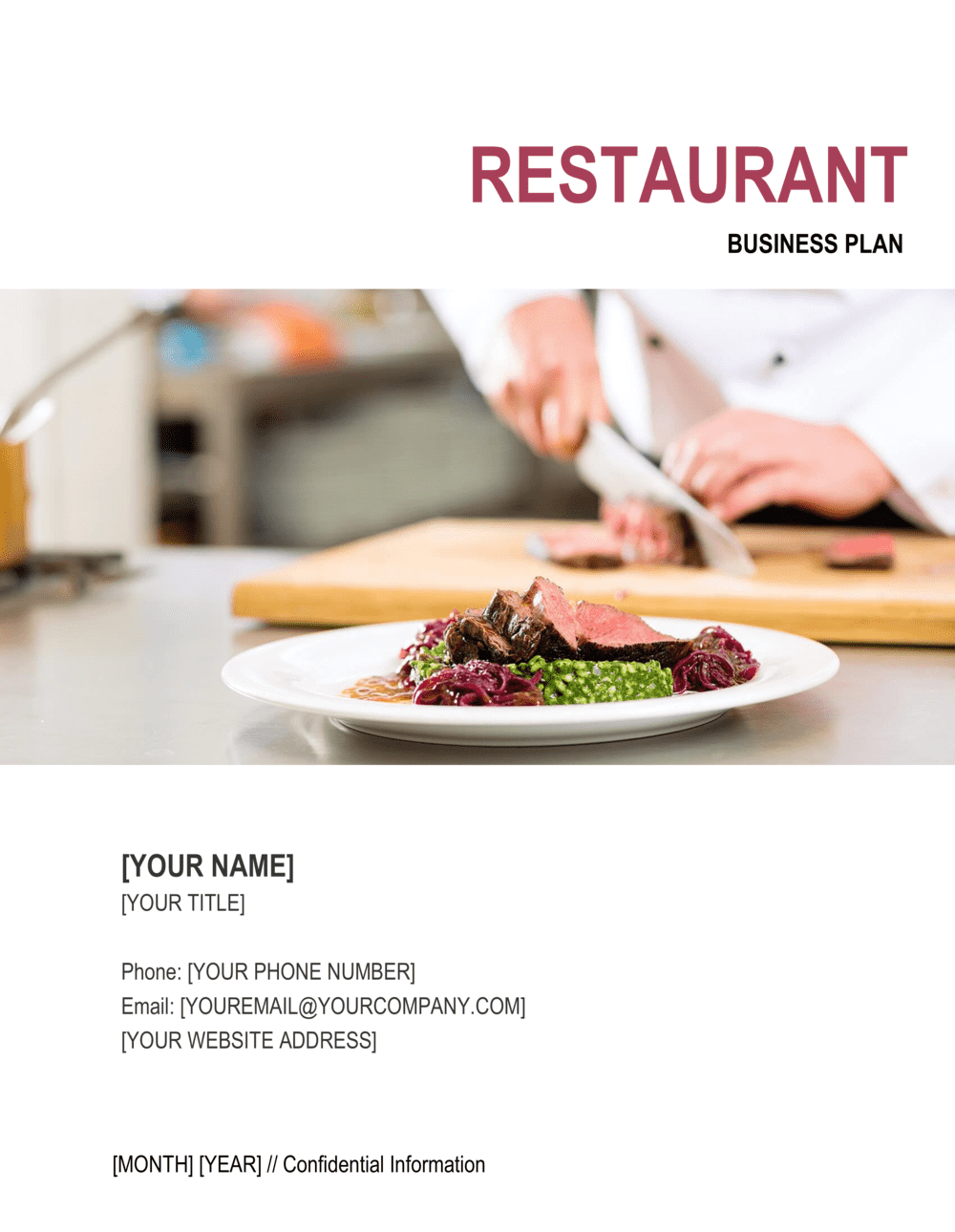
Restaurant Business Plan 3 Template

Free Word download β€’ Edit online β€’ Save & share with Drive β€’ Export to PDF

33 pagesβ€’2h 45m – 3h 40m to fillβ€’Difficulty: Expert
Learn more ↓
FreeRestaurant Business Plan 3 Template

At a glance

What it is
A Restaurant Business Plan is a structured document that maps your concept, target market, menu strategy, operations, staffing model, and 3-year financial projections into a single investor- and lender-ready file. This free Word download gives you a professionally formatted starting point you can edit online and export as PDF to present to banks, investors, landlords, or franchise partners.
When you need it
Use it when opening a new restaurant, expanding to a second location, converting an existing space, or applying for an SBA loan or private investment that requires a formal written plan.
What's inside
Executive summary, restaurant concept and mission, market and competitive analysis, menu overview, marketing and sales strategy, operations and staffing plan, and financial projections including startup costs, P&L, and cash flow β€” all organized in a logical sequence lenders and investors expect to see.

What is a Restaurant Business Plan?

A Restaurant Business Plan is a structured planning document that translates a food-service concept into a concrete operational and financial roadmap. It covers everything a lender, investor, or business partner needs to evaluate the opportunity: the concept and target customer, local market demand, competitive positioning, menu and pricing strategy, staffing model, and three years of financial projections built from covers-per-day and average-check assumptions. Unlike a general business plan, it incorporates hospitality-specific metrics β€” prime cost, food cost percentage, table turn rate, and ramp-up period cash flow β€” that are the real drivers of restaurant viability.

Why You Need This Document

Opening a restaurant without a written business plan is one of the fastest ways to exhaust startup capital before reaching a stabilized operating level. Banks and SBA lenders require a formal plan for any restaurant financing above $150,000 β€” and investors expect one before committing a dollar. Beyond capital raising, the planning process itself forces you to stress-test the assumptions that determine whether your concept is profitable: if your target food cost and labor cost together exceed 65% of projected revenue at realistic cover counts, no amount of marketing will fix the underlying unit economics. A completed restaurant business plan surfaces those problems on paper, where they cost nothing to fix, rather than in Month 4 of operations, where they can cost everything. This template gives you the structure to build that plan in a format lenders and investors recognize and trust.

Which variant fits your situation?

If your situation is…Use this template
Opening a full-service sit-down restaurantRestaurant Business Plan
Launching a fast-casual or quick-service conceptRestaurant Business Plan 3
Starting a food truck or mobile food businessFood Truck Business Plan
Opening a coffee shop or cafΓ©Coffee Shop Business Plan
Presenting to a bank or SBA lenderBank Loan Business Plan
Early-stage concept testing with minimal detailOne-Page Business Plan
Expanding an existing restaurant to a new marketBusiness Expansion Plan

Common mistakes to avoid

❌ Using national food-service statistics instead of local market data

Why it matters: Lenders and investors evaluate a specific location, not the national industry. National data tells them nothing about demand on your street corner.

Fix: Replace every national statistic with a local equivalent β€” neighborhood demographics, nearby competitor sales estimates, and local foot traffic data from tools like Placer.ai or the city's economic development office.

❌ Omitting a working capital reserve from startup costs

Why it matters: Most restaurants operate at a loss during the 3–6 month ramp-up period. Without a cash reserve, a slower-than-projected opening month triggers a cash crisis before the business has a chance to stabilize.

Fix: Add a minimum of three months of projected operating expenses as a working capital line item in startup costs β€” six months is safer for full-service concepts.

❌ Building revenue projections top-down from market share

Why it matters: Claiming 2% of a $50M local dining market sounds plausible on paper but gives lenders no basis to evaluate the underlying operating assumptions.

Fix: Build projections bottom-up: seats Γ— turn rate Γ— average check Γ— operating days = monthly revenue. Show each variable explicitly so lenders can stress-test the arithmetic.

❌ Attaching a full printed menu instead of a menu summary

Why it matters: A 40-item menu in the body of a business plan breaks the document's flow and buries the pricing strategy narrative in item names and descriptions.

Fix: Summarize the menu by category with item counts, price range, and food cost target in the body. Attach the full menu as Appendix A.

❌ Listing every marketing channel with no budget allocation

Why it matters: A marketing section that promises social media, PR, influencer campaigns, local events, and email without a dollar figure for each signals that the owner has not planned for these costs.

Fix: Assign a Year 1 marketing budget as a percentage of projected revenue (typically 3–6%) and allocate it explicitly across two to three primary channels.

❌ Presenting a staffing chart without corresponding payroll calculations

Why it matters: A staffing chart that lists eight FOH and five BOH staff looks complete until a lender multiplies those headcounts by local wage rates and discovers the labor cost exceeds 45% of projected revenue.

Fix: For every position in the staffing chart, include estimated weekly hours and wage rate. Sum to a weekly payroll figure and confirm it aligns with the labor cost percentage in the financial model.

The 9 key sections, explained

Executive Summary

Restaurant Concept and Mission

Market Analysis

Competitive Analysis

Menu Overview and Pricing Strategy

Marketing and Customer Acquisition Strategy

Operations and Staffing Plan

Financial Projections

Startup Costs and Funding Requirements

How to fill it out

  1. 1

    Define your concept and mission first

    Write a clear concept statement covering cuisine type, service style, ambiance, and target customer before filling in any other section. Every subsequent section should reinforce this core positioning.

    πŸ’‘ Test your concept statement on someone outside the restaurant industry β€” if they cannot picture the dining experience from your description, revise it.

  2. 2

    Conduct local market research

    Gather hyper-local data β€” neighborhood demographics from the US Census, foot traffic estimates from Google Maps or Placer.ai, and competitor average-check data from Yelp or OpenTable. Replace every national statistic with a local one.

    πŸ’‘ Visit each direct competitor at least twice before writing the competitive analysis. Note wait times, average check, and observable customer demographics.

  3. 3

    Build a preliminary menu with food cost calculations

    List your menu categories and 3–5 signature items with a raw food cost per plate calculated from current supplier pricing. Confirm your target food cost percentage is achievable before locking pricing.

    πŸ’‘ If your food cost on any signature item exceeds 38%, either renegotiate supplier terms or adjust the menu price before the plan is finalized.

  4. 4

    Model revenue from covers up, not market share down

    Estimate seats, projected table turn rate by meal period, and operating days per month. Multiply by your target average check to get monthly revenue. Build this for each of the first 12 months, starting at 40–60% of capacity and ramping to a stabilized level.

    πŸ’‘ Model a base case and a 70%-of-plan downside scenario. Lenders will apply a haircut to your projections β€” showing you've already stress-tested them signals financial credibility.

  5. 5

    Itemize every startup cost line by line

    Get real quotes for build-out, equipment, and FF&E rather than using round-number estimates. Add a 10–15% contingency buffer on top of your total. Include all license and permit fees specific to your city and state.

    πŸ’‘ Restaurant equipment costs are frequently underestimated by 20–30%. Get at least two competing vendor quotes for kitchen equipment before finalizing this section.

  6. 6

    Complete the staffing plan with wage assumptions

    List every position β€” FOH, BOH, and management β€” with estimated hours per week and wage rate. Calculate total weekly labor cost and confirm it falls within your target labor cost percentage at projected revenue.

    πŸ’‘ Check your city or state's minimum wage and any tip credit rules before setting FOH wage assumptions β€” these vary significantly and affect your labor model.

  7. 7

    Write the executive summary last

    Pull the single most compelling data point from each section β€” concept, market size, competitive advantage, and financial highlight β€” and compress them into one to two pages.

    πŸ’‘ Lenders and investors read the executive summary and the financial projections first. If those two sections are compelling, they read the rest. If not, they do not.

  8. 8

    Attach supporting documents as appendices

    Include a sample menu, letters of intent from suppliers or landlords, chef credentials, any existing traction data (catering revenue, food truck sales), and your full financial model spreadsheet.

    πŸ’‘ A signed letter of intent from the landlord β€” even a preliminary one β€” significantly strengthens an SBA loan application.

Frequently asked questions

What is a restaurant business plan?

A restaurant business plan is a structured document that defines your concept, target market, menu strategy, operations, staffing model, and financial projections β€” typically covering three years. It serves as both an internal roadmap for opening and operating the business and an external document for securing financing from banks, investors, or the SBA.

What sections should a restaurant business plan include?

A complete restaurant business plan covers nine core sections: executive summary, restaurant concept and mission, market analysis, competitive analysis, menu overview and pricing strategy, marketing and customer acquisition, operations and staffing plan, financial projections, and startup costs with funding requirements. Most complete plans run 20–30 pages plus a financial model appendix.

How long does it take to write a restaurant business plan?

First-time owners typically spend 30–60 hours over two to four weeks on a complete plan. The financial model β€” startup costs, monthly P&L, and cash flow β€” accounts for roughly half that time. Using a structured template reduces the formatting and structural work by about 50%, letting you focus time on the local market research and financial modeling that requires original data.

Do I need a business plan to get an SBA loan for a restaurant?

Yes. SBA lenders require a complete business plan for any restaurant startup loan, including the 7(a) and 504 programs. The plan must include financial projections with assumptions, a startup cost itemization, and evidence of the owner's relevant industry experience. A well-completed template is generally sufficient for loans under $500K; more complex applications may benefit from a consultant review.

What financial projections should a restaurant business plan include?

At minimum: a monthly P&L for Year 1 and annual P&L for Years 2 and 3, a cash flow statement on the same cadence, a startup cost schedule with funding sources, and a break-even analysis. The projections should be built from covers-per-day and average-check assumptions β€” not top-down market share estimates. Include a downside scenario at 70% of projected revenue.

What is a realistic food cost percentage for a restaurant?

The industry benchmark for food cost as a percentage of food revenue is 28–35% for most full-service and fast-casual restaurants. Fine dining may run 30–38% due to premium ingredients. Quick-service and fast-food concepts often target 25–30%. Beverage cost runs lower β€” typically 18–24% for beer and wine, and under 15% for spirits. Combined prime cost (food plus labor) should stay below 60–65% of total revenue to generate a viable operating margin.

How is a restaurant business plan different from a general business plan?

A restaurant business plan includes industry-specific sections and metrics that a general business plan does not β€” covers per day, table turn rate, food cost percentage, prime cost, seating capacity analysis, health permit and liquor license costs, and kitchen equipment itemization. The financial model is also built on hospitality-specific assumptions rather than generic revenue-per-employee or subscription metrics.

Can I use this template for a food truck or ghost kitchen?

Yes, with modifications. For a food truck, replace the seating and build-out sections with vehicle acquisition cost, commissary kitchen fees, and event permit strategy. For a ghost kitchen or delivery-only concept, the operations section focuses on order volume per hour, delivery platform commission rates (typically 15–30% of order value), and packaging costs rather than FOH staffing and table turn rates.

How do I estimate startup costs for a restaurant?

Break startup costs into six buckets: lease deposit and pre-opening rent (typically 3–6 months), build-out and renovation, kitchen equipment and FF&E, licenses and permits, initial food and beverage inventory, and working capital reserve. Get real vendor quotes for equipment and contractor bids for build-out rather than round-number estimates. Add a 10–15% contingency buffer. For a full-service restaurant in a US metro area, total startup costs typically range from $250,000 to $750,000 depending on the size and condition of the space.

How this compares to alternatives

vs General Business Plan

A general business plan covers any industry and uses generic revenue and cost structures. A restaurant business plan includes hospitality-specific sections β€” covers per day, food cost percentage, prime cost, kitchen equipment itemization, and liquor license costs β€” that a general template does not address. Use the restaurant-specific template for any food-service concept.

vs One-Page Business Plan

A one-page plan is a rapid-alignment tool for internal ideation or early-stage concept testing. It lacks the financial depth, market evidence, and operational detail that banks, investors, and landlords require. Use it to test the concept quickly, then build the full restaurant plan before approaching any capital source.

vs Restaurant Business Plan (Standard)

The standard Restaurant Business Plan template targets full-service sit-down concepts with detailed FOH operations and multi-course menu structures. Restaurant Business Plan 3 is structured for fast-casual, quick-service, or delivery-forward concepts where speed of service, order volume, and delivery platform economics are the primary operational variables.

vs Financial Projections Template

A standalone financial projections template produces the numbers without the surrounding market context, concept narrative, and operational plan. Lenders and investors never evaluate a financial model in isolation β€” they need the full plan to judge whether the revenue assumptions are credible. Use both: the business plan template for the narrative and the financial projections template for the detailed model appendix.

Industry-specific considerations

Full-service restaurants

Seating capacity, table turn rate, FOH-to-BOH staffing ratio, and liquor license costs are the primary drivers of plan complexity.

Fast-casual and quick-service

Higher volume per labor hour, lower average check, delivery platform integration, and simplified menu structure reduce food cost variance.

Food trucks and mobile concepts

Vehicle acquisition and wrap costs replace build-out, commissary kitchen fees are a recurring operational cost, and event permit strategy drives location revenue.

Ghost kitchens and delivery-only brands

Delivery platform commission rates (15–30%) must be modeled explicitly in the P&L β€” they materially compress margins compared to dine-in revenue.

Template vs pro β€” what fits your needs?

PathBest forCostTime
Use the templateFirst-time owners applying for SBA loans under $500K or presenting to local investorsFree2–4 weeks (30–60 hours)
Template + professional reviewConcepts requiring a detailed financial model review or experienced hospitality advisor input$500–$2,500 for a hospitality consultant or accountant review3–5 weeks
Custom draftedMulti-location concepts, franchise development plans, or raises above $1M from institutional investors$3,000–$10,000 for a professional restaurant business plan writer4–8 weeks

Glossary

Covers Per Day
The total number of individual meals or guest seatings served in a single operating day β€” a key restaurant revenue driver.
Average Check
The average amount a single guest or table spends per visit, calculated by dividing total revenue by the number of covers.
Food Cost Percentage
The cost of ingredients as a percentage of menu revenue; the industry target is typically 28–35% for full-service restaurants.
Labor Cost Percentage
Total wages and payroll taxes divided by revenue; most restaurants target a combined food and labor cost below 60–65% of sales.
Table Turn Rate
The number of times a table is occupied and vacated during a meal period β€” a higher rate increases revenue without adding seats.
Prime Cost
The sum of food cost and labor cost β€” the single most important operational metric for restaurant profitability.
COGS (Cost of Goods Sold)
All direct costs of producing the menu items sold, including food, beverages, and packaging for takeout or delivery.
Break-Even Point
The monthly revenue level at which total sales exactly equal total fixed and variable costs, producing zero profit or loss.
Concept Statement
A concise description of the restaurant's cuisine type, service style, ambiance, and target customer that anchors all other planning decisions.
Ramp-Up Period
The initial months after opening during which revenue grows from zero toward a stabilized operating level, typically 3–6 months.

Part of your Business Operating System

This document is one of 3,000+ business & legal templates included in Business in a Box.

  • Fill-in-the-blanks β€” ready in minutes
  • 100% customizable Word document
  • Compatible with all office suites
  • Export to PDF and share electronically

Create your document in 3 simple steps.

From template to signed document β€” all inside one Business Operating System.
1
Download or open template

Access over 3,000+ business and legal templates for any business task, project or initiative.

2
Edit and fill in the blanks with AI

Customize your ready-made business document template and save it in the cloud.

3
Save, Share, Send, Sign

Share your files and folders with your team. Create a space of seamless collaboration.

Save time, save money, and create top-quality documents.

β˜…β˜…β˜…β˜…β˜…

"Fantastic value! I'm not sure how I'd do without it. It's worth its weight in gold and paid back for itself many times."

Managing Director Β· Mall Farm
Robert Whalley
Managing Director, Mall Farm Proprietary Limited
β˜…β˜…β˜…β˜…β˜…

"I have been using Business in a Box for years. It has been the most useful source of templates I have encountered. I recommend it to anyone."

Business Owner Β· 4+ years
Dr Michael John Freestone
Business Owner
β˜…β˜…β˜…β˜…β˜…

"It has been a life saver so many times I have lost count. Business in a Box has saved me so much time and as you know, time is money."

Owner Β· Upstate Web
David G. Moore Jr.
Owner, Upstate Web

Run your business with a system β€” not scattered tools

Stop downloading documents. Start operating with clarity. Business in a Box gives you the Business Operating System used by over 250,000 companies worldwide to structure, run, and grow their business.

Start freeΒ Β·Β No credit card required