Conflicts Of Interest Policy Template

Free Word download β€’ Edit online β€’ Save & share with Drive β€’ Export to PDF

5 pagesβ€’25–30 min to fillβ€’Difficulty: Standard
Learn more ↓
FreeConflicts Of Interest Policy Template

At a glance

What it is
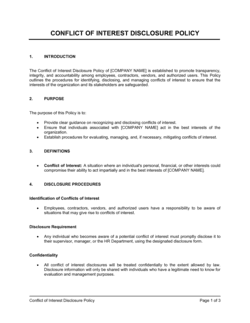
A Conflicts of Interest Policy is an internal governance document that defines what constitutes a conflict of interest, requires employees and directors to disclose actual or potential conflicts, and establishes a clear process for reviewing and resolving them. This free Word download gives you a complete, editable policy you can tailor to your organization and distribute to staff, board members, and contractors.
When you need it
Use it when onboarding new employees or board members, when applying for nonprofit tax-exempt status, or when formalizing governance practices for a growing organization that needs documented standards for ethical decision-making.
What's inside
A purpose and scope statement, definitions of conflict types, disclosure and recusal procedures, a review and investigation process, record-keeping requirements, and enforcement and disciplinary provisions β€” structured so every stakeholder knows their obligations.

What is a Conflicts of Interest Policy?

A Conflicts of Interest Policy is an internal governance document that defines what constitutes a conflict of interest, establishes an obligation for employees, directors, officers, and other covered persons to disclose actual, potential, or apparent conflicts, and creates a structured process for reviewing and resolving those situations. It works by removing conflicted individuals from the decisions they could improperly influence β€” through formal disclosure, recusal from related deliberations and votes, and documented review by an independent committee. Unlike a general code of conduct, a conflicts of interest policy is procedural: it tells covered persons exactly when to disclose, to whom, and what happens next.

Why You Need This Document

Without a written conflicts of interest policy, your organization has no consistent standard for identifying or managing situations where personal interests could override organizational ones β€” and no defensible record showing that decisions were made on the merits. For nonprofits, the absence of a formal policy is flagged on IRS Form 990 and can complicate or delay 501(c)(3) applications. For businesses with boards or investors, undisclosed conflicts in vendor selection, hiring, or contract awards expose the organization to litigation, voided transactions, and reputational damage. When a conflict surfaces after the fact β€” as they routinely do β€” the question regulators, auditors, and courts ask first is whether a policy existed and whether it was followed. This template gives you a complete, documented framework that answers both questions before they are ever asked.

Which variant fits your situation?

If your situation is…Use this template
Nonprofit organization seeking IRS 501(c)(3) status or completing Form 990Nonprofit Conflicts of Interest Policy
Publicly traded company with SEC disclosure obligationsCorporate Governance Conflicts of Interest Policy
Standalone form for annual employee disclosureConflict of Interest Disclosure Form
Government contractor or public-sector organizationGovernment Contractor Conflict of Interest Policy
Healthcare organization with physician self-referral concernsHealthcare Conflict of Interest Policy
University or research institution managing grant fundingResearch Conflict of Interest Policy
Procurement or purchasing department controlling vendor selectionProcurement Conflict of Interest Policy

Common mistakes to avoid

❌ Covering only employees and not board members

Why it matters: Board members vote on major financial decisions, vendor contracts, and executive compensation β€” the highest-stakes conflict scenarios. Excluding them from the policy leaves the organization's most consequential decisions unprotected.

Fix: Explicitly include all board members, officers, and committee members in the scope section, and require them to complete the same annual disclosure form as employees.

❌ No annual disclosure requirement

Why it matters: A one-time onboarding disclosure misses conflicts that arise mid-employment, such as a new ownership stake in a supplier or a family member joining a competing firm.

Fix: Add an annual disclosure trigger tied to a specific calendar date, and track completion centrally so the review committee can follow up on outstanding forms.

❌ Recusal from voting but not from discussion

Why it matters: A conflicted person who participates in deliberations before stepping out for the vote can still frame the decision, answer questions selectively, and shape the outcome β€” defeating the purpose of recusal.

Fix: Require the conflicted person to leave the room for the entire discussion, not just the vote, and document in the minutes that they were absent for deliberation.

❌ No named reporting channel for suspected violations

Why it matters: Employees who suspect a colleague has an undisclosed conflict rarely report it if the policy only says to 'notify management' β€” they fear direct retaliation or feel uncertain who to contact.

Fix: Name a specific officer (e.g., general counsel, board chair) and an alternative channel (e.g., anonymous ethics hotline) so employees have a concrete, accessible path to report concerns.

❌ Vague enforcement language with no named authority

Why it matters: Consequences listed as 'may result in disciplinary action' without a named decision-maker are perceived as unenforceable and are routinely ignored in practice.

Fix: Name the person or body with authority to impose each level of discipline β€” e.g., HR for employees, the board for officers β€” and tie disciplinary action to the employee handbook's existing procedures.

❌ No defined policy review schedule

Why it matters: An outdated policy that references defunct committees, incorrect thresholds, or superseded regulations creates confusion and can be challenged in enforcement proceedings.

Fix: Set a formal review interval β€” every one or two years β€” name the responsible reviewer, and print the effective date and next review date on the policy document itself.

The 10 key sections, explained

Purpose and policy statement

Scope and covered persons

Definition of conflicts of interest

Disclosure requirements and procedures

Recusal and abstention process

Review and determination process

Record-keeping requirements

Enforcement and disciplinary consequences

Whistleblower protection

Policy review and updates

How to fill it out

  1. 1

    Identify all covered persons

    Determine which categories of individuals the policy will cover β€” employees, board members, officers, contractors, and volunteers. List every category explicitly in the scope section.

    πŸ’‘ When in doubt about whether a category should be included, ask whether that person can influence a procurement, hiring, or financial decision. If yes, include them.

  2. 2

    Define conflict types with concrete examples

    Go beyond the abstract definition and list at least five specific scenarios β€” such as ownership in a vendor, a family member employed by a competitor, or receipt of gifts above a stated dollar threshold.

    πŸ’‘ Pull examples from situations your organization has actually encountered or that are common in your industry. Abstract definitions are ignored; relatable scenarios prompt disclosure.

  3. 3

    Set the disclosure timeline and frequency

    Specify three disclosure triggers: at onboarding, annually (tie to a specific date β€” e.g., January 31 each year), and within a short window of any new conflict arising (5 business days is common).

    πŸ’‘ Align the annual disclosure cycle with your fiscal year-end or board calendar so compliance reviews don't compete with other peak periods.

  4. 4

    Name the review committee and its authority

    Identify who reviews disclosures β€” a board audit committee, HR leadership, general counsel, or a named officer. State the committee's authority to approve, reject, or require recusal on conflicted transactions.

    πŸ’‘ For small organizations without a formal committee, designate at least two reviewers who must agree β€” single-person review creates its own conflict risk.

  5. 5

    Write the recusal procedure in step-by-step terms

    Describe exactly what a conflicted person must do: disclose before the meeting begins, leave the room, abstain from the vote, and not lobby other members. Describe how recusal is recorded in minutes.

    πŸ’‘ A one-paragraph recusal requirement is clearer than a general statement to 'step aside.' The more specific the procedure, the less room for ambiguous partial compliance.

  6. 6

    Specify record retention periods and custodians

    Name the person responsible for retaining disclosure forms and review records, and set a retention period of at least 7 years β€” matching most audit statute-of-limitations windows.

    πŸ’‘ Store signed disclosure forms in a location the review committee can access independently β€” not only in the HR file of the conflicted person.

  7. 7

    Add enforcement language with named authority

    State the range of disciplinary consequences and identify who has authority to impose each level β€” line manager for minor violations, the board for director violations.

    πŸ’‘ Cross-reference your employee handbook's disciplinary procedure to keep consequences consistent across policies.

  8. 8

    Distribute, collect acknowledgments, and set a review date

    Send the policy to all covered persons with an acknowledgment form. Record the review date on the policy document itself and schedule a calendar reminder for the next review cycle.

    πŸ’‘ Use a dated signature block β€” not just a checkbox β€” so acknowledgments hold up as evidence of receipt if a violation is later disputed.

Frequently asked questions

What is a conflicts of interest policy?

A conflicts of interest policy is an internal governance document that defines what constitutes a conflict of interest, requires covered persons to disclose actual, potential, or apparent conflicts, and establishes a process for reviewing and resolving them. It protects the organization from decisions that benefit individuals at the expense of the entity, and demonstrates to regulators, funders, and stakeholders that governance standards are in place.

Who needs a conflicts of interest policy?

Any organization whose employees, directors, or volunteers can influence financial decisions, vendor selection, or hiring should have one. Nonprofits seeking IRS 501(c)(3) status are effectively required to have one β€” the Form 990 asks directly whether the organization has such a policy. For-profit businesses with boards, investor relationships, or government contracts also benefit significantly from a formal written policy.

What is the difference between an actual, potential, and apparent conflict of interest?

An actual conflict exists when a person's private interest directly influences or has already influenced an organizational decision. A potential conflict exists when an interest could foreseeably affect future decisions. An apparent conflict is a situation that a reasonable outside observer would view as compromising impartiality, even if the person believes their judgment is unaffected. A well-drafted policy requires disclosure of all three types.

Is a conflicts of interest policy legally required?

No federal law mandates a conflicts of interest policy for private companies in most jurisdictions, but it is effectively required for nonprofits applying for or maintaining 501(c)(3) status β€” the IRS treats its absence as a governance red flag on Form 990. Publicly traded companies face related disclosure obligations under SEC rules. Government contractors, healthcare organizations, and universities may face sector-specific requirements that make a formal policy functionally mandatory.

How often should employees be required to complete a conflict of interest disclosure?

At a minimum, covered persons should disclose at onboarding and once per year thereafter, tied to a fixed calendar date. They should also be required to disclose within a short window β€” typically 5 business days β€” whenever a new conflict arises, regardless of where they are in the annual cycle. Organizations in high-risk sectors such as financial services or procurement often require semi-annual disclosure.

What happens when a conflict of interest is disclosed?

Once disclosed, a designated review committee evaluates whether the conflict is material and whether the proposed transaction or decision meets an arm's-length standard. The conflicted person is recused from all related discussions and votes. The committee documents its determination, and the record is retained with the original disclosure form. In most cases, a properly disclosed and managed conflict does not require voiding the transaction β€” the process itself is the safeguard.

Can a board member with a conflict of interest still participate in a vote?

No. A board member with a disclosed material conflict should leave the room entirely during deliberation and abstain from the vote, with their recusal noted in the meeting minutes. Allowing a conflicted director to participate β€” even only in discussion β€” can expose the organization to claims of self-dealing and, in nonprofits, to IRS intermediate sanctions for excess benefit transactions.

What should a conflict of interest disclosure form include?

The disclosure form should capture the covered person's name, role, and date; a description of the nature of the conflict or potential conflict; the names of any related parties involved; the estimated financial interest, if applicable; and a signature attesting that the disclosure is complete and accurate. It should be paired with an acknowledgment that the person has read and understood the full policy.

How does a conflicts of interest policy differ from a code of conduct?

A code of conduct is a broad statement of the organization's ethical values and behavioral expectations covering topics like honesty, respect, and professional conduct. A conflicts of interest policy is a narrower, procedural document focused specifically on disclosing and managing situations where personal interests could compromise organizational decision-making. Most organizations have both β€” the code of conduct sets the tone, and the conflicts policy operationalizes one specific aspect of it.

How this compares to alternatives

vs Code of Ethics

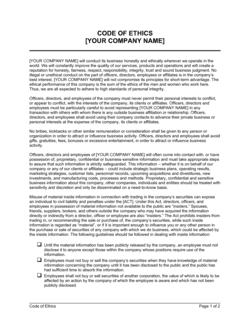
A code of ethics sets broad principles and values that guide all organizational behavior β€” honesty, fairness, accountability. A conflicts of interest policy is a narrower procedural document that operationalizes one specific ethical concern through required disclosure, recusal, and review steps. Most organizations need both: the code of ethics provides the framework; the conflicts policy delivers the mechanism.

vs Employee Handbook

An employee handbook covers the full range of employment policies β€” attendance, PTO, benefits, conduct, and more. A conflicts of interest policy is a standalone governance document that applies not just to employees but also to directors, officers, and contractors. Many organizations include a summary of the conflicts policy in the handbook and require employees to read the full standalone document separately.

vs Non-Disclosure Agreement

An NDA protects confidential information from being shared outside the organization. A conflicts of interest policy addresses a different risk β€” the misuse of organizational position or information for personal gain. Both are governance tools, but they target unrelated behaviors and should be used together rather than as substitutes.

vs Whistleblower Policy

A whistleblower policy governs how employees can report any suspected misconduct or policy violation and protects them from retaliation for doing so. A conflicts of interest policy defines the specific obligations around disclosure and recusal. Many conflicts policies include a brief whistleblower protection clause, but a standalone whistleblower policy provides more comprehensive reporting channels, anonymity protections, and investigation procedures.

Industry-specific considerations

Nonprofit organizations

IRS Form 990 asks whether the organization has a written conflicts policy; its absence is flagged as a governance deficiency and can complicate 501(c)(3) applications and renewals.

Financial services

Broker-dealers, investment advisers, and banks face SEC and FINRA requirements to identify and manage conflicts between firm interests and client interests, making a formal policy a regulatory baseline.

Healthcare

Physician self-referral laws (Stark Law) and anti-kickback statutes mean healthcare organizations must document conflicts between clinical decision-makers and entities they refer to or have ownership interests in.

Professional services

Law firms, accounting firms, and consultancies use conflicts policies to manage client conflicts β€” situations where advising one client could be adverse to another β€” which is both an ethical and a malpractice-liability concern.

Government and public sector

Public-sector procurement rules impose strict conflict requirements on officials involved in contract awards; a documented policy and disclosure process is typically mandated and audited.

Higher education and research

Universities receiving federal research grants must comply with PHS and NSF conflict-of-interest regulations requiring disclosure of significant financial interests by investigators β€” typically defined as interests exceeding $5,000.

Template vs pro β€” what fits your needs?

PathBest forCostTime
Use the templateSmall businesses, nonprofits completing Form 990, and organizations formalizing governance for the first timeFree1–2 hours
Template + professional reviewOrganizations with investor relationships, board members, or operating in regulated industries such as healthcare or financial services$300–$800 for a legal or compliance review2–5 business days
Custom draftedPublicly traded companies, federal contractors, or multi-entity organizations with complex related-party transaction structures$1,500–$5,000+1–3 weeks

Glossary

Conflict of Interest
A situation in which a person's private interests β€” financial, personal, or professional β€” could improperly influence their judgment or actions in their organizational role.
Disclosure
The act of formally informing the organization about an actual, potential, or perceived conflict of interest, typically through a written statement.
Recusal
The removal of an individual from participating in a discussion, vote, or decision where they have a disclosed conflict of interest.
Related Party
A person or entity with a close personal or financial connection to an employee or director β€” such as a spouse, family member, or company in which they hold an ownership stake.
Material Interest
A financial or other stake in a transaction or organization that is significant enough that a reasonable person would consider it capable of influencing judgment.
Arm's-Length Transaction
A deal negotiated between parties acting independently, without one party exerting undue influence over the other β€” the standard used to evaluate fairness in related-party dealings.
Review Committee
The designated body β€” often the board, an audit committee, or senior HR β€” responsible for evaluating disclosed conflicts and determining whether recusal or other action is required.
Whistleblower Protection
A provision preventing retaliation against employees who report suspected conflicts of interest or policy violations in good faith.
Annual Disclosure Requirement
An obligation for covered persons to complete and submit a conflict-of-interest disclosure statement at least once per year, regardless of whether a new conflict has arisen.
Apparent Conflict
A situation that would appear to a reasonable outside observer to compromise impartiality, even if the individual does not believe their judgment is actually affected.

Part of your Business Operating System

This document is one of 3,000+ business & legal templates included in Business in a Box.

  • Fill-in-the-blanks β€” ready in minutes
  • 100% customizable Word document
  • Compatible with all office suites
  • Export to PDF and share electronically

Create your document in 3 simple steps.

From template to signed document β€” all inside one Business Operating System.
1
Download or open template

Access over 3,000+ business and legal templates for any business task, project or initiative.

2
Edit and fill in the blanks with AI

Customize your ready-made business document template and save it in the cloud.

3
Save, Share, Send, Sign

Share your files and folders with your team. Create a space of seamless collaboration.

Save time, save money, and create top-quality documents.

β˜…β˜…β˜…β˜…β˜…

"Fantastic value! I'm not sure how I'd do without it. It's worth its weight in gold and paid back for itself many times."

Managing Director Β· Mall Farm
Robert Whalley
Managing Director, Mall Farm Proprietary Limited
β˜…β˜…β˜…β˜…β˜…

"I have been using Business in a Box for years. It has been the most useful source of templates I have encountered. I recommend it to anyone."

Business Owner Β· 4+ years
Dr Michael John Freestone
Business Owner
β˜…β˜…β˜…β˜…β˜…

"It has been a life saver so many times I have lost count. Business in a Box has saved me so much time and as you know, time is money."

Owner Β· Upstate Web
David G. Moore Jr.
Owner, Upstate Web

Run your business with a system β€” not scattered tools

Stop downloading documents. Start operating with clarity. Business in a Box gives you the Business Operating System used by over 250,000 companies worldwide to structure, run, and grow their business.

Start freeΒ Β·Β No credit card required