- Creditor
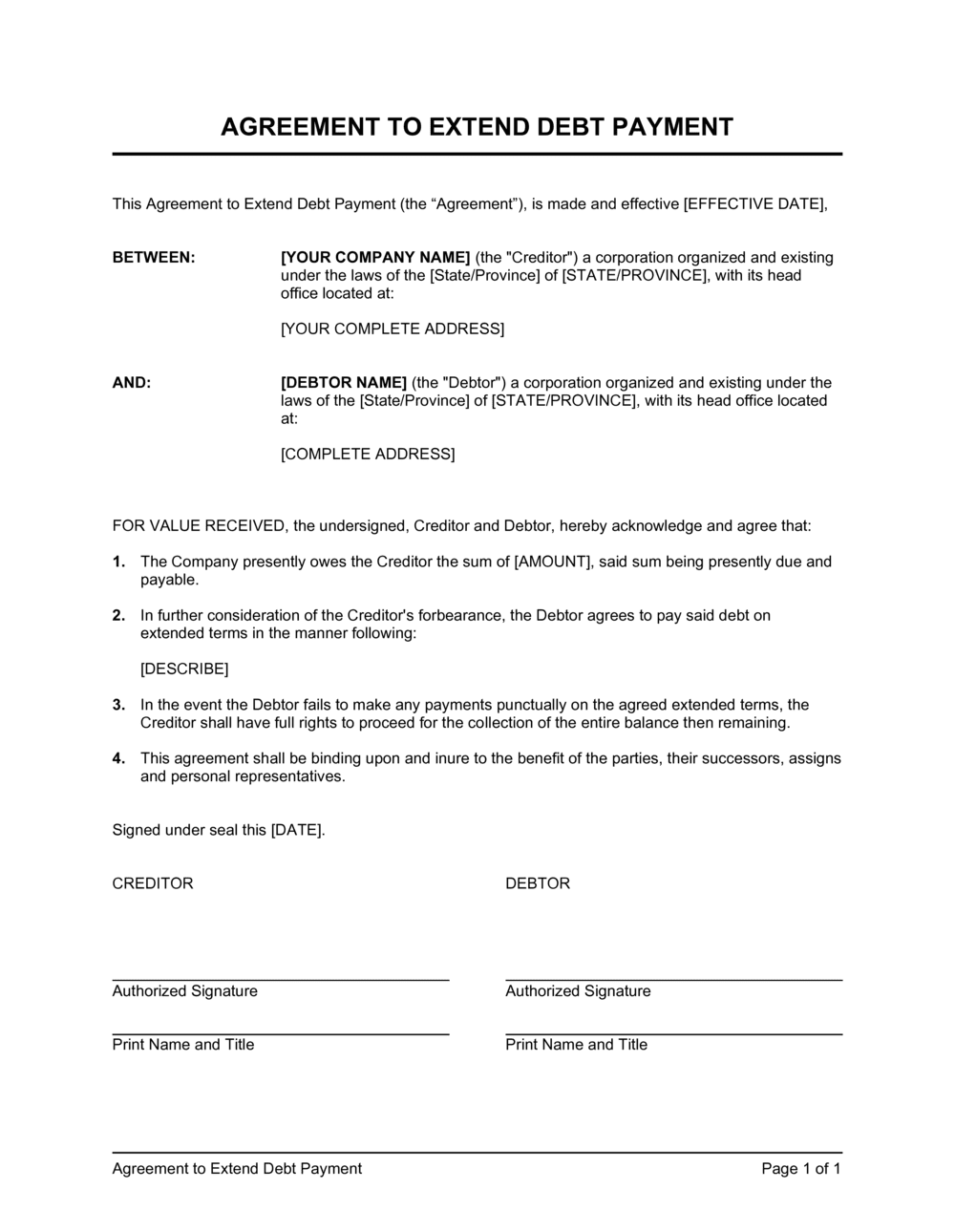
- The party owed money — the lender, supplier, or service provider who extended credit and is agreeing to the revised repayment terms.
- Debtor
- The party who owes money and is requesting or agreeing to the extension of the original payment deadline.
- Original Obligation
- The debt, loan, invoice, or promissory note that created the payment duty — its amount, date, and governing terms are referenced in the extension agreement.
- Extension Period
- The additional time granted beyond the original due date during which the debtor is permitted to repay without being in default.
- Maturity Date
- The new final date by which the entire outstanding balance must be repaid under the extended agreement.
- Forbearance
- The creditor's agreement to refrain from exercising its legal remedies — such as collection or suit — during the extension period.
- Default
- Failure to make a payment on time or to meet any other obligation in the agreement, triggering the creditor's right to demand immediate full repayment or pursue legal remedies.
- Acceleration Clause
- A provision that makes the entire remaining balance immediately due and payable upon a specified event — typically a missed payment or breach.
- Consideration
- Something of value exchanged by each party to make the agreement legally binding — in this context, the creditor's forbearance in exchange for the debtor's continued repayment commitment.
- Integration Clause
- A clause stating the written agreement is the complete and final record of the parties' understanding, replacing all prior oral or written negotiations about the debt modification.
- Waiver
- A voluntary relinquishment of a known right — for example, a creditor waiving a past default to allow the extension to take effect — which should be stated explicitly and narrowly.