Finder's Fee Agreement Template

Free Word download • Edit online • Save & share with Drive • Export to PDF

4 pages20–30 min to fillDifficulty: StandardSignature requiredLegal review recommended
Learn more ↓
FreeFinder's Fee Agreement Template

At a glance

What it is
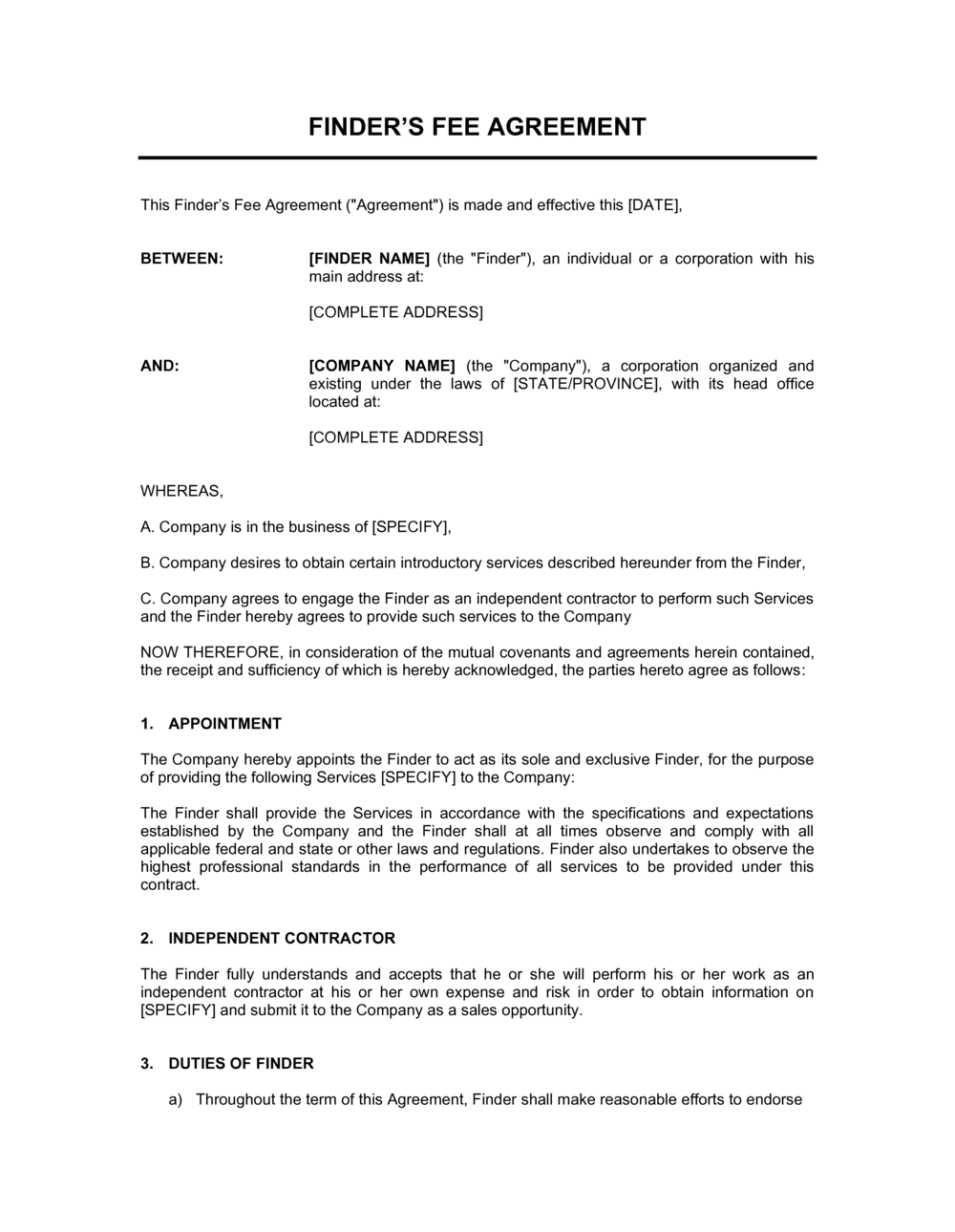
A Finder's Fee Agreement is a legally binding contract between a company and an individual or entity (the "finder") that compensates the finder for introducing a qualifying counterparty — such as an investor, acquirer, strategic partner, or customer — who goes on to complete a defined transaction. This free Word download covers fee structure, qualifying introduction criteria, payment trigger, exclusivity, term, and governing law in a concise document you can edit online and export as PDF.
When you need it
Use it before a finder makes any introduction on your behalf — once a deal closes without a signed agreement in place, fee disputes are difficult and expensive to resolve. It is equally essential when you are acting as the finder to ensure your compensation is contractually protected.
What's inside
Parties and recitals, scope of engagement and exclusivity, definition of a qualifying introduction, fee structure and calculation method, payment trigger and timing, representations on broker-dealer status, term and termination, confidentiality, and governing law and dispute resolution.

What is a Finder's Fee Agreement?

A Finder's Fee Agreement is a legally binding contract between a company and a finder — an individual or entity that introduces a qualifying counterparty such as an investor, acquirer, or high-value customer — entitling the finder to a defined fee if that introduction results in a completed transaction. The agreement specifies exactly which introductions qualify, how the fee is calculated (as a fixed amount or a percentage of transaction value), the event that triggers payment, how long the finder's rights survive after the agreement ends, and the representations each party makes about their regulatory status. It is distinct from a sales commission arrangement because the finder's obligation ends at the introduction — they have no ongoing role in negotiating or closing the deal.

Why You Need This Document

Without a signed finder's fee agreement in place before any introduction is made, both sides are exposed. For the company, an undocumented arrangement creates open-ended fee liability — courts in multiple jurisdictions have awarded substantial damages on implied-contract and unjust-enrichment theories when a deal closes and no written agreement governs the fee. For the finder, the absence of a written contract means compensation depends entirely on the company's goodwill once the deal is done, at which point the company's incentive to pay is at its lowest. Beyond the basic fee dispute risk, capital-raise arrangements involving securities carry broker-dealer registration considerations that can expose both the company and the finder to regulatory enforcement if not addressed explicitly in the agreement. This template provides the structural protections both parties need — qualifying introduction criteria, a payment trigger tied to closing, a tail period that protects the finder through slow-moving deals, and a broker-dealer representation that allocates regulatory risk clearly — in a document you can customize and execute in under an hour.

Which variant fits your situation?

If your situation is…Use this template
Finder introduces an equity investor to a startupFinder's Fee Agreement (Capital Raise)
Finder introduces a buyer to a business for saleBusiness Broker Agreement
Ongoing referral arrangement with a sales partnerReferral Agreement
Finder introduces customers rather than capital or acquirersSales Commission Agreement
Finder is also providing advisory services beyond introductionsAdvisory Board Agreement
Finder introduces a strategic licensing or distribution partnerStrategic Partnership Agreement
Company wants a mutual NDA in place before sharing deal detailsNon-Disclosure Agreement

Common mistakes to avoid

❌ No qualifying introduction definition

Why it matters: Without a clear definition, any contact the finder has ever mentioned — however tangentially — becomes grounds for a fee claim if a deal closes. This can result in multiple finders claiming fees on the same transaction.

Fix: Define a qualifying introduction as a first written introduction of a specific named counterparty, submitted by the finder to the company in writing on a specified date, where that counterparty was not previously known to the company.

❌ Omitting the broker-dealer representation

Why it matters: In the US, paying a fee to an unregistered finder for soliciting investors in securities transactions violates Section 15(a) of the Securities Exchange Act — exposing both parties to SEC enforcement, deal rescission rights for investors, and potential disgorgement of fees paid.

Fix: Include an explicit representation from the finder that they are not required to register as a broker-dealer, paired with an indemnification obligation that shifts regulatory liability to the finder if the representation is breached.

❌ No tail period after termination

Why it matters: A company can terminate the agreement one day before a deal closes with a party the finder introduced months earlier and owe nothing under the contract — leaving the finder with only an expensive and uncertain unjust enrichment claim.

Fix: Include a tail period of at least 12 months post-termination during which the finder is entitled to a fee on any transaction that closes with a counterparty they introduced during the active term.

❌ Undefined transaction value calculation base

Why it matters: When the agreement says the fee is X% of 'transaction value' without defining that term, disputes arise over whether to include escrowed funds, earnouts, rolled equity, or assumed liabilities — each of which can represent millions of dollars.

Fix: Define transaction value explicitly in the agreement, listing every component included and excluded. For acquisitions, state whether the base is equity value, enterprise value, or total consideration including assumed debt.

The 9 key clauses, explained

Parties and recitals

In plain language: Identifies the company and the finder as legal entities, states the date of the agreement, and sets out the commercial purpose — the finder will make introductions in exchange for a fee on qualifying transactions.

Sample language
This Finder's Fee Agreement ('Agreement') is entered into as of [DATE] between [COMPANY LEGAL NAME], a [STATE] [ENTITY TYPE] ('Company'), and [FINDER LEGAL NAME / INDIVIDUAL NAME] ('Finder'). The parties agree as follows.

Common mistake: Using a trade name instead of the registered legal entity name for either party. If the entity name on the agreement doesn't match the contracting party in the underlying transaction, enforcing the fee becomes complicated.

Scope of engagement and exclusivity

In plain language: Defines the type of introductions the finder is authorized to make — investor introductions, customer referrals, or acquisition targets — and whether the finder has exclusive rights in that category or geography.

Sample language
Finder is authorized to introduce potential [investors / acquirers / customers] to Company on a [non-exclusive / exclusive] basis during the Term. Exclusivity, if granted, is limited to [GEOGRAPHY / SECTOR] and does not restrict Company from pursuing opportunities sourced through its own efforts.

Common mistake: Granting broad exclusivity without geographic or category limits. An exclusive agreement with no boundaries can prevent the company from pursuing any deal without owing a fee, even for relationships it developed independently.

Definition of a qualifying introduction

In plain language: Specifies exactly what counts as an introduction that triggers fee eligibility — typically a first written introduction of a counterparty not already known to or in active discussions with the company.

Sample language
An introduction qualifies for a fee if: (a) Finder provides Company with the counterparty's name and contact details in writing; (b) the counterparty was not previously known to Company or in active discussions with Company as of the date of introduction; and (c) the introduction is the direct and proximate cause of the Transaction.

Common mistake: Omitting a 'previously known' carve-out. Without it, a finder can claim a fee on a deal the company was already pursuing independently, creating a dispute over causation that is expensive to litigate.

Fee structure and calculation

In plain language: States the fee as a fixed dollar amount or a percentage of transaction value, defines what constitutes the calculation base, and addresses tiered or capped structures where applicable.

Sample language
Company shall pay Finder a fee equal to [X]% of the Transaction Value, where Transaction Value means the aggregate [equity proceeds received / enterprise value / contract value] at closing. The fee is capped at $[AMOUNT] in any single transaction.

Common mistake: Using 'transaction value' without defining it. Whether deferred consideration, earnouts, or escrowed amounts are included in the base dramatically affects the fee — courts will not fill this gap favorably.

Payment trigger and timing

In plain language: Sets the specific event that makes the fee due and payable — typically the closing date of the transaction — and the number of days within which payment must be made after that trigger.

Sample language
The fee is due and payable within [10] business days of the closing of the Transaction. If Transaction Value is received in installments, Finder's fee shall be payable pro rata as each installment is received by Company.

Common mistake: Tying the payment trigger to 'receipt of funds' when the deal includes non-cash consideration such as stock or earnouts. Specify how non-cash components are valued and when the fee portion attributable to them is due.

Representations on broker-dealer status

In plain language: Requires the finder to represent that they are not required to be registered as a broker-dealer under applicable securities law, and shifts indemnification liability to the finder if that representation is false.

Sample language
Finder represents and warrants that Finder is not required to be registered as a broker-dealer under the Securities Exchange Act of 1934 or any applicable state or foreign securities law in connection with the activities contemplated by this Agreement. Finder shall indemnify Company for any losses arising from a breach of this representation.

Common mistake: Omitting this clause entirely in capital-raise agreements. US federal and state securities regulators have pursued enforcement actions against both finders and companies when unregistered finders solicited investors for compensation.

Term and termination

In plain language: Sets the duration of the agreement, the conditions under which either party may terminate early, and the tail period during which the finder retains fee rights after termination for previously made introductions.

Sample language
This Agreement commences on the Effective Date and continues for [12] months unless terminated earlier by either party on [30] days' written notice. Notwithstanding termination, Finder shall be entitled to a fee on any Transaction that closes within [12] months after termination with a counterparty introduced by Finder during the Term.

Common mistake: No tail period at all. Without one, a company can terminate the agreement the day before a deal closes with a finder-introduced party and owe nothing — courts have awarded damages in such cases, but only after costly litigation.

Confidentiality

In plain language: Obligates both parties to keep the terms of the agreement and any confidential information exchanged in the course of making introductions strictly private.

Sample language
Each party shall hold in strict confidence all Confidential Information received from the other party and shall not disclose it to any third party without prior written consent. 'Confidential Information' includes the existence and terms of this Agreement, financial data, and the identities of introduced counterparties.

Common mistake: Omitting the counterparty's identity from the definition of confidential information. Finders who disclose the names of introduced parties to competitors can undermine the deal and expose the company to liability.

Governing law and dispute resolution

In plain language: Specifies which jurisdiction's law governs the agreement and whether disputes are resolved by litigation, mediation, or binding arbitration.

Sample language
This Agreement is governed by the laws of [STATE / PROVINCE / COUNTRY], without regard to conflict of law principles. Any dispute shall be resolved by binding arbitration administered by [AAA / JAMS] in [CITY], except that either party may seek injunctive relief in any court of competent jurisdiction.

Common mistake: Choosing a governing law with no connection to where either party operates. Several jurisdictions apply local securities law to finder arrangements regardless of the contractual choice — a mismatch creates regulatory ambiguity.

How to fill it out

  1. 1

    Identify the parties with their legal entity names

    Enter the company's full registered name, entity type (LLC, Corp, Ltd.), and state or country of formation. Do the same for the finder — if an individual, use their full legal name; if a firm, use the registered entity name.

    💡 Check the finder's business registration before signing. Paying a fee to an unregistered entity the finder uses to avoid tax or regulatory obligations can create liability for the company.

  2. 2

    Define the scope and exclusivity clearly

    Specify exactly what type of introduction the finder is authorized to make — investor introductions for a specific funding round, acquisition targets in a defined sector, or customer referrals in a named territory. State whether the arrangement is exclusive or non-exclusive.

    💡 Non-exclusive is almost always preferable for the company. Reserve exclusivity only if the finder is making a substantial upfront investment of time or resources.

  3. 3

    Draft the qualifying introduction criteria

    List the precise conditions that must be met for an introduction to trigger fee eligibility: first written introduction, counterparty not previously known, and the introduction being the direct cause of the transaction. Include a process for the finder to register introductions in writing.

    💡 Require the finder to submit a brief written notice naming the counterparty within 48 hours of each introduction. This creates a timestamped record that resolves causation disputes.

  4. 4

    Set the fee percentage and calculation base

    Enter the fee percentage and define the exact base — total equity raised, enterprise value at closing, or contract value — being explicit about whether escrowed amounts, earnouts, and non-cash consideration are included.

    💡 For capital raises, 3–5% of proceeds is a common market range for finders without broker-dealer registration. Fees above 5% attract heightened regulatory scrutiny in most jurisdictions.

  5. 5

    Specify the payment trigger and mechanics

    State the precise closing event that makes the fee due and the number of business days within which payment must follow. For installment or earnout deals, define the pro-rata payment schedule.

    💡 Add a clause requiring the company to give the finder advance written notice of a closing date — at least 3 business days — so the finder can verify the calculation before funds are disbursed.

  6. 6

    Include the broker-dealer representation and indemnity

    Insert the finder's representation that they are not required to register as a broker-dealer and the indemnification clause that shifts regulatory liability to the finder if the representation turns out to be false.

    💡 If there is any doubt about the finder's regulatory status — particularly for capital-raise arrangements involving securities — consult a securities attorney before signing.

  7. 7

    Set the term and tail period

    Enter the agreement's duration (typically 6–18 months for a specific transaction process) and the tail period (typically 12 months post-termination). Confirm the termination notice requirement — 30 days is standard.

    💡 Match the tail period to the realistic deal timeline for your industry. M&A processes often run 12–18 months; a 6-month tail may leave the finder unprotected if the deal closes slowly.

  8. 8

    Execute before any introduction is made

    Both parties must sign the agreement before the finder makes any introduction. A finder who introduces a counterparty before the agreement is signed has no written contract to enforce, regardless of the outcome.

    💡 Use a timestamped e-signature tool to create an unambiguous record that execution preceded the first introduction. Store the fully executed copy immediately.

Frequently asked questions

What is a finder's fee agreement?

A finder's fee agreement is a contract between a company and an individual or firm (the finder) that compensates the finder for introducing a qualifying counterparty — such as an investor, acquirer, or customer — who goes on to complete a defined transaction. It specifies what counts as a qualifying introduction, the fee percentage or amount, the event that triggers payment, and how long the finder's rights last after the agreement ends. Without a signed agreement, fee disputes are resolved by courts interpreting implied contracts — an expensive and uncertain process for both sides.

What is a typical finder's fee percentage?

For capital raises involving equity investments, market practice in the US typically runs 3–5% of gross proceeds for finders without broker-dealer registration. For M&A transactions, the Lehman formula (5% on the first $1M, 4% on the second, 3% on the third, 2% on the fourth, and 1% thereafter) or a modified version is commonly referenced. Customer referral fees vary widely by industry — 5–15% of the first year's contract value is a common range for B2B software deals. All percentages are negotiable and should reflect the finder's contribution relative to the deal complexity.

Do finders need to be registered as broker-dealers in the US?

This is one of the most significant legal risks in finder arrangements involving securities. Under Section 15(a) of the Securities Exchange Act of 1934, any person who effects transactions in securities for compensation — including soliciting investors — must be registered as a broker-dealer with the SEC. Finders who do more than make a passive introduction and receive transaction-based compensation may trigger this requirement. The SEC has not created a formal exemption for finders, though there is a long history of no-action letters for narrowly scoped arrangements. Legal advice specific to the transaction is strongly recommended before engaging a finder for a capital raise involving securities.

What is a tail period and how long should it be?

A tail period is the time after the agreement's expiration or termination during which the finder retains the right to receive a fee if a transaction closes with a counterparty they introduced while the agreement was active. Without a tail, a company can terminate the agreement immediately before a deal closes and owe nothing. Tail periods of 12 months are standard for most transactions; M&A processes that routinely take 12–18 months to close may warrant an 18-month tail. The tail should be tied specifically to named counterparties introduced in writing during the active term.

What is the difference between a finder's fee agreement and a referral agreement?

The terms are often used interchangeably, but in practice a finder's fee agreement typically covers a one-time or limited-scope arrangement tied to a specific transaction — a funding round, an acquisition, or a large contract. A referral agreement is more commonly used for an ongoing commercial arrangement where one party continuously refers customers to another in exchange for a recurring commission or fee. The regulatory considerations also differ: finder arrangements involving securities transactions carry broker-dealer registration risk, while straightforward customer referral programs generally do not.

Can a finder's fee agreement be enforced if it isn't in writing?

In many jurisdictions, an oral agreement for a finder's fee may be enforceable as an implied or quasi-contract if the finder can prove the parties reached an agreement and the company was unjustly enriched. However, these claims are difficult and expensive to litigate, and courts apply varying standards of proof. Several US states require certain finder or brokerage agreements to be in writing to be enforceable. A signed written agreement is the only reliable protection for both the finder and the company.

Should a finder's fee agreement include a confidentiality clause?

Yes. The agreement itself and the identities of introduced counterparties are commercially sensitive — a finder who discloses the target's name to a competitor or a rival bidder can materially damage the transaction. A confidentiality clause should cover the existence and terms of the agreement, the identities of all counterparties introduced, and any financial or strategic information shared in the course of making introductions. If deeper information-sharing is anticipated, a separate mutual NDA signed before substantive discussions is advisable.

What happens if two finders both claim credit for the same introduction?

Competing finder claims arise when the company has multiple active finder agreements and two finders independently introduce the same counterparty, or when one finder argues their earlier contact causally led to the transaction. The best protection is a written registration process: require each finder to submit a written notice naming the counterparty immediately upon making an introduction, and maintain a dated log. The first registered written introduction for a given counterparty takes priority. Without this process, the company may face simultaneous fee claims from multiple finders on a single transaction.

Does a finder's fee agreement need to be notarized?

Notarization is not required for a finder's fee agreement to be enforceable in most jurisdictions. A signed agreement with dated signatures from both parties — including via qualified electronic signature — is generally sufficient. Some parties include a witness signature block as an additional authentication measure, particularly for high-value transactions, but this is a matter of preference rather than legal requirement in most cases.

How this compares to alternatives

vs Referral Agreement

A referral agreement is designed for ongoing, recurring customer referrals — one party continuously directs business to another in exchange for a commission on each resulting sale. A finder's fee agreement is typically scoped to a specific transaction type (a funding round, an acquisition, or a named contract), carries a defined term, and includes a tail period. Finder agreements also carry broker-dealer regulatory considerations that standard referral agreements do not.

vs Sales Commission Agreement

A sales commission agreement compensates a salesperson or agent for generating customer revenue on an ongoing basis — typically as a percentage of each closed sale. A finder's fee agreement compensates a third party for a specific introduction that leads to a single defined transaction. The finder is not a salesperson and typically has no ongoing involvement in closing the deal after the introduction.

vs Advisory Board Agreement

An advisory board agreement compensates an individual for providing ongoing strategic guidance, mentorship, and network access — often in exchange for equity. A finder's fee agreement is purely transactional: the finder is owed a fee only if a qualifying transaction closes, with no ongoing service obligation. If the finder is also expected to provide strategic advice, both agreements should be executed separately to avoid conflating the two obligations.

vs Non-Disclosure Agreement

An NDA protects confidential information exchanged between parties but creates no obligation to pay a fee or complete a transaction. A finder's fee agreement creates a binding payment obligation contingent on a qualifying introduction and a closed transaction. The two documents serve different purposes and are frequently executed together — the NDA before substantive information is shared, and the finder's fee agreement to govern the commercial arrangement.

Industry-specific considerations

Technology / SaaS

Finder introductions most commonly target venture capital and angel investors during pre-seed through Series B; broker-dealer registration risk is highest when the finder is actively soliciting investors rather than making passive introductions.

Real Estate

Finder's fees for introducing joint-venture equity partners or lenders to real estate developers are common, but must be distinguished from broker commissions regulated under state real estate licensing laws.

Mergers and Acquisitions

M&A finder arrangements typically use a modified Lehman formula on deal enterprise value, with a 12–18 month tail period to account for the extended timeline from introduction to close.

Financial Services

Finder arrangements in regulated financial services — banking, insurance, or investment management — face the most intense scrutiny; many jurisdictions require the finder to hold a financial intermediary or solicitor license, making legal review essential.

Jurisdictional notes

United States

The most significant US risk is broker-dealer registration under Section 15(a) of the Securities Exchange Act of 1934. Finders who solicit investors for compensation in securities transactions without registration face SEC enforcement. The SEC has not adopted a formal finder exemption, though the SEC has issued no-action guidance for narrowly scoped arrangements. State blue-sky laws impose additional requirements that vary significantly — California, New York, and Texas each have active securities enforcement programs. Legal counsel is strongly recommended for any finder arrangement involving the sale of securities.

Canada

In Canada, the registration requirement for finder activities involving securities is governed provincially. In Ontario, British Columbia, and most other provinces, a person who trades in securities or acts as an adviser for compensation must be registered under the applicable Securities Act. Narrow exemptions exist for isolated, non-recurring introductions, but the scope is fact-specific. Quebec applies civil law principles to fee agreements generally, requiring clear cause and object. Legal review is strongly recommended for capital-raise finders in any Canadian province.

United Kingdom

In the UK, arranging deals in investments for compensation is a regulated activity under the Financial Services and Markets Act 2000 (FSMA). Finders who go beyond passive introductions and begin arranging or facilitating investment transactions may require FCA authorization. The distinction between a mere introducer (generally unregulated) and an arranger (regulated) turns on the degree of active participation in the transaction. Post-Brexit, UK rules operate independently of EU requirements. Legal advice from an FCA-regulated solicitor is advisable before structuring any finder arrangement involving UK-regulated investments.

European Union

EU finder arrangements involving securities or investment products are subject to MiFID II, which requires firms providing investment services — including the reception and transmission of orders — to be authorized by the relevant national competent authority. The applicable rules vary by member state, with Germany (BaFin), France (AMF), and the Netherlands (AFM) among the most active regulators. For non-securities finder arrangements such as M&A introductions or commercial customer referrals, national contract law governs, and enforceability is generally straightforward. GDPR applies to any personal data exchanged in the introduction process.

Template vs lawyer — what fits your deal?

PathBest forCostTime
Use the templateCustomer referral arrangements and non-securities introductions with clear, straightforward fee structuresFree30–60 minutes
Template + legal reviewFinder introductions for equity capital raises, M&A targets, or any arrangement where broker-dealer status is a consideration$400–$9002–5 days
Custom draftedComplex or high-value M&A finder arrangements, regulated industry introductions, or cross-border transactions with multiple jurisdictions$2,000–$8,000+1–3 weeks

Glossary

Finder
The individual or entity that makes an introduction between the company and a potential counterparty and is entitled to a fee if the introduction results in a completed transaction.
Qualifying Introduction
An introduction that meets specific criteria defined in the agreement — typically a first written introduction of a counterparty not previously known to the company — that triggers fee eligibility if a deal closes.
Transaction
The specific event — closing of an investment round, signing of an acquisition agreement, or execution of a customer contract — that triggers the fee payment obligation.
Finder's Fee
The compensation paid to the finder, expressed as a fixed amount or a percentage of the transaction value, upon completion of a qualifying transaction.
Tail Period
A defined period after the agreement's expiration during which the finder remains entitled to a fee if a qualifying transaction closes with a party they introduced while the agreement was active.
Broker-Dealer Registration
A regulatory requirement under US federal securities law (Section 15 of the Exchange Act) to register with the SEC before soliciting investors or facilitating securities transactions for compensation.
Payment Trigger
The specific contractual milestone — such as the closing of a funding round or receipt of proceeds — at which the fee becomes due and payable.
Exclusivity
A clause granting the finder the sole right to make introductions in a defined category or territory, preventing the company from engaging other finders for the same purpose simultaneously.
Transaction Value
The aggregate consideration exchanged in a transaction — total equity raised, deal enterprise value, or contract value — used as the base for calculating a percentage-based finder's fee.
Indemnification
A contractual obligation by one party to compensate the other for losses arising from a breach of representations — commonly used to protect the company if the finder is found to require broker-dealer registration.

Part of your Business Operating System

This document is one of 3,000+ business & legal templates included in Business in a Box.

  • Fill-in-the-blanks — ready in minutes
  • 100% customizable Word document
  • Compatible with all office suites
  • Export to PDF and share electronically

Create your document in 3 simple steps.

From template to signed document — all inside one Business Operating System.
1
Download or open template

Access over 3,000+ business and legal templates for any business task, project or initiative.

2
Edit and fill in the blanks with AI

Customize your ready-made business document template and save it in the cloud.

3
Save, Share, Send, Sign

Share your files and folders with your team. Create a space of seamless collaboration.

Save time, save money, and create top-quality documents.

★★★★★

"Fantastic value! I'm not sure how I'd do without it. It's worth its weight in gold and paid back for itself many times."

Managing Director · Mall Farm
Robert Whalley
Managing Director, Mall Farm Proprietary Limited
★★★★★

"I have been using Business in a Box for years. It has been the most useful source of templates I have encountered. I recommend it to anyone."

Business Owner · 4+ years
Dr Michael John Freestone
Business Owner
★★★★★

"It has been a life saver so many times I have lost count. Business in a Box has saved me so much time and as you know, time is money."

Owner · Upstate Web
David G. Moore Jr.
Owner, Upstate Web

Run your business with a system — not scattered tools

Stop downloading documents. Start operating with clarity. Business in a Box gives you the Business Operating System used by over 250,000 companies worldwide to structure, run, and grow their business.

Free Forever Plan · No credit card required