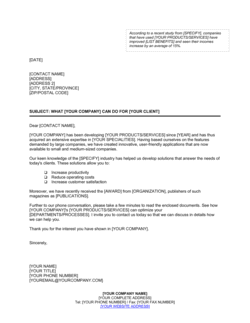
Letter For Business Proposal Template

Free Word download β€’ Edit online β€’ Save & share with Drive β€’ Export to PDF

2 pagesβ€’20–25 min to fillβ€’Difficulty: Standard
Learn more ↓
FreeLetter For Business Proposal Template

At a glance

What it is
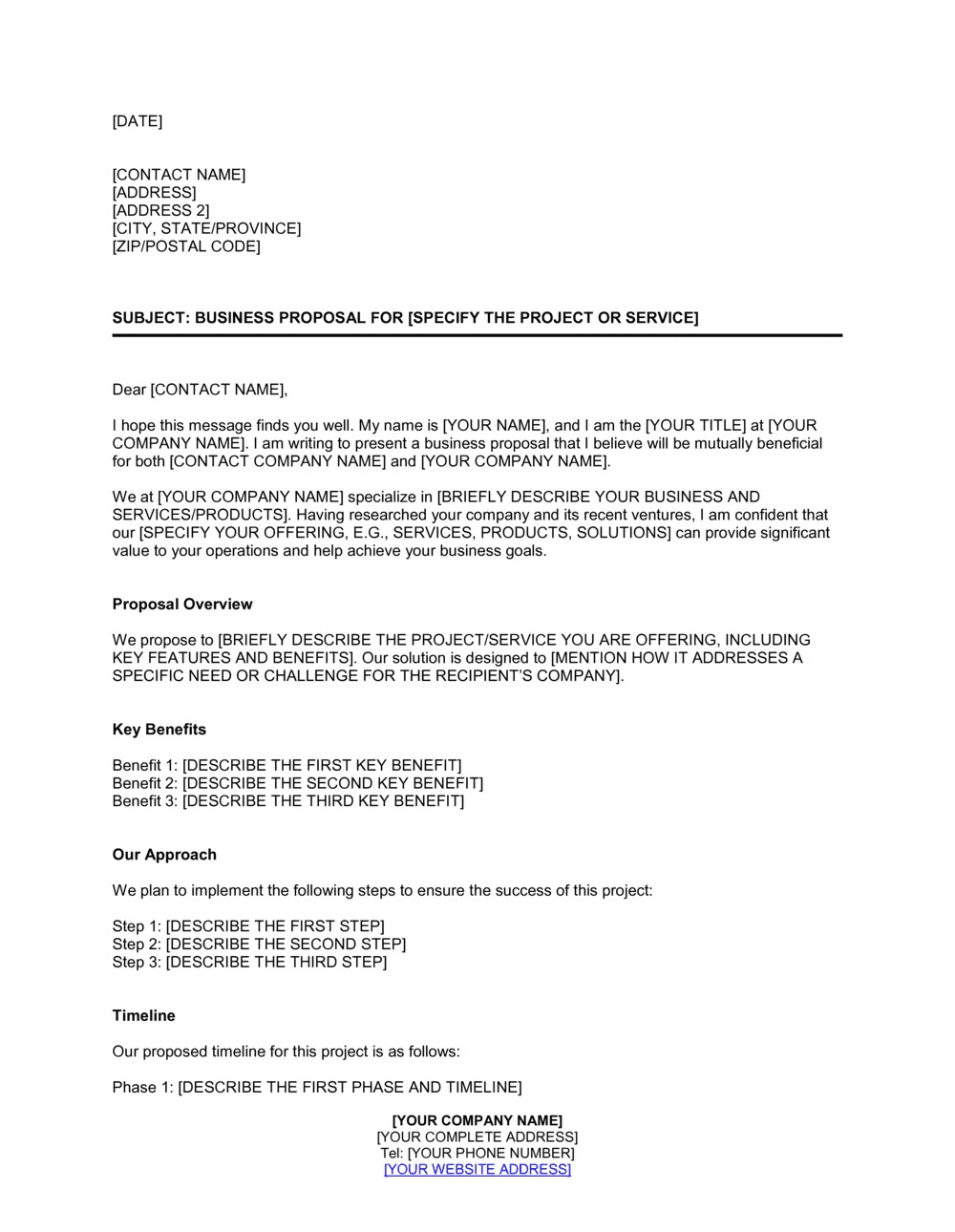
A Letter for Business Proposal is a short formal letter that introduces a business offer or partnership opportunity to a prospective client, partner, or investor. This free Word download gives you a structured, professional starting point you can edit online and export as PDF to accompany a full proposal package or stand alone as an initial outreach.
When you need it
Use it when approaching a new client with a service or product offer, when pitching a joint venture to a potential partner, or when submitting a formal proposal in response to a request for proposal (RFP). It sets a professional tone before the detailed document is reviewed.
What's inside
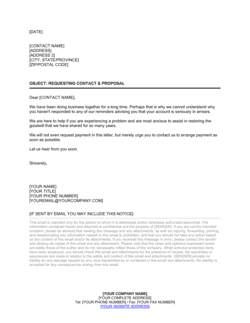
Sender and recipient contact details, a professional salutation, an opening that states the purpose, a body that summarizes the offer and its key benefits, a call to action inviting a meeting or response, and a formal closing with the sender's name and title.

What is a Letter for Business Proposal?

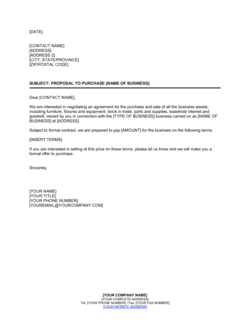
A Letter for Business Proposal is a formal one-page business letter that introduces a specific offer, service, or partnership opportunity to a prospective client, partner, or investor. It opens with the recipient's need, presents the sender's proposed solution and its measurable benefit, cites supporting evidence, and closes with a clear call to action. Unlike a casual email or a generic introduction, a proposal letter creates a professional first impression and frames the detailed proposal document that typically accompanies it β€” ensuring the recipient understands the offer before reviewing the full submission.

Why You Need This Document

A strong proposal sent without a covering letter often goes unread or gets misrouted through a buying organization's approval chain. Decision-makers receive dozens of unsolicited proposals; a well-structured letter that leads with their problem, summarizes your solution in concrete terms, and names a specific follow-up date gives your submission a dramatically higher chance of being reviewed. Without it, even a compelling proposal sits unopened because no one has been told why they should read it or what to do next. This template gives you a consistent, professional format that adapts to any industry or opportunity β€” so every proposal you send makes the right first impression from the first line.

Which variant fits your situation?

If your situation is…Use this template
Submitting a detailed written proposal alongside this letterBusiness Proposal
Responding formally to a request for proposal (RFP)Request for Proposal Response Letter
Proposing a joint venture or strategic partnershipJoint Venture Proposal
Introducing your company to a prospective client for the first timeBusiness Introduction Letter
Following up after a proposal has been submittedFollow-Up Letter After Proposal Submission
Proposing a new service or product to an existing clientUpsell or Service Expansion Letter
Seeking investor funding with a formal letter of intentLetter of Intent

Common mistakes to avoid

❌ Opening with company history instead of the recipient's problem

Why it matters: Decision-makers receive dozens of proposal letters weekly. A first paragraph about your founding year and office locations gets the letter closed before the offer is even stated.

Fix: Lead with a one-sentence statement of the recipient's challenge or goal, then introduce your company as the solution in the second sentence.

❌ No specific call to action

Why it matters: Ending with 'please feel free to reach out' places all momentum on the recipient and results in no response even when the offer is strong.

Fix: Specify a next step β€” a 30-minute call, a proposal review meeting β€” and name a follow-up date so the conversation does not stall.

❌ Sending to the wrong contact

Why it matters: A letter addressed to a department head when purchasing decisions sit with the CFO or VP of Operations gets forwarded at best and ignored at worst, adding weeks of delay.

Fix: Research the actual decision-maker for the type of purchase you are proposing before sending. When in doubt, address both the functional contact and the budget holder.

❌ Vague offer with no numbers or timeline

Why it matters: A letter that describes services in general terms without pricing, deliverables, or a timeline gives the recipient nothing concrete to evaluate or approve.

Fix: Include at minimum a price range, a key deliverable, and a projected completion timeframe β€” even rough figures give the recipient a basis to move forward.

The 9 key clauses, explained

Sender and recipient header

In plain language: The letterhead block with the sender's full name, title, company, address, and date, followed by the recipient's name, title, organization, and address.

Sample language
[YOUR NAME] | [YOUR TITLE] | [COMPANY NAME] | [ADDRESS] | [DATE] [RECIPIENT NAME] | [RECIPIENT TITLE] | [RECIPIENT COMPANY] | [RECIPIENT ADDRESS]

Common mistake: Using a personal email address or informal address block instead of official letterhead details β€” this undermines credibility before the recipient reads a single sentence.

Subject line

In plain language: A one-line heading that tells the reader exactly what the letter is about, placed after the salutation in formal business style.

Sample language
Re: Proposal for [SERVICE / PRODUCT] β€” [COMPANY NAME]

Common mistake: Leaving the subject line blank or writing something generic like 'Business Proposal' with no context β€” specific subject lines get opened and filed correctly; vague ones get ignored.

Salutation

In plain language: A personalized formal greeting addressing the decision-maker by name and title.

Sample language
Dear Ms. [LAST NAME],

Common mistake: Using 'To Whom It May Concern' when the recipient's name is discoverable β€” it signals you did no research and reduces the chance of a response.

Opening β€” purpose and context

In plain language: The first paragraph states who you are, how you learned of the opportunity, and the specific purpose of the letter in one to two sentences.

Sample language
I am writing on behalf of [COMPANY NAME] to present a proposal for [SPECIFIC SERVICE / SOLUTION] that we believe will address [RECIPIENT COMPANY]'s need for [STATED NEED OR CHALLENGE].

Common mistake: Opening with a lengthy company history rather than the recipient's problem β€” decision-makers stop reading when the first paragraph is about you, not them.

Value proposition and offer summary

In plain language: The body paragraph that summarizes what you are offering, the specific benefit it delivers, and why your company is positioned to deliver it.

Sample language
[COMPANY NAME] has [RELEVANT EXPERIENCE / CREDENTIAL] and proposes to deliver [SPECIFIC DELIVERABLE] within [TIMEFRAME] at a fee of [PRICE OR PRICE RANGE]. Our approach will enable [RECIPIENT COMPANY] to achieve [MEASURABLE OUTCOME].

Common mistake: Listing features and capabilities without connecting them to a measurable outcome for the recipient β€” generic capability statements do not differentiate the offer.

Supporting evidence or differentiator

In plain language: One to two sentences citing a relevant client result, case study, credential, or specific differentiator that makes the offer credible and distinctive.

Sample language
We recently delivered [SIMILAR PROJECT] for [CLIENT TYPE], resulting in [QUANTIFIED RESULT] within [TIMEFRAME]. [COMPANY NAME] is also [CERTIFICATION / AWARD / DISTINCTION] in [RELEVANT AREA].

Common mistake: Omitting this paragraph entirely β€” without at least one proof point, the value proposition is an unsubstantiated claim that sophisticated buyers discount immediately.

Call to action

In plain language: A specific, actionable request that tells the recipient exactly what to do next and by when β€” schedule a call, review the attached proposal, or reply by a date.

Sample language
I would welcome the opportunity to discuss this proposal in a 30-minute call at your convenience. I will follow up on [SPECIFIC DATE] if I have not heard from you. You may also reach me directly at [PHONE / EMAIL].

Common mistake: Ending with a passive phrase like 'Please feel free to contact us if interested' β€” this places the entire burden on the recipient and dramatically lowers response rates.

Complimentary close and signature block

In plain language: The formal sign-off, sender's handwritten or electronic signature, printed name, title, and contact information.

Sample language
Sincerely, [SIGNATURE] [YOUR NAME] [YOUR TITLE] [PHONE] | [EMAIL]

Common mistake: Omitting the title and direct contact details from the signature block β€” leaving only a name makes it harder for the recipient to route a reply to the right person.

Enclosure or attachment notation

In plain language: A line at the bottom of the letter indicating that a proposal, brochure, or other document is attached.

Sample language
Encl: Business Proposal β€” [PROJECT / SERVICE NAME]

Common mistake: Referencing an attachment in the letter body but omitting the enclosure line β€” recipients who receive a printed version have no record that a document was meant to accompany the letter.

How to fill it out

  1. 1

    Add your letterhead and the recipient's details

    Enter your full name, title, company name, address, and the date at the top. Then add the recipient's name, title, organization, and mailing or email address.

    πŸ’‘ Verify the recipient's exact title on LinkedIn or the company website before sending β€” an incorrect title signals you did not do basic research.

  2. 2

    Write a specific subject line

    Insert a subject line after the salutation that names the specific service, product, or project and your company β€” for example, 'Re: Digital Marketing Services Proposal β€” Acme Agency.'

    πŸ’‘ Subject lines that include the recipient's company name outperform generic lines in open and response rates.

  3. 3

    Craft the opening paragraph around the recipient's need

    State who you are and why you are writing in the context of a problem or opportunity the recipient faces β€” not a history of your company.

    πŸ’‘ Reference a specific trigger for the outreach β€” an RFP, a mutual introduction, or a recent announcement by the recipient's company β€” to make the letter feel timely rather than generic.

  4. 4

    Summarize the offer with a concrete outcome

    In one short paragraph, describe what you are proposing, the expected deliverable, the timeline, and the price or price range. End with the measurable result the recipient will achieve.

    πŸ’‘ Use specific numbers wherever possible β€” '20% reduction in processing time' is more persuasive than 'significant efficiency gains.'

  5. 5

    Add one proof point or differentiator

    Include a single sentence citing a relevant client result, certification, or credential that supports your claim. Keep it concise β€” one strong example outweighs a list of vague assertions.

    πŸ’‘ If you cannot share a client name, describe the result by industry and company size β€” 'a mid-sized logistics firm with 200 employees' is still credible.

  6. 6

    State a clear call to action with a follow-up date

    Tell the recipient exactly what to do next β€” schedule a call, review the attached proposal, or reply by a specific date. Name a follow-up date so the conversation stays moving.

    πŸ’‘ Offering two specific meeting time slots in the CTA reduces the back-and-forth and increases the chance of booking a call.

  7. 7

    Proofread, add the enclosure line, and export

    Check names, titles, and figures for accuracy. Add the enclosure notation if a proposal document is attached. Export as PDF before sending to preserve formatting.

    πŸ’‘ Read the letter aloud before sending β€” awkward phrasing and missing words are easier to catch when spoken than when scanned silently.

Frequently asked questions

What is a letter for a business proposal?

A letter for a business proposal is a formal one-page letter that introduces a business offer, partnership opportunity, or service recommendation to a prospective client or partner. It summarizes the value of the offer, establishes the sender's credibility, and invites the recipient to review a full proposal or schedule a follow-up conversation. It typically accompanies a detailed proposal document rather than replacing it.

What should a business proposal letter include?

A complete business proposal letter includes the sender and recipient contact details, a specific subject line, a personalized salutation, an opening that frames the recipient's need, a body paragraph summarizing the offer and its measurable outcome, a supporting proof point or differentiator, a clear call to action with a follow-up date, a professional close and signature block, and an enclosure line if a proposal document is attached.

How long should a business proposal letter be?

One page is the standard length for a business proposal letter β€” typically three to five short paragraphs. Decision-makers rarely read beyond a single page for an introductory letter. If you need more space to explain the offer, put the detail in the attached proposal and keep the letter focused on the problem, the offer summary, and the next step.

Is a business proposal letter the same as a business proposal?

No. A business proposal letter is a short formal cover letter that introduces the offer and sets the tone. A business proposal is the full document β€” often 5–30 pages β€” that provides market context, detailed scope, methodology, pricing, timelines, and terms. The letter is typically the first thing the recipient reads; the proposal is the diligence document they review before making a decision.

Should a business proposal letter be signed?

A signature is not legally required for a business proposal letter to be effective, but including one β€” handwritten or electronic β€” adds professionalism and makes the communication feel personal rather than templated. For high-value opportunities or formal RFP responses, a signed letter signals that a senior person in your organization has personally reviewed and endorsed the submission.

How do I make a business proposal letter stand out?

Lead with the recipient's specific problem or goal rather than your company history. Use one concrete proof point β€” a relevant client result with a number β€” to support your value claim. State a specific call to action with a follow-up date rather than a passive invitation to contact you. Personalize the subject line with the recipient's company name. These four adjustments consistently produce higher response rates than generic templates.

Can I use this letter template for an RFP response?

Yes. Address it to the named contact in the RFP, reference the RFP number or title in the subject line, and adapt the value proposition paragraph to directly address the evaluation criteria listed in the RFP. The enclosure line should reference the full proposal document you are submitting. Many RFPs specify a cover letter format β€” check the instructions and adjust the template accordingly.

What tone should a business proposal letter use?

Formal but direct. Avoid overly stiff language that feels bureaucratic, but do not use casual or conversational phrasing in a formal submission. Write in active voice, keep sentences under 25 words, and avoid filler phrases like 'we are pleased to submit' or 'please do not hesitate to contact us' β€” these add length without adding meaning.

How this compares to alternatives

vs Business Proposal

A business proposal is a full document β€” often 5–30 pages β€” covering scope, methodology, pricing, timelines, and terms. A proposal letter is a one-page introduction that frames the offer and invites the recipient to review the proposal. The letter gets the proposal read; the proposal closes the deal. Most submissions require both.

vs Letter of Introduction

A letter of introduction presents your company or a colleague without making a specific offer. A business proposal letter makes a concrete, scoped offer with a value proposition and a call to action. Use an introduction letter for first-contact relationship building; use a proposal letter when you have a specific opportunity to pitch.

vs Letter of Intent

A letter of intent signals a serious intention to enter a transaction or partnership and often outlines preliminary terms β€” it carries more legal weight than a proposal letter. A business proposal letter is a sales document, not a binding commitment. Use a letter of intent after both parties have agreed in principle; use a proposal letter to open the conversation.

vs Cover Letter for a Proposal

A cover letter for a proposal is a brief transmittal note β€” often two to three sentences β€” that accompanies a formal proposal submission in an RFP process. A business proposal letter is a fuller persuasive document that can stand alone as an outreach tool. The cover letter transmits; the proposal letter sells.

Industry-specific considerations

Professional Services

Consultants and agencies use this letter to introduce a scoped engagement, reference a relevant client outcome, and invite a discovery call before submitting a full statement of work.

Construction and Trades

Contractors submit a formal proposal letter with each bid, summarizing the project scope, estimated timeline, and licensing credentials before the detailed quote is reviewed.

Technology / SaaS

Sales teams use proposal letters to frame a software solution around the prospect's specific operational pain point before attaching a detailed pricing and implementation proposal.

Nonprofit and Education

Nonprofit executives address proposal letters to corporate sponsors or foundations, connecting the partnership offer to the funder's stated community or ESG priorities.

Template vs pro β€” what fits your needs?

PathBest forCostTime
Use the templateSmall businesses, freelancers, and sales teams sending standard service or product proposalsFree15–30 minutes per letter
Template + professional reviewHigh-value opportunities, RFP submissions, or proposals to enterprise or government clients$50–$200 for a copywriter or business writing review1–2 hours
Custom draftedStrategic partnerships, major contract bids, or proposals requiring legal or technical precision$300–$1,000+ for a professional proposal writer1–3 days

Glossary

Business Proposal Letter
A formal letter that introduces a business offer or opportunity and invites the recipient to review the accompanying proposal or arrange a follow-up discussion.
RFP (Request for Proposal)
A formal document issued by a buyer or organization inviting vendors to submit detailed proposals for a product or service.
Value Proposition
A concise statement of the specific benefit your offer delivers to the recipient and why it is preferable to alternatives.
Call to Action (CTA)
A specific, time-bound request at the end of the letter that tells the recipient exactly what to do next β€” schedule a call, reply by a date, or review an attached document.
Salutation
The formal greeting that opens the letter, addressing the recipient by name and title β€” for example, 'Dear Ms. [LAST NAME]'.
Enclosure Line
A notation at the bottom of the letter β€” 'Encl: Business Proposal' β€” indicating that additional documents accompany the letter.
Subject Line
A brief heading placed between the salutation and the opening paragraph that states the topic of the letter, helping the reader route and file it quickly.
Complimentary Close
The formal sign-off phrase before the sender's signature β€” 'Sincerely,' 'Respectfully yours,' or 'Best regards' β€” calibrated to the formality of the relationship.
Letterhead
Pre-formatted header on business correspondence showing the company name, logo, address, phone, and website β€” used to establish credibility at a glance.
Executive Summary (in a letter)
A one- to two-sentence distillation of the entire proposal, placed in the opening paragraph so a time-pressed reader grasps the offer without reading further.

Part of your Business Operating System

This document is one of 3,000+ business & legal templates included in Business in a Box.

  • Fill-in-the-blanks β€” ready in minutes
  • 100% customizable Word document
  • Compatible with all office suites
  • Export to PDF and share electronically

Create your document in 3 simple steps.

From template to signed document β€” all inside one Business Operating System.
1
Download or open template

Access over 3,000+ business and legal templates for any business task, project or initiative.

2
Edit and fill in the blanks with AI

Customize your ready-made business document template and save it in the cloud.

3
Save, Share, Send, Sign

Share your files and folders with your team. Create a space of seamless collaboration.

Save time, save money, and create top-quality documents.

β˜…β˜…β˜…β˜…β˜…

"Fantastic value! I'm not sure how I'd do without it. It's worth its weight in gold and paid back for itself many times."

Managing Director Β· Mall Farm
Robert Whalley
Managing Director, Mall Farm Proprietary Limited
β˜…β˜…β˜…β˜…β˜…

"I have been using Business in a Box for years. It has been the most useful source of templates I have encountered. I recommend it to anyone."

Business Owner Β· 4+ years
Dr Michael John Freestone
Business Owner
β˜…β˜…β˜…β˜…β˜…

"It has been a life saver so many times I have lost count. Business in a Box has saved me so much time and as you know, time is money."

Owner Β· Upstate Web
David G. Moore Jr.
Owner, Upstate Web

Run your business with a system β€” not scattered tools

Stop downloading documents. Start operating with clarity. Business in a Box gives you the Business Operating System used by over 250,000 companies worldwide to structure, run, and grow their business.

Start freeΒ Β·Β No credit card required