1
Gather the approved project baseline documents
Before filling anything in, collect the original project charter, scope statement, approved budget, signed schedule, and any change orders. These are your reference points for every variance calculation in the evaluation.
💡 Create a folder with all baseline documents before you open the template. Every figure you enter should trace back to a specific approved document.
2
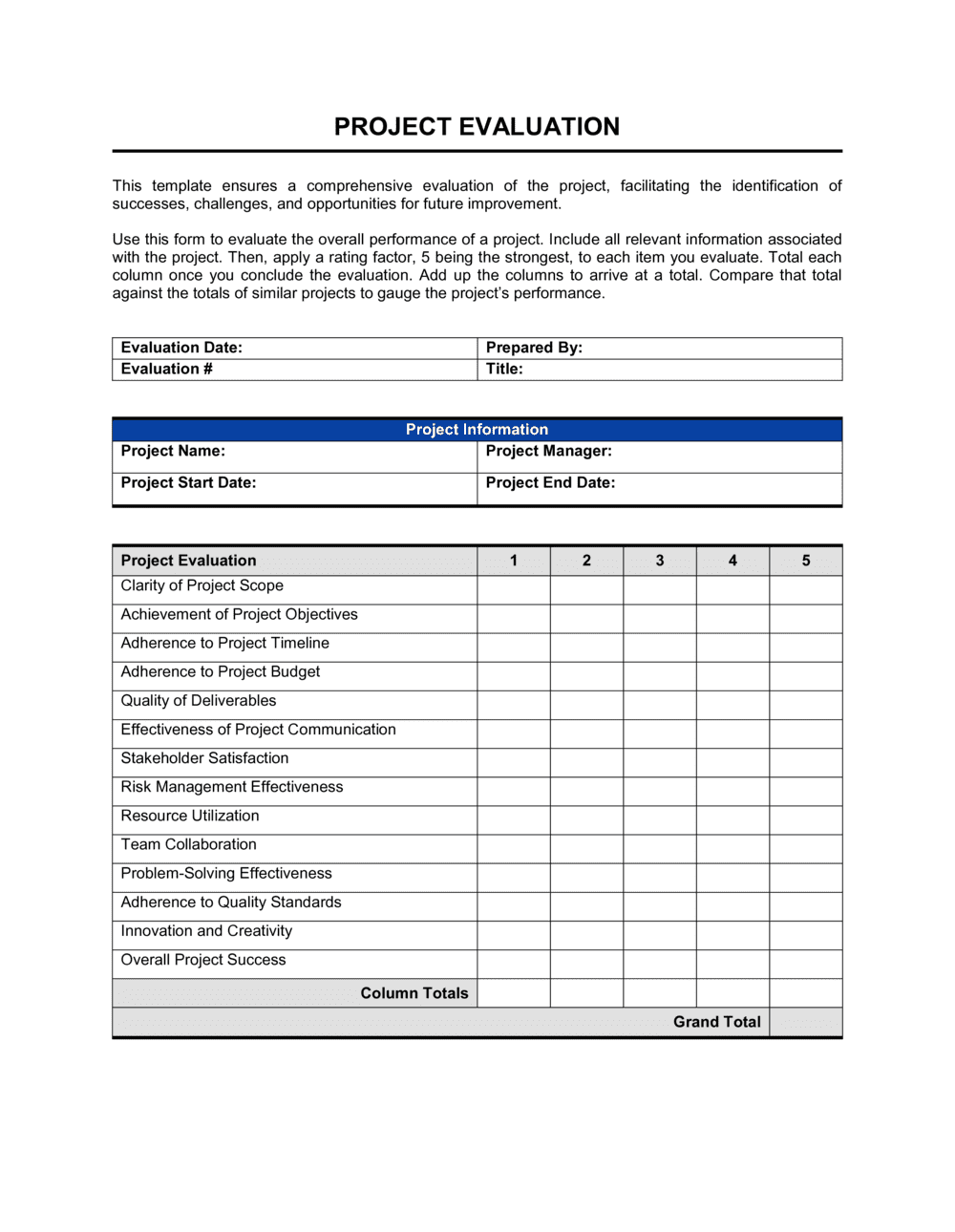
Complete the project identification block
Enter the project name, ID, sponsoring organization, project manager name, authorized budget, and exact start and end dates. Include the reference number of the original approval or contract authorization.
💡 Match the project name and ID exactly as they appear in your project management system or contract — even minor discrepancies create cross-referencing problems during audits.
3
Rate each objective and document your evidence
For each original objective, assign a status of Met, Partially Met, or Not Met. For anything less than fully met, record specific evidence — test results, client correspondence, delivery records — not a narrative opinion.
💡 If scope changed during the project, evaluate against the most recently approved scope baseline, not the original one. Reference the change order number explicitly.
4
Complete the deliverables table with acceptance records
List every planned deliverable, the planned and actual delivery date, and the acceptance status. Link each accepted deliverable to a signed acceptance record, a formal sign-off email, or a system-generated confirmation.
💡 Do not mark a deliverable as accepted unless you have a documented acknowledgment from the receiving party. A verbal 'looks good' is not an acceptance record.
5
Calculate and categorize budget and schedule variances
Compute the variance for schedule (days) and budget (dollars and percentage) using the approved baseline figures. Break budget variance into at least three cost categories — labor, materials, and overhead — to show where deviation occurred.
💡 If variance exceeds ±10%, include a one-paragraph root cause explanation directly in the evaluation. Unexplained variances invite audit scrutiny and client disputes.
6
Review the risk and issue log and record outcomes
Go through every risk and issue logged during the project and record whether each materialized, was avoided, or was partially mitigated. Note the effectiveness of any mitigation action applied.
💡 Risks that did not materialize are as valuable to document as those that did — future project teams need calibrated probability estimates, not just worst-case histories.
7
Write specific, actionable lessons learned
For each major issue or success, write a lesson that names the phase, describes what happened, quantifies the impact where possible, and prescribes a specific process change. Aim for six to ten lessons minimum.
💡 Force each lesson to answer: 'What would we do differently, and what exact step would change?' Generic lessons are discarded; specific ones get adopted.
8
Obtain all required signatures before filing
Route the completed evaluation to the project manager, sponsor, and client representative in that order. Confirm all signatures are dated on or after the project completion date.
💡 Use Business in a Box eSign to collect signatures with timestamps and store the executed copy in BIB Drive — email attachments get lost and lack audit trails.