Product Returns and Refunds Policy Template

Free Word download β€’ Edit online β€’ Save & share with Drive β€’ Export to PDF

4 pagesβ€’20–30 min to fillβ€’Difficulty: Standard
Learn more ↓
FreeProduct Returns and Refunds Policy Template

At a glance

What it is
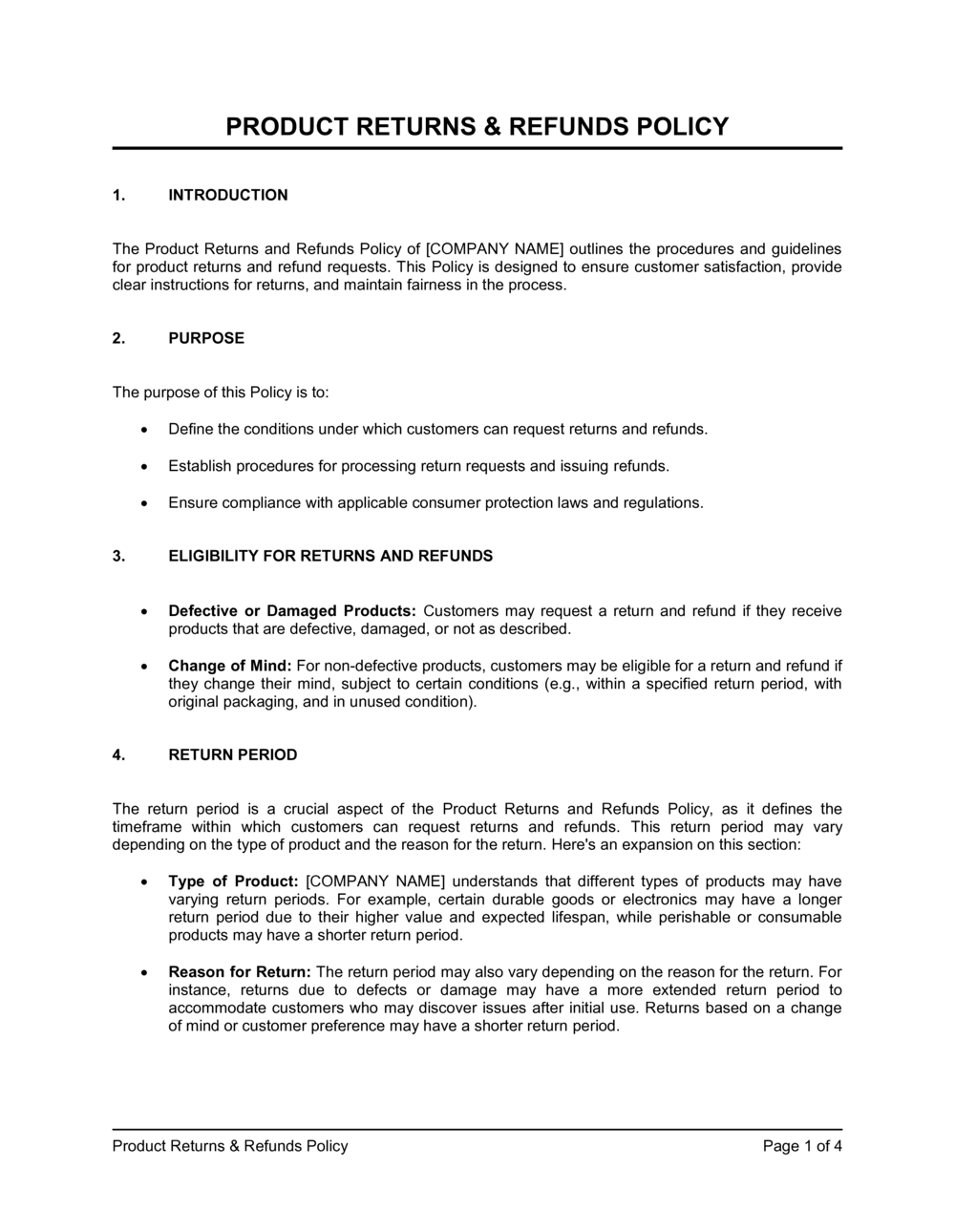
A Product Returns and Refunds Policy is an operational document that defines the conditions under which customers may return purchased goods and receive a refund, exchange, or store credit. This free Word download gives you a structured, customer-facing policy you can edit online and publish on your website, include in order confirmations, or post at your point of sale.
When you need it
Use it when launching an online store or retail location, when updating inconsistent or outdated terms after customer disputes, or when a payment processor or marketplace requires a written policy before approving your account.
What's inside
Return eligibility criteria, timeframes, accepted return conditions, refund methods and processing times, exchange and store credit options, non-returnable item exclusions, and the step-by-step process customers must follow to initiate a return.

What is a Product Returns and Refunds Policy?

A Product Returns and Refunds Policy is an operational document that defines the terms under which customers may return purchased goods and receive a refund, exchange, or store credit. It specifies the return window, eligibility conditions, non-returnable item categories, the process for initiating a return, who bears the cost of return shipping, and the method and timeline for issuing refunds. By putting these terms in writing and publishing them before purchase, a business sets clear expectations that govern every post-purchase transaction β€” from a simple size exchange to a damaged-goods claim.

Why You Need This Document

Without a written returns and refunds policy, every customer dispute becomes a judgment call β€” inconsistent outcomes frustrate staff, erode customer trust, and generate chargebacks that carry fees and threaten your merchant account standing. Payment processors including Stripe and PayPal review your published policy when assessing chargeback risk; marketplace platforms including Amazon, Etsy, and eBay require a visible returns policy as a condition of selling on their platforms. Consumer protection laws in the EU, Australia, and several US states impose default rights on customers even when no policy exists β€” meaning silence does not protect you, it just removes your ability to define the terms. A clear, well-structured returns policy reduces contact volume, speeds up staff processing, and converts what would otherwise be a point of conflict into a routine operational step. This template gives you a professionally formatted, editable starting point that covers every standard scenario β€” ready to publish in under an hour.

Which variant fits your situation?

If your situation is…Use this template
Selling physical products online via a dedicated storefrontE-commerce Returns Policy
Operating a physical retail store with in-person returnsRetail Returns and Refunds Policy
Selling digital downloads, software, or online coursesDigital Product Refund Policy
Offering subscription boxes or recurring product deliveriesSubscription Cancellation and Refund Policy
Selling on a marketplace that mandates a specific returns formatMarketplace Seller Return Policy
Running a service-based business that charges upfront feesService Refund Policy
Operating a wholesale or B2B product businessWholesale Returns and Credits Policy

Common mistakes to avoid

❌ Starting the return window from the purchase date

Why it matters: Items with 5–10 day shipping times effectively give customers only 20–25 days to return a product on a nominal 30-day policy. Customers who miss the window blame the seller, not the carrier.

Fix: Measure the return window from the delivery confirmation date recorded by the carrier's tracking system. State this explicitly in the policy.

❌ No separate process for damaged or defective items

Why it matters: Routing broken-product claims through the standard return flow adds unnecessary friction for customers who are already dissatisfied, increasing chargeback rates and negative reviews.

Fix: Create a dedicated damaged-item section with a 7-day photo-evidence window and a commitment to resolve via replacement or full refund within a stated timeframe.

❌ Omitting non-returnable categories from the policy

Why it matters: When customers discover mid-return that their item is ineligible β€” after they have already contacted support and packaged the product β€” the resulting frustration almost always escalates into a chargeback.

Fix: List every non-returnable category explicitly at purchase and in the policy. For non-returnable items, add a checkbox acknowledgment at checkout.

❌ Vague refund timelines without distinguishing internal and bank processing

Why it matters: A policy that says 'refunds issued within 10 days' means different things to customers and finance teams. Customers count from the day they drop off the return; sellers count from when they process it.

Fix: State your internal processing time separately from bank processing time: 'We initiate refunds within 5 business days of receiving your return. Your bank may require an additional 3–5 days to post the credit.'

❌ No policy effective date or version control

Why it matters: When a policy is updated, disputes arise over which version applies to orders placed during the transition. Without an effective date, there is no authoritative answer.

Fix: Include an effective date on the document and archive previous versions internally. State that orders are governed by the policy in effect at the time of purchase.

❌ Burying the returns policy in a general FAQ rather than a dedicated page

Why it matters: Payment processors, marketplace platforms, and consumer protection authorities commonly require a clearly accessible, standalone policy. A buried FAQ often fails platform compliance checks.

Fix: Publish the policy as a dedicated, linked page in your website footer, link to it from your checkout page, and include the URL in every order confirmation email.

The 10 key sections, explained

Policy Overview and Purpose

Return Eligibility Criteria

Non-Returnable Items

Return Timeframe

How to Initiate a Return

Return Shipping Responsibilities

Refund Methods and Processing Times

Exchanges

Damaged or Defective Items

Policy Updates and Contact Information

How to fill it out

  1. 1

    Define your return window

    Choose a return window appropriate to your product type and competitive market. Standard windows are 14 days (fast-fashion, perishables), 30 days (general retail), or 60 days (furniture, electronics). Measure from delivery confirmation, not purchase date.

    πŸ’‘ Check your primary competitors' return windows before finalizing β€” a significantly shorter window will be a visible disadvantage to shoppers comparing options.

  2. 2

    List all non-returnable item categories

    Identify every product category or SKU type that you cannot or will not accept back β€” digital goods, custom orders, perishables, final-sale items, undergarments, and gift cards are the most common. List them explicitly in the non-returnable section.

    πŸ’‘ A specific list of exclusions reduces customer service contacts far more effectively than a general statement like 'some items may not be eligible.'

  3. 3

    Set the return condition requirements

    Specify the exact condition items must be in to qualify: unused, with tags, in original packaging, or unopened. If your product has hygiene or safety considerations, state these explicitly as eligibility conditions.

    πŸ’‘ Take photographs of standard packaging when receiving stock β€” these become the reference standard when assessing returns.

  4. 4

    Assign return shipping responsibility

    Decide who pays for return shipping under each scenario: change of mind, defective item, wrong item sent, and sizing issue. Document each scenario separately to avoid ambiguity.

    πŸ’‘ Offering free returns for defective or incorrect items while charging for change-of-mind returns is the most widely accepted cost split and generates the fewest disputes.

  5. 5

    Configure your refund methods and timelines

    State whether refunds go to the original payment method, as store credit, or both. Include your internal processing time (e.g., within 5 business days of receiving the return) and note that bank processing adds 3–5 additional days.

    πŸ’‘ Offering store credit as an alternative with a small incentive β€” such as 10% extra credit β€” converts a cash refund into retained revenue without increasing customer friction.

  6. 6

    Write the damaged and defective item process separately

    Create a distinct pathway for DOA or damaged-on-arrival claims, with a shorter reporting window (typically 7 days from delivery), photo evidence requirements, and a faster resolution target.

    πŸ’‘ Pre-drafting an acknowledgment email template for damaged item claims reduces resolution time and makes the process feel more professional to affected customers.

  7. 7

    Add your contact details and effective date

    Insert the specific email address and phone number for returns, plus the date this version of the policy takes effect. Link to the policy from your website footer, order confirmation emails, and checkout page.

    πŸ’‘ Publishing the policy in at least three locations β€” footer, checkout, and order confirmation β€” satisfies most platform requirements and reduces 'I didn't see your policy' disputes.

  8. 8

    Review against marketplace and payment processor requirements

    If you sell on Amazon, eBay, Etsy, or Shopify, cross-check your policy against their published seller requirements β€” some mandate minimum return windows or specific refund timelines that override your own terms.

    πŸ’‘ Keep a separate internal reference document mapping your policy terms to each platform's requirements, and update it whenever a platform announces policy changes.

Frequently asked questions

What should a product returns and refunds policy include?

A complete policy covers return eligibility criteria, the return window measured from delivery date, a list of non-returnable items, the condition items must be in to qualify, who pays return shipping, refund methods and processing timelines, exchange options, a separate process for damaged or defective items, and the policy's effective date with contact information. Missing any of these creates gaps that customers and platforms will interpret in the customer's favor.

Is a returns policy legally required?

In the United States, federal law does not require a written returns policy, but if you do not publish one, the FTC requires you to accept returns within a reasonable period. In the EU, the Consumer Rights Directive mandates a minimum 14-day cooling-off period for online purchases, regardless of your policy. In Australia, consumer guarantees under the Australian Consumer Law require remedies for faulty goods regardless of what your policy states. Most payment processors and marketplaces also require a published policy as a condition of your account.

How long should a return window be?

The standard return window for general retail and e-commerce is 30 days from delivery. Competitive categories like apparel and electronics often extend to 60 or 90 days to match market expectations. Shorter windows β€” 14 days β€” are common for perishables, hygiene products, and certain consumables. Whatever window you choose, measure it from the confirmed delivery date, not the order or purchase date.

Do I have to offer free returns?

You are not legally required to offer free returns in most jurisdictions, but your policy must be clearly disclosed at or before purchase. Charging for return shipping on change-of-mind returns is widely accepted. However, for items that arrive damaged, defective, or materially different from the listing, covering return shipping costs is standard practice and reduces chargeback rates significantly. Several major platforms β€” including Amazon β€” require seller-paid returns for certain categories.

What is the difference between a return policy and a refund policy?

A returns policy defines the conditions under which a customer may send a product back β€” eligibility, timeframe, condition, and process. A refund policy defines what the customer receives in exchange β€” cash refund, store credit, or exchange β€” and how long it takes. In practice, most businesses combine both into a single document because they describe two stages of the same transaction. Separating them into two documents increases customer confusion without adding clarity.

Can I have a no-refund policy?

You can implement a no-refund policy for non-faulty items in many jurisdictions, provided it is clearly disclosed before purchase. However, consumer protection laws in the EU, Australia, and several US states require remedies for defective or misdescribed products regardless of your policy terms. A strict no-refund policy also significantly increases chargeback rates, as customers who cannot obtain a refund directly will dispute the charge with their card issuer β€” often successfully.

Where should I publish my returns policy?

Publish it in at least three locations: a dedicated page linked from your website footer, your checkout or cart page where customers can see it before completing a purchase, and your order confirmation emails. If you sell on marketplaces, you must also enter the key terms into each platform's seller settings. Payment processors such as Stripe and PayPal may review your published policy when assessing your chargeback risk profile.

How do I handle returns for digital products?

Digital products β€” software downloads, ebooks, online courses, and subscriptions β€” are typically excluded from standard return policies because delivery is immediate and the product cannot be physically returned. Most jurisdictions allow you to exclude digital goods from standard return rights provided you obtain explicit customer acknowledgment of the no-refund terms at checkout. In the EU, customers must waive their 14-day cooling-off right for digital content before download begins.

What triggers a chargeback and how does a clear policy prevent it?

Chargebacks are typically triggered when a customer cannot reach a seller, receives no response to a refund request within a reasonable time, or believes the product was materially different from its description. A clearly published policy with a responsive contact channel eliminates the first two triggers. Accurate product descriptions and a well-defined defective-item process address the third. Sellers with published, visible returns policies and documented return requests have stronger grounds to dispute chargebacks with their payment processor.

How often should I update my returns and refunds policy?

Review your policy at least annually, and update it whenever you change your product range, enter new markets with different consumer protection laws, update your shipping partners, or change your payment processor. Archive previous versions with their effective dates β€” orders are governed by the policy in effect at the time of purchase, and you may need to reference an older version in a dispute months after a policy change.

How this compares to alternatives

vs Terms and Conditions

Terms and Conditions govern the entire commercial relationship between a business and its customers β€” payment, intellectual property, disclaimers, dispute resolution, and acceptable use. A returns and refunds policy is a focused subset that addresses only the post-purchase return and refund process. Most businesses need both; the returns policy is often incorporated by reference into the broader Terms and Conditions.

vs Privacy Policy

A privacy policy governs how a business collects, stores, and uses customer data β€” it has no direct bearing on returns or refunds. The two documents serve entirely different regulatory purposes: a privacy policy is required under GDPR, CCPA, and similar data laws; a returns policy is required by consumer protection and marketplace rules. Both should be published and linked from the website footer.

vs Warranty Policy

A warranty policy covers manufacturer or seller commitments to repair or replace products that fail due to defects in materials or workmanship over a defined period β€” typically 12 to 24 months. A returns policy covers a shorter post-purchase window and addresses dissatisfaction, sizing issues, and general change-of-mind returns as well as defects. For products with a manufacturer warranty, both documents should be published and cross-referenced.

vs Shipping Policy

A shipping policy defines delivery timeframes, carriers, shipping costs, and how lost or delayed shipments are handled. A returns policy governs what happens after delivery. The two are complementary β€” the shipping policy ends when delivery is confirmed; the returns policy begins from that point. Linking the two documents in both directions reduces customer confusion about where to go for different post-purchase issues.

Industry-specific considerations

E-commerce and online retail

Carrier tracking integration for delivery-based return windows, platform-specific policy display requirements for Shopify and WooCommerce, and automated RMA generation at scale.

Apparel and footwear

Extended return windows of 60–90 days are standard to compete with major retailers; sizing-exchange processes and hygiene exclusions for underwear and swimwear are category-specific requirements.

Consumer electronics

Manufacturer warranty coordination alongside the seller return policy, DOA processes with expedited replacement, and restocking fees of 10–15% for opened items are common in this category.

Food, beverage, and consumables

Most consumable products are non-returnable once opened, making the non-returnable exclusion list and clear pre-purchase disclosure the most critical policy elements.

Handmade, custom, and personalized goods

Custom and personalized items are typically final sale; the policy must include an explicit exclusion with a checkout-stage acknowledgment to avoid disputes on Etsy and similar platforms.

Health, beauty, and personal care

Hygiene and safety regulations restrict returns on opened personal care products; unopened item return windows are typically 30 days with condition requirements strictly enforced.

Template vs pro β€” what fits your needs?

PathBest forCostTime
Use the templateSmall to mid-size retailers and e-commerce sellers with standard product ranges and straightforward return scenariosFree30–60 minutes
Template + professional reviewBusinesses selling into the EU or Australia where statutory consumer rights override policy terms, or sellers on multiple platforms with conflicting requirements$150–$400 for a legal or compliance review1–3 days
Custom draftedEnterprise retailers, regulated product categories (medical devices, food supplements), or businesses with high-volume returns operations requiring customized RMA workflows$500–$2,000+1–2 weeks

Glossary

Return Window
The number of days after purchase or delivery within which a customer is eligible to initiate a return β€” commonly 14, 30, or 60 days.
Return Merchandise Authorization (RMA)
A unique reference number issued by the seller that authorizes a specific return shipment and allows the return to be tracked and processed.
Restocking Fee
A percentage of the purchase price charged to the customer when a product is returned in acceptable condition, used to offset handling and re-shelving costs.
Store Credit
A non-cash refund in the form of credit applied to the customer's account or issued as a voucher, usable on future purchases.
Final Sale
A purchase designated at the time of sale as ineligible for return or refund β€” typically applied to clearance items, personalized goods, or perishables.
Exchange
A return resolved by sending the customer a replacement product of equal or different value rather than issuing a monetary refund.
Chargeback
A forced reversal of a payment transaction initiated by the cardholder through their bank, bypassing the seller's refund process β€” chargebacks carry fees and can affect merchant account standing.
Return Shipping Label
A prepaid or customer-paid shipping label provided to facilitate the physical return of a product to the seller's warehouse or store.
Dead on Arrival (DOA)
A product that is defective or non-functional immediately upon unboxing, typically qualifying for an expedited replacement or full refund outside the standard return window.
Condition Upon Return
The required physical state of the product at the time of return β€” commonly 'unused and in original packaging' β€” which the policy uses to determine refund eligibility.

Part of your Business Operating System

This document is one of 3,000+ business & legal templates included in Business in a Box.

  • Fill-in-the-blanks β€” ready in minutes
  • 100% customizable Word document
  • Compatible with all office suites
  • Export to PDF and share electronically

Create your document in 3 simple steps.

From template to signed document β€” all inside one Business Operating System.
1
Download or open template

Access over 3,000+ business and legal templates for any business task, project or initiative.

2
Edit and fill in the blanks with AI

Customize your ready-made business document template and save it in the cloud.

3
Save, Share, Send, Sign

Share your files and folders with your team. Create a space of seamless collaboration.

Save time, save money, and create top-quality documents.

β˜…β˜…β˜…β˜…β˜…

"Fantastic value! I'm not sure how I'd do without it. It's worth its weight in gold and paid back for itself many times."

Managing Director Β· Mall Farm
Robert Whalley
Managing Director, Mall Farm Proprietary Limited
β˜…β˜…β˜…β˜…β˜…

"I have been using Business in a Box for years. It has been the most useful source of templates I have encountered. I recommend it to anyone."

Business Owner Β· 4+ years
Dr Michael John Freestone
Business Owner
β˜…β˜…β˜…β˜…β˜…

"It has been a life saver so many times I have lost count. Business in a Box has saved me so much time and as you know, time is money."

Owner Β· Upstate Web
David G. Moore Jr.
Owner, Upstate Web

Run your business with a system β€” not scattered tools

Stop downloading documents. Start operating with clarity. Business in a Box gives you the Business Operating System used by over 250,000 companies worldwide to structure, run, and grow their business.

Free Forever PlanΒ Β·Β No credit card required