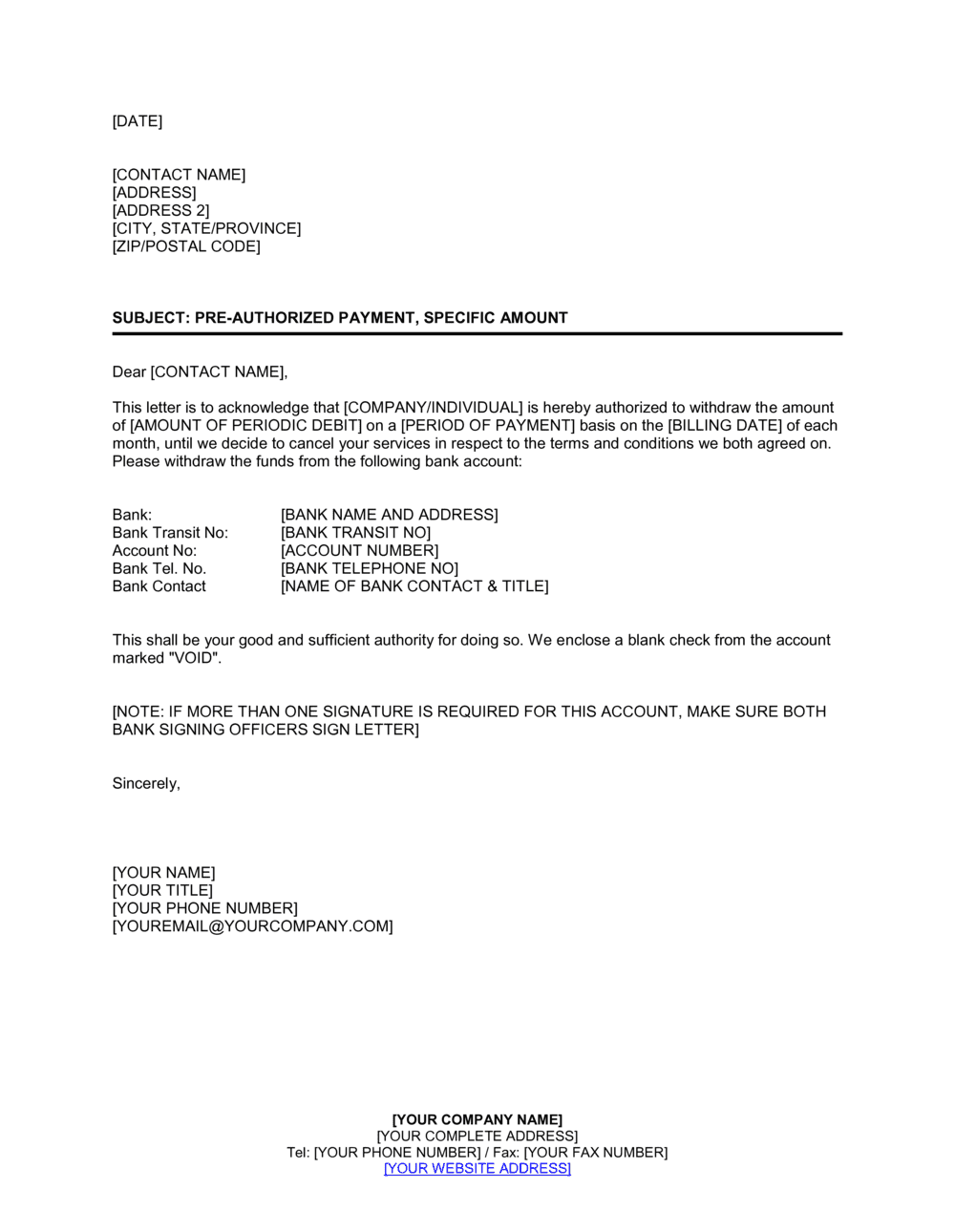
Pre-Authorized Payment_Specific Amount Template

Free Word download β€’ Edit online β€’ Save & share with Drive β€’ Export to PDF

1 pageβ€’20–30 min to fillβ€’Difficulty: Standardβ€’Signature requiredβ€’Legal review recommended
Learn more ↓
FreePre-Authorized Payment_Specific Amount Template

At a glance

What it is
A Pre Authorized Payment (Specific Amount) agreement is a legally binding authorization a payee obtains from a payer allowing the payee to withdraw a fixed, predetermined dollar amount from the payer's bank account on a recurring schedule. This free Word download gives you a ready-to-edit template you can customize with your payment amounts, frequency, and banking details, then export as PDF for signature before the first debit runs.
When you need it
Use it whenever you need to collect a fixed recurring payment from a customer, tenant, member, or client β€” such as monthly subscription fees, loan repayments, membership dues, or lease payments β€” without requiring manual action from the payer each cycle.
What's inside
Payer and payee identification, bank account and routing details, the specific authorized debit amount, payment frequency and start date, cancellation rights, dispute and reimbursement provisions, and governing financial institution rules.

What is a Pre Authorized Payment (Specific Amount) Agreement?

A Pre Authorized Payment (Specific Amount) Agreement is a legally binding written authorization a payee obtains from a payer β€” the bank account holder β€” permitting the payee to withdraw a fixed, predetermined dollar amount directly from the payer's account on a recurring schedule, without requiring the payer's manual action each cycle. Unlike a variable-amount authorization, the specific-amount form locks the debit at a single stated figure per billing period, which typically allows the payee to waive pre-notification requirements and simplifies both the processing and the compliance obligations on each side. The agreement operates within a layered legal framework that includes the bilateral contract between the parties and the operating rules of the applicable banking scheme β€” Nacha in the United States, Payments Canada Rule H1 in Canada, Bacs in the United Kingdom, and SEPA Direct Debit in the European Union.

Why You Need This Document

Without a signed pre-authorized payment authorization on file before the first debit runs, every withdrawal from the payer's account is technically unauthorized β€” and under Nacha, Payments Canada, Bacs, and SEPA rules, the payer's bank is entitled to reverse it and charge the amount back to the payee, often with fees. The burden of proof always sits with the payee: if you cannot produce a signed, compliant authorization when a payer disputes a charge, the reimbursement claim succeeds automatically regardless of whether the underlying payment obligation exists. Beyond dispute exposure, a properly drafted agreement reduces NSF rates by setting clear expectations around timing and amounts, provides an enforceable basis for NSF and re-presentment fees, and satisfies the compliance requirements your payment processor or bank will ask to see during onboarding. This template gives you a complete, banking-scheme-aware starting point that covers every required element β€” account identification, fixed amount, frequency, cancellation rights, and dispute procedure β€” so you can onboard recurring payers quickly and defend every debit you process.

Which variant fits your situation?

If your situation is…Use this template
Collecting a fixed amount on a predictable recurring schedulePre Authorized Payment β€” Specific Amount
Collecting a variable amount that changes each billing cyclePre Authorized Payment β€” Variable Amount
Processing ACH debits for US-based business paymentsACH Authorization Agreement
Authorizing a one-time bank debit for a single transactionOne-Time Pre Authorized Debit Form
Setting up direct debit for UK bank account paymentsDirect Debit Mandate
Automating credit card charges on a recurring billing cycleRecurring Credit Card Authorization Form
Documenting the full credit or lending relationship alongside the payment authorizationLoan Agreement

Common mistakes to avoid

❌ Using variable-amount language in a specific-amount form

Why it matters: Writing 'up to $[X]' or 'approximately $[X]' on a specific-amount authorization converts it into a variable-amount PAD, which requires different disclosure language and triggers additional pre-notification obligations under most banking rules.

Fix: State a single, exact dollar figure β€” both numerically and in words β€” and use a separate variable-amount authorization form if the payment amount will ever change.

❌ Failing to obtain the authorization before the first debit

Why it matters: Processing a debit before the signed authorization is in hand β€” or worse, before the payer has seen the terms β€” is an unauthorized transaction under Nacha, Payments Canada, and SEPA rules and exposes the payee to mandatory reimbursement plus potential network fines.

Fix: Execute the authorization and collect the voided cheque before scheduling the first debit with your payment processor.

❌ Omitting the dispute and reimbursement clause

Why it matters: Banking network rules require payees to inform payers of their reimbursement rights. An authorization that omits this clause may fail compliance review at the payer's bank and can be rejected by the payment processor.

Fix: Include a clear dispute and reimbursement clause directing the payer to contact the payee first and, if unresolved, their financial institution β€” and state the applicable dispute window (typically 90 days for unauthorized transactions).

❌ Not retaining a copy of the signed authorization

Why it matters: A payer who disputes a debit as unauthorized will win the reimbursement claim automatically if the payee cannot produce a signed authorization. Most banking schemes place the burden of proof on the payee.

Fix: Store the original signed authorization and the attached voided cheque for the full duration of the debit series plus at least two years after the final payment, in a secure and readily retrievable format.

❌ Setting a cancellation notice period longer than 30 days for consumers

Why it matters: Most banking scheme rules β€” including Payments Canada Rule H1 and Nacha consumer guidelines β€” cap the notice period a payee can require from a consumer payer. An overly long notice requirement may be deemed unenforceable.

Fix: Set the cancellation notice period at 10–30 days for consumer payers and confirm the specific minimum permitted by the banking scheme applicable to your jurisdiction.

❌ Authorizing unlimited re-presentment of returned debits

Why it matters: Nacha rules limit ACH re-presentment to two additional attempts after the original return. Exceeding this cap without a separate, specific written authorization from the payer constitutes a rule violation and can result in fines or processor suspension.

Fix: Cap re-presentment at two additional attempts in the returned-payment clause and include specific language authorizing those attempts β€” or obtain a separate written authorization for each re-presentment beyond the first.

The 10 key clauses, explained

Parties and account identification

In plain language: Identifies the payee (the business collecting payment) and the payer (the account holder), along with the payer's bank name, account number, and routing or transit number.

Sample language
I, [PAYER FULL NAME], of [PAYER ADDRESS], authorize [PAYEE BUSINESS NAME] ('Payee') to debit my account at [BANK NAME], account number [ACCOUNT NUMBER], transit/routing number [ROUTING NUMBER], for the amounts set out below.

Common mistake: Collecting only the last four digits of the account number for privacy β€” the full account and routing numbers are required for the bank to process the debit, and the authorization is unenforceable without them.

Authorized debit amount

In plain language: States the exact fixed dollar amount the payee is authorized to withdraw each cycle β€” the defining feature of a specific-amount PAD over a variable-amount authorization.

Sample language
Payee is authorized to debit my account in the fixed amount of $[AMOUNT] ([AMOUNT IN WORDS] dollars) per [PAYMENT FREQUENCY].

Common mistake: Writing 'up to $[X]' instead of a single fixed figure. This converts a specific-amount authorization into a variable-amount one, which requires different disclosure language and a distinct form under most banking rules.

Payment frequency and start date

In plain language: Defines how often debits occur (weekly, bi-weekly, monthly, annually) and the date on which the first debit will be processed.

Sample language
Debits shall occur on the [DAY] of each [MONTH / WEEK], commencing [START DATE], and continuing until this authorization is cancelled in accordance with the terms below.

Common mistake: Stating only the frequency without a specific start date. An ambiguous start date creates disputes over when the authorization became effective and whether initial debits were properly authorized.

Purpose of payment

In plain language: Describes the goods, services, or obligation the recurring payment relates to, linking the authorization to the underlying commercial or contractual relationship.

Sample language
These debits are for [DESCRIPTION OF GOODS OR SERVICES β€” e.g., monthly membership fees under the Membership Agreement dated [DATE]] between Payee and Payer.

Common mistake: Leaving the purpose field blank or writing 'services.' Regulators and dispute arbitrators use the purpose clause to verify the authorization was given in a specific commercial context β€” a blank field weakens the payee's position in a reimbursement claim.

Duration and termination

In plain language: States whether the authorization runs for a fixed number of payments or indefinitely, and sets out the conditions under which it automatically terminates.

Sample language
This authorization shall remain in effect until: (a) [NUMBER] payments have been processed; or (b) the underlying agreement between the parties is terminated; or (c) Payer provides written notice of cancellation in accordance with Clause [X].

Common mistake: Omitting an automatic termination trigger tied to the underlying contract. If the service agreement ends but the PAD continues, the payee risks processing unauthorized debits and liability for reimbursement plus fees.

Cancellation and revocation rights

In plain language: Sets out the payer's right to cancel the authorization, the required notice period, and the method of delivery for the cancellation notice.

Sample language
Payer may cancel this authorization at any time by providing written notice to Payee at [PAYEE ADDRESS / EMAIL] at least [30] days before the next scheduled debit date. Cancellation of this authorization does not relieve Payer of any payment obligations under the underlying agreement.

Common mistake: Requiring more than 30 days' cancellation notice. Most banking rules β€” including Nacha in the US and Payments Canada rules for PADs β€” cap the permissible notice requirement, and an overly long notice period can be deemed unenforceable.

Dispute and reimbursement procedure

In plain language: Explains how the payer can dispute an unauthorized or erroneous debit, the timeframe for raising a dispute, and the process for obtaining a reimbursement.

Sample language
Payer has the right to dispute any debit that was not authorized or that did not comply with this authorization by contacting Payee at [CONTACT DETAILS] within [90] days of the debit date. Questions regarding the right to reimbursement should be directed to Payer's financial institution.

Common mistake: Omitting the dispute and reimbursement clause entirely. Banking networks require payees to include this language; its absence can cause the entire authorization to fail compliance review at the payer's bank.

Waiver of pre-notification

In plain language: A clause by which the payer waives their right to receive advance notice before each recurring debit, streamlining processing for predictable fixed-amount payments.

Sample language
Payer waives the right to receive pre-notification of each debit and acknowledges that no further notice will be provided prior to each scheduled withdrawal of the fixed amount stated above.

Common mistake: Including a pre-notification waiver for variable-amount authorizations. The waiver is appropriate only for truly fixed amounts β€” if the amount can change, pre-notification is required under most banking scheme rules and the waiver is invalid.

Returned payment and NSF fees

In plain language: States what happens if a debit is returned due to insufficient funds, including any NSF fee the payer agrees to pay and the payee's right to re-present the item.

Sample language
If a debit is returned due to non-sufficient funds, Payer authorizes Payee to re-present the debit once within [5] business days and agrees to pay a returned-item fee of $[FEE AMOUNT], in addition to any fee charged by Payer's financial institution.

Common mistake: Authorizing unlimited re-presentment without a cap. Nacha rules limit ACH re-presentment to two additional attempts after the original; exceeding that limit without proper authorization exposes the payee to rule violations and fines.

Governing law and banking scheme rules

In plain language: Specifies the jurisdiction whose laws govern the agreement and acknowledges that applicable banking network rules β€” Nacha, Payments Canada, SEPA, Bacs β€” take precedence over conflicting contract terms.

Sample language
This authorization is governed by the laws of [STATE / PROVINCE / COUNTRY] and is subject to the rules of [APPLICABLE BANKING SCHEME β€” e.g., Nacha ACH Operating Rules / Payments Canada Rule H1]. In the event of conflict, the applicable banking scheme rules shall prevail.

Common mistake: Omitting the banking scheme reference and relying solely on contract law. PAD and ACH authorizations operate within a layered regulatory framework; a governing law clause alone does not satisfy the compliance requirements of the payment network.

How to fill it out

  1. 1

    Identify both parties and their roles

    Enter the payee's full legal business name and contact details, and the payer's full legal name and current address. Confirm that the payer is the actual account holder β€” not a third party β€” before proceeding.

    πŸ’‘ If the payer is a business rather than an individual, identify the authorized signatory by name and title to ensure the authorization is binding on the entity.

  2. 2

    Record the complete bank account details

    Enter the payer's bank name, full account number, and routing or transit number exactly as they appear on a voided cheque or bank statement. Attach a voided cheque to the signed form as standard practice.

    πŸ’‘ Ask the payer to attach a voided cheque to the signed authorization β€” it confirms all banking details match and significantly reduces failed-debit rates.

  3. 3

    State the fixed debit amount precisely

    Enter the exact dollar and cent amount to be debited each cycle β€” written numerically and in words. Do not use ranges or 'up to' language; this must be a single fixed figure.

    πŸ’‘ If the amount will ever change (e.g., annual price increases), use a variable-amount PAD form instead, or include an amendment clause requiring fresh written consent before the new amount takes effect.

  4. 4

    Set the frequency, start date, and number of payments

    Specify the billing cycle (weekly, monthly, quarterly, or annually), the calendar date of the first debit, and either the total number of payments authorized or the condition that terminates the authorization.

    πŸ’‘ Tie the authorization's end date to the underlying contract term β€” this prevents debits from continuing after the service or membership agreement lapses.

  5. 5

    Describe the purpose of the payments

    Write a specific, plain-English description of what the recurring payment covers β€” for example, 'monthly gym membership fees under the Membership Agreement dated [DATE].' Reference the underlying agreement by name and date.

    πŸ’‘ A specific purpose clause reduces successful chargeback claims: it gives the payer's bank clear evidence that the debit was tied to a known commercial obligation.

  6. 6

    Include the cancellation and dispute provisions

    Confirm the cancellation notice period (typically 10–30 days before the next debit), the delivery method for cancellation notices, and the dispute window and contact details for the reimbursement procedure.

    πŸ’‘ Match your cancellation notice requirement to the applicable banking scheme minimum β€” do not exceed 30 days for consumer payers, as most banking rules cap it there.

  7. 7

    Execute before the first debit date

    Both parties should sign and date the authorization before the first scheduled debit is processed. Provide the payer with a copy of the signed authorization at the time of execution.

    πŸ’‘ Retain a copy of the signed authorization β€” including the attached voided cheque β€” for the entire duration of the agreement plus at least 2 years after the last debit, to defend against reimbursement claims.

  8. 8

    Submit to your payment processor and file the original

    Provide the completed authorization to your bank, payment processor, or ACH originator as required by their onboarding process. File the executed original in a secure, retrievable system.

    πŸ’‘ Some processors require a digital copy of the signed authorization before activating the debit series β€” confirm your processor's specific submission requirements before the first billing date.

Frequently asked questions

What is a pre-authorized payment agreement?

A pre-authorized payment agreement is a written authorization signed by a bank account holder that permits a payee β€” such as a business, lender, or service provider β€” to withdraw funds directly from the account on a recurring schedule without requiring the payer's manual action each time. The specific-amount variant fixes the withdrawal at a set dollar figure per cycle, making it suitable for subscriptions, loan installments, memberships, and fixed-rate service contracts.

What is the difference between a specific-amount and a variable-amount pre-authorized payment?

A specific-amount authorization fixes the debit at a single, stated dollar figure β€” for example, $149.00 per month β€” and typically allows the payer to waive pre-notification since the amount never changes. A variable-amount authorization permits the debit to fluctuate each cycle based on usage, consumption, or a formula, and generally requires the payee to notify the payer of the upcoming amount in advance. Using the wrong form for your billing model can invalidate the authorization under banking network rules.

Is a pre-authorized payment agreement legally binding?

Yes β€” a properly executed pre-authorized payment agreement is generally enforceable as a contract between the payee and payer, subject to applicable banking scheme rules and consumer protection laws. The agreement must clearly state the authorized amount, frequency, and cancellation rights, and must be signed by the account holder (or an authorized representative for a business account) before the first debit is processed. Consider consulting a lawyer if the amounts are significant or the payer is located in a different jurisdiction.

Can a payer cancel a pre-authorized payment?

Yes. Payers retain the right to cancel a pre-authorized payment authorization at any time under banking scheme rules in most jurisdictions. The cancellation typically requires written notice to the payee within a specified period β€” often 10 to 30 days β€” before the next scheduled debit. Cancelling the PAD does not automatically cancel any underlying payment obligation the payer owes under a separate service or credit agreement; those debts remain due by other means.

What happens if a pre-authorized debit is returned for insufficient funds?

If the payer's account has insufficient funds on the debit date, the bank returns the item unpaid and both parties typically incur fees. Under Nacha ACH rules, the payee may re-present the debit up to two additional times. The PAD agreement should specify any NSF fee the payer agrees to pay and the number of re-presentment attempts permitted. Repeated NSF returns can result in the payment processor suspending the payee's debit privileges.

Do I need to provide a copy of the authorization to the payer?

Yes. Most banking scheme rules β€” including Payments Canada Rule H1, Nacha consumer guidelines, and SEPA mandate requirements β€” require the payee to provide the payer with a copy of the signed authorization at the time of execution. Failing to do so can expose the payee to successful reimbursement claims even where the payer did sign the form.

How long should I retain a signed pre-authorized payment authorization?

Best practice β€” and the requirement under most banking scheme rules β€” is to retain the signed original for the full duration of the recurring debit series plus at least two years after the final payment. For consumer-facing authorizations in Canada, Payments Canada rules require retention for a minimum of one year after the last PAD item. Retaining the voided cheque alongside the authorization is also standard practice as it corroborates the banking details.

What is required for a pre-authorized payment authorization to be valid?

At minimum, a valid authorization must identify the payee and payer, state the exact bank account and routing details, specify the authorized amount and frequency, include a start date, describe the purpose of the payments, set out the payer's cancellation and reimbursement rights, and be signed by the account holder before the first debit. Many banking schemes β€” particularly in Canada and the EU β€” impose additional specific content requirements, so check the rules of the applicable payment network.

Can I use this template for both personal and business bank accounts?

Yes, with modifications. For personal (consumer) accounts, enhanced disclosure and reimbursement rights apply under most banking scheme consumer protection rules. For business accounts, the signatory must be authorized to bind the business entity, and many banking networks apply a shorter dispute window (typically 10 business days rather than 90 days for consumers). Clearly identify whether the payer is an individual or a business entity in the authorization and tailor the notice periods accordingly.

How this compares to alternatives

vs Pre Authorized Payment β€” Variable Amount

A variable-amount pre-authorized payment authorization permits the debit to fluctuate each cycle based on usage, billing, or a formula β€” and generally requires pre-notification of each amount before it is processed. The specific-amount form is simpler, eliminates the pre-notification requirement, and is appropriate only where the debit is the same fixed dollar figure every cycle. Use the variable-amount form for utility bills, usage-based fees, or any service where the charge changes month to month.

vs Recurring Credit Card Authorization Form

A recurring credit card authorization charges a payer's credit card rather than debiting a bank account directly. Credit card authorizations are governed by card network rules (Visa, Mastercard) rather than ACH or banking scheme rules, and the dispute and chargeback process differs significantly. Bank account debits typically carry lower processing fees than credit card transactions; credit cards offer the payer stronger built-in dispute rights and are often preferred by consumers for discretionary purchases.

vs Direct Debit Mandate (UK/EU)

A Direct Debit Mandate is the functional equivalent of a PAD agreement for UK and EU bank accounts, operating under the Bacs or SEPA Direct Debit schemes respectively. The substantive authorization content is similar, but the specific mandate format, indemnity scheme protections, and submission processes differ materially from North American PAD and ACH frameworks. Use the jurisdiction-specific form required by the applicable banking scheme β€” a North American PAD form is not interchangeable with a SEPA or Bacs mandate.

vs Loan Agreement

A Loan Agreement documents the principal, interest rate, repayment schedule, and terms of a lending relationship β€” it is the source of the borrower's payment obligation. A pre-authorized payment authorization is the operational mechanism that enables the lender to collect those payments automatically. The two documents work in tandem: the loan agreement creates the debt; the PAD authorizes the debit. Both are needed for an automated lending arrangement, and each is a distinct legal instrument.

Industry-specific considerations

Financial Services and Lending

Fixed installment loan repayments, mortgage payment collection, and credit facility drawdowns β€” where the payment schedule and amount are set at origination and do not vary.

Healthcare and Wellness

Monthly membership fees for gyms, physiotherapy clinics, and wellness programs where patients or members pay a fixed monthly rate for ongoing access to services.

Property Management and Real Estate

Fixed monthly rent collection from residential and commercial tenants, strata or HOA fee collection, and parking or storage unit payments with set rates.

Professional Services

Retainer fee collection from clients on monthly billing cycles, fixed-rate managed service provider fees, and accounting or legal subscription service payments.

Jurisdictional notes

United States

US pre-authorized bank debits are governed by Nacha ACH Operating Rules. Payees must obtain a written or electronic authorization before originating an ACH debit, retain it for two years after revocation, and provide the payer with a copy. Consumer authorizations carry a 60-day reimbursement window; business authorizations are typically 2 business days. The FTC's Restore Online Shoppers' Confidence Act (ROSCA) imposes additional requirements for recurring charges originating from online transactions.

Canada

Canadian pre-authorized debits are governed by Payments Canada Rule H1, which sets out mandatory content requirements for PAD agreements including a specific statement of the payer's reimbursement rights. Consumer PADs carry a 90-day reimbursement right for unauthorized items and a 10-business-day right for items that do not comply with the authorization terms. Business PADs have a shortened reimbursement window of 10 business days. PAD agreements must be in French for Quebec-based consumers under the Consumer Protection Act.

United Kingdom

UK direct debits operate under the Bacs Direct Debit Scheme, governed by the Direct Debit Guarantee. Businesses must be approved Bacs originators (or use a bureau sponsor) before collecting direct debits. The Direct Debit Guarantee gives payers an immediate refund right for any unauthorized or incorrect debit, with no time limit for claims. Businesses must provide advance notice of the first collection date and amount, and of any changes to amount or date thereafter. Post-Brexit, UK and EU SEPA direct debits are now separate schemes.

European Union

EU recurring bank debits use the SEPA Direct Debit (SDD) Core or B2B scheme, operated under European Payments Council rules and implemented via the EU Payment Services Directive 2 (PSD2). Core SDD mandates give consumers an unconditional 8-week refund right and a 13-month right for unauthorized transactions. The B2B scheme (for business payers) waives the unconditional refund right but requires the debtor's bank to verify the mandate. Mandate management β€” including a unique mandate reference number β€” is required for all SDD transactions.

Template vs lawyer β€” what fits your deal?

PathBest forCostTime
Use the templateBusinesses collecting fixed recurring fees from consumers or commercial clients in a single domestic jurisdiction with standard payment amountsFree15 minutes per authorization
Template + legal reviewHigh-volume billing operations, authorizations for significant recurring amounts, or any cross-border debit arrangement$200–$500 for a payment counsel or banking lawyer review1–3 days
Custom draftedFinancial institutions, regulated lenders, payment processors, or businesses processing PADs under multiple jurisdictions simultaneously$1,000–$3,500+1–2 weeks

Glossary

Pre Authorized Debit (PAD)
A payment arrangement where the payee is authorized in writing to withdraw funds directly from the payer's bank account on an agreed schedule.
Payee
The business or individual receiving the authorized payment β€” typically the merchant, lender, or service provider.
Payer
The account holder who signs the authorization and whose bank account is debited on the scheduled dates.
ACH (Automated Clearing House)
The US electronic network that processes direct debits and credit transfers between bank accounts, governed by Nacha operating rules.
SEPA Direct Debit
The EU-wide payment scheme enabling euro-denominated direct debits across participating member states under standardized rules.
Revocation
The payer's right to cancel a pre-authorized payment authorization, typically by providing written notice to the payee within a specified notice period.
NSF (Non-Sufficient Funds)
A returned debit that occurs when the payer's account does not hold enough funds to cover the authorized withdrawal on the processing date.
Reimbursement Right
A payer's entitlement to recover funds debited in error or without valid authorization, as protected under banking rules in most jurisdictions.
Nacha
The organization that governs ACH network rules in the United States, setting standards for authorization, processing, and dispute resolution.
Pre-notification
An advance notice sent by the payee to the payer before the first debit runs, confirming the amount and scheduled date β€” required under certain banking rules.
Mandate
The formal authorization document β€” equivalent to a PAD agreement β€” used under the SEPA and UK Direct Debit schemes.

Part of your Business Operating System

This document is one of 3,000+ business & legal templates included in Business in a Box.

  • Fill-in-the-blanks β€” ready in minutes
  • 100% customizable Word document
  • Compatible with all office suites
  • Export to PDF and share electronically

Create your document in 3 simple steps.

From template to signed document β€” all inside one Business Operating System.
1
Download or open template

Access over 3,000+ business and legal templates for any business task, project or initiative.

2
Edit and fill in the blanks with AI

Customize your ready-made business document template and save it in the cloud.

3
Save, Share, Send, Sign

Share your files and folders with your team. Create a space of seamless collaboration.

Save time, save money, and create top-quality documents.

β˜…β˜…β˜…β˜…β˜…

"Fantastic value! I'm not sure how I'd do without it. It's worth its weight in gold and paid back for itself many times."

Managing Director Β· Mall Farm
Robert Whalley
Managing Director, Mall Farm Proprietary Limited
β˜…β˜…β˜…β˜…β˜…

"I have been using Business in a Box for years. It has been the most useful source of templates I have encountered. I recommend it to anyone."

Business Owner Β· 4+ years
Dr Michael John Freestone
Business Owner
β˜…β˜…β˜…β˜…β˜…

"It has been a life saver so many times I have lost count. Business in a Box has saved me so much time and as you know, time is money."

Owner Β· Upstate Web
David G. Moore Jr.
Owner, Upstate Web

Run your business with a system β€” not scattered tools

Stop downloading documents. Start operating with clarity. Business in a Box gives you the Business Operating System used by over 250,000 companies worldwide to structure, run, and grow their business.

Free Forever PlanΒ Β·Β No credit card required