Assignment of Pre-Employment Works Template

Free Word download • Edit online • Save & share with Drive • Export to PDF

1 page20–30 min to fillDifficulty: StandardSignature requiredLegal review recommended
Learn more ↓
FreeAssignment of Pre-Employment Works Template

At a glance

What it is
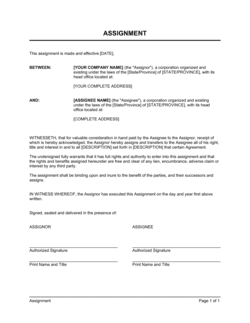
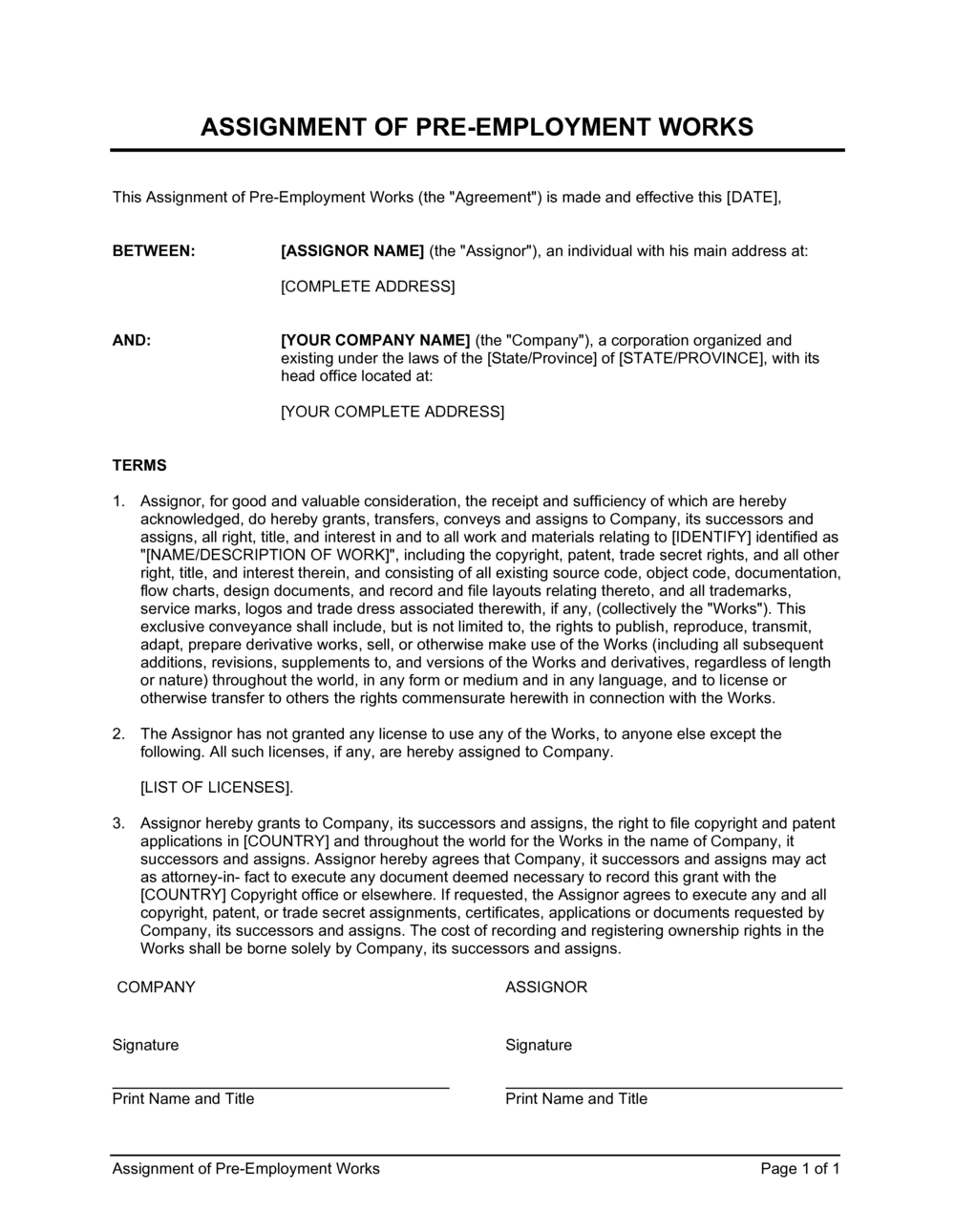
An Assignment of Pre-Employment Works is a legally binding agreement through which a new employee transfers ownership of specific intellectual property — inventions, software, designs, or creative works — created before their hire date to the employer. This free Word download gives you a structured, attorney-reviewed starting point you can edit online and export as PDF, covering prior work identification, scope of assignment, retained rights, and warranties.
When you need it
Use it when onboarding a new hire whose prior inventions, code, designs, or other IP will be used in, or are relevant to, the company's products or operations. It is also appropriate when a founder assigns pre-company IP to a newly incorporated entity before bringing on investors or co-founders.
What's inside
Identification of the parties and the specific prior works being assigned, a clear grant of assignment transferring all rights to the employer, representations and warranties from the assignor, a retained-rights carve-out for excluded works, consideration for the transfer, and governing law.

What is an Assignment of Pre-Employment Works?

An Assignment of Pre-Employment Works is a legally binding agreement through which a new employee or founder formally transfers ownership of intellectual property — source code, software, inventions, designs, written works, or other creative output — created before their employment start date to the employer. Unlike the IP assignment clause found in a standard employment contract, which only covers work created during the employment relationship, this document reaches back to capture specific prior works that are relevant to the company's business and that the employee is bringing with them to the role. It establishes a clear chain of title from the outset, identifies exactly which works are being transferred, and protects both parties by carving out works the employee retains.

Why You Need This Document

Without a signed assignment of pre-employment works, any IP the employee created before their first day remains legally theirs — regardless of how central it is to your product. A developer who writes the core algorithm for your platform before joining is still the legal copyright and patent owner of that code the moment they walk through the door. If they leave, they take those rights with them, and you may have built your entire product on IP you do not own. This gap is one of the most common reasons investors reject or delay funding rounds — VCs conduct IP due diligence on every deal, and undocumented prior works create title defects that block closings. An executed assignment of pre-employment works, completed at onboarding, closes that gap cleanly, gives your company a clear and defensible chain of title, and protects the employee too — by specifying exactly what they have given up and what personal projects they keep.

Which variant fits your situation?

If your situation is…Use this template
Assigning IP created during employment going forwardIntellectual Property Assignment Agreement
Protecting confidential information alongside IP assignmentEmployee Non-Disclosure Agreement
Full new-hire IP and confidentiality package in one documentEmployment Contract with IP Assignment
Assigning IP from a contractor before converting them to employeeIndependent Contractor IP Assignment
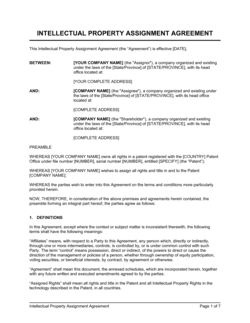
Transferring IP rights from a founder to a newly formed entityIP Assignment from Founder to Company
Disclosing but not assigning prior inventions — retaining employee rightsPrior Inventions Disclosure Schedule
Assigning all business IP during an acquisition or mergerBusiness Asset Purchase Agreement

Common mistakes to avoid

❌ Signing the agreement after the employee's start date

Why it matters: In common-law jurisdictions, an employee who has already started work has given no new consideration for the assignment, potentially voiding the entire transfer — especially for restrictive IP clauses.

Fix: Always execute before day one. If circumstances require a post-start signature, provide documented additional consideration — a cash bonus, salary increase, or extra PTO — at the time of signing.

❌ Using a catch-all description instead of a specific prior works schedule

Why it matters: Courts have voided IP assignments where the transferred works could not be identified with reasonable certainty, leaving the company with no enforceable ownership of the IP it thought it acquired.

Fix: Attach a Schedule A listing each work by name, creation date, and format. Have the employee initial the schedule at signing.

❌ Omitting the excluded-works carve-out

Why it matters: Without a clear Schedule B, employees worry that all their personal projects are being swept up, leading to refusal to sign, delayed onboarding, or a later challenge claiming the assignment was coerced.

Fix: Proactively offer a Schedule B for unrelated personal works. A generous carve-out costs nothing and substantially increases the likelihood of clean, uncontested execution.

❌ Failing to request prior employer IP agreement disclosures

Why it matters: If the works being assigned are also covered by the employee's previous employer's IP assignment, the company may acquire rights it cannot actually use — and face infringement claims from the prior employer.

Fix: Include a representation requiring the employee to disclose any prior employer agreements that might encumber the listed works. Review those agreements before finalizing Schedule A.

❌ Choosing a governing law that doesn't match the employee's work location

Why it matters: Several jurisdictions — California, Germany, and France in particular — apply mandatory local IP law to employment relationships regardless of what the contract states.

Fix: Set governing law to the state, province, or country where the employee will actually work. For remote employees in multiple jurisdictions, seek local legal advice for each relevant location.

❌ No further-assurances clause

Why it matters: Without it, a former employee who becomes hostile can refuse to sign patent applications or copyright registrations, leaving the company unable to formally register IP it contractually owns.

Fix: Include a standard further-assurances clause requiring the employee to execute any documents and take any actions reasonably necessary to perfect or register the company's rights.

The 10 key clauses, explained

Parties and recitals

In plain language: Identifies the employer and the employee or founder, states the date of the agreement, and explains the background — that the assignor created certain works before the employment relationship and the parties wish to clarify and transfer ownership.

Sample language
This Assignment of Pre-Employment Works ('Agreement') is entered into as of [DATE] by and between [COMPANY LEGAL NAME], a [STATE/COUNTRY] [ENTITY TYPE] ('Company'), and [EMPLOYEE FULL NAME] ('Assignor').

Common mistake: Using the employer's trade name instead of its registered legal entity. If the legal name on the agreement doesn't match the company's corporate registration, the assignment may be unenforceable against the entity that actually holds the IP.

Schedule of prior works

In plain language: An attached exhibit listing each specific work being assigned — with a description, creation date, and format — so there is no ambiguity about what is and is not transferred.

Sample language
The works listed in Schedule A attached hereto ('Prior Works') were created by Assignor prior to [START DATE] and include: [BRIEF DESCRIPTION OF WORK], created approximately [DATE], in the form of [CODE / DESIGN / MANUSCRIPT / OTHER].

Common mistake: Using vague catch-all language like 'all prior work related to the company's business' without a specific schedule. Courts have voided overbroad assignments where the work could not be identified with reasonable certainty.

Grant of assignment

In plain language: The operative clause where the assignor formally transfers all rights — copyright, patent, trade secret, and any other IP rights — in the prior works to the company, worldwide and in perpetuity.

Sample language
Assignor hereby irrevocably assigns to Company all right, title, and interest in and to the Prior Works, including all copyright, patent rights, trade secrets, and other intellectual property rights, worldwide, in perpetuity, for all media now known or hereafter developed.

Common mistake: Omitting the words 'irrevocably' and 'worldwide.' Courts have treated assignments without these qualifiers as potentially revocable licenses, leaving the company's ownership vulnerable to challenge.

Excluded and retained works

In plain language: Lists any prior works the employee is explicitly keeping — works unrelated to the company's business — so the assignment does not overreach and the employee has certainty about what they retain.

Sample language
Notwithstanding the foregoing, the parties agree that the works listed in Schedule B ('Excluded Works') are retained by Assignor and are not assigned under this Agreement.

Common mistake: Omitting this clause entirely to keep the agreement 'simple.' Employees who feel their personal projects are at risk may refuse to sign — or sign under protest and challenge the agreement later. A clear carve-out builds trust and improves enforceability.

Consideration

In plain language: States what the employee receives in exchange for the assignment — usually the offer of employment itself, and sometimes a nominal cash payment — to ensure the agreement is supported by valid legal consideration.

Sample language
In consideration of the Assignor's employment with the Company commencing [START DATE], and other good and valuable consideration, the receipt and sufficiency of which are hereby acknowledged, Assignor agrees to the terms of this Agreement.

Common mistake: Relying solely on 'love and affection' or leaving consideration entirely unstated. Without documented consideration, the assignment may be challenged as a gratuitous transfer, particularly if signed after employment has already begun.

Representations and warranties

In plain language: The assignor confirms they are the sole owner of the prior works, the works are original, no third-party rights or licenses encumber them, and the works do not infringe any existing IP rights.

Sample language
Assignor represents and warrants that: (a) Assignor is the sole owner of the Prior Works; (b) the Prior Works are original and do not infringe any third-party rights; (c) no liens, encumbrances, or third-party licenses apply to the Prior Works; and (d) Assignor has full authority to make this assignment.

Common mistake: Skipping warranties entirely to reduce negotiation friction. If the assigned IP later turns out to be co-owned with a prior employer or third party, the company has no contractual recourse against the assignor without warranty language.

Moral rights waiver

In plain language: Where applicable, the assignor waives any moral rights — such as rights of attribution or integrity — in the assigned works so the company can modify, sublicense, or commercialize them without restriction.

Sample language
To the extent permitted by applicable law, Assignor hereby irrevocably waives any and all moral rights in the Prior Works, including the right of attribution and the right of integrity, and consents to any modification, adaptation, or use of the Prior Works by Company.

Common mistake: Omitting the moral rights waiver in agreements involving EU, UK, or Canadian employees. Moral rights are inalienable in some of these jurisdictions — the waiver must be explicit and, in some cases, may not be fully effective regardless.

Further assurances and cooperation

In plain language: Requires the assignor to sign any additional documents, execute patent applications, and cooperate with the company's efforts to register or protect the assigned IP after the agreement is signed.

Sample language
Assignor agrees to execute any documents and take any further actions reasonably requested by Company to perfect, register, or enforce Company's rights in the Prior Works, including executing patent applications, copyright registrations, or assignment recordals.

Common mistake: No further-assurances clause at all. Without it, an assignor who later becomes hostile can refuse to sign patent applications or copyright registrations, leaving the company unable to formally register the IP.

Governing law and dispute resolution

In plain language: Specifies which jurisdiction's law governs the agreement and how disputes will be resolved — typically arbitration or the courts of a named state or country.

Sample language
This Agreement shall be governed by the laws of [STATE / PROVINCE / COUNTRY], without regard to its conflict-of-laws provisions. Any dispute shall be resolved by [binding arbitration / the courts of [JURISDICTION]].

Common mistake: Choosing a governing law with no connection to where the employee lives or works. Courts in several jurisdictions will apply local IP law regardless of the chosen governing law, particularly when the assignment affects an employee's statutory rights.

Entire agreement and severability

In plain language: Confirms the agreement is the complete record of the parties' understanding on this subject, and that if any clause is found unenforceable, the remaining clauses survive.

Sample language
This Agreement constitutes the entire agreement between the parties with respect to the subject matter hereof and supersedes all prior discussions. If any provision is found unenforceable, it shall be modified to the minimum extent necessary, and the remaining provisions shall remain in full force.

Common mistake: Omitting severability, especially in jurisdictions where certain IP assignment clauses are statutory exceptions — without it, one void clause could void the entire agreement.

How to fill it out

  1. 1

    Enter the legal entity names and effective date

    Use the company's full registered corporate name and the employee's full legal name as it appears on government-issued ID. Set the effective date to on or before the employee's first day of work.

    💡 Check your corporate registry filing for the exact legal name — a trade name on the agreement creates enforceability gaps if the IP is ever litigated.

  2. 2

    Build Schedule A — the prior works list

    Work with the incoming employee to identify every relevant prior work: describe each item clearly, include the approximate creation date, and specify its format (source code, design file, manuscript, patent application, etc.).

    💡 A vague description like 'software related to data analytics' is legally insufficient. Use the actual project or file name, the programming language, and the version or repository URL where possible.

  3. 3

    Define excluded works in Schedule B

    List any works the employee is explicitly retaining — personal projects, side businesses, or IP unrelated to the company's current or reasonably anticipated business activities.

    💡 Offering a clear excluded-works list dramatically improves employee willingness to sign. A generous carve-out for truly unrelated projects costs the company nothing and reduces signing friction significantly.

  4. 4

    Confirm the consideration clause is accurate

    State the employment offer — including the start date — as the primary consideration. If the agreement is signed by an existing employee (not a new hire), add a separate documented benefit such as a bonus or additional PTO as fresh consideration.

    💡 Post-start-date signatures are legally risky in common-law jurisdictions. If you cannot sign before day one, document the fresh consideration in writing before the signing date.

  5. 5

    Review and complete the representations and warranties

    Ensure the warranty section covers sole ownership, originality, absence of encumbrances, and no third-party infringement. Ask the employee to disclose any prior-employer IP agreements that might cloud ownership of the listed works.

    💡 Request copies of any prior employer's IP assignment or NDA that might cover the works being assigned. A disclosed conflict is far easier to resolve before the agreement is signed than after a dispute arises.

  6. 6

    Include the moral rights waiver if applicable

    If your company operates in or employs workers from the EU, UK, or Canada, retain the moral rights waiver clause and confirm with local counsel whether the waiver is enforceable in that jurisdiction.

    💡 In France and Germany, moral rights cannot be fully waived — the waiver language still demonstrates intent and limits practical exposure, but local counsel should advise on the residual risk.

  7. 7

    Set the governing law to the employee's work jurisdiction

    Use the state, province, or country where the employee will primarily perform their work — not simply where the company is headquartered.

    💡 California Labor Code §2870 carves out employee rights to IP developed entirely on personal time with no company resources. Ensure the schedule of prior works and excluded works are drafted with this in mind for California employees.

  8. 8

    Execute before or on the first day of work

    Both parties must sign the agreement before the employee's first day. Obtain wet or electronic signatures on both the main agreement and the schedules (Schedules A and B).

    💡 Have the employee initial each page of Schedule A to confirm they reviewed and agreed to the specific list — this prevents later claims that the schedule was added after signing.

Frequently asked questions

What is an assignment of pre-employment works?

An assignment of pre-employment works is a legally binding agreement through which a new employee or founder transfers ownership of specific intellectual property — code, designs, inventions, or creative works — created before their employment start date to the employer. Without this agreement, IP created before hire remains the property of the employee even if it is directly used in the company's products or operations.

Why can't an employment contract's IP assignment clause cover pre-employment works?

A standard employment IP assignment clause — including work-made-for-hire provisions — covers works created during the employment relationship. Works created before the employment start date fall outside the scope of that clause by definition. A separate pre-employment works assignment, with a specific schedule of the works and consideration for the transfer, is required to transfer ownership of those prior works to the company.

When should this agreement be signed?

It must be signed on or before the employee's first day of work. In common-law jurisdictions — the US, Canada, UK, and Australia — an employee who has already started work has given up nothing new, meaning a post-start signature may lack the consideration necessary to make the assignment enforceable. If you cannot execute before day one, provide documented additional consideration such as a bonus or salary increase at the time of signing.

Does the employee have to assign all of their prior work?

No — and they should not be asked to. The agreement should cover only works that are reasonably related to the company's current or anticipated business. Works the employee created entirely on personal time and unrelated to the company's business should be explicitly listed in a Schedule B of excluded works. Overreaching assignments are more likely to be challenged and can expose the company to liability for coercing an overbroad IP transfer.

What is the difference between this document and a standard IP assignment agreement?

A standard IP assignment agreement transfers rights in works created going forward — during the employment relationship — typically as part of the employment contract. An assignment of pre-employment works specifically addresses IP that already exists at the time of hire. Both documents are often used together as part of the new-hire onboarding packet, particularly for technical or creative roles.

Can prior employer IP agreements block a pre-employment works assignment?

Yes — if the works being assigned were created while the employee was subject to a prior employer's IP assignment agreement, the prior employer may have a superior claim. The assignment agreement should include a warranty requiring the employee to disclose any such prior agreements. If a conflict exists, it should be resolved — by obtaining a release from the prior employer or removing the conflicting works from Schedule A — before the new assignment is executed.

Is this agreement enforceable in California?

California Labor Code §2870 limits the scope of employee IP assignments: works developed entirely on personal time, with no company equipment or resources, and unrelated to the company's current or reasonably anticipated business, cannot be assigned under California law. For California employees, Schedule B should be drafted with these statutory exceptions in mind, and legal counsel should review the agreement to confirm compliance.

Does this agreement need to be notarized?

Notarization is not required for an assignment of pre-employment works to be legally binding in most jurisdictions. However, for works subject to formal registration — patents or copyright — the patent or copyright office may require a notarized assignment to record the transfer in its registry. Recording the assignment with the relevant IP registry is best practice and may be necessary to assert ownership against third parties.

What happens if the employee refuses to sign?

If the works at issue are central to the company's products or operations, an employee's refusal to assign them is a material issue that should be resolved before the hire is completed. Options include: restructuring the role to avoid relying on the disputed works, negotiating a license instead of an outright assignment, or in the case of founders, delaying incorporation of the new entity until IP is cleanly transferred.

How this compares to alternatives

vs Intellectual Property Assignment Agreement

A standard IP assignment agreement governs ownership of works created during the employment relationship — after the hire date. An assignment of pre-employment works addresses only works that already existed before employment began. Most technology companies use both: the pre-employment assignment at onboarding and a standard IP assignment clause in the employment contract for ongoing work.

vs Employment Contract (with IP clause)

An employment contract's IP assignment clause transfers rights in work created in the scope of employment — it does not reach back to capture pre-hire inventions. A standalone pre-employment works assignment is required as a separate document with its own schedule and consideration to cover those prior works. Both documents are typically signed together at onboarding.

vs Independent Contractor Agreement

A contractor agreement governs IP created by a self-employed individual during a project engagement, typically with a work-made-for-hire clause or assignment clause for deliverables. An assignment of pre-employment works specifically addresses what the person brought with them before any work relationship began. If a contractor converts to an employee, both a contractor IP assignment and a pre-employment works assignment may be needed.

vs Non-Disclosure Agreement

An NDA protects confidential information by restricting disclosure — it does not transfer ownership of any IP. An assignment of pre-employment works actively transfers title from the employee to the company. The two documents serve complementary purposes and are frequently signed together: the NDA protects confidential prior works from disclosure, while the assignment transfers ownership of those same works.

Industry-specific considerations

Technology / SaaS

Engineers commonly bring open-source projects, proprietary algorithms, or prototype code created at prior employers or during personal development — a precise schedule and prior-employer disclosure are essential.

Life Sciences and Biotech

Researchers may bring patentable inventions, cell lines, or research data from academic institutions — university IP policies often create competing ownership claims requiring resolution before assignment.

Creative and Media

Designers, writers, and video producers frequently hold copyright in prior work portfolios; moral rights waivers and specific work identification are critical in EU and UK jurisdictions.

Financial Services and Fintech

Proprietary trading models, analytics tools, and financial software created before hire carry significant value and prior-employer conflict risk — warranties and encumbrance representations require particular attention.

Manufacturing and Engineering

Mechanical engineers and industrial designers may bring patented or patent-pending inventions from prior roles; chain-of-title documentation and prior employer disclosure are critical before any patent filing.

Professional Services

Consultants and strategists converting to employee status often hold methodology IP, client frameworks, or proprietary tools — the excluded-works schedule must carefully delineate personal-practice tools from company-use assets.

Jurisdictional notes

United States

California Labor Code §2870 prohibits assigning works developed entirely on personal time with no company resources and unrelated to the company's business — Schedule B should reflect these statutory carve-outs. Delaware and New York impose no equivalent statutory limits. Federal patent law requires a written assignment to transfer patent rights; recording with the USPTO within three months of execution protects against intervening transfers.

Canada

Canadian common law generally permits broad IP assignments as part of the employment consideration, but provincial employment standards acts may affect enforceability if the assignment was signed after the employment start date without fresh consideration. Quebec's Civil Code requires agreements to be in French for provincially regulated employers and may impose additional formality requirements on IP transfers. Copyright moral rights — the right of attribution and integrity — exist under the Copyright Act and must be waived explicitly.

United Kingdom

The Copyright, Designs and Patents Act 1988 gives employers automatic ownership of works created by employees in the course of employment — but pre-employment works fall outside this rule and require a written assignment. Moral rights under UK copyright law are personal to the author and cannot be transferred, only waived; the waiver must be in writing and signed. The agreement should be governed by the law of England and Wales or Scotland as appropriate to the employee's work location.

European Union

EU member states vary significantly on employee IP rights — Germany's Employee Inventions Act (ArbNErfG) requires employers to formally claim inventions and may entitle employees to additional compensation even after assignment. In France, moral rights are perpetual, inalienable, and cannot be waived under any circumstances. The EU Software Directive provides some employer rights in software created by employees, but pre-employment software falls outside this scope. GDPR implications arise if the prior works contain personal data — the assignment must not purport to transfer data in violation of GDPR.

Template vs lawyer — what fits your deal?

PathBest forCostTime
Use the templateStartups and small businesses onboarding employees with clearly identified, low-complexity prior works in a single domestic jurisdictionFree30 minutes per hire
Template + legal reviewTechnical hires with significant prior inventions, employees in IP-sensitive industries, or any hire subject to a prior employer IP agreement$300–$800 for a 1–2 hour IP attorney review2–5 business days
Custom draftedFounders assigning pre-incorporation IP before a funding round, cross-border hires with competing prior employer claims, or high-value patent-pending inventions$1,500–$5,000+1–3 weeks

Glossary

Assignor
The person transferring ownership of the intellectual property — typically the new employee or founder.
Assignee
The party receiving ownership of the intellectual property — typically the employer or the company entity.
Pre-Employment Works
Inventions, software, designs, creative works, or other IP that the assignor created before the employment start date.
Schedule of Prior Works
An attached list identifying each specific work being assigned, including a brief description, creation date, and format.
Excluded Works
Works the employee explicitly retains ownership of — those that are not related to the company's business and are listed on a retained-rights schedule.
Consideration
The benefit given in exchange for the assignment — typically the offer of employment itself or a nominal monetary payment — making the contract legally binding.
Moral Rights
Non-economic rights an author holds in creative works — such as the right to attribution — which in some jurisdictions must be expressly waived in addition to assigning economic rights.
Chain of Title
The documented sequence of ownership transfers for a piece of IP, proving the current holder has a clear and unencumbered right to it.
Work Made for Hire
A US copyright doctrine under which certain works created by employees in the scope of employment automatically belong to the employer — pre-employment works fall outside this doctrine.
Encumbrance
Any third-party claim, license, or lien on the IP being assigned — the assignor typically warrants that the works are free of encumbrances at the time of transfer.
Warranties
Binding representations made by the assignor — such as confirming they are the sole owner, the works are original, and no third-party rights exist — which survive the assignment.

Part of your Business Operating System

This document is one of 3,000+ business & legal templates included in Business in a Box.

  • Fill-in-the-blanks — ready in minutes
  • 100% customizable Word document
  • Compatible with all office suites
  • Export to PDF and share electronically

Create your document in 3 simple steps.

From template to signed document — all inside one Business Operating System.
1
Download or open template

Access over 3,000+ business and legal templates for any business task, project or initiative.

2
Edit and fill in the blanks with AI

Customize your ready-made business document template and save it in the cloud.

3
Save, Share, Send, Sign

Share your files and folders with your team. Create a space of seamless collaboration.

Save time, save money, and create top-quality documents.

★★★★★

"Fantastic value! I'm not sure how I'd do without it. It's worth its weight in gold and paid back for itself many times."

Managing Director · Mall Farm
Robert Whalley
Managing Director, Mall Farm Proprietary Limited
★★★★★

"I have been using Business in a Box for years. It has been the most useful source of templates I have encountered. I recommend it to anyone."

Business Owner · 4+ years
Dr Michael John Freestone
Business Owner
★★★★★

"It has been a life saver so many times I have lost count. Business in a Box has saved me so much time and as you know, time is money."

Owner · Upstate Web
David G. Moore Jr.
Owner, Upstate Web

Run your business with a system — not scattered tools

Stop downloading documents. Start operating with clarity. Business in a Box gives you the Business Operating System used by over 250,000 companies worldwide to structure, run, and grow their business.

Free Forever Plan · No credit card required