LLC Membership Agreement Template

Free Word download β€’ Edit online β€’ Save & share with Drive β€’ Export to PDF

4 pagesβ€’25–30 min to fillβ€’Difficulty: Complexβ€’Signature requiredβ€’Legal review recommended
Learn more ↓
FreeLLC Membership Agreement Template

At a glance

What it is
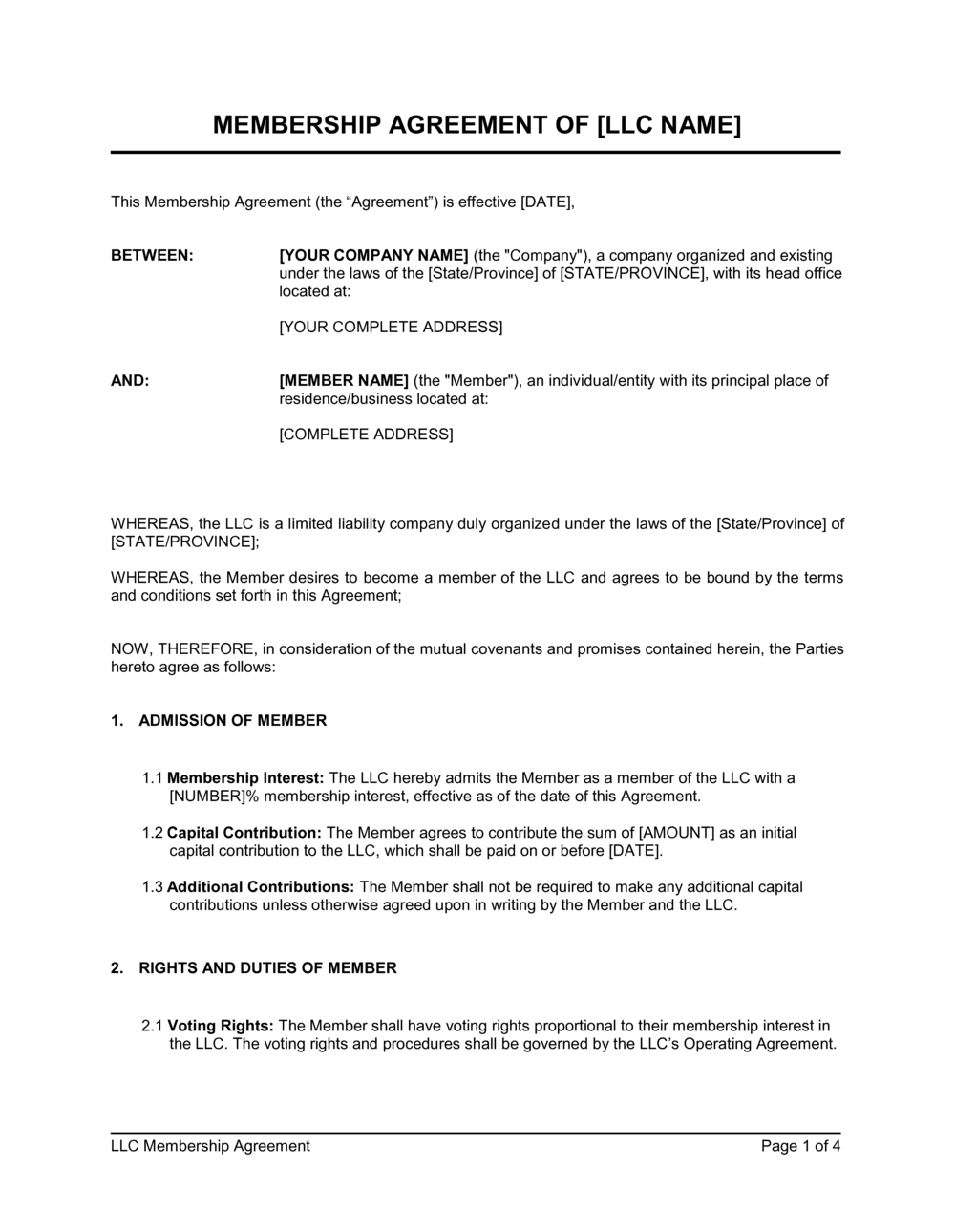
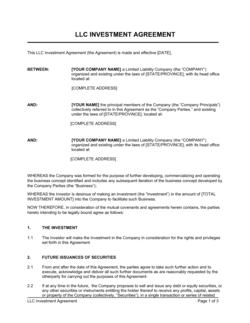
An LLC Membership Agreement is a legally binding document among the members of a limited liability company that governs ownership percentages, capital contributions, profit and loss allocations, voting rights, management structure, and procedures for admitting or removing members. This free Word download gives you a structured, attorney-reviewed starting point you can edit online and export as PDF to formalize your LLC's internal governance from day one.
When you need it
Use it when forming a new multi-member LLC, adding a new member to an existing LLC, restructuring ownership percentages, or replacing an informal or incomplete operating agreement that no longer reflects how the business actually operates.
What's inside
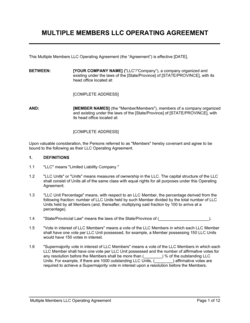
Member names and ownership percentages, capital contribution schedule, profit and loss allocation rules, voting thresholds and management authority, transfer and buyout restrictions, member exit and dissolution procedures, and governing law provisions.

What is an LLC Membership Agreement?

An LLC Membership Agreement β€” also called an operating agreement β€” is a legally binding contract among the members of a limited liability company that defines each member's ownership interest, capital contribution obligations, share of profits and losses, voting rights, management authority, and rights and procedures upon a member's exit or the LLC's dissolution. Unlike the Articles of Organization filed with the state, the membership agreement is a private document that governs the LLC's internal affairs in full operational detail. It replaces the default rules of the applicable state LLC statute with terms the members have actually negotiated and agreed to, and it serves as the primary reference document for resolving any future dispute among members about how the business is supposed to operate.

Why You Need This Document

Without a written LLC membership agreement, your LLC operates under whatever default rules your state legislature wrote β€” rules that almost certainly do not reflect how you and your co-members actually intend to run the business. In most states, those defaults allocate profits equally per capita regardless of capital contributed, give each member identical voting power regardless of ownership percentage, and provide no mechanism to force out a disruptive member or value a departing member's interest. The practical consequences are severe: a 70% owner can be outvoted on distributions by the two 15% members acting together, a member who contributed nothing can claim an equal share of profits, and a deadlocked two-member LLC with no tiebreaker provision faces court-ordered dissolution as the only available remedy. Banks and institutional investors routinely require a signed membership agreement before opening accounts or funding transactions. This template gives you a complete, attorney-reviewed starting point that closes every major governance gap β€” so your LLC operates on your terms from day one rather than the state's defaults.

Which variant fits your situation?

If your situation is…Use this template
Single founder with no other members now but planning to add them laterSingle-Member LLC Operating Agreement
Two or more equal partners launching a new business togetherMulti-Member LLC Membership Agreement
LLC structured with a designated manager rather than member managementManager-Managed LLC Operating Agreement
Real estate holding LLC with passive investor membersReal Estate LLC Operating Agreement
Members seeking to add buy-sell provisions tied to life or disability eventsBuy-Sell Agreement
LLC member departing and transferring their interest to a new partyLLC Membership Interest Transfer Agreement
Dissolving an LLC and winding up member distributionsLLC Dissolution Agreement

Common mistakes to avoid

❌ Operating without any written membership agreement

Why it matters: State default LLC statutes β€” not your actual intentions β€” govern every dispute. Default rules in most states allocate profits equally per capita, not by contribution, and give each member equal voting power regardless of ownership percentage.

Fix: Execute a membership agreement before the LLC begins operations or accepts any capital contributions, even if the document is a simple one-page version that will be expanded later.

❌ Omitting a deadlock resolution clause in a 50/50 LLC

Why it matters: Equal-split LLCs with no tiebreaker mechanism are routinely dissolved by courts when members cannot agree β€” regardless of how valuable the business is or how much both parties want to continue operating.

Fix: Include a buy-sell or mediation-then-arbitration clause specifically triggered by deadlock. A well-drafted shotgun provision typically resolves gridlock without litigation because neither party wants to be caught with an unfair offer.

❌ No mandatory tax distribution provision

Why it matters: LLC income passes through to members' personal tax returns whether or not cash is distributed. Without a mandatory tax distribution, members can face five-figure tax bills on profits they never received.

Fix: Add a clause requiring the LLC to distribute to each member an amount equal to at least their estimated federal and state income tax liability on allocated LLC income, payable quarterly.

❌ Vague or absent valuation method for buyouts

Why it matters: When a member exits and there is no agreed valuation formula, the parties negotiate from incompatible starting positions β€” one using book value, the other using a revenue multiple. This is the primary driver of LLC dissolution litigation.

Fix: Specify the buyout valuation method in the agreement: either a formula (e.g., 4Γ— trailing EBITDA), a designated appraiser selection process, or a fixed buy-sell price review schedule.

❌ Signing the agreement after capital contributions are already made

Why it matters: Provisions in a signed agreement that retroactively govern contributions already made may be unenforceable in common-law jurisdictions, particularly those covering allocation and distribution of funds already in the LLC's account.

Fix: Execute the membership agreement before any member transfers cash or property to the LLC. If contributions have already been made, treat them as loans or deposits until the agreement is signed, then convert them.

❌ Confusing membership interest percentages with distribution percentages

Why it matters: Some LLCs allocate profits differently from ownership percentages for legitimate business reasons, but doing so without coordinated tax advice creates IRS audit risk and member disputes.

Fix: Either align profit allocations with ownership percentages for simplicity, or engage a CPA experienced in partnership tax to document the substantial economic effect of any special allocations.

The 10 key clauses, explained

Parties, formation, and registered agent

In plain language: Identifies all members by full legal name, records the LLC's formation state and date, and states the registered agent and principal place of business.

Sample language
This LLC Membership Agreement is entered into as of [DATE] by and among [MEMBER 1 FULL NAME], [MEMBER 2 FULL NAME], and [MEMBER 3 FULL NAME] (collectively, 'Members') with respect to [LLC NAME], a limited liability company organized under the laws of [STATE], with its principal office at [ADDRESS].

Common mistake: Using a member's nickname or trade name instead of their legal name. Enforcement and tax reporting both require names that match government-issued ID and IRS records.

Membership interests and capital contributions

In plain language: States each member's ownership percentage or unit count and the amount, type, and deadline for their initial capital contribution.

Sample language
Member 1 holds [X]% of the Membership Interests in exchange for a capital contribution of $[AMOUNT] due no later than [DATE]. Member 2 holds [Y]% in exchange for $[AMOUNT] of services valued at $[AMOUNT].

Common mistake: Failing to specify the form and deadline for contributions. An undocumented service contribution has no agreed value and can create IRS taxable-income disputes for both the member and the LLC.

Profit and loss allocations

In plain language: Defines how the LLC's annual net income and net loss are split among members β€” typically pro rata to membership interest, but can include special allocations.

Sample language
Net profit and net loss of the LLC shall be allocated among the Members in proportion to their respective Membership Interests, unless otherwise unanimously agreed in writing.

Common mistake: Using allocations that differ from distribution percentages without a qualified tax professional reviewing the structure. Mismatched allocations trigger IRS scrutiny under the substantial economic effect rules.

Distributions

In plain language: Sets the timing, frequency, and discretion rules for distributing cash or property to members β€” including whether tax distributions are mandatory.

Sample language
The LLC shall make distributions to Members at such times and in such amounts as determined by a [MAJORITY / SUPERMAJORITY] vote of the Members, provided that the LLC shall distribute to each Member an amount sufficient to cover that Member's estimated federal and state income tax liability attributable to LLC income (a 'Tax Distribution') within [30] days of each fiscal quarter end.

Common mistake: Omitting a mandatory tax distribution clause. Pass-through entities allocate taxable income to members whether or not cash is distributed; members can face tax bills with no corresponding cash payout.

Management authority and voting rights

In plain language: Specifies whether the LLC is member-managed or manager-managed, identifies the initial manager(s) if applicable, and sets voting thresholds for routine and major decisions.

Sample language
The LLC shall be [member-managed / manager-managed]. Routine business decisions require approval by Members holding a majority of Membership Interests. The following actions require approval by Members holding at least [X]% of Membership Interests: [MAJOR DECISIONS LIST].

Common mistake: Not listing specific major decisions requiring a supermajority. Without this list, any member can argue that selling company assets or taking on significant debt needs only a simple majority vote.

Transfer restrictions and right of first refusal

In plain language: Prohibits members from transferring their interest without consent and gives existing members the right to purchase a transferring member's interest before it goes to a third party.

Sample language
No Member may transfer, sell, assign, pledge, or encumber all or any portion of their Membership Interest without the prior written consent of Members holding at least [X]% of Membership Interests. Any proposed transfer shall first be offered to the remaining Members pro rata at the same price and terms offered by the proposed transferee.

Common mistake: Including a blanket transfer prohibition with no exception for transfers to a member's wholly-owned trust or family holding entity. This forces unnecessary consent rounds for routine estate-planning moves.

Member withdrawal and exit procedures

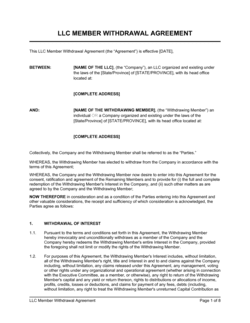
In plain language: Defines whether voluntary withdrawal is permitted, the notice required, and how the departing member's interest is valued and purchased.

Sample language
A Member may withdraw by providing [60] days' written notice to the LLC and the other Members. Upon withdrawal, the withdrawing Member's interest shall be purchased by the LLC at Fair Market Value as determined by a mutually agreed appraiser, with payment due within [90] days of valuation.

Common mistake: No valuation methodology for the buyout price. When members disagree on value and there is no agreed formula or appraisal process, exit disputes routinely end in litigation.

Deadlock resolution

In plain language: Establishes a procedure for breaking gridlock when members holding equal votes cannot reach a decision β€” including mediation, buy-sell triggers, or designated tiebreaker authority.

Sample language
If the Members are unable to reach a decision on a matter requiring approval after [30] days of good-faith negotiation, either Member may invoke the buy-sell procedure in Schedule [X], under which one Member offers to buy the other's interest at a stated price and the other Member must either sell at that price or buy the offeror's interest at the same price.

Common mistake: Leaving deadlock resolution out of a 50/50 LLC entirely. Equal-split LLCs with no deadlock clause are the single most common source of LLC litigation and court-ordered dissolution.

Dissolution and winding up

In plain language: Lists the events that trigger dissolution, the order in which assets are distributed (creditors first, then members pro rata), and who manages the wind-up process.

Sample language
The LLC shall dissolve upon: (a) unanimous written consent of all Members; (b) entry of a judicial dissolution order; or (c) the occurrence of any event that makes continuation unlawful. Upon dissolution, assets shall be applied first to LLC debts and obligations, then to Members in proportion to their positive capital account balances.

Common mistake: Not specifying the wind-up manager. When no one is designated, each member may act unilaterally, creating conflicting obligations to creditors and delaying the closing of the LLC's affairs.

Governing law and dispute resolution

In plain language: States which state's LLC statutes govern the agreement and whether disputes are resolved by arbitration, mediation, or litigation in a specified forum.

Sample language
This Agreement is governed by the laws of the State of [STATE], without regard to conflicts of law principles. Any dispute arising under this Agreement shall be resolved by binding arbitration administered by [AAA / JAMS] in [CITY, STATE], except that any party may seek injunctive relief in a court of competent jurisdiction.

Common mistake: Choosing a governing state with no connection to where the LLC operates or its members reside. Courts in the operating state may apply local LLC statutes regardless of the governing-law clause.

How to fill it out

  1. 1

    Confirm the LLC's legal name and formation details

    Enter the LLC's full registered name exactly as it appears on the Articles of Organization, the state of formation, the formation date, and the registered agent's name and address.

    πŸ’‘ Pull the information directly from your filed Articles of Organization β€” mismatches between the agreement and state records can complicate banking, contracts, and tax filings.

  2. 2

    List all members with their legal names and ownership percentages

    Enter each member's full legal name (or entity name and state of formation for entity members), their membership interest percentage, and the nature of their capital contribution β€” cash, property, or services.

    πŸ’‘ Ownership percentages must add up to exactly 100%. If you plan to reserve an equity pool for future members, establish it as a separate unissued interest at formation.

  3. 3

    Set the capital contribution amounts and deadlines

    Specify the dollar amount (or fair market value for non-cash contributions), the form of contribution, and the date by which each member must fund their commitment.

    πŸ’‘ For service contributions, get a written valuation at the time of agreement β€” the IRS may later challenge an undocumented service valuation and treat it as ordinary income to the contributing member.

  4. 4

    Define profit and loss allocations and distribution rules

    Decide whether allocations and distributions follow ownership percentages or use a custom formula. If you use a custom formula, note that special allocations must satisfy the IRS substantial economic effect test β€” consult a tax professional.

    πŸ’‘ Always include a mandatory tax distribution clause so members are not taxed on phantom income β€” profits allocated to them on paper but never paid out in cash.

  5. 5

    Select member-managed or manager-managed structure

    Choose the management model and, if manager-managed, name the initial manager(s). Then list the specific decisions that require a supermajority vote β€” at minimum: admitting new members, selling substantially all assets, taking on debt over a threshold, and amending the agreement.

    πŸ’‘ A defined list of major decisions is more useful than a vague 'extraordinary matters' standard. Courts enforce specific thresholds; they fill ambiguity with default statutory rules.

  6. 6

    Draft transfer restrictions and the right of first refusal

    Set the consent threshold required for any transfer and document the right-of-first-refusal mechanics β€” offer price, response period (typically 30 days), and proration among remaining members.

    πŸ’‘ Include a carve-out permitting transfers to a member's revocable living trust or wholly-owned holding entity without triggering the ROFR β€” this avoids friction on common estate-planning moves.

  7. 7

    Add a deadlock resolution mechanism for equal-split LLCs

    If the LLC has two members with equal ownership, include a buy-sell or shotgun clause that allows either member to trigger a forced purchase at a stated price. This is the only reliable way to resolve a true 50/50 deadlock short of litigation.

    πŸ’‘ The Texas-style 'shotgun' provision β€” one member names a price, the other must buy or sell at that price β€” creates strong incentives for both parties to propose a fair valuation.

  8. 8

    Sign before commencing operations or accepting contributions

    All members must sign the agreement before the LLC begins operations or any capital is contributed. Backdating or signing after contributions have been made weakens the agreement's enforceability on capital-call and allocation provisions.

    πŸ’‘ Use an e-signature platform that timestamps each signature and archives the fully-executed copy. Store a copy alongside the Articles of Organization in your LLC's permanent records.

Frequently asked questions

What is an LLC membership agreement?

An LLC membership agreement β€” also called an operating agreement β€” is a legally binding contract among the members of a limited liability company that governs ownership interests, capital contributions, voting rights, profit distributions, management authority, and exit procedures. It functions as the LLC's internal constitution, replacing state default rules with terms the members actually agreed to. Most states do not require one to be filed publicly, but operating without one exposes members to unpredictable default statutory rules.

Is an LLC membership agreement legally required?

Most US states do not require a written LLC operating agreement to form an LLC, but several β€” including California, Delaware, Maine, Missouri, and New York β€” do require one. Even in states where it is not mandatory, virtually every business attorney recommends executing one before the LLC begins operations. Without a written agreement, state default rules govern disputes, often producing outcomes that differ sharply from what the members intended.

What is the difference between an LLC membership agreement and articles of organization?

Articles of organization are the public formation document filed with the state to legally create the LLC β€” they contain minimal information such as the LLC name, registered agent, and management type. A membership agreement is a private contract among the members that governs the LLC's internal operations in full detail. Both are needed: the articles create the legal entity; the membership agreement governs how it actually runs.

Can a single-member LLC use this agreement?

Single-member LLCs benefit from an operating agreement even without multiple parties, primarily to document the owner's capital account, confirm the LLC's separation from the owner's personal finances, and satisfy banking requirements. However, a single-member operating agreement is structurally simpler β€” it omits voting, deadlock, and transfer provisions. This multi-member membership agreement template is designed for LLCs with two or more members.

How do I split ownership percentages in an LLC?

Ownership percentages should reflect each member's relative capital contribution, sweat equity, and risk allocation β€” there is no legally mandated formula. Equal splits (e.g., 50/50 or 33/33/34) are common but carry deadlock risk for two-member LLCs. Contribution-weighted splits are more common in capital-intensive businesses. Whatever percentages are chosen, document the rationale and the valuation basis for any non-cash contributions at the time of agreement.

What happens if an LLC has no membership agreement and a member wants to leave?

Without a written agreement, the departing member's rights are governed entirely by state default LLC statutes, which vary significantly. In most states, a member cannot be forced out, their interest cannot be bought out at a mandated price, and there is no defined valuation mechanism. The result is typically a protracted negotiation or litigation. A written agreement with a defined exit and valuation procedure resolves this in days rather than months.

Do all LLC members need to sign the membership agreement?

Yes. Every member whose name appears in the agreement must sign it for the document to be binding on all parties. New members added after the initial formation typically sign a joinder agreement β€” a short document confirming they have read and agree to be bound by the existing membership agreement β€” rather than requiring all original members to re-sign a new agreement.

Can an LLC membership agreement be amended?

Yes, but amendment typically requires the approval threshold specified in the agreement β€” commonly a supermajority (66% or 75%) or unanimous consent for fundamental changes. The agreement should specify both the vote required to amend and the process (written notice, a stated period for review, and a signed written amendment). Oral amendments are generally not enforceable.

Should I hire a lawyer to draft my LLC membership agreement?

For simple two-member LLCs with equal splits and straightforward operations, a high-quality template reviewed by the members is usually sufficient. Engage a lawyer when the LLC has three or more members with unequal economics, when the business involves significant assets or IP, when members are in different states or countries, when special tax allocations are planned, or when outside investors are involved. A 2–3 hour attorney review typically costs $400–$900 and is strongly recommended before any significant capital is contributed.

How this compares to alternatives

vs Partnership Agreement

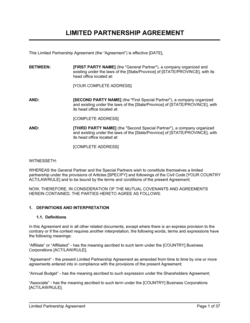
A partnership agreement governs a general or limited partnership β€” a business structure where at least one partner bears unlimited personal liability for business debts. An LLC membership agreement covers an LLC, where all members are shielded from personal liability by the LLC's corporate veil. The documents address similar governance questions but exist in different legal frameworks with different risk profiles for the parties.

vs Shareholder Agreement

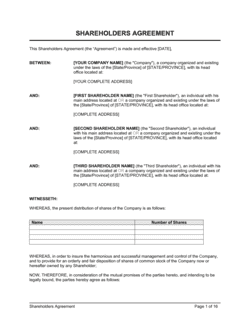
A shareholder agreement governs a corporation's equity holders, covering share classes, board composition, dividend policy, and drag-along rights. An LLC membership agreement covers the equivalent ground for LLC members, but uses membership interest units rather than shares, and the LLC structure offers more flexible tax treatment. Corporations suit companies planning a venture-backed funding path or IPO; LLCs suit businesses preferring pass-through taxation and simpler governance.

vs Buy-Sell Agreement

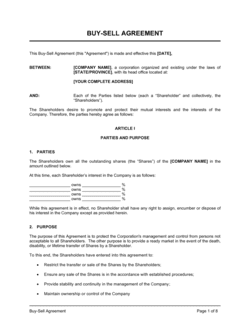
A buy-sell agreement is a standalone document that governs the transfer of ownership interests when a triggering event occurs β€” death, disability, divorce, or voluntary exit. An LLC membership agreement typically incorporates buy-sell provisions within the broader governance framework, but a standalone buy-sell agreement provides more detailed valuation mechanics and funding provisions (such as life insurance requirements). For LLCs with significant buyout risk, both documents are often used together.

vs Joint Venture Agreement

A joint venture agreement covers a collaboration between two or more existing entities for a specific project or purpose, often without forming a new legal entity. An LLC membership agreement governs an actual LLC entity with ongoing operations, full limited liability protection, and formal governance requirements. Joint ventures are typically time-limited and project-scoped; LLC membership agreements govern indefinite, general-purpose business operations.

Industry-specific considerations

Real estate investment

Distribution waterfall clauses prioritize preferred returns to passive investors before residual profits flow to the managing member, and transfer restrictions prevent co-investors from selling to unknown third parties mid-project.

Technology and SaaS

IP assignment provisions confirm that all software and technology developed by member-employees vests in the LLC, not the individual members, from day one.

Professional services

Licensing and credentialing conditions restrict membership to licensed professionals in states that prohibit non-professional ownership of licensed-service LLCs.

Food and beverage

Operational authority clauses designate a managing member responsible for liquor licensing, health department compliance, and day-to-day vendor relationships without requiring full-member votes for routine decisions.

Construction and real estate development

Project-specific LLCs use the agreement to define each member's contribution (land, capital, or construction services), the timeline for contributions, and the distribution order upon project sale.

Family-owned businesses

Succession and transfer provisions include family-only transfer carve-outs, buy-sell triggers tied to death or incapacity, and life-insurance-funded buyout mechanisms to keep ownership within the family.

Jurisdictional notes

United States

LLC law is state-specific β€” Delaware, Wyoming, and Nevada are popular formation states for their flexible statutes, but the LLC's operating state may impose its own requirements regardless of where it was formed. California, New York, and a handful of other states require a written operating agreement by statute. Several states (including California and New York) require periodic public filings that may reference the agreement. Non-compete and IP assignment clauses in the agreement must comply with the governing state's employment and trade-secret laws.

Canada

Canada does not have a direct equivalent to a US LLC β€” the closest analogues are limited partnerships or corporations depending on the province. Some provinces allow a limited liability partnership (LLP) for professionals. US-style LLC agreements are sometimes used for Canadian subsidiaries of US LLCs, but Canadian counsel should review any such structure for compliance with provincial business corporation acts and CRA tax treatment of the LLC's income.

United Kingdom

The UK does not recognize the US LLC as a domestic entity form. The nearest equivalent is a Limited Liability Partnership (LLP), which requires an LLP Members' Agreement rather than a US-style LLC membership agreement. US LLCs operating in the UK may face HMRC classification issues β€” HMRC has historically treated certain US LLCs as opaque (corporation-equivalent) rather than transparent (partnership-equivalent), affecting how income is taxed for UK-resident members. UK counsel review is essential for any cross-border LLC structure.

European Union

EU member states each have their own equivalent to limited liability entities β€” the GmbH (Germany and Austria), SARL (France), SL (Spain), and Srl (Italy) are common examples. US LLCs are not recognized as domestic EU entities and face varied tax treatment across member states. GDPR compliance should be addressed in the agreement if the LLC processes personal data of EU residents. Cross-border EU members should ensure the agreement's governing law and dispute resolution clauses are enforceable in each relevant member state.

Template vs lawyer β€” what fits your deal?

PathBest forCostTime
Use the templateTwo-member LLCs with equal splits, straightforward cash contributions, and simple pass-through tax needsFree1–2 hours
Template + legal reviewLLCs with three or more members, unequal economics, special allocations, or significant contributed assets$400–$900 (2–3 hour attorney review)2–5 days
Custom draftedLLCs with outside investors, preferred return waterfalls, complex IP, multi-state or international members, or planned capital raises$2,000–$8,000+2–4 weeks

Glossary

Membership Interest
A member's ownership stake in an LLC, expressed as a percentage or number of units, which determines their share of profits, losses, and voting power.
Capital Contribution
Cash, property, or services a member contribuves to the LLC in exchange for their membership interest.
Operating Agreement
The foundational governance document for an LLC β€” sometimes called a membership agreement β€” that sets out the rights and obligations of all members.
Profit and Loss Allocation
The formula that determines how each member's share of net income or net loss is calculated and attributed for tax and distribution purposes.
Distributions
Cash or property paid out to LLC members from profits or capital, as distinct from salary or guaranteed payments.
Voting Threshold
The percentage of member votes required to approve a specific decision β€” e.g., a simple majority (50%+1) for routine matters, a supermajority (66% or 75%) for major actions.
Transfer Restriction
A clause limiting a member's ability to sell, gift, or pledge their membership interest to a third party without the consent of the other members.
Right of First Refusal
A provision giving existing members the right to purchase a departing member's interest on the same terms offered by an outside buyer before the outside sale can proceed.
Manager-Managed LLC
An LLC structure in which day-to-day authority is delegated to one or more designated managers rather than exercised collectively by all members.
Guaranteed Payment
A fixed payment made to a member for services or capital, similar in function to a salary, that is deductible by the LLC and taxable to the member regardless of profit.
Dissolution Event
A triggering event β€” such as unanimous member vote, a member's death, or a court order β€” that initiates the winding-up and termination of the LLC.

Part of your Business Operating System

This document is one of 3,000+ business & legal templates included in Business in a Box.

  • Fill-in-the-blanks β€” ready in minutes
  • 100% customizable Word document
  • Compatible with all office suites
  • Export to PDF and share electronically

Create your document in 3 simple steps.

From template to signed document β€” all inside one Business Operating System.
1
Download or open template

Access over 3,000+ business and legal templates for any business task, project or initiative.

2
Edit and fill in the blanks with AI

Customize your ready-made business document template and save it in the cloud.

3
Save, Share, Send, Sign

Share your files and folders with your team. Create a space of seamless collaboration.

Save time, save money, and create top-quality documents.

β˜…β˜…β˜…β˜…β˜…

"Fantastic value! I'm not sure how I'd do without it. It's worth its weight in gold and paid back for itself many times."

Managing Director Β· Mall Farm
Robert Whalley
Managing Director, Mall Farm Proprietary Limited
β˜…β˜…β˜…β˜…β˜…

"I have been using Business in a Box for years. It has been the most useful source of templates I have encountered. I recommend it to anyone."

Business Owner Β· 4+ years
Dr Michael John Freestone
Business Owner
β˜…β˜…β˜…β˜…β˜…

"It has been a life saver so many times I have lost count. Business in a Box has saved me so much time and as you know, time is money."

Owner Β· Upstate Web
David G. Moore Jr.
Owner, Upstate Web

Run your business with a system β€” not scattered tools

Stop downloading documents. Start operating with clarity. Business in a Box gives you the Business Operating System used by over 250,000 companies worldwide to structure, run, and grow their business.

Start freeΒ Β·Β No credit card required