Office and Administrative Personel Job Description Template

Free Word download β€’ Edit online β€’ Save & share with Drive β€’ Export to PDF

2 pagesβ€’20–30 min to fillβ€’Difficulty: Standardβ€’Signature requiredβ€’Legal review recommended
Learn more ↓
FreeOffice and Administrative Personel Job Description Template

At a glance

What it is
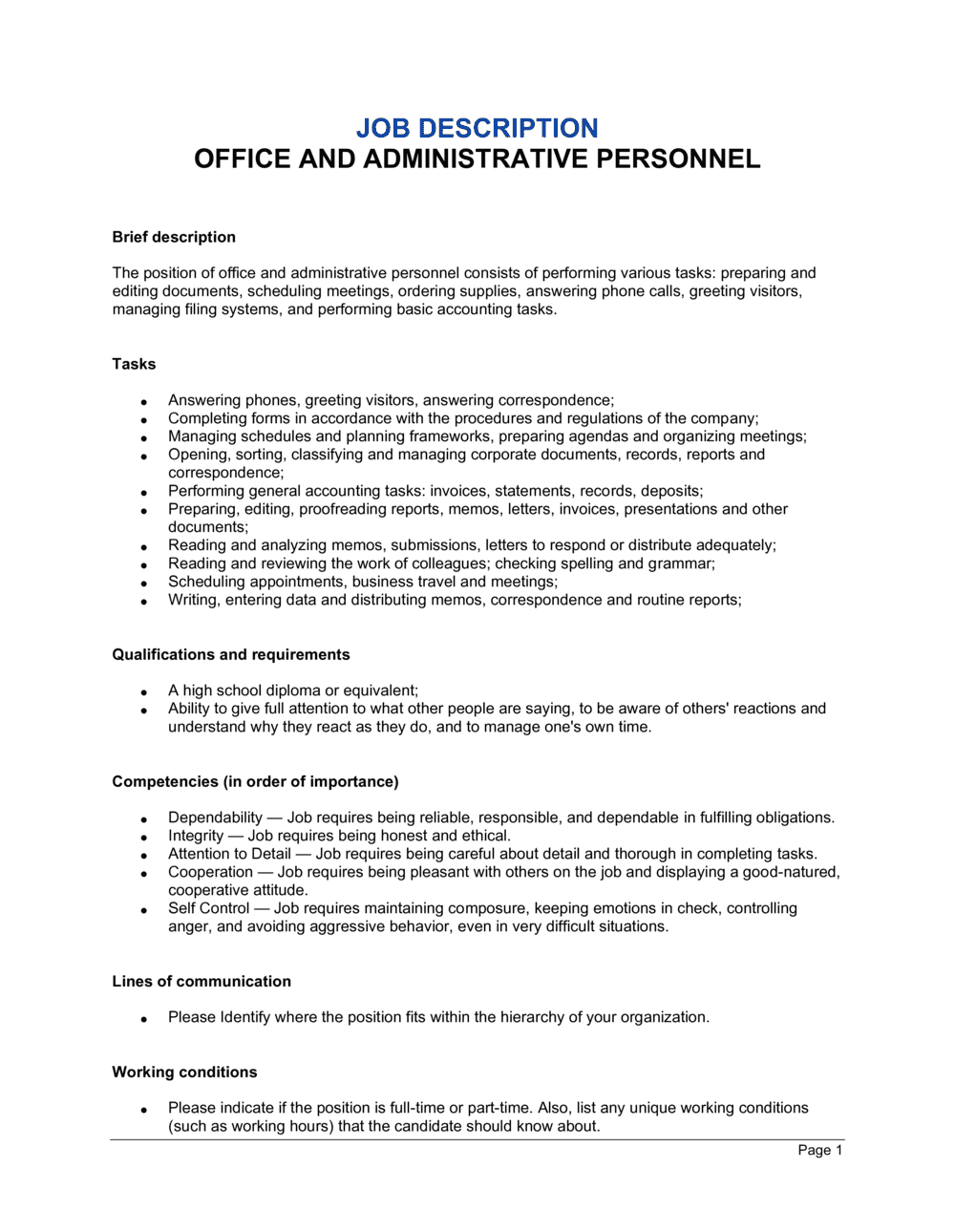
An Office and Administrative Personnel Job Description is a formal document that defines the duties, qualifications, reporting relationships, and performance expectations for office-based and administrative roles. This free Word download gives you a professionally structured starting point you can edit online and export as PDF β€” covering everything from daily tasks and required skills to compensation range and employment conditions.
When you need it
Use it when posting a new administrative vacancy, formalizing an existing role, or updating outdated position descriptions during a company reorganization. It also forms part of the employment agreement package when onboarding a new hire.
What's inside
Job title and department, position summary, reporting structure, core duties and responsibilities, required and preferred qualifications, compensation and benefits overview, working conditions, and acknowledgement signature block.

What is an Office and Administrative Personnel Job Description?

An Office and Administrative Personnel Job Description is a formal document that defines the title, duties, qualifications, reporting relationships, authority limits, and working conditions for an office-based or administrative support role. It functions as both a hiring tool and an employment record β€” establishing documented expectations before a new hire's first day and providing the written foundation for performance management, disciplinary action, and classification decisions throughout the employment relationship. When signed by both the employee and a company representative, it creates a legal record that agreed role expectations were communicated and understood.

Why You Need This Document

Operating without a documented job description creates four concrete risks for employers of administrative staff. First, vague or absent duty definitions leave you without a written standard to enforce during performance reviews or disciplinary proceedings β€” employees can credibly claim they were never told what was expected of them. Second, failing to identify essential functions exposes the organization to ADA and equivalent accommodation disputes where the scope of required adjustments is disputed. Third, misclassifying an administrative role as FLSA-exempt without documented justification can trigger back overtime liability running years into the past. Fourth, in jurisdictions with pay transparency laws β€” Colorado, California, New York, and others β€” posting without a compliant compensation range invites regulatory scrutiny and internal pay-equity complaints. A properly completed and signed job description, issued before the start date, addresses all four risks simultaneously and costs less than 30 minutes to produce with this template.

Which variant fits your situation?

If your situation is…Use this template
Hiring a general office administrator or receptionistOffice Administrator Job Description
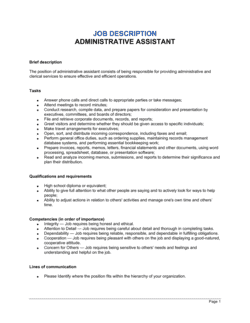
Defining a senior administrative or executive assistant roleExecutive Assistant Job Description
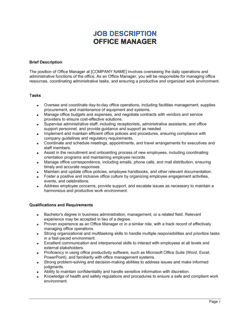
Creating a description for an office manager overseeing support staffOffice Manager Job Description
Documenting a data entry or records management positionData Entry Clerk Job Description
Defining a part-time or temporary administrative support roleTemporary Administrative Staff Job Description
Formalizing a virtual or remote administrative assistant roleVirtual Assistant Job Description
Outlining a billing or accounts payable clerk positionBilling Clerk Job Description

Common mistakes to avoid

❌ Misclassifying the role as FLSA exempt

Why it matters: Non-exempt employees classified as exempt are owed back overtime at 1.5Γ— their regular rate, plus potential penalties. Administrative roles are frequently misclassified because the title sounds white-collar even when duties are largely routine and non-discretionary.

Fix: Apply the FLSA primary duty test before selecting exempt status. If the employee spends more than 50% of time on non-discretionary, routine tasks, the role is likely non-exempt. Confirm against the current salary threshold for your state.

❌ Using a vague or copied-and-pasted position summary

Why it matters: A generic summary that could describe any administrative role provides no defensible basis for performance management, disciplinary action, or termination β€” and signals to regulators that job descriptions are a formality rather than a management tool.

Fix: Write the summary from scratch for each role, naming the specific team, function, and one or two measurable outcomes the employee is accountable for.

❌ Skipping the acknowledgement signature before the start date

Why it matters: Without a signed acknowledgement, an employee can credibly claim they were unaware of specific duties or conduct standards β€” weakening any future disciplinary action or termination for cause.

Fix: Include the signature block in the onboarding package and collect it before or on day one. Store the executed copy in the personnel file, not just the HRIS.

❌ Publishing a pay range that violates local pay transparency laws

Why it matters: Colorado, California, New York, Washington, and several other jurisdictions require posted ranges to reflect the actual range offered. Ranges that are artificially narrow or exclude incumbents expose the employer to regulatory fines and employee pay-equity claims.

Fix: Review your jurisdiction's pay transparency requirements before publishing. Audit current employee compensation in the role to ensure the posted range is accurate and defensible.

❌ Listing credentials that are not business-justified

Why it matters: Degree requirements, specific years of experience, or background check criteria that are not directly tied to essential functions can create disparate-impact liability under Title VII, the EEOA, and equivalent statutes.

Fix: For each required qualification, document the specific essential function it supports. If you cannot make that connection, reclassify it as preferred or remove it.

❌ Omitting the confidentiality clause for roles with data access

Why it matters: Administrative staff routinely access payroll data, personnel files, vendor contracts, and client records. Without a documented confidentiality obligation, disciplinary or legal action for a data breach has no written foundation.

Fix: Include a confidentiality clause in every administrative job description that references access to non-public company, employee, or client information β€” and cross-reference the company's data protection policy.

The 10 key clauses, explained

Job Title, Department, and Classification

In plain language: States the official position title, the department it sits in, the FLSA classification (exempt or non-exempt), and the employment type (full-time, part-time, or temporary).

Sample language
Job Title: [TITLE] | Department: [DEPARTMENT] | Reports To: [MANAGER TITLE] | FLSA Status: [Exempt / Non-Exempt] | Employment Type: [Full-Time / Part-Time / Temporary]

Common mistake: Misclassifying an administrative role as exempt when the employee earns below the FLSA salary threshold or primarily performs non-discretionary tasks β€” exposing the employer to back overtime claims.

Position Summary

In plain language: A brief paragraph explaining the role's primary purpose, how it fits within the organization, and the main outcomes it is accountable for.

Sample language
The [TITLE] provides administrative support to [DEPARTMENT/TEAM] and is responsible for [PRIMARY FUNCTION]. This role ensures [ORGANIZATIONAL OUTCOME] and reports directly to [MANAGER TITLE].

Common mistake: Writing a position summary so generic it could apply to any role β€” making it useless for performance management and difficult to defend in a misclassification or discrimination claim.

Essential Duties and Responsibilities

In plain language: A numbered or bulleted list of the core tasks the employee is expected to perform regularly, marked as 'essential functions' where legally significant.

Sample language
Essential Functions include: (1) Managing correspondence, scheduling, and calendar coordination for [DEPARTMENT]; (2) Maintaining physical and digital filing systems in compliance with [COMPANY] records retention policy; (3) Processing purchase orders and expense reports up to $[AMOUNT].

Common mistake: Including every possible task without distinguishing essential from marginal functions. Courts and arbitrators focus on essential functions when evaluating ADA accommodation requests or performance disputes.

Required Qualifications

In plain language: The minimum education, experience, certifications, and technical skills a candidate must have to be considered for the role.

Sample language
Minimum Qualifications: High school diploma or equivalent required; associate's or bachelor's degree preferred. Minimum [X] years of administrative experience. Proficiency in Microsoft Office Suite (Word, Excel, Outlook). [CERTIFICATION] required.

Common mistake: Setting credential requirements β€” such as a four-year degree β€” that are not genuinely necessary for the role. Unjustified requirements create disparate-impact exposure under Title VII and equivalent laws.

Preferred Qualifications

In plain language: Additional skills or experience that are desirable but not mandatory, used to differentiate candidates without making the role inaccessible.

Sample language
Preferred Qualifications: Experience with [SOFTWARE SYSTEM]. Bilingual proficiency in [LANGUAGE]. Prior experience in [INDUSTRY]. Familiarity with [PROCESS OR TOOL].

Common mistake: Using preferred qualifications to specify characteristics that are proxies for protected class membership β€” such as 'cultural fit' without defined criteria β€” creating implicit bias risk.

Reporting Relationships and Authority

In plain language: Identifies who the position reports to, any direct reports, and the scope of authority β€” including spending limits, system access levels, and decision-making rights.

Sample language
This position reports to the [MANAGER TITLE]. Direct reports: [NONE / LIST TITLES]. Authority includes approval of expenditures up to $[AMOUNT] and access to [SYSTEMS]. All decisions above this threshold require approval from [TITLE].

Common mistake: Omitting spending or system-access authority levels entirely, leaving employees to infer their own limits β€” a common source of unauthorized expenditures and access control violations.

Working Conditions and Physical Requirements

In plain language: Describes the physical environment, schedule, travel expectations, and any physical demands of the role β€” required for ADA compliance and honest candidate assessment.

Sample language
This position operates in a standard office environment. Typical hours: [DAYS/HOURS]. Occasional travel to [LOCATION] may be required. Physical requirements: ability to sit for extended periods, lift up to [X] lbs, and operate standard office equipment.

Common mistake: Overstating physical requirements β€” such as listing heavy lifting for a desk-based role β€” in a way that screens out protected-class candidates without a legitimate business justification.

Compensation and Benefits

In plain language: States the pay range, pay frequency, and a reference to benefits eligibility β€” providing transparency to candidates and establishing documented expectations.

Sample language
Compensation: $[MIN] – $[MAX] per [hour/year], paid [bi-weekly / semi-monthly]. Benefits: eligible for the Company's standard benefits program including [health, dental, vision, 401(k)] as in effect from time to time.

Common mistake: Publishing a compensation range that is narrower than the actual range offered to hired candidates β€” a growing compliance issue in jurisdictions with pay transparency laws such as Colorado, New York, and California.

Confidentiality and Data Handling

In plain language: Notifies the employee that the role involves access to confidential company, client, or employee information and that handling obligations survive the employment relationship.

Sample language
In the course of this role, [EMPLOYEE NAME] will have access to confidential information including [TYPES OF INFORMATION]. Such information must be handled in accordance with [COMPANY NAME]'s Data Protection Policy and applicable privacy law.

Common mistake: Omitting this clause for administrative roles that handle payroll data, personnel files, or client records β€” leaving no documented basis for disciplinary action if confidentiality is breached.

Acknowledgement and Signature Block

In plain language: A statement signed and dated by both the employee and a company representative confirming the description has been received, reviewed, and understood.

Sample language
I acknowledge that I have received and reviewed this job description and understand that it is not a contract of employment. It may be amended by [COMPANY NAME] with reasonable notice. Employee Signature: _______________ Date: _______. Manager Signature: _______________ Date: _______.

Common mistake: Not obtaining a signed acknowledgement before the employee's first day β€” making it difficult to enforce performance standards or justify disciplinary action based on duties the employee later claims they were unaware of.

How to fill it out

  1. 1

    Enter the job title, department, and classification

    Fill in the official position title, the department it belongs to, and the direct reporting manager's title. Confirm FLSA classification by checking current salary thresholds and primary duty tests before selecting exempt or non-exempt.

    πŸ’‘ Cross-reference the Department of Labor's current salary threshold β€” $684/week as of 2024 β€” before marking any role as exempt. State thresholds in California, New York, and Washington are higher.

  2. 2

    Write the position summary

    Draft two to four sentences explaining what the role does, why it exists, and what outcomes it is responsible for. Write it from the perspective of how the role serves the organization, not just what the employee will do day-to-day.

    πŸ’‘ If you cannot summarize the role in four sentences, the scope is likely too broad β€” consider whether it should be split into two separate positions.

  3. 3

    List essential duties with clear percentage guidance

    Enumerate core tasks in order of frequency or importance. Label the most critical tasks as essential functions. Where possible, indicate approximately what percentage of the role each major duty represents (e.g., '40% calendar and correspondence management').

    πŸ’‘ Tasks that account for less than 5% of the role are marginal functions β€” list them separately or omit them to keep the essential functions list defensible.

  4. 4

    Define required and preferred qualifications separately

    List only genuinely necessary minimum qualifications under 'Required.' Move nice-to-have skills and experience to 'Preferred.' For each required credential, confirm it is directly tied to a specific essential function.

    πŸ’‘ Requiring a bachelor's degree for a role that is effectively an entry-level administrative position invites disparate-impact scrutiny. Document the business justification if you retain it.

  5. 5

    Specify reporting relationships and authority limits

    Name the direct supervisor by title (not name β€” titles stay accurate when personnel change). State any direct reports. Document spending authority, system-access level, and any signing authority in explicit dollar or scope terms.

    πŸ’‘ Authority limits written vaguely as 'minor expenditures' cause internal control failures. Use a specific dollar amount every time.

  6. 6

    Complete the working conditions and physical requirements section

    Describe the work environment (open office, remote, hybrid), standard hours, and any travel. List physical requirements that are genuinely necessary β€” seated work, lifting, repetitive motion β€” so candidates can self-assess and accommodation requests are anticipated.

    πŸ’‘ Only list physical requirements you would actually enforce or need to accommodate. Overstating them creates legal risk without any operational benefit.

  7. 7

    Insert the compensation range and benefits reference

    Enter the pay range and frequency. If your jurisdiction has a pay transparency law, the range must reflect the actual range used for the position β€” not an aspirational floor and ceiling.

    πŸ’‘ Audit your current pay for employees in similar roles before publishing a range. A range that excludes current incumbents creates internal equity issues immediately.

  8. 8

    Obtain signed acknowledgements before the first day

    Present the completed description to the new hire before their start date, allow time for review, and collect a signed and dated acknowledgement from both the employee and the hiring manager. File it in the employee's personnel record.

    πŸ’‘ If a role changes materially after signing, issue an updated description and collect a new acknowledgement β€” the dated signature trail is your record of communicated expectations.

Frequently asked questions

What is an office and administrative personnel job description?

An office and administrative personnel job description is a formal document that defines the title, duties, qualifications, reporting structure, and working conditions for a support or administrative role within an organization. It establishes documented expectations for the employee, provides a basis for performance management, and supports legally compliant hiring and classification decisions. When signed by both parties, it creates a written record that agreed terms were communicated before employment began.

Is a job description legally binding?

A job description is generally not a standalone contract of employment, but it does carry legal weight. A signed acknowledgement creates a record that the employee was informed of their duties, reporting structure, and conduct expectations β€” which courts and arbitrators reference in wrongful termination, discrimination, and accommodation disputes. Including an explicit statement that the document is not a contract of employment protects the employer's flexibility to update duties over time.

What is the difference between required and preferred qualifications?

Required qualifications are the minimum criteria a candidate must meet to be considered β€” tied directly to the essential functions of the role. Preferred qualifications are desirable but not mandatory, used to differentiate candidates. The distinction matters legally: required credentials that are not genuinely job-related can create disparate-impact liability. Keep the required list narrow and defensible, and move everything else to preferred.

Does a job description need to address ADA compliance?

Yes. Under the Americans with Disabilities Act and equivalent statutes in Canada and the UK, job descriptions must identify essential functions separately from marginal functions. This distinction determines whether a reasonable accommodation request can be granted without fundamentally altering the role. Physical requirements must reflect genuine operational needs β€” not assumptions about how the job is typically done. Courts give significant weight to job descriptions in ADA accommodation litigation.

Do administrative roles need to specify FLSA classification?

Yes, and it matters considerably for administrative roles specifically. The FLSA administrative exemption applies only when the employee's primary duty is office or non-manual work directly related to management or general business operations, and includes the exercise of discretion and independent judgment on significant matters. Many administrative roles do not meet this standard and must be classified as non-exempt, entitling the employee to overtime pay for hours over 40 per week.

Can I update a job description after an employee is hired?

Yes β€” job descriptions can and should be updated when roles evolve. However, materially changing essential functions, compensation, or reporting structure without notice may constitute constructive dismissal in Canada, the UK, and EU member states. Best practice is to notify the employee in writing of the changes, provide a reasonable adaptation period, and obtain a new signed acknowledgement. In the US, at-will employment allows broader unilateral changes, but documentation remains important.

What pay transparency requirements apply to administrative job postings?

Colorado, California, New York, Washington, Illinois, and several other US states and municipalities now require employers to include a compensation range in job postings. The posted range must reflect the actual range the employer is willing to pay β€” not an artificially wide or narrow window. Canada and the UK are moving toward similar disclosure requirements. Posting a range also reduces negotiation friction and improves time-to-fill for administrative roles.

Should the job description be included in the employment contract?

In most cases, the job description is incorporated by reference into the employment contract as a schedule rather than embedded in the contract body. This allows duties to be updated without amending the core agreement. Include a clause in the employment contract stating that the job description may be amended by the employer with reasonable notice, and ensure the employee initials the schedule at signing.

How often should administrative job descriptions be reviewed?

Review job descriptions at least annually, during organizational restructuring, when software or process changes alter how the role functions, and before any re-hire cycle for the position. Descriptions that are more than two years old frequently misrepresent current duties β€” creating performance management gaps and increasing the risk that a classification error goes undetected until an audit or complaint.

How this compares to alternatives

vs Employment Contract

An employment contract is the binding legal agreement governing the entire working relationship β€” compensation, IP assignment, non-compete, and termination terms. A job description defines the specific duties and qualifications of the role. The job description is typically incorporated into the employment contract as a schedule; together they form a complete onboarding document set.

vs Job Offer Letter

A job offer letter confirms the role, start date, and compensation to secure candidate acceptance β€” it is not a comprehensive operational document. A job description provides the detailed duties, qualifications, authority limits, and working conditions that the offer letter summarizes. Administrative hires should receive both: the offer letter to accept and the job description to acknowledge.

vs Employee Handbook

An employee handbook sets company-wide policies, procedures, and conduct standards that apply to all employees. A job description is role-specific, defining what one position does and what qualifications it requires. The handbook provides the policy framework; the job description provides the role-level detail. Neither replaces the other.

vs Independent Contractor Agreement

An independent contractor agreement engages a self-employed individual for project-based work without employment entitlements. A job description is an employee document that creates the framework for an ongoing employment relationship, including performance management and benefits eligibility. Using a job description format for a contractor engagement can contribute to misclassification findings by implying employment-level control.

Industry-specific considerations

Professional Services

Administrative roles in law, accounting, and consulting firms require explicit confidentiality clauses covering client matter files, billing data, and engagement records β€” often linked to professional conduct codes.

Healthcare

Medical office and administrative roles must reference HIPAA handling obligations, patient records access controls, and any required certifications such as medical billing or coding credentials.

Financial Services

Administrative staff with access to client account data or transaction records require enhanced confidentiality terms and references to FINRA, FCA, or equivalent regulatory data-handling obligations.

Retail / E-commerce

Back-office administrative roles in retail environments often involve shift scheduling, POS system access, and cash-handling authority limits that must be specified to avoid internal control failures.

Jurisdictional notes

United States

FLSA classification (exempt vs. non-exempt) must be determined before publishing the description β€” the current federal salary threshold is $684/week, but California, New York, and Washington set higher thresholds. Pay transparency laws in Colorado, California, New York, and Illinois require a posted compensation range. The ADA requires essential functions to be explicitly identified to support accommodation analysis.

Canada

Provincial Employment Standards Acts govern minimum notice and overtime rules that may be referenced in the description. Pay equity legislation in Ontario and federally regulated workplaces requires that compensation ranges be defensible across gender lines. Quebec employers must provide French-language descriptions for provincially regulated roles. Constructive dismissal risk means material duty changes should be documented and acknowledged in writing.

United Kingdom

The Equality Act 2010 requires that job requirements be proportionate and justified β€” credential requirements that screen out protected groups without business justification create indirect discrimination liability. The statement of employment particulars required within day one of hire should cross-reference the job description. Working time regulations cap the standard week at 48 hours unless the employee opts out in writing.

European Union

The EU Pay Transparency Directive (effective 2026 for larger employers) requires pay range disclosure in job postings across member states. GDPR applies to any personal data collected during the hiring process and referenced in the description. Works council consultation may be required before implementing new job classifications in Germany, France, and the Netherlands. Fixed-term administrative roles in several member states are subject to strict renewal limits.

Template vs lawyer β€” what fits your deal?

PathBest forCostTime
Use the templateStandard administrative and office support hires in a single jurisdiction with no unusual access to sensitive data or regulatory requirementsFree20–30 minutes per role
Template + legal reviewRoles in regulated industries (healthcare, finance), multi-state postings subject to pay transparency laws, or descriptions that will be attached to employment contracts$150–$400 for an HR consultant or employment lawyer review1–2 days
Custom draftedSenior administrative roles with fiduciary access, cross-border hires, or organizations undergoing classification audits where every job description must be legally defensible$500–$1,500 per role3–7 days

Glossary

Job Description
A formal document specifying the title, duties, qualifications, and reporting relationships for a defined position within an organization.
Position Summary
A two-to-four sentence overview of the role's primary purpose and its contribution to the organization, placed at the top of the job description.
Essential Functions
Core duties the employee must be able to perform, with or without reasonable accommodation β€” the designation carries legal weight under the ADA and equivalent statutes.
Reporting Structure
The chain of command indicating who the position reports to and, if applicable, which roles report to the position.
FLSA Classification
US designation under the Fair Labor Standards Act as either exempt (salaried, no overtime entitlement) or non-exempt (hourly, overtime required above 40 hours per week).
KSA (Knowledge, Skills, and Abilities)
A framework for listing the specific competencies required to perform a job effectively β€” commonly used in government and regulated-sector hiring.
At-Will Employment
Employment that either party may end at any time for any lawful reason β€” the default in most US states, referenced in many job descriptions as a condition of hire.
Reasonable Accommodation
A modification to job duties, schedule, or workspace that enables a qualified person with a disability to perform the essential functions of the role.
Probationary Period
An initial employment phase β€” typically 30 to 90 days β€” during which performance is closely evaluated and termination formalities may differ from the standard policy.
Acknowledgement Signature
A signed and dated statement by the employee confirming they have received, read, and understood the job description β€” creating a record that expectations were communicated.

Part of your Business Operating System

This document is one of 3,000+ business & legal templates included in Business in a Box.

  • Fill-in-the-blanks β€” ready in minutes
  • 100% customizable Word document
  • Compatible with all office suites
  • Export to PDF and share electronically

Create your document in 3 simple steps.

From template to signed document β€” all inside one Business Operating System.
1
Download or open template

Access over 3,000+ business and legal templates for any business task, project or initiative.

2
Edit and fill in the blanks with AI

Customize your ready-made business document template and save it in the cloud.

3
Save, Share, Send, Sign

Share your files and folders with your team. Create a space of seamless collaboration.

Save time, save money, and create top-quality documents.

β˜…β˜…β˜…β˜…β˜…

"Fantastic value! I'm not sure how I'd do without it. It's worth its weight in gold and paid back for itself many times."

Managing Director Β· Mall Farm
Robert Whalley
Managing Director, Mall Farm Proprietary Limited
β˜…β˜…β˜…β˜…β˜…

"I have been using Business in a Box for years. It has been the most useful source of templates I have encountered. I recommend it to anyone."

Business Owner Β· 4+ years
Dr Michael John Freestone
Business Owner
β˜…β˜…β˜…β˜…β˜…

"It has been a life saver so many times I have lost count. Business in a Box has saved me so much time and as you know, time is money."

Owner Β· Upstate Web
David G. Moore Jr.
Owner, Upstate Web

Run your business with a system β€” not scattered tools

Stop downloading documents. Start operating with clarity. Business in a Box gives you the Business Operating System used by over 250,000 companies worldwide to structure, run, and grow their business.

Start freeΒ Β·Β No credit card required