Offering Memorandum Limited Partnership Template

Free Word download • Edit online • Save & share with Drive • Export to PDF

5 pages25–35 min to fillDifficulty: ComplexSignature requiredLegal review recommended
Learn more ↓
FreeOffering Memorandum Limited Partnership Template

At a glance

What it is
An Offering Memorandum Limited Partnership (also called a Private Placement Memorandum or PPM) is a legally binding disclosure document a general partner issues to prospective limited partners when raising capital for a private fund or investment vehicle. This free Word download gives you a structured, investor-ready starting point covering fund terms, risk factors, management fees, distribution waterfalls, and LP rights — ready to edit online and export as PDF.
When you need it
Use it when soliciting capital contributions from accredited or institutional investors under a private placement exemption, before any investor commits funds or executes a subscription agreement. Issuing it before capital is received is a regulatory requirement in most jurisdictions.
What's inside
Fund overview and investment objectives, general partner biography and track record, risk factors, fees and expense structure, distribution waterfall and carried interest, LP rights and governance, subscription procedures, and key legal notices including the securities law disclaimer and confidentiality obligations.

What is an Offering Memorandum Limited Partnership?

An Offering Memorandum Limited Partnership — also called a Private Placement Memorandum (PPM) — is a formal legal disclosure document that a general partner (GP) issues to prospective limited partners (LPs) before accepting capital commitments into a private fund or investment vehicle. It defines every material term of the investment: the fund's strategy and objectives, the GP's track record, the full risk landscape, management fees, the distribution waterfall and carried interest mechanics, LP governance rights, and the procedures investors must follow to subscribe. Unlike a pitch deck or business plan, an offering memorandum is a securities law instrument that creates direct legal liability for material omissions and misstatements — it is the document that establishes what was and was not disclosed to investors before their capital was accepted.

Why You Need This Document

Raising capital from investors without a properly structured offering memorandum exposes a general partner to three categories of serious risk simultaneously. First, without documented disclosure of material risks, fees, and conflicts of interest, every investor in the fund holds a potential fraud or rescission claim against the GP — regardless of whether any misrepresentation was intentional. Second, accepting capital before verifying accredited-investor status and issuing the required disclosures destroys the Regulation D private placement exemption, making the entire offering a potential unregistered public security subject to SEC enforcement. Third, ambiguous waterfall or fee language — the most common drafting deficiency — becomes the source of LP disputes at the precise moment returns are realized, when the stakes are highest. A well-drafted offering memorandum closes all three exposures, establishes the GP's credibility with institutional LPs conducting due diligence, and gives both parties a single authoritative reference for the economic and governance terms throughout the fund's life.

Which variant fits your situation?

If your situation is…Use this template
Raising a real estate acquisition fund with multiple propertiesReal Estate Private Placement Memorandum
Launching a venture fund targeting early-stage startupsVenture Capital Fund PPM
Syndicating a single commercial property dealReal Estate Syndication Offering Memorandum
Offering securities to the general public via Regulation A+Regulation A+ Offering Circular
Issuing equity to a small number of founders and early backersSubscription Agreement
Documenting a convertible note raise from angel investorsConvertible Note Agreement
Forming the underlying limited partnership entity before the raiseLimited Partnership Agreement

Common mistakes to avoid

❌ No tailored risk factors — copying boilerplate from an unrelated fund

Why it matters: Generic risk factors that do not reflect the actual strategy provide weaker legal protection and signal to sophisticated LPs that the GP has not thought carefully about downside scenarios.

Fix: Draft risk factors specific to your asset class, leverage policy, geographic market, and key-man concentration. Review SEC comment letters in your sector for the disclosures regulators expect.

❌ Accepting subscriptions before verifying accredited-investor status

Why it matters: Receiving capital before confirming accredited-investor status destroys the Regulation D private placement exemption, potentially making the offering an unregistered public security and triggering rescission rights for every investor.

Fix: Require a completed and signed Accredited Investor Questionnaire and AML documentation before wiring instructions are provided and before any subscription funds are accepted.

❌ Ambiguous waterfall language on preferred return compounding

Why it matters: If the memorandum does not state whether the preferred return compounds or accrues simply, disputes at distribution time are nearly inevitable — and litigation outcomes depend entirely on which party makes the better contractual argument.

Fix: State explicitly: 'The Preferred Return accrues at [X]% per annum, compounded annually, from the date each LP's capital contribution is drawn.' Model the effect before finalizing.

❌ Presenting gross IRR figures without a net-of-fees equivalent

Why it matters: Sophisticated LPs compare funds on a net basis. Presenting only gross returns without a corresponding net figure is misleading and may constitute a material omission under SEC anti-fraud rules.

Fix: Present both gross and net IRR for every prior fund or investment, with a footnote explaining what fees and expenses have been deducted from the net figure.

❌ Setting the LP removal threshold at an unreachable level

Why it matters: A removal threshold of 85–90% of LP interests is effectively unworkable in a diversified fund, giving LPs no meaningful recourse against GP misconduct short of litigation.

Fix: Set the for-cause removal threshold at 50–66.7% of LP interests, consistent with ILPA Principles 3.0 recommendations, to satisfy institutional LP due-diligence requirements.

❌ Omitting a confidentiality and no-redistribution legend

Why it matters: A memorandum distributed without confidentiality obligations can be forwarded to non-accredited investors, creating an unregistered public offering and exposing the GP to federal and state securities liability.

Fix: Include a prominent confidentiality legend on the cover page and in a standalone confidentiality clause, stating that the document may not be reproduced or redistributed without GP consent.

The 10 key clauses, explained

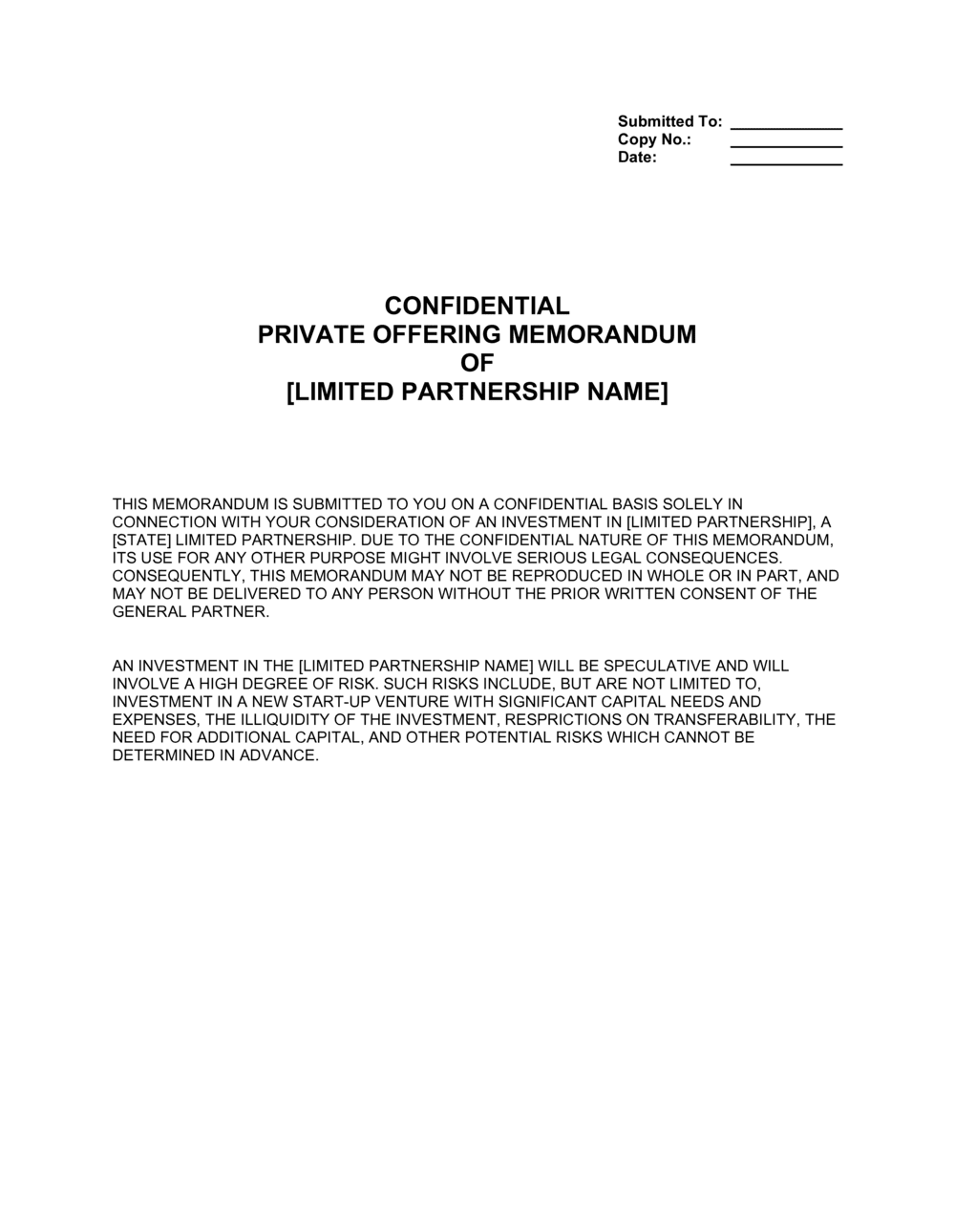
Cover page and securities law disclaimer

In plain language: States the fund name, total offering size, GP identity, date of the memorandum, and a prominent disclaimer that the securities have not been registered with the SEC or any state regulator.

Sample language
THE INTERESTS DESCRIBED IN THIS MEMORANDUM HAVE NOT BEEN REGISTERED UNDER THE SECURITIES ACT OF 1933 AND ARE BEING OFFERED IN RELIANCE UPON AN EXEMPTION FROM REGISTRATION. THIS MEMORANDUM IS CONFIDENTIAL AND IS DELIVERED TO [RECIPIENT NAME] SOLELY FOR EVALUATING AN INVESTMENT IN [FUND NAME], LP.

Common mistake: Omitting the unregistered-securities disclaimer from the cover page. Regulators treat any written solicitation without this notice as a potential unregistered public offering, triggering rescission rights for investors.

Fund overview and investment objectives

In plain language: Describes the fund's strategy, target sector or asset class, investment criteria, geographic focus, and the GP's thesis for why the opportunity exists.

Sample language
[FUND NAME] is a [STRATEGY] limited partnership targeting [ASSET CLASS / SECTOR] investments in [GEOGRAPHIC FOCUS]. The Fund seeks to achieve [RETURN TARGET] by [INVESTMENT APPROACH] over a [X]-year investment period.

Common mistake: Overpromising returns by using specific projected figures without adequate risk-factor caveats. Forward-looking statements must be paired with material risk disclosures or they can constitute securities fraud.

General partner biography and track record

In plain language: Profiles the GP entity and key principals — investment history, prior fund performance, relevant credentials, and any material conflicts of interest.

Sample language
[GP ENTITY NAME] is managed by [PRINCIPAL NAME], who has [X] years of experience in [SECTOR]. Prior investments include [REPRESENTATIVE TRANSACTION] generating a [X]x multiple and [X]% IRR. Past performance is not indicative of future results.

Common mistake: Presenting net IRR figures without disclosing the calculation methodology, vintage year, and whether fees and expenses have been deducted. Inconsistent performance presentation exposes the GP to SEC enforcement.

Risk factors

In plain language: A comprehensive list of material risks specific to the fund strategy, asset class, GP experience, leverage, liquidity, regulatory environment, and economic conditions.

Sample language
INVESTING IN THE FUND INVOLVES A HIGH DEGREE OF RISK. PROSPECTIVE INVESTORS SHOULD CAREFULLY CONSIDER THE FOLLOWING RISK FACTORS BEFORE INVESTING: [ILLIQUIDITY RISK] — Interests in the Fund are not transferable without GP consent and there is no secondary market. [CONCENTRATION RISK] — The Fund may hold as few as [X] investments, making returns highly dependent on individual outcomes.

Common mistake: Copying generic risk factors from another fund without tailoring them to the actual strategy. Boilerplate risk disclosures that do not reflect the fund's specific risks offer weaker legal protection and can mislead investors.

Fees and expense structure

In plain language: States the management fee rate and calculation basis, any organizational or placement fees, fund operating expenses, and which expenses are borne by the fund versus the GP.

Sample language
Management Fee: [X]% per annum of [committed / invested] capital, payable [quarterly / semi-annually] in advance. Organizational Expenses: capped at $[X], with excess borne by the GP. Fund Operating Expenses — including legal, audit, and administration — are borne by the Fund and allocated pro rata among LP capital accounts.

Common mistake: Failing to specify whether the management fee is calculated on committed or invested capital. The distinction materially affects LP economics during the deployment period and is a frequent source of LP disputes.

Distribution waterfall and carried interest

In plain language: Sets out the exact sequence — return of capital, preferred return, GP catch-up, and profit split — in which distributions are made to LPs and the GP.

Sample language
Distributions shall be made in the following order: (1) to LPs, return of contributed capital; (2) to LPs, a [X]% per annum preferred return on unreturned capital; (3) to the GP, a catch-up equal to [X]% of cumulative preferred return distributions; (4) thereafter, [80]% to LPs and [20]% to the GP as carried interest.

Common mistake: Ambiguous waterfall language that does not specify whether the preferred return is calculated on a simple or compounded basis. Courts have split on this question, and ambiguity consistently benefits whoever litigates the point.

LP rights and governance

In plain language: Defines voting rights, LP Advisory Committee composition and authority, GP removal provisions, key-man events, fund extension rights, and amendment procedures.

Sample language
Limited Partners holding [X]% or more of aggregate Interests may, upon [X] days' written notice, remove the General Partner for Cause. A Key Man Event occurs if [KEY PRINCIPAL NAME(S)] ceases to devote substantially full time to the Fund, in which case new investments are suspended pending LP Advisory Committee consent.

Common mistake: Setting the LP removal threshold so high (e.g., 80%) that it is functionally unreachable. Institutional LPs increasingly require meaningful governance rights, and an unworkable removal clause can block the fundraise.

Transfer restrictions and redemption terms

In plain language: Prohibits or restricts the transfer of LP interests without GP consent, states any lock-up period, and for open-end funds, sets the redemption notice period and frequency.

Sample language
No LP may transfer, assign, or pledge its Interest without the prior written consent of the GP, which may be withheld in its sole discretion. Interests are subject to a [X]-year lock-up from the date of initial subscription. The GP may, at its discretion, permit transfers to affiliates or for estate-planning purposes.

Common mistake: No restriction on transfers to non-accredited investors. An unrestricted transfer could cause the fund to lose its private placement exemption, potentially triggering retroactive registration requirements.

Subscription procedure and representations

In plain language: Describes how prospective investors apply, what documentation they must provide, the accredited-investor representations required, anti-money-laundering certifications, and the GP's right to accept or reject subscriptions.

Sample language
To subscribe, each prospective LP must complete, execute, and deliver the Subscription Agreement attached as Exhibit [A], together with (i) an Accredited Investor Questionnaire, (ii) AML/KYC documentation as specified by the GP, and (iii) a wire of the subscribed amount to the escrow account specified by the GP. The GP reserves the right to reject any subscription in its sole discretion.

Common mistake: Accepting subscriptions before receiving signed accredited-investor representations. Investing prior to verification destroys the Regulation D exemption and exposes the GP to securities law liability.

Confidentiality and no-action representations

In plain language: Prohibits the recipient from sharing the memorandum, reproduces the restrictions on resale of the interests, and confirms the investor is not relying on the GP for investment or tax advice.

Sample language
By accepting this Memorandum, the recipient agrees to keep its contents strictly confidential and to return or destroy it upon the GP's request. The recipient acknowledges that: (i) no federal or state securities commission has reviewed this Memorandum; (ii) no representation has been made regarding tax treatment; and (iii) the recipient has relied solely on its own advisors in evaluating this investment.

Common mistake: Omitting the tax-advice disclaimer when the fund has favorable tax treatment (e.g., pass-through losses). Investors who later dispute tax outcomes will claim reliance on the memorandum unless the disclaimer is explicit.

How to fill it out

  1. 1

    Complete the cover page and securities disclaimer

    Insert the fund's legal name, total offering size, GP legal entity name, state of organization, and the date the memorandum is issued. Confirm the securities law disclaimer is prominently placed on the cover in bold or uppercase.

    💡 Date the memorandum the day you first distribute it to any prospective investor — this establishes the disclosure baseline for regulatory purposes.

  2. 2

    Draft the fund overview and investment strategy

    Describe the asset class, investment criteria, geographic focus, target holding period, and return thesis in specific terms. Avoid vague language like 'attractive returns' — state target gross and net IRR ranges with the assumptions behind them.

    💡 Pair every forward-looking statement with a qualifying clause such as 'subject to market conditions and the risk factors described herein' to reduce securities law exposure.

  3. 3

    Document GP track record with consistent methodology

    List prior funds or investments with vintage year, investment date, realized and unrealized multiples, gross and net IRR, and fee methodology. Mark unrealized investments clearly. State 'past performance is not indicative of future results' adjacent to every performance table.

    💡 Use ILPA or GIPS-compliant performance presentation standards — institutional LPs expect them and will request a reformat if you don't.

  4. 4

    Write tailored, strategy-specific risk factors

    Draft at least eight to twelve risk factors specific to your fund strategy, jurisdiction, leverage policy, and key-man concentration. Organize them under headings (investment risks, fund structure risks, regulatory risks, economic risks).

    💡 Review your last three investment decisions for what could have gone wrong — those scenarios are your most credible risk factors.

  5. 5

    Define fees and expenses with precise calculation mechanics

    State the management fee rate, the calculation base (committed vs. invested capital), the step-down schedule if any, organizational expense cap, and which expenses are fund-borne vs. GP-borne.

    💡 Model the fee impact across the expected deployment timeline before finalizing — a 2% fee on committed capital during a 3-year deployment period is materially more expensive than the same rate on invested capital.

  6. 6

    Draft the distribution waterfall with explicit compounding language

    State each waterfall tier in numbered sequence. Specify whether the preferred return compounds annually or accrues simply, and the effective date from which it accrues — the first capital contribution date, the investment date, or the closing date.

    💡 Have your fund accountant model the waterfall under three distribution scenarios (early exit, base case, delayed exit) before finalizing the language.

  7. 7

    Set LP governance rights and key-man provisions

    Specify LP Advisory Committee seat allocation, the GP removal threshold and trigger events, key-man definitions and consequences, and the fund extension vote requirement.

    💡 Benchmarking governance terms against the ILPA Principles 3.0 gives you a defensible starting position in LP negotiations.

  8. 8

    Attach and cross-reference all exhibits

    Attach the Subscription Agreement, Accredited Investor Questionnaire, AML/KYC checklist, and the Limited Partnership Agreement as labeled exhibits. Confirm each is cross-referenced in the body of the memorandum.

    💡 Number exhibits alphabetically (Exhibit A, B, C) and include a table of contents — institutional LPs' legal teams review exhibits first and will flag any that are missing.

Frequently asked questions

What is an offering memorandum for a limited partnership?

An offering memorandum for a limited partnership is a formal disclosure document a general partner issues to prospective limited partners when raising private investment capital. It describes the fund's strategy, management team, risk factors, fee structure, distribution waterfall, and investor rights in legally binding detail. It serves as both the primary marketing document and the legal disclosure required to rely on a private placement exemption from securities registration.

Is a limited partnership offering memorandum legally required?

No federal statute explicitly mandates an offering memorandum for every private placement, but issuing one is effectively required in practice. Under SEC Rule 506(b), non-accredited investors must receive disclosures substantially equivalent to a registered offering. Even in accredited-only raises, anti-fraud rules under Section 10(b) of the Exchange Act require material information to be disclosed to investors. Omitting an offering memorandum leaves the GP without evidence of what was and was not represented to investors.

What is the difference between an offering memorandum and a private placement memorandum?

The terms are used interchangeably in practice. Both refer to the same type of disclosure document issued in connection with a private securities offering. Some practitioners use "offering memorandum" for fund-style vehicles (limited partnerships, hedge funds) and "private placement memorandum" for operating company equity raises, but there is no legal distinction between the two formats.

Who can invest in a limited partnership based on an offering memorandum?

In the United States, most limited partnership interests are offered exclusively to accredited investors under SEC Regulation D, Rule 506(b) or 506(c). Accredited investors include individuals with income exceeding $200,000 ($300,000 joint) or net worth exceeding $1 million excluding a primary residence, as well as certain institutional investors. Rule 506(b) permits up to 35 sophisticated non-accredited investors but requires additional disclosure obligations. Rule 506(c) restricts the offering to verified accredited investors only.

What should a limited partnership offering memorandum include?

A complete offering memorandum should include: a cover page with securities disclaimer, fund overview and investment strategy, GP biography and track record, comprehensive risk factors, management fee and expense structure, distribution waterfall and carried interest mechanics, LP rights and governance provisions, transfer restrictions, subscription procedure, confidentiality obligations, and exhibits including the subscription agreement and limited partnership agreement.

How long does it take to prepare a limited partnership offering memorandum?

A first-time GP using a quality template typically requires four to eight weeks to produce a complete offering memorandum, including legal review. The most time-intensive sections are the risk factors, the performance track record, and the financial projections. Experienced fund attorneys can complete a draft in two to three weeks from a fully briefed template; custom-drafted documents from scratch take six to ten weeks.

Does an offering memorandum need to be filed with the SEC?

The offering memorandum itself does not need to be filed with the SEC for a Regulation D offering. However, the GP must file a Form D notice with the SEC within 15 days of the first sale of securities. Many states also require a state-level notice filing — called a blue sky filing — within a specified period of the first sale to residents of that state.

What is the difference between the offering memorandum and the limited partnership agreement?

The offering memorandum is the disclosure document prospective investors read before deciding to invest — it explains what the fund does, the risks, and the economic terms. The limited partnership agreement (LPA) is the binding governance document that actually creates the partnership and governs the legal relationship between the GP and LPs once they have invested. The two documents must be consistent with each other; the LPA controls in any conflict, and both should be reviewed together.

Can I use an offering memorandum template without a lawyer?

A high-quality template substantially reduces drafting time and ensures the key structural elements are present, but securities law counsel is strongly recommended before distributing the document to any prospective investor. The legal consequences of a defective offering memorandum — rescission liability, SEC enforcement, and state securities actions — are significant. A securities attorney review typically costs $2,500–$8,000 and is proportionate to the risk of raising capital from multiple investors under federal securities law.

How this compares to alternatives

vs Limited Partnership Agreement

The limited partnership agreement is the binding governance document that creates the partnership and defines the legal rights and obligations of the GP and each LP. The offering memorandum is the disclosure document investors read before deciding to invest. Both must exist and be consistent with each other — the LPA governs; the offering memorandum discloses.

vs Subscription Agreement

A subscription agreement is the document an investor executes to formally apply to become an LP — it contains their capital commitment, accredited-investor representations, and AML certifications. The offering memorandum is the disclosure document distributed before the subscription agreement is signed. The subscription agreement references and incorporates the offering memorandum by definition.

vs Shareholder Agreement

A shareholder agreement governs the relationship among equity holders in a corporation, covering voting rights, transfer restrictions, drag-along and tag-along rights. An offering memorandum and limited partnership structure is used for private fund vehicles, not corporations. Corporations that raise private equity use shareholder agreements alongside a share purchase agreement, not an offering memorandum.

vs Business Plan

A business plan is an internal or external strategy document used to articulate market opportunity, operations, and financial projections — typically for lenders or early-stage investors. An offering memorandum is a formal securities disclosure document governed by federal and state securities law, carrying legal liability for material omissions and misstatements. A business plan is a planning tool; an offering memorandum is a legal instrument.

Industry-specific considerations

Private Equity

Closed-end fund structures with defined investment periods, capital call mechanics, and portfolio company acquisition strategies requiring detailed risk and conflict-of-interest disclosures.

Real Estate

Property-level risk factors including zoning, environmental liability, tenant concentration, and leverage covenants, alongside deal-by-deal or blind-pool fund structures.

Venture Capital

Early-stage concentration risk, illiquidity timelines of 7–12 years, anti-dilution provisions, pro-rata rights, and the high probability of total loss on individual portfolio companies.

Hedge Funds / Alternative Investments

Redemption gates, side-pocket provisions, leverage and short-selling risk disclosures, and performance-fee high-water marks unique to open-end fund structures.

Jurisdictional notes

United States

Most limited partnership interests are offered under SEC Regulation D, Rule 506(b) (up to 35 sophisticated non-accredited investors plus unlimited accredited investors) or Rule 506(c) (verified accredited investors only, general solicitation permitted). A Form D must be filed with the SEC within 15 days of the first sale. State blue sky notice filings are required in most states within specified periods. Investment advisers managing over $150M must register with the SEC; smaller managers register with their state.

Canada

Canadian securities law is provincially regulated. Limited partnership interests are typically offered under accredited investor or minimum investment exemptions under National Instrument 45-106. An offering memorandum exemption is available in most provinces for raises of any size, but triggers a statutory right of rescission for investors for 48 hours and up to 180 days for material misstatements. Quebec investors require French-language disclosure documents for provincially regulated offerings.

United Kingdom

Offers of limited partnership interests to UK investors are regulated under the Financial Services and Markets Act 2000. Unless the offering falls under an exemption — such as the financial promotion exemption for certified high-net-worth individuals or sophisticated investors — the memorandum must be approved by an FCA-authorized person. Managers of alternative investment funds above EUR 100M AUM must register as Alternative Investment Fund Managers under the UK AIFMD.

European Union

EU fund managers above EUR 100M AUM are regulated under the Alternative Investment Fund Managers Directive (AIFMD), requiring authorization and prescribing disclosure obligations to investors. Private placements to professional investors may proceed under national private placement regimes (NPPRs), which vary significantly by member state. GDPR applies to any personal data collected from EU-resident investors in the subscription process. France, Germany, and Luxembourg are the dominant EU fund domiciles for LP vehicles.

Template vs lawyer — what fits your deal?

PathBest forCostTime
Use the templateFund managers preparing an initial draft for attorney review or structuring a small raise among a handful of known accredited investorsFree2–4 weeks (drafting)
Template + legal reviewFirst-time GPs raising up to $5M from accredited investors under Regulation D Rule 506(b)$2,500–$8,000 (securities attorney review and customization)3–6 weeks
Custom draftedInstitutional fund raises above $10M, multi-jurisdictional offerings, regulated fund structures, or GPs with complex track records$15,000–$50,000+ (full fund formation and offering document package)6–12 weeks

Glossary

General Partner (GP)
The managing partner of the limited partnership who makes investment decisions, bears unlimited liability, and receives carried interest.
Limited Partner (LP)
A passive investor in the partnership whose liability is limited to their capital contribution and who does not participate in day-to-day management.
Carried Interest
The GP's profit share — typically 20% of net gains — earned after limited partners have received their invested capital plus a preferred return.
Preferred Return (Hurdle Rate)
A minimum annual return — typically 6–8% — that must be paid to limited partners before the GP is entitled to any carried interest.
Distribution Waterfall
The contractual sequence governing how cash proceeds are allocated among LPs and the GP — return of capital, preferred return, catch-up, then carried interest split.
Accredited Investor
A person or entity meeting minimum income ($200K individual / $300K joint) or net-worth ($1M excluding primary residence) thresholds under SEC Regulation D, eligible to invest in private placements.
Private Placement Exemption
A securities law carve-out — such as SEC Rule 506(b) or 506(c) — that allows issuers to raise capital without registering the offering with a regulator.
Subscription Agreement
The separate document through which a prospective LP formally applies to invest, represents their accredited-investor status, and commits a specific capital amount.
Capital Call
A GP's written notice requiring limited partners to contribute a portion of their committed capital by a specified date to fund an investment or expense.
Clawback Provision
A clause requiring the GP to return previously distributed carried interest if cumulative LP returns fall below the agreed preferred return at the fund's wind-down.
Management Fee
An annual fee — typically 1.5–2% of committed or invested capital — charged by the GP to cover fund operating expenses and management compensation.
Side Letter
A separate agreement with a specific LP granting rights or concessions not available to all investors, such as lower fees, co-investment rights, or reporting preferences.

Part of your Business Operating System

This document is one of 3,000+ business & legal templates included in Business in a Box.

  • Fill-in-the-blanks — ready in minutes
  • 100% customizable Word document
  • Compatible with all office suites
  • Export to PDF and share electronically

Create your document in 3 simple steps.

From template to signed document — all inside one Business Operating System.
1
Download or open template

Access over 3,000+ business and legal templates for any business task, project or initiative.

2
Edit and fill in the blanks with AI

Customize your ready-made business document template and save it in the cloud.

3
Save, Share, Send, Sign

Share your files and folders with your team. Create a space of seamless collaboration.

Save time, save money, and create top-quality documents.

★★★★★

"Fantastic value! I'm not sure how I'd do without it. It's worth its weight in gold and paid back for itself many times."

Managing Director · Mall Farm
Robert Whalley
Managing Director, Mall Farm Proprietary Limited
★★★★★

"I have been using Business in a Box for years. It has been the most useful source of templates I have encountered. I recommend it to anyone."

Business Owner · 4+ years
Dr Michael John Freestone
Business Owner
★★★★★

"It has been a life saver so many times I have lost count. Business in a Box has saved me so much time and as you know, time is money."

Owner · Upstate Web
David G. Moore Jr.
Owner, Upstate Web

Run your business with a system — not scattered tools

Stop downloading documents. Start operating with clarity. Business in a Box gives you the Business Operating System used by over 250,000 companies worldwide to structure, run, and grow their business.

Start free · No credit card required