Notifying Bank of Additional Signing Officer Template

Free Word download β€’ Edit online β€’ Save & share with Drive β€’ Export to PDF

1 pageβ€’15–25 min to fillβ€’Difficulty: Standard
Learn more ↓
FreeNotifying Bank of Additional Signing Officer Template

At a glance

What it is
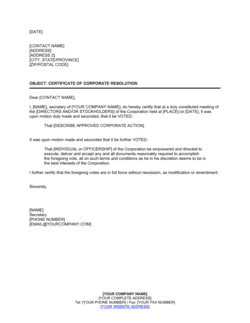
A Notification to Bank of Additional Signing Officer is a formal corporate letter instructing a financial institution to add a new authorized signatory to one or more business accounts. This free Word download gives you a ready-to-edit template that references the underlying board resolution, identifies the new officer by name and title, lists the affected account numbers, and states the effective date β€” everything your bank's compliance team needs to process the change.
When you need it
Use it whenever your company appoints a new director, officer, or manager who needs signing authority on a corporate bank account β€” whether following a board meeting, a change in executive leadership, or the opening of a new subsidiary account.
What's inside
Company and bank identification details, a reference to the authorizing board resolution, full particulars of the new signing officer, a list of affected accounts, the effective date of the authority, any signing conditions or limits, and the authorized corporate signatory block.

What is a Notification to Bank of Additional Signing Officer?

A Notification to Bank of Additional Signing Officer is a formal corporate letter sent to a financial institution instructing it to add a new authorized signatory to one or more existing business accounts. It identifies the company and the affected accounts, references the board resolution that granted the authority, provides the new officer's full particulars, states any signing conditions or dollar limits, and confirms the effective date. Banks treat this letter β€” together with a copy of the underlying board resolution β€” as the complete authorization package required to update their internal account mandate records.

Why You Need This Document

Operating without a properly notified signing authority creates two immediate problems: the new officer cannot legally execute transactions on the account, and any attempt to do so without formal bank recognition creates an unauthorized signature risk that can void payments or trigger compliance flags. When a director, CFO, or operations manager joins your organization and needs account access, verbal instructions to a bank teller are not sufficient β€” banks require a written, signed instruction from an existing authorized officer before they will update their mandate records. A missed or delayed notification also means the new officer cannot sign cheques, authorize wire transfers, or execute payroll runs until the bank confirms the update, creating operational bottlenecks precisely when the new hire needs to be productive. This template gives you the exact structure banks expect β€” with every required element in the right order β€” so your signing authority update is processed cleanly the first time.

Which variant fits your situation?

If your situation is…Use this template
Adding a new officer as the sole additional signatoryNotification to Bank of Additional Signing Officer
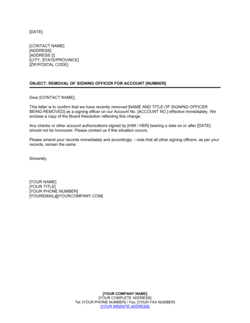
Removing an existing signing officer who has left the companyNotification to Bank of Removal of Signing Officer
Replacing one signing officer with another in a single transactionChange of Signing Authority Letter
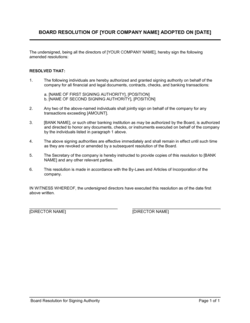
Documenting the board's decision to grant signing authorityBoard Resolution β€” Authorized Signatories
Opening a new corporate bank account with initial signatoriesCorporate Bank Account Opening Letter
Notifying the bank of a company name or address changeNotification to Bank of Change of Company Information
Granting authority limited to a specific dollar thresholdLimited Signing Authority Authorization Letter

Common mistakes to avoid

❌ Sending the letter without the board resolution

Why it matters: Banks treat the board resolution as the primary authorization document. A letter without it will be held pending receipt of the resolution, delaying the effective date.

Fix: Attach a certified copy of the board resolution every time you send this letter, even if the bank has not explicitly requested it.
❌ Having the new signatory sign the notification letter

Why it matters: The letter is an instruction to the bank from an already-recognized authority. If the only signature is from the person being added, the bank has no verified authorization to act on it.

Fix: Always have one or more officers already on the existing account mandate sign the letter before sending.

❌ Omitting specific account numbers

Why it matters: Vague references to 'all accounts' create disputes about scope and may not update every account in the bank's system, leaving gaps in the new officer's practical authority.

Fix: List every affected account number explicitly, one per line, with the account type for clarity.

❌ Not specifying an effective date

Why it matters: Without a date, the bank's compliance team must make a judgment call on when the authority began β€” this creates a gap in your audit trail and can expose the company to unauthorized transaction risk.

Fix: Always enter a specific calendar date in the effective date field, even if it is the same day the letter is sent.

The 9 key clauses, explained

Letter header and bank addressee

In plain language: Identifies the company sending the letter and the specific bank branch or relationship manager receiving it, with the date.

Sample language
[DATE] | [BANK NAME] | [BRANCH ADDRESS] | Attn: [BRANCH MANAGER / RELATIONSHIP MANAGER NAME] | Re: Notification of Additional Signing Officer β€” Account(s) [ACCOUNT NUMBER(S)]

Common mistake: Addressing the letter to the general bank address rather than the specific branch holding the account β€” this delays routing and can push the effective date past the intended date.

Opening statement and company identification

In plain language: States the company's full legal name, its account relationship with the bank, and the purpose of the letter in the first sentence.

Sample language
We write on behalf of [COMPANY LEGAL NAME] (the 'Company'), holder of account number(s) [ACCOUNT NUMBER(S)] at [BANK NAME], [BRANCH], to formally notify you of the addition of an authorized signing officer to the Company's account mandate.

Common mistake: Using a trade name instead of the registered legal entity name β€” if the name doesn't match the bank's account records exactly, the bank may reject or delay processing.

Board resolution reference

In plain language: Cites the date and subject of the board resolution that authorizes the new signing officer, giving the bank a traceable internal authorization source.

Sample language
Pursuant to a resolution of the Board of Directors of the Company dated [RESOLUTION DATE], a copy of which is enclosed, the Board has authorized [NEW OFFICER FULL NAME] to act as a signing officer on behalf of the Company.

Common mistake: Omitting the board resolution entirely and relying on the letter alone. Banks treat the resolution as the primary authorization document; the letter is the transmission vehicle.

New officer particulars

In plain language: Provides the full legal name, job title, and any identifying information the bank requires to update its records and match a specimen signature.

Sample language
Name: [NEW OFFICER FULL LEGAL NAME] | Title: [JOB TITLE] | Effective Date of Authority: [DATE] | Specimen signature is provided on the bank's standard form attached hereto.

Common mistake: Providing a nickname or shortened name that differs from government-issued ID β€” the bank's KYC process will require an exact match, causing delays.

Affected accounts list

In plain language: Lists each account number and type to which the new signing authority applies, so there is no ambiguity about scope.

Sample language
This authorization applies to the following accounts held with [BANK NAME]: (1) Operating Account β€” Account No. [XXXXXXXXXX]; (2) Payroll Account β€” Account No. [XXXXXXXXXX]; (3) [ADDITIONAL ACCOUNT TYPE] β€” Account No. [XXXXXXXXXX].

Common mistake: Writing 'all accounts' without listing specific account numbers β€” if the company later disputes which accounts were covered, vague language creates unnecessary ambiguity.

Signing conditions or limits

In plain language: States any restrictions on the new signatory's authority β€” dollar thresholds, dual-signature requirements above a certain amount, or transaction types excluded.

Sample language
[NEW OFFICER FULL NAME] is authorized to sign individually for transactions up to $[AMOUNT]. Transactions exceeding $[AMOUNT] require the co-signature of [INCUMBENT SIGNATORY NAME / TITLE]. This authority does not extend to [EXCLUDED TRANSACTION TYPE, IF ANY].

Common mistake: Omitting signing limits entirely when a dual-signature policy exists internally β€” the bank will default to single-signatory authority, bypassing the intended control.

Confirmation that existing signatories remain unchanged

In plain language: Explicitly states that all previously authorized signing officers retain their existing authority, so the bank does not inadvertently remove them.

Sample language
All existing authorized signing officers on the above accounts remain authorized in accordance with the current account mandate. This notification adds to, and does not replace, any prior signing authority on record.

Common mistake: Not including this confirmation β€” bank administrators processing the change may interpret a partial mandate update as a full replacement, accidentally revoking other signatories.

Effective date and request for confirmation

In plain language: States the date from which the new authority takes effect and asks the bank to confirm receipt and update of the account mandate.

Sample language
The foregoing authorization is effective as of [EFFECTIVE DATE]. We kindly request that you update your records accordingly and provide written confirmation of the mandate change at your earliest convenience.

Common mistake: Leaving the effective date blank or writing 'immediately' β€” banks require a specific calendar date to timestamp the mandate update in their compliance records.

Authorized corporate signatory block

In plain language: The closing signature block, signed by one or more existing authorized officers of the company, validating the instruction.

Sample language
Yours truly, [EXISTING AUTHORIZED OFFICER NAME] | [TITLE] | [COMPANY LEGAL NAME] | Date: [DATE]

Common mistake: Having the letter signed only by the new signing officer being added β€” the bank requires the instruction to come from an officer already on the existing mandate, not the one being added.

How to fill it out

  1. 1

    Confirm the board resolution is in place before drafting

    The letter references a specific board resolution date and encloses a copy. Make sure the resolution has been signed and dated before you fill in the letter β€” the dates must match.

    πŸ’‘ If the board has not yet met, use the Board Resolution β€” Authorized Signatories template first and then return to this letter.

  2. 2

    Enter your company's full legal name and account details

    Use the exact registered legal name as it appears on your bank account β€” not a trade name or abbreviation. List every account number the new authority should cover.

    πŸ’‘ Pull the account numbers directly from a recent bank statement to avoid transposition errors.

  3. 3

    Complete the new officer's particulars

    Enter the officer's full legal name, job title, and the effective date of their authority. Attach a completed specimen signature card on the bank's standard form if required.

    πŸ’‘ Call your bank relationship manager in advance to ask whether they require a specific identification form or KYC documentation alongside this letter β€” requirements vary by institution.

  4. 4

    Define any signing limits or dual-signature conditions

    Decide whether the new officer has unlimited individual authority or is subject to a dollar cap requiring a co-signature. Enter the threshold amount and the co-signatory's name and title.

    πŸ’‘ For most small businesses, setting a dual-signature requirement at $5,000–$10,000 balances operational efficiency with financial controls.

  5. 5

    Confirm existing signatories are explicitly preserved

    Review the clause confirming that prior authorized signatories remain unchanged. Do not delete this clause β€” it prevents the bank from inadvertently revoking existing authority.

    πŸ’‘ If you are simultaneously removing a signatory, use a separate removal letter rather than combining both changes in one document.

  6. 6

    Have an existing authorized officer sign the letter

    The letter must be executed by someone already on the bank's account mandate β€” not by the new signatory being added. Check the name matches the bank's current records.

    πŸ’‘ Send the letter by registered mail or via your bank's secure message portal, and keep a copy of the delivery confirmation with the signed letter on file.

Frequently asked questions

What is a notification to bank of additional signing officer?

It is a formal corporate letter sent to a bank instructing it to add a new authorized signatory to one or more business accounts. It references the board resolution that granted the authority, identifies the new officer by full legal name and title, lists the affected account numbers, and states the effective date. Banks require this document β€” along with a copy of the board resolution β€” before updating their account mandate records.

Do I need a board resolution before sending this letter?

Yes. The board resolution is the foundational authorization that gives the bank confidence the company has formally approved the new signatory. The letter is the transmission document that communicates that decision to the bank. Without the resolution, most banks will hold the request pending receipt of supporting authorization. Draft and sign the board resolution first, then complete this letter referencing the resolution's date.

Who should sign this notification letter?

An officer who is already an authorized signatory on the bank account must sign the letter. The new signing officer being added cannot sign their own authorization β€” the bank requires the instruction to come from a recognized source already on the account mandate. If two existing signatories are required for corporate correspondence, both should sign.

Can I add multiple signing officers in a single letter?

Yes. The letter can be adapted to list more than one new signing officer by repeating the officer particulars clause for each individual and attaching separate specimen signature cards. Keep a clear numbered list to make it easy for the bank's compliance team to process each addition.

What happens if the new signatory's name on the letter differs from their ID?

The bank's know-your-customer (KYC) process requires an exact match between the name on the letter, the specimen signature, and government- issued identification. Any discrepancy β€” a middle name included on one document but not another, or an abbreviated first name β€” will trigger a clarification request from the bank and delay the effective date.

Does this letter need to be notarized?

In most cases, no. Standard commercial banks accept a signed corporate letter accompanied by a certified board resolution without requiring notarization. However, some international banks, trust companies, or accounts held in heavily regulated jurisdictions may require a notarized copy. Confirm requirements with your bank relationship manager before sending.

How long does it take the bank to process the new signing authority?

Processing time varies by institution β€” most major commercial banks update an account mandate within 3 to 7 business days of receiving a complete package (letter plus board resolution plus specimen signature). Some banks offer expedited processing for an additional fee. Until you receive written confirmation from the bank, treat the new authority as pending and do not rely on the new officer to execute transactions.

Should I keep a copy of this letter on file?

Yes. File the signed letter, the board resolution, the bank's written confirmation, and any specimen signature forms together in your corporate minute book or governance records. This package is the complete audit trail for the signing authority grant and may be needed during a financial audit, a due diligence review, or a banking dispute.

What if I also need to remove an existing signatory at the same time?

It is best practice to handle additions and removals in separate letters. Combining them increases the risk that the bank processes one instruction and overlooks the other, or interprets the combined instruction incorrectly. Use this letter to add the new officer and a separate removal notification to revoke the departing officer's authority, referencing the same board resolution if both actions were authorized at the same meeting.

How this compares to alternatives

vs Board Resolution β€” Authorized Signatories

The board resolution is the internal corporate authorization document that creates the legal basis for granting signing authority. This notification letter is the external communication sent to the bank to implement that decision. Both documents are required β€” the resolution without the letter leaves the bank uninformed; the letter without the resolution lacks the authorization the bank needs to act.

vs Notification to Bank of Removal of Signing Officer

The removal letter revokes a departing officer's signing authority and instructs the bank to update its mandate accordingly. This addition letter grants new authority. Use them together when replacing one signing officer with another, but send them as separate documents to reduce the risk of processing errors at the bank.

vs Corporate Bank Account Opening Letter

A bank account opening letter establishes a brand-new account and designates the initial authorized signatories at the time of opening. This notification letter adds signatories to an existing account. Use the opening letter for new accounts and this template for any subsequent changes to an existing mandate.

vs Limited Signing Authority Authorization Letter

A limited signing authority letter grants a specific individual authority for a defined transaction type, time period, or dollar range β€” typically used for one-off situations like a signing officer travelling abroad. This notification letter grants ongoing, mandate-level signing authority. Use the limited version for temporary or narrowly scoped authorizations.

Industry-specific considerations

Professional Services

Law firms and accounting practices regularly update signing authority as partners join or are promoted, often requiring dual-signature controls above specific billing thresholds.

Construction and Real Estate

Project-based entities frequently add site managers or project directors as signatories on dedicated project accounts with transaction limits tied to budget line items.

Retail and E-commerce

Multi-location retailers add regional managers to local operating accounts while maintaining head-office dual-signature requirements above daily cash management thresholds.

Manufacturing

Manufacturers often grant procurement managers limited signing authority on dedicated supplier payment accounts to streamline high-volume, time-sensitive purchase transactions.

Template vs pro β€” what fits your needs?

PathBest forCostTime
Use the templateAny company adding a standard signing officer to a domestic commercial bank accountFree10–15 minutes
Template + professional reviewCompanies with complex dual-signature policies, multiple accounts across different institutions, or heavily regulated industries$100–$300 (corporate lawyer or accountant review)1–2 business days
Custom draftedInternational accounts, trust accounts, or situations where the bank has imposed non-standard mandate requirements$300–$8002–5 business days

Glossary

Signing Officer
A person authorized by a corporation to sign documents, cheques, or agreements that legally bind the company.
Authorized Signatory
An individual whose signature is formally recognized by a bank or counterparty as binding on behalf of the corporate entity.
Board Resolution
A formal written decision adopted by a company's board of directors, which provides the legal authority for actions such as granting bank signing rights.
Signing Authority
The scope of a signatory's power β€” which accounts, transaction types, and dollar limits they are permitted to authorize.
Dual Signing Requirement
A control policy requiring two authorized signatories to approve a transaction, typically applied above a defined dollar threshold.
Corporate Resolution
A document that memorializes a specific decision of the board of directors or shareholders, used by banks as evidence of authorization.
Specimen Signature
A sample of an authorized signatory's signature submitted to the bank so it can be matched against future signed documents.
Effective Date
The calendar date from which the new signing authority takes effect and the bank is authorized to accept the officer's signature.
Account Mandate
The bank's internal record of who is authorized to operate a corporate account and under what conditions.
Incumbent Signatory
An existing authorized officer whose signing rights remain unchanged when a new signatory is added to the account.

Part of your Business Operating System

This document is one of 3,000+ business & legal templates included in Business in a Box.

  • Fill-in-the-blanks β€” ready in minutes
  • 100% customizable Word document
  • Compatible with all office suites
  • Export to PDF and share electronically

Create your document in 3 simple steps.

From template to signed document β€” all inside one Business Operating System.
1
Download or open template

Access over 3,000+ business and legal templates for any business task, project or initiative.

2
Edit and fill in the blanks with AI

Customize your ready-made business document template and save it in the cloud.

3
Save, Share, Send, Sign

Share your files and folders with your team. Create a space of seamless collaboration.

Save time, save money, and create top-quality documents.

β˜…β˜…β˜…β˜…β˜…

"Fantastic value! I'm not sure how I'd do without it. It's worth its weight in gold and paid back for itself many times."

Managing Director Β· Mall Farm
Robert Whalley
Managing Director, Mall Farm Proprietary Limited
β˜…β˜…β˜…β˜…β˜…

"I have been using Business in a Box for years. It has been the most useful source of templates I have encountered. I recommend it to anyone."

Business Owner Β· 4+ years
Dr Michael John Freestone
Business Owner
β˜…β˜…β˜…β˜…β˜…

"It has been a life saver so many times I have lost count. Business in a Box has saved me so much time and as you know, time is money."

Owner Β· Upstate Web
David G. Moore Jr.
Owner, Upstate Web

Run your business with a system β€” not scattered tools

Stop downloading documents. Start operating with clarity. Business in a Box gives you the Business Operating System used by over 250,000 companies worldwide to structure, run, and grow their business.

Free Forever PlanΒ Β·Β No credit card required