Notifying Bank of Removal of Signing Officer Template

Free Word download β€’ Edit online β€’ Save & share with Drive β€’ Export to PDF

1 pageβ€’15–25 min to fillβ€’Difficulty: Standard
Learn more ↓
FreeNotifying Bank of Removal of Signing Officer Template

At a glance

What it is
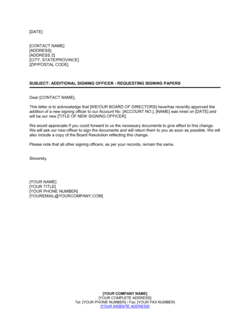
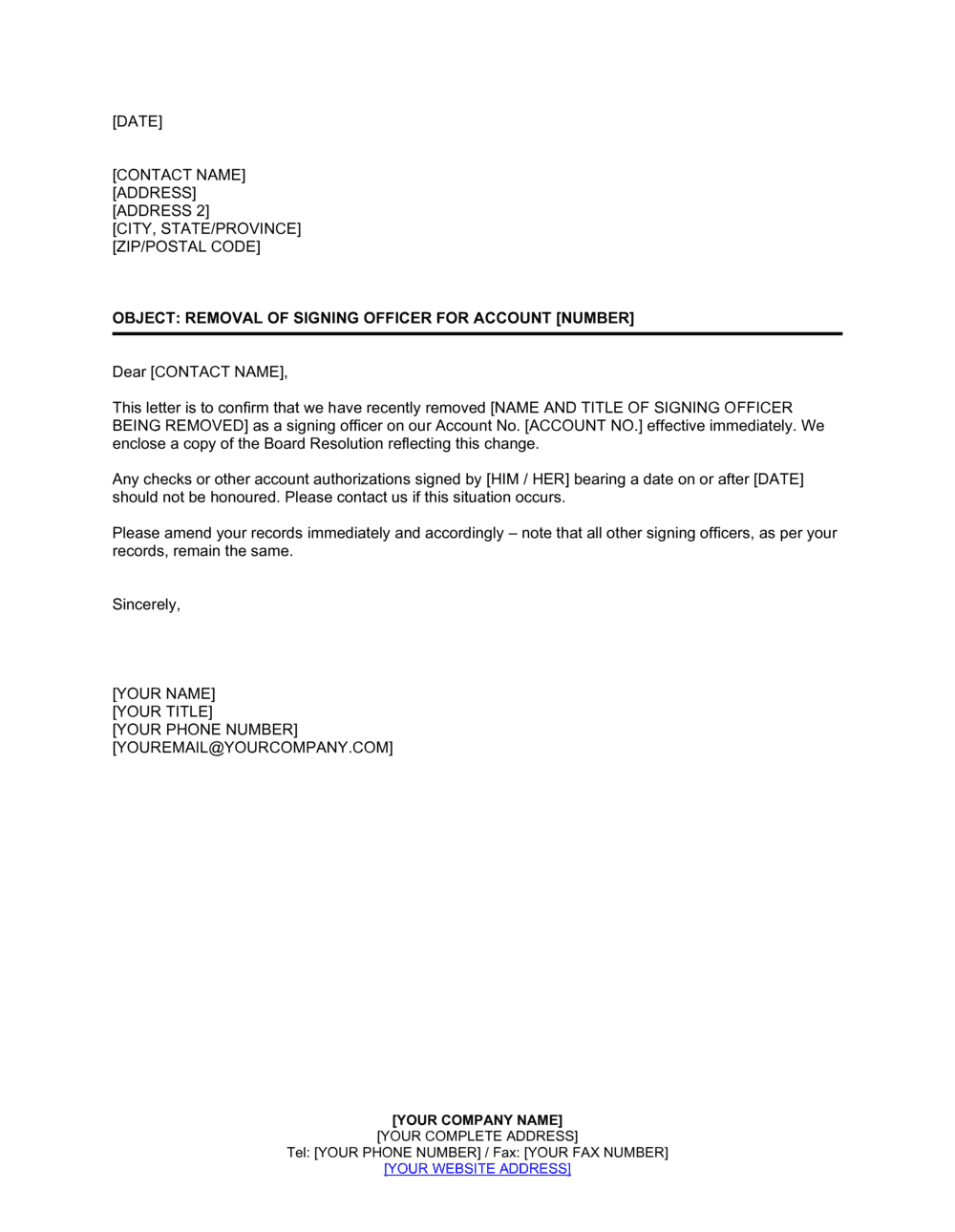
A Notification to Bank of Removal of Signing Officer is a formal corporate letter sent to a financial institution instructing it to revoke an authorized signatory's access to one or more business accounts. This free Word download includes all the key components β€” account references, board resolution citation, effective date, and replacement authority confirmation β€” so you can edit and send within minutes.
When you need it
Use it whenever an authorized signatory leaves the company, is terminated, resigns from a board role, or otherwise should no longer have authority to transact on behalf of the organization. Sending this letter promptly after the board resolution is passed closes the window of unauthorized access.
What's inside
Company and bank details, a reference to the authorizing board resolution, the full name and title of the officer being removed, a list of affected account numbers, the effective date of removal, and a confirmation of remaining or replacement signing authorities.

What is a Notification to Bank of Removal of Signing Officer?

A Notification to Bank of Removal of Signing Officer is a formal corporate letter sent to a financial institution instructing it to revoke a named individual's authority to transact on one or more company bank accounts. It references the board resolution that authorized the change, identifies the officer by full legal name and title, lists every affected account number, states the precise effective date, and confirms who retains signing authority going forward. Banks treat this letter β€” together with a certified copy of the board resolution β€” as the authoritative instruction required before they will update the account mandate on their records.

Why You Need This Document

Failing to send this letter promptly after an officer's departure or removal leaves a live window of unauthorized financial access β€” one that can be exploited intentionally or inadvertently. Without a written instruction on file, a bank has no basis to reject transactions initiated by the former officer, and you may have limited recourse for unauthorized withdrawals processed during the gap. For terminations, every day between the departure date and the bank's receipt of the removal notice is a period of real financial exposure. This template gives you a bank-accepted format with all required components β€” resolution reference, account list, effective date, and remaining authority confirmation β€” so you can close that window in under 15 minutes and move on to the next step of the offboarding process.

Which variant fits your situation?

If your situation is…Use this template
Adding a new signing officer at the same time as removing the old oneNotification to Bank of Change of Signing Officer
Granting signing authority to a new officer with no removalNotification to Bank of Addition of Signing Officer
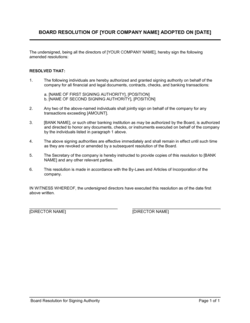
Authorizing a board resolution that triggers the signatory changeBanking Resolution
Closing a corporate bank account entirelyBank Account Closure Letter
Notifying the bank of a new authorized officer after incorporationCorporate Banking Authorization Letter
Recording the signatory change in internal governance filesBoard Resolution to Open Bank Account
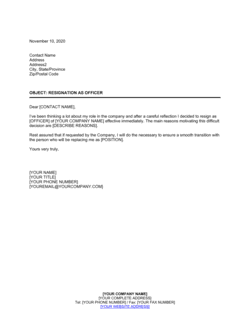
Documenting the departure of the officer in an official capacityOfficer Resignation Letter

Common mistakes to avoid

❌ Not enclosing the certified board resolution

Why it matters: Banks treat signatory changes as high-risk instructions β€” without a certified resolution, they will hold the letter and request documentation before acting, leaving the removed officer's access live.

Fix: Prepare the certified resolution before drafting the letter, and physically check that it is enclosed before sealing the envelope or sending electronically.

❌ Omitting subsidiary or secondary accounts

Why it matters: A removal letter that only covers the main operating account leaves the officer with live signing authority on payroll, foreign currency, or savings accounts β€” any of which can be used to initiate unauthorized transactions.

Fix: List every account held at the bank under the company's name, cross-referenced against your most recent bank statements, to ensure no account is missed.

❌ Sending the letter after a significant delay following departure

Why it matters: Every day between an officer's departure and the bank's receipt of the removal notice is a window of unauthorized access β€” even an honest former officer may inadvertently transact on habit.

Fix: Prepare the letter on the same day the board resolution is passed and deliver it within one business day, using courier or the bank's secure portal if same-day processing is critical.

❌ Having the removed officer sign the removal letter

Why it matters: A letter instructing a bank to remove an officer's authority is not valid if signed by that same officer β€” the bank's compliance process will flag and reject it, requiring you to resubmit with a current authorized officer's signature.

Fix: Always have a different, currently authorized officer β€” the CEO, CFO, or another director β€” execute the letter before it is sent.

The 9 key clauses, explained

Header and addressee block

In plain language: Identifies the sending company, the specific bank branch, the branch manager or relationship contact, and the date of the letter.

Sample language
[DATE] | [BANK NAME], [BRANCH ADDRESS] | Attn: [BRANCH MANAGER NAME / RELATIONSHIP MANAGER TITLE] | Re: Removal of Authorized Signing Officer β€” Account(s) [ACCOUNT NUMBER(S)]

Common mistake: Addressing the letter to a generic branch rather than the named relationship manager or corporate banking contact β€” generic addressing slows processing because no one owns the action.

Opening authority statement

In plain language: States the company's full legal name, its relationship with the bank, and the purpose of the letter in the first sentence.

Sample language
On behalf of [COMPANY LEGAL NAME] (the 'Company'), we write to formally notify [BANK NAME] of the removal of [OFFICER NAME] as an authorized signing officer on the Company's accounts, effective [EFFECTIVE DATE].

Common mistake: Using a trade name instead of the registered legal entity name β€” if the name on the letter does not match the account holder of record, the bank may reject the instruction pending verification.

Board resolution reference

In plain language: Cites the specific board resolution that authorizes the removal, including the resolution date and number, so the bank can match the instruction to a governance record.

Sample language
This instruction is made pursuant to a resolution of the Board of Directors of [COMPANY LEGAL NAME] passed on [RESOLUTION DATE] (Resolution No. [NUMBER]), a certified copy of which is enclosed.

Common mistake: Omitting the resolution reference entirely β€” banks require evidence of corporate authority before acting on signatory changes, and an unsupported instruction will be held pending documentation.

Officer identification

In plain language: Names the officer being removed, states their former title, and includes any identifier the bank holds on file (e.g., employee ID, date of birth, or specimen signature reference) to prevent confusion with similarly named individuals.

Sample language
The individual to be removed is [FULL LEGAL NAME], formerly [TITLE / ROLE], whose specimen signature is on file with the Bank under reference [SPECIMEN REFERENCE / DATE ADDED].

Common mistake: Providing only a first and last name without a title or reference number β€” common names create ambiguity, and the bank may require additional verification before acting.

List of affected accounts

In plain language: Enumerates every account number from which the officer's authority is being revoked, so there is no ambiguity about scope.

Sample language
The removal applies to the following accounts held by the Company with [BANK NAME]: (1) Account No. [XXXXXXXX] β€” Operating Account; (2) Account No. [XXXXXXXX] β€” Payroll Account; (3) Account No. [XXXXXXXX] β€” USD Foreign Currency Account.

Common mistake: Listing only the primary account and forgetting subsidiary, payroll, or foreign-currency accounts β€” the removed officer retains live access to any account not explicitly listed.

Effective date and interim transaction handling

In plain language: States the exact date the removal takes effect and instructs the bank on how to handle any transactions the removed officer may have initiated before that date.

Sample language
The removal is effective as of [DATE]. The Bank is instructed to reject any transaction, cheque, or withdrawal instruction bearing the sole signature of [OFFICER NAME] presented on or after [DATE]. Transactions processed in good faith prior to receipt of this notice remain valid.

Common mistake: Omitting guidance on in-flight transactions β€” without it, the bank must decide unilaterally whether to honor or reject cheques already signed but not yet cleared.

Confirmation of remaining signing authorities

In plain language: Confirms who retains or now holds signing authority so the bank's mandate on file remains complete and operational.

Sample language
Following this removal, the authorized signing officers for the above accounts are: [NAME 1], [TITLE], and [NAME 2], [TITLE], signing [individually / jointly for amounts over $[THRESHOLD]], as previously recorded with the Bank.

Common mistake: Leaving this section blank β€” a removal notice that does not confirm remaining authority creates uncertainty and may prompt the bank to freeze the account pending clarification.

Enclosures and supporting documents

In plain language: Lists all documents enclosed with the letter β€” typically the certified board resolution and, where required, updated specimen signature cards or account mandate forms.

Sample language
Enclosed: (1) Certified copy of Board Resolution dated [DATE]; (2) Updated Account Mandate / Signing Authority Form; (3) [BANK-SPECIFIC FORM NAME, IF APPLICABLE].

Common mistake: Referencing enclosures in the letter but forgetting to attach them β€” the bank cannot act until it receives the certified resolution, causing unnecessary delay.

Authorization and closing

In plain language: Closes the letter with the signature of a current authorized officer (not the one being removed), their name and title, and a request for written confirmation of the change.

Sample language
Please confirm in writing once this change has been processed. Should you require any further information, please contact [NAME] at [PHONE / EMAIL]. Yours sincerely, [AUTHORIZED OFFICER NAME] | [TITLE] | [COMPANY LEGAL NAME]

Common mistake: Having the letter signed by the officer being removed β€” a letter authorizing someone's own removal is not valid and will be rejected by the bank's compliance team.

How to fill it out

  1. 1

    Pass and certify the board resolution first

    Before filling in the letter, ensure the board has formally passed a resolution authorizing the removal. Obtain a certified copy β€” signed by the corporate secretary or a director β€” ready to enclose.

    πŸ’‘ The resolution date and number go directly into the letter; have the certified copy in hand before you open the template.

  2. 2

    Enter the company and bank details in the header

    Fill in your company's full registered legal name, the bank's full name and branch address, and the name of your relationship manager or the branch manager. Date the letter the day you intend to send it.

    πŸ’‘ Call your bank's corporate banking line to confirm the correct addressee name and branch address β€” outdated contact details are the most common reason letters are rerouted and delayed.

  3. 3

    Identify the officer being removed precisely

    Enter the officer's full legal name, their former title, and any reference the bank holds β€” such as the date their specimen signature was lodged or an employee reference number.

    πŸ’‘ If the officer has a common name, include their date of birth or the last four digits of a government ID number to prevent the bank from confusing them with another account holder.

  4. 4

    List every affected account by number

    Go through your full list of corporate accounts at this bank and include every account number from which the officer's authority should be revoked β€” operating, payroll, savings, foreign currency, and any line-of-credit accounts.

    πŸ’‘ Pull your most recent bank statements for each account to verify account numbers β€” a transposed digit means the removal won't register on that account.

  5. 5

    Set the effective date

    Enter the specific calendar date the removal takes effect. For immediate removal, use the date the letter is delivered. Allow 1–3 business days if sending by mail to ensure the bank can process it before the date arrives.

    πŸ’‘ For a termination scenario, align the effective date with the employee's last day to close any gap between departure and access removal.

  6. 6

    Confirm remaining signing authorities

    List the names and titles of all officers who retain signing authority after the removal, and note whether they sign individually or jointly (and any threshold amounts for joint signing).

    πŸ’‘ If the removed officer was the sole signatory, you must name a replacement in this section β€” otherwise the bank may freeze the account until a new mandate is received.

  7. 7

    Attach the certified board resolution and any bank forms

    Enclose the certified board resolution copy and any bank-specific signatory change forms your institution requires. Some banks have their own mandate update forms that must accompany the letter.

    πŸ’‘ Contact your bank in advance to ask whether they require a proprietary form β€” submitting only the letter without required forms adds 5–10 business days to the processing time.

  8. 8

    Have a current authorized officer sign and send

    The letter must be signed by an officer who currently holds signing authority on the account β€” not the person being removed. Send by courier, registered mail, or secure electronic channel per your bank's instructions, and retain proof of delivery.

    πŸ’‘ Follow up with your relationship manager by phone or email the same day to confirm receipt and ask for a written acknowledgment of the change.

Frequently asked questions

What is a notification to bank of removal of signing officer?

It is a formal corporate letter sent to a bank instructing it to revoke a specific individual's authority to transact on one or more company accounts. It references the board resolution that authorized the change, identifies the officer by full name and title, lists the affected account numbers, and states the effective date. Banks require this letter β€” along with a certified copy of the resolution β€” before they will update their records.

Do I need a board resolution to remove a signing officer?

Yes, in almost all cases. Banks require evidence of corporate authority before changing who can transact on an account. A certified copy of the board resolution β€” showing the resolution date, number, and signatures of the requisite directors β€” is the standard supporting document. Without it, most banks will not act on the instruction, regardless of how the letter is worded.

How quickly does a bank remove a signing officer after receiving the letter?

Processing times vary by institution, but most corporate banks update their records within 1–5 business days of receiving a complete instruction package β€” letter plus certified resolution plus any bank-specific forms. For urgent terminations, call your relationship manager the same day to flag the request and ask whether same-day processing is available.

What happens to cheques already signed by the removed officer?

The letter should include explicit instructions on in-flight transactions. Typically, transactions initiated before the effective date and processed in good faith by the bank remain valid. Cheques bearing the removed officer's signature and presented on or after the effective date should be rejected. Including clear language on this point in the letter prevents the bank from having to make that judgment call unilaterally.

Can the removal letter cover multiple bank accounts?

Yes, and it should. The letter should list every account β€” operating, payroll, foreign currency, savings, and credit facilities β€” from which the officer's authority is being revoked. Omitting any account means the officer retains live signing authority on that account, even if the main operating account has been updated.

Who should sign the removal letter?

Any current authorized officer of the company β€” typically the CEO, CFO, or corporate secretary β€” other than the officer being removed. If the removed officer is the only person currently on the bank mandate, additional steps are required to establish a new signatory before the removal can be processed. Contact your bank's corporate banking team for guidance in that scenario.

Should I notify the bank by email or in writing?

Most banks require a formal written letter as the authoritative instruction, sometimes accompanied by their own proprietary signatory change forms. Email alone is generally insufficient for compliance purposes. Deliver the letter by courier or registered mail and retain proof of delivery, or use the bank's secure document portal if one is available. Follow up by phone or email to confirm receipt.

What if the officer being removed refuses to cooperate?

The company does not need the departing officer's cooperation to send this letter β€” authority to remove a signatory rests with the board, not the individual. A certified board resolution and a letter signed by another authorized officer is sufficient. If the removed officer attempts to transact after the effective date, contact the bank immediately and consider seeking legal advice on any unauthorized transactions.

Is this letter the same as a bank account closure letter?

No. A removal of signing officer letter changes who can access an account, but leaves the account open and operational under the remaining authorized signatories. A bank account closure letter terminates the account entirely. Use the removal letter when the company's banking relationship continues but the individual's authority does not.

How this compares to alternatives

vs Banking Resolution

A banking resolution is the internal board document that authorizes the signatory change β€” it is the source of authority. The notification letter is the external communication sent to the bank to act on that resolution. Both documents are typically required together; the letter without the resolution will not be processed.

vs Notification to Bank of Addition of Signing Officer

An addition letter grants new signing authority to an individual; a removal letter revokes it. When replacing one officer with another at the same time, some banks accept a single change-of-signatory letter covering both actions, but separate letters are clearer and easier to process individually.

vs Board Resolution to Open a Bank Account

A resolution to open a bank account establishes the account and designates initial signatories. A removal notification updates the mandate on an existing account. The two documents serve different lifecycle stages of the same banking relationship.

vs Corporate Authorization Letter

A general corporate authorization letter delegates authority for a specific transaction or purpose, typically one-time. A signing officer removal letter permanently updates the bank's standing mandate on record. The removal letter is a governance document; a corporate authorization letter is a transactional one.

Industry-specific considerations

Financial Services

Regulatory compliance requirements mean that signatory changes must be documented and filed promptly; many institutions have prescribed internal forms that must accompany the external bank letter.

Professional Services

Partner departures and firm restructurings frequently trigger signatory changes across multiple client trust accounts and operating accounts simultaneously.

Nonprofit Organizations

Treasurer rotations following annual general meetings require prompt bank notification to maintain continuity of financial operations and satisfy grant-condition reporting requirements.

Retail / E-commerce

High staff turnover in finance roles means signatory removal letters are issued more frequently, making a reliable template critical to maintaining consistent, bank-accepted formatting.

Template vs pro β€” what fits your needs?

PathBest forCostTime
Use the templateAny company needing to remove a signing officer from one or more standard corporate bank accountsFree10–15 minutes
Template + professional reviewCompanies with complex multi-account structures, dual-signing thresholds, or cross-border banking relationships$100–$300 (corporate secretary or legal counsel review)1 business day
Custom draftedOrganizations in regulated industries with specific compliance documentation requirements or those dealing with disputed departures$300–$8002–5 business days

Glossary

Signing Officer
An individual authorized by a company's board or governing body to execute financial transactions, sign cheques, and bind the organization on banking matters.
Authorized Signatory
A person formally designated by an organization to sign documents and conduct transactions on its behalf, as recorded with the relevant institution.
Board Resolution
A formal written decision passed by a company's board of directors that authorizes a specific action β€” such as changing banking signatories.
Effective Date
The specific calendar date on which the removal of signing authority takes legal and practical effect with the bank.
Specimen Signature
A sample of an authorized signatory's signature held on file by the bank, used to verify the authenticity of signed documents.
Banking Resolution
A specific type of board resolution that governs who is authorized to operate a company's bank accounts and under what conditions.
Dual Signing Authority
A requirement that two authorized signatories must both sign for a transaction to be valid β€” common for cheques above a defined dollar threshold.
Account Mandate
The set of instructions on file with a bank that governs who may operate an account, what transaction types are permitted, and what signing requirements apply.
Corporate Governance
The system of rules, practices, and processes by which a company is directed and controlled, including the management of financial authorities.
Indemnification
A commitment by the company to hold the bank harmless for transactions processed in good faith prior to the bank's receipt and processing of the removal notice.

Part of your Business Operating System

This document is one of 3,000+ business & legal templates included in Business in a Box.

  • Fill-in-the-blanks β€” ready in minutes
  • 100% customizable Word document
  • Compatible with all office suites
  • Export to PDF and share electronically

Create your document in 3 simple steps.

From template to signed document β€” all inside one Business Operating System.
1
Download or open template

Access over 3,000+ business and legal templates for any business task, project or initiative.

2
Edit and fill in the blanks with AI

Customize your ready-made business document template and save it in the cloud.

3
Save, Share, Send, Sign

Share your files and folders with your team. Create a space of seamless collaboration.

Save time, save money, and create top-quality documents.

β˜…β˜…β˜…β˜…β˜…

"Fantastic value! I'm not sure how I'd do without it. It's worth its weight in gold and paid back for itself many times."

Managing Director Β· Mall Farm
Robert Whalley
Managing Director, Mall Farm Proprietary Limited
β˜…β˜…β˜…β˜…β˜…

"I have been using Business in a Box for years. It has been the most useful source of templates I have encountered. I recommend it to anyone."

Business Owner Β· 4+ years
Dr Michael John Freestone
Business Owner
β˜…β˜…β˜…β˜…β˜…

"It has been a life saver so many times I have lost count. Business in a Box has saved me so much time and as you know, time is money."

Owner Β· Upstate Web
David G. Moore Jr.
Owner, Upstate Web

Run your business with a system β€” not scattered tools

Stop downloading documents. Start operating with clarity. Business in a Box gives you the Business Operating System used by over 250,000 companies worldwide to structure, run, and grow their business.

Start freeΒ Β·Β No credit card required