Notice of Intention to File a Mechanic Template

Free Word download β€’ Edit online β€’ Save & share with Drive β€’ Export to PDF

1 pageβ€’15–20 min to fillβ€’Difficulty: Standard
Learn more ↓
FreeNotice of Intention to File a Mechanic Template

At a glance

What it is
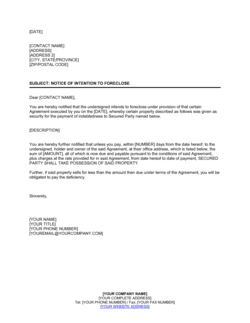
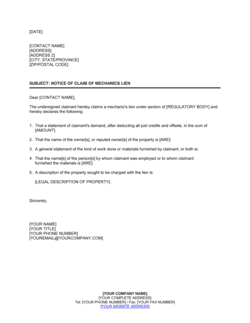
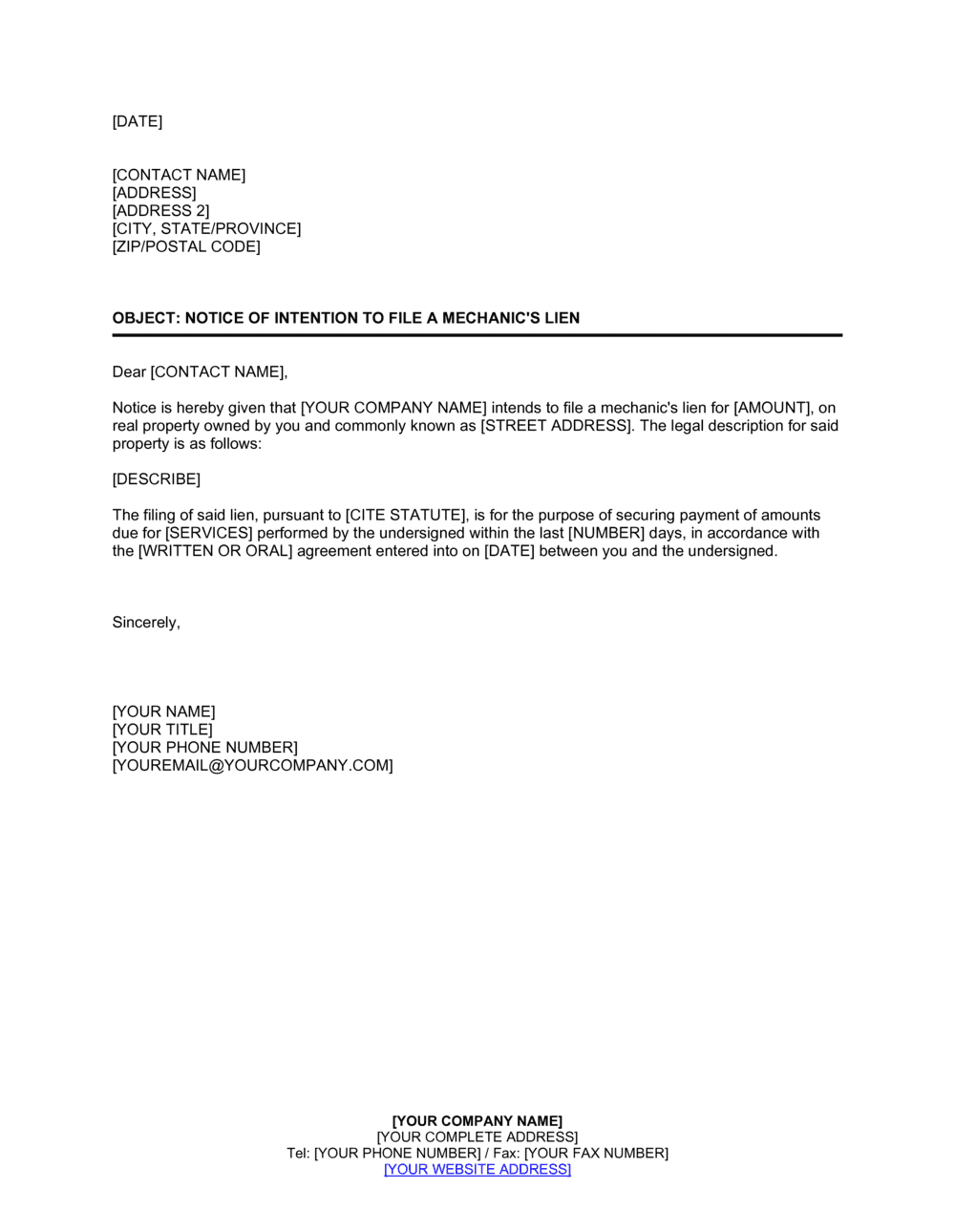
A Notice of Intention to File a Mechanic's Lien is a formal written warning sent by a contractor, subcontractor, or supplier to a property owner β€” and often to the general contractor β€” stating that payment for work or materials is overdue and that a mechanic's lien will be filed against the property if the balance is not settled. This free Word download gives you a ready-to-send letter you can edit online and export as PDF in minutes.
When you need it
Send it when invoices for construction labor, materials, or services remain unpaid past the agreed due date and you intend to protect your right to payment by encumbering the property title. It is typically sent before the statutory deadline for filing the actual lien.
What's inside
Sender and recipient identification, property description, a clear statement of the outstanding amount owed, a deadline for payment, and a formal declaration of intent to file a lien if the debt is not resolved.

What is a Notice of Intention to File a Mechanic's Lien?

A Notice of Intention to File a Mechanic's Lien is a formal written letter sent by a contractor, subcontractor, or materials supplier to a property owner β€” and typically to the general contractor β€” warning that a mechanic's lien will be recorded against the property if an outstanding construction debt is not paid by a stated deadline. It identifies the unpaid claimant, describes the work or materials furnished, specifies the exact amount owed, and sets a firm payment deadline before the more consequential step of encumbering the property's title. Unlike the lien itself, this letter creates no legal claim on the property β€” it is a final, good-faith demand that gives the owner an opportunity to resolve the dispute without the costly and commercially disruptive consequence of a recorded lien.

Why You Need This Document

An unpaid contractor who skips straight to filing a mechanic's lien without prior notice risks damaging business relationships, triggering immediate legal countermeasures, and β€” in states that require a pre-lien notice as a statutory condition β€” losing lien rights entirely. Sending this notice first accomplishes three things simultaneously: it demonstrates good faith, it satisfies mandatory pre-lien notice requirements in jurisdictions that impose them, and it applies immediate commercial pressure on property owners who cannot sell or refinance a property encumbered by a title claim. In practice, a well-drafted notice resolves the majority of payment disputes without the claimant ever filing the actual lien β€” saving the time and filing fees associated with a formal lien and the relationship costs of an escalated dispute. This template gives you a professionally formatted, jurisdiction-neutral letter that covers every required element, so you can send a credible, complete notice the same day payment goes overdue.

Which variant fits your situation?

If your situation is…Use this template
Subcontractor notifying owner directly when GC has not paidNotice of Intention to File a Mechanic's Lien (Subcontractor)
Supplier of materials seeking to protect payment for delivered goodsPreliminary Notice / Notice to Owner (Supplier)
Unpaid balance already past statutory deadline β€” lien filing required immediatelyMechanic's Lien
Dispute resolved and lien notice needs to be withdrawn formallyRelease of Mechanic's Lien
Contractor escalating to formal demand before litigationDemand Letter for Payment
Owner responding to a lien threat with a payment plan offerPayment Agreement / Installment Agreement
Dispute requires documentation of work completed and materials suppliedConstruction Invoice

Common mistakes to avoid

❌ Sending notice after the statutory deadline

Why it matters: Missing the state-mandated window for pre-lien notice forfeits your right to file a mechanic's lien entirely, leaving you with only a contract claim and no security interest in the property.

Fix: Track the last furnishing date on every project and calendar the notice and filing deadlines at project start β€” not when payment becomes overdue.

❌ Addressing the notice only to the general contractor

Why it matters: The property owner is the party with title β€” failing to notify them directly can invalidate the notice under statutes that require owner notification as a condition of lien rights.

Fix: Always address the notice to the property owner of record and copy the general contractor; verify ownership through county assessor records, not just the job site contact.

❌ Using vague work descriptions

Why it matters: A description like 'construction work' is insufficient in many jurisdictions and leaves the notice open to a challenge that it does not adequately identify the claim.

Fix: Describe the specific trade, scope, and contract relationship: 'electrical rough-in and panel installation under subcontract with [GC NAME]' is specific enough to withstand scrutiny.

❌ Overstating the amount claimed

Why it matters: Claiming more than is actually owed can expose the claimant to allegations of bad faith and, in some states, result in the entire lien being voided as fraudulent.

Fix: Base the claimed amount on a specific unpaid invoice or account ledger, not an estimate. If disputed change orders are included, note them separately.

The 8 key clauses, explained

Date and Sender's Identification

In plain language: Opens the letter with the date it is sent and the full legal name, address, and contact information of the party claiming payment.

Sample language
[DATE] [CLAIMANT COMPANY NAME] [CLAIMANT ADDRESS] [CITY, STATE, ZIP] [PHONE] | [EMAIL]

Common mistake: Using a trade name instead of the registered legal entity name β€” if the name on the notice does not match the entity that contracted for the work, the notice may be challenged as defective.

Recipient's Identification

In plain language: States the full name and address of the property owner β€” and, where required, the general contractor β€” who is receiving the notice.

Sample language
TO: [PROPERTY OWNER FULL NAME] [PROPERTY OWNER ADDRESS] [CITY, STATE, ZIP] CC: [GENERAL CONTRACTOR NAME], [ADDRESS]

Common mistake: Sending the notice only to the general contractor and not to the property owner. In most jurisdictions, the property owner must receive direct notice for lien rights to be preserved.

Property Description

In plain language: Identifies the real property subject to the potential lien by street address and, where available, the legal parcel description from county records.

Sample language
RE: Property located at [STREET ADDRESS], [CITY, STATE, ZIP] (Assessor's Parcel No. [APN]).

Common mistake: Providing only a street address without the legal description or APN. An inaccurate property identification can render the eventual lien filing defective and unenforceable.

Description of Work or Materials Furnished

In plain language: Briefly describes the scope of labor performed or materials supplied for which payment is outstanding, including the approximate dates of service.

Sample language
[CLAIMANT] furnished [DESCRIPTION OF LABOR / MATERIALS] to the above-referenced property between [START DATE] and [LAST FURNISHING DATE] pursuant to a contract with [CONTRACTING PARTY].

Common mistake: Describing the work too vaguely β€” 'construction services' rather than 'framing labor and materials for the second-floor addition.' Vague descriptions weaken both the notice and any subsequent lien filing.

Amount of Unpaid Balance

In plain language: States the specific dollar amount currently owed, including any applicable interest or fees permitted under the contract.

Sample language
As of [DATE], the total outstanding balance owed to [CLAIMANT] for the above work is $[AMOUNT], which remains unpaid despite [CLAIMANT]'s repeated demands for payment.

Common mistake: Rounding or estimating the amount rather than stating the precise invoiced balance. An overstated amount can expose the claimant to bad-faith claims; an understated amount may limit recovery.

Statement of Intent to File

In plain language: The operative clause β€” formally declares that the claimant intends to file a mechanic's lien against the property if payment is not received by the deadline stated.

Sample language
Please be advised that unless full payment of $[AMOUNT] is received by [PAYMENT DEADLINE DATE], [CLAIMANT] intends to file a mechanic's lien against the above-described property in the amount of $[AMOUNT] plus any additional amounts permitted by law.

Common mistake: Softening the language to 'may consider filing a lien' instead of a clear statement of intent. Ambiguous language reduces the urgency and may not satisfy statutory pre-lien notice requirements in some jurisdictions.

Payment Deadline

In plain language: Sets a specific calendar date β€” typically 10 to 30 days from the notice date β€” by which payment must be received to avoid the lien filing.

Sample language
Payment in the full amount of $[AMOUNT] must be received by [CLAIMANT] no later than [DATE], [X] days from the date of this notice.

Common mistake: Setting an unrealistically short deadline β€” fewer than 7 days β€” which can appear coercive and may undermine good-faith negotiation or settlement.

Closing and Signature Block

In plain language: Closes the letter professionally, identifies the authorized signatory by name and title, and leaves space for a signature.

Sample language
We trust this matter can be resolved without further action. Please direct all correspondence and payments to the address above. Sincerely, [AUTHORIZED SIGNATORY NAME] [TITLE], [CLAIMANT COMPANY NAME]

Common mistake: Omitting the title or authority of the signatory β€” a notice signed by an unidentified individual without a stated role raises questions about whether the claimant authorized the notice.

How to fill it out

  1. 1

    Confirm the statutory deadline in the applicable jurisdiction

    Before drafting, verify the lien filing deadline for your state or province. Most US states require a lien to be filed within 60 to 90 days of the last date work was performed; the pre-lien notice deadline is often shorter.

    πŸ’‘ Some states β€” California, Texas, and Florida among them β€” require a preliminary notice at the start of the project as a condition of lien rights; if that notice was missed, consult a construction attorney before proceeding.

  2. 2

    Enter the claimant's full legal name and contact details

    Use the registered legal name of your business entity exactly as it appears on your contractor's license or articles of incorporation. Include a mailing address, phone number, and email.

    πŸ’‘ If you are a sole proprietor, use your full legal name followed by 'd/b/a [TRADE NAME]' to avoid any mismatch with your contractor registration.

  3. 3

    Identify the property owner and general contractor

    Look up the property owner's full legal name on county assessor or title records β€” do not rely on the general contractor's representation. Add the GC as a CC recipient.

    πŸ’‘ Check the county recorder's office online to confirm the owner of record. Properties held by LLCs or trusts require the entity name, not a person's name.

  4. 4

    Describe the work and dates of furnishing

    Write a specific one- to two-sentence description of the work performed or materials supplied, including the contract start date and the last date you provided labor or materials.

    πŸ’‘ The 'last furnishing date' determines your lien deadline β€” use the actual last day work was performed, not the invoice date or project completion date.

  5. 5

    State the precise unpaid balance

    Enter the exact outstanding amount from your most recent unpaid invoice or account statement. If the contract allows interest on late payments, calculate and include it.

    πŸ’‘ Attach a copy of the unpaid invoice to the notice so the recipient has the documentation needed to approve payment immediately.

  6. 6

    Set a firm payment deadline

    Enter a specific calendar date β€” typically 10 to 21 days from the notice date β€” giving the owner reasonable time to respond and process payment.

    πŸ’‘ A 14-day window is the most common practice; it signals urgency without appearing coercive and gives you time to follow up before the lien filing deadline.

  7. 7

    Send by certified mail and retain proof of delivery

    Send the notice via certified mail with return receipt requested to every named recipient. Keep the green card and a copy of the signed letter in your project file.

    πŸ’‘ Email a copy simultaneously to create a timestamped digital record β€” courts accept electronic delivery as supplementary evidence even when certified mail is the primary method.

Frequently asked questions

What is a notice of intention to file a mechanic's lien?

A notice of intention to file a mechanic's lien is a formal written warning sent by a contractor, subcontractor, or supplier to a property owner stating that payment for construction work or materials is overdue and that a mechanic's lien will be recorded against the property if the balance is not paid by a specified date. It serves as a final demand before the more serious step of encumbering the property's title.

Is this notice the same as a mechanic's lien?

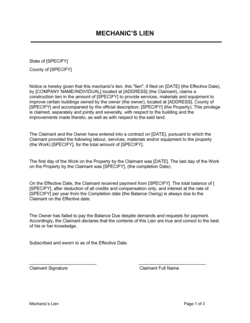
No. The notice of intention is a warning letter sent before a lien is filed. A mechanic's lien is a formal legal document recorded with the county recorder's office that encumbers the property's title and can force a sale if the debt remains unpaid. Sending the notice first gives the owner an opportunity to pay and avoid the more damaging consequence of a title encumbrance.

Do I have to send this notice before filing a mechanic's lien?

In many US states, a preliminary or pre-lien notice is a mandatory condition of preserving lien rights β€” skipping it forfeits the right to file the actual lien. In other states, the pre-lien notice is optional but recommended as a good-faith escalation step. Check your specific state's mechanics' lien statute to determine whether a pre-lien notice is required and what its timing and content requirements are.

How much time do I have to send this notice?

Deadlines vary by state and by the claimant's role. In California, subcontractors and suppliers must serve a preliminary notice within 20 days of first furnishing labor or materials. In Texas, subcontractors must send a notice by the 15th day of the second or third month following non-payment. Most states tie the deadline to the last date work was performed or materials were delivered rather than the invoice due date.

Who should receive the notice?

The property owner of record is the primary recipient in virtually all jurisdictions. The general contractor should also receive a copy. In some states, the construction lender must also be notified. Use county assessor or recorder records to confirm the owner's full legal name and mailing address β€” relying on the GC's representation of who the owner is can result in notice sent to the wrong party.

Can this notice be sent via email?

Most states specify certified mail or personal delivery as the required method for statutory pre-lien notices. Email alone typically does not satisfy the service requirements. Sending a certified-mail copy with return receipt requested provides documented proof of delivery, which is essential if the lien is later contested. Email a copy simultaneously as a supplementary record, but do not rely on it as the primary method.

What happens after I send the notice?

The property owner typically has the number of days stated in your notice β€” usually 10 to 21 days β€” to remit payment. If payment is received, the matter is resolved and no lien is filed. If payment is not received, you proceed to prepare and record the actual mechanic's lien with the county recorder's office before the statutory filing deadline. Sending the notice often prompts payment without requiring the more costly lien filing.

Does sending this notice damage my business relationship with the owner or GC?

A professionally written notice framed as a payment reminder rather than a threat typically preserves working relationships better than an unexpected lien filing. Most experienced property owners and GCs understand that protecting lien rights is standard practice in the construction industry. The risk to relationships is far lower at the notice stage than after a lien has been recorded against the title.

How this compares to alternatives

vs Mechanic's Lien

A mechanic's lien is a recorded legal instrument that encumbers property title and can ultimately force a sale to satisfy the debt. This notice is a pre-lien warning letter β€” it creates no encumbrance but signals that one is coming. Send the notice first; file the actual lien only if the notice goes unanswered past your deadline.

vs Demand Letter for Payment

A general demand letter requests payment for any type of debt. A notice of intention to file a mechanic's lien is specific to construction debts and invokes the claimant's statutory lien rights against real property. The lien notice carries more weight with property owners because the consequence β€” a cloud on title β€” directly threatens their ability to sell or refinance.

vs Release of Mechanic's Lien

A release of mechanic's lien is sent after payment is received to remove a recorded lien from the property's title. This notice of intention is sent before any lien is filed, as a warning. The two documents sit at opposite ends of the same payment dispute: this notice opens the escalation; the release closes it.

vs Payment Agreement

A payment agreement formalizes an installment plan when the full balance cannot be paid immediately. It is often the outcome of a successful lien notice negotiation β€” the owner acknowledges the debt and commits to a structured repayment schedule. Use the lien notice to prompt the conversation; use the payment agreement to document the resolution.

Industry-specific considerations

Residential Construction

Subcontractors and finish trades frequently send this notice when homeowners withhold final payment pending punch-list disputes on remodel or new-build projects.

Commercial Construction

Material suppliers and specialty subcontractors on commercial projects use this notice to protect payment when drawn-out GC payment cycles push invoices past 60 or 90 days.

Manufacturing and Building Materials

Lumber yards, concrete suppliers, and equipment rental companies send this notice when delivered materials remain unpaid after the agreed net terms have expired.

Professional Services (Construction-Adjacent)

Architects, engineers, and surveyors whose services are lienable under state statute use this notice when design or inspection fees go unpaid after project milestones.

Template vs pro β€” what fits your needs?

PathBest forCostTime
Use the templateContractors and suppliers sending a standard pre-lien warning on a domestic project with a straightforward unpaid balanceFree15–30 minutes
Template + professional reviewProjects in states with strict statutory pre-lien notice requirements, or claims involving disputed change orders$100–$300 for a construction attorney review1–2 days
Custom draftedLarge commercial projects, multi-party lien disputes, or cases where preliminary notice deadlines may have been missed$300–$1,000+2–5 days

Glossary

Mechanic's Lien
A legal claim against real property that secures payment for labor, materials, or services provided during construction or renovation.
Preliminary Notice
A notice sent early in a project β€” often before work begins or within days of first furnishing β€” required in many states as a condition of preserving lien rights.
Lien Claimant
The contractor, subcontractor, or supplier asserting the right to file a mechanic's lien against a property.
Property Owner
The individual or entity that holds title to the real property on which the construction work was performed.
Notice Deadline
The statutory deadline β€” typically 20 to 90 days from the last date work was performed or materials were furnished β€” by which a lien must be filed or rights are forfeited.
Lien Waiver
A document signed by a contractor or supplier releasing their right to file a lien, typically exchanged in return for a payment.
Subrogation
The right of a party who has paid a debt on behalf of another to step into the creditor's position and pursue recovery against the original debtor.
Cloud on Title
Any encumbrance, claim, or outstanding lien that impairs a property owner's ability to sell or refinance the property with a clean title.
Joint Check Agreement
An arrangement in which an owner issues payment checks jointly to both the general contractor and a subcontractor or supplier to ensure funds reach the lower-tier party.
Stop Notice
A remedy available in some states that orders a construction lender or owner to withhold funds from the general contractor until a subcontractor or supplier claim is resolved.

Part of your Business Operating System

This document is one of 3,000+ business & legal templates included in Business in a Box.

  • Fill-in-the-blanks β€” ready in minutes
  • 100% customizable Word document
  • Compatible with all office suites
  • Export to PDF and share electronically

Create your document in 3 simple steps.

From template to signed document β€” all inside one Business Operating System.
1
Download or open template

Access over 3,000+ business and legal templates for any business task, project or initiative.

2
Edit and fill in the blanks with AI

Customize your ready-made business document template and save it in the cloud.

3
Save, Share, Send, Sign

Share your files and folders with your team. Create a space of seamless collaboration.

Save time, save money, and create top-quality documents.

β˜…β˜…β˜…β˜…β˜…

"Fantastic value! I'm not sure how I'd do without it. It's worth its weight in gold and paid back for itself many times."

Managing Director Β· Mall Farm
Robert Whalley
Managing Director, Mall Farm Proprietary Limited
β˜…β˜…β˜…β˜…β˜…

"I have been using Business in a Box for years. It has been the most useful source of templates I have encountered. I recommend it to anyone."

Business Owner Β· 4+ years
Dr Michael John Freestone
Business Owner
β˜…β˜…β˜…β˜…β˜…

"It has been a life saver so many times I have lost count. Business in a Box has saved me so much time and as you know, time is money."

Owner Β· Upstate Web
David G. Moore Jr.
Owner, Upstate Web

Run your business with a system β€” not scattered tools

Stop downloading documents. Start operating with clarity. Business in a Box gives you the Business Operating System used by over 250,000 companies worldwide to structure, run, and grow their business.

Free Forever PlanΒ Β·Β No credit card required