Conflict Of Interest Disclosure Policy Template

Free Word download β€’ Edit online β€’ Save & share with Drive β€’ Export to PDF

3 pagesβ€’20–30 min to fillβ€’Difficulty: Standard
Learn more ↓
FreeConflict Of Interest Disclosure Policy Template

At a glance

What it is
A Conflict of Interest Disclosure Policy is an internal governance document that defines what constitutes a conflict of interest, requires employees, directors, and officers to disclose any personal or financial interests that could influence their business decisions, and establishes the procedures for managing or resolving those conflicts. This free Word download gives you a complete, editable starting point you can tailor to your organization's structure and export as PDF for distribution and acknowledgment.
When you need it
Use it when onboarding new employees or board members, when your organization handles procurement or vendor selection, or when preparing for an audit, grant application, or regulatory review that requires documented ethics governance. Nonprofits seeking IRS 501(c)(3) status are specifically expected to have a formal policy in place.
What's inside
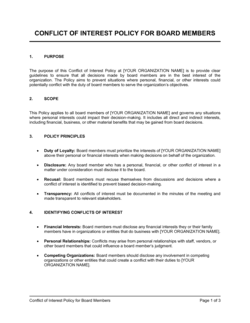
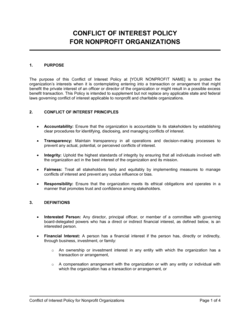
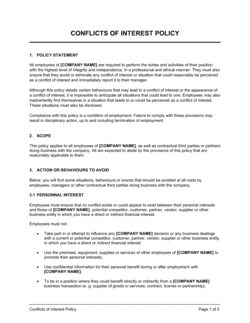
A purpose statement and scope definition, plain-language definitions of conflict types, disclosure and recusal procedures, a review and enforcement process, annual acknowledgment requirements, and a sample disclosure form.

What is a Conflict of Interest Disclosure Policy?

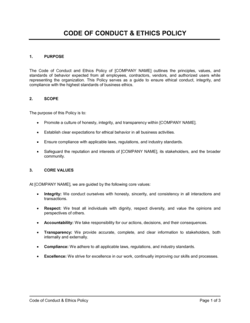
A Conflict of Interest Disclosure Policy is an internal governance document that defines what constitutes a conflict of interest, requires employees, directors, officers, and other covered individuals to disclose any personal or financial interests that could improperly influence their organizational decisions, and establishes clear procedures for reviewing, managing, and resolving those disclosures. It covers the full range of conflict scenarios β€” from an employee who owns shares in a vendor company to a board member whose family member applies for a grant β€” and sets out the recusal, recordkeeping, and enforcement mechanisms that allow the organization to act on disclosures consistently. This free Word download gives organizations of any size a complete, editable policy they can customize, sign, and distribute in a single session.

Why You Need This Document

Without a written conflict of interest policy, your organization has no documented standard against which to measure employee conduct, no process for identifying conflicted decisions before they cause damage, and no audit trail to demonstrate ethical governance to regulators, funders, or the public. The consequences of operating without one are concrete: the IRS flags nonprofits that cannot produce a conflict of interest policy on Form 990; government contractors risk contract termination or debarment when undisclosed conflicts surface during an audit; and a single high-profile procurement decision tainted by an undisclosed interest can trigger litigation, loss of funding, and lasting reputational damage. A properly implemented policy does not prevent all conflicts β€” it creates the transparency that allows your organization to manage them before they become crises. This template gives you a complete governance foundation that takes hours, not weeks, to put in place.

Which variant fits your situation?

If your situation is…Use this template
Governing a nonprofit board where directors approve grants and contractsNonprofit Conflict of Interest Policy
Managing disclosure for a publicly traded companyCorporate Code of Ethics and Conduct
Covering employee relationships with vendors and suppliers specificallyVendor Conflict of Interest Policy
Addressing conflicts in a research or academic institutionResearch Conflict of Interest Policy
Documenting a one-time individual disclosure rather than an ongoing policyConflict of Interest Disclosure Form
Building a broader ethics framework that encompasses multiple policiesCode of Business Conduct and Ethics
Covering gifts, hospitality, and anti-bribery obligations alongside conflictsGifts and Entertainment Policy

Common mistakes to avoid

❌ Scoping the policy to employees only

Why it matters: Board members, volunteers, and contractors often have the most significant external relationships β€” vendor ownership stakes, board seats at competing organizations, or family ties to grantees. Excluding them creates the most material governance gap.

Fix: Explicitly list every covered category in the scope clause: employees, officers, directors, board members, independent contractors, and volunteers.

❌ No concrete examples of what constitutes a conflict

Why it matters: Individuals self-assess too narrowly when the policy uses abstract language. Research consistently shows that people do not recognize their own conflicts of interest even when acting in good faith.

Fix: Add three to five specific examples relevant to your organization's activities β€” vendor ownership, family employment, outside board service, and grant applicant relationships.

❌ Collecting acknowledgments only at hire and never recertifying

Why it matters: Financial interests, family relationships, and outside employment change constantly. A one-time acknowledgment at hire becomes stale within months and provides no ongoing assurance.

Fix: Require annual recertification by a fixed date and track completion. Follow up in writing with anyone who misses the deadline.

❌ Allowing the conflicted individual to remain in the room during deliberations

Why it matters: Even a silent presence influences group decisions. Research on group dynamics shows that people moderate their views when a conflicted party is present, undermining the independence the recusal was meant to protect.

Fix: State explicitly in the recusal clause that the individual must leave the room β€” not merely abstain from voting β€” during any discussion related to the conflict.

❌ No designated recordkeeper or centralized disclosure log

Why it matters: Disclosure records stored in email threads or individual files are effectively invisible to auditors, regulators, and new leadership. During a governance review, the inability to produce a disclosure log is treated as evidence of non-compliance.

Fix: Assign a single role to maintain a centralized log of all disclosures, committee determinations, and outcomes, and retain records for at least five years.

❌ Setting vague disciplinary consequences

Why it matters: Stating only that 'appropriate action will be taken' signals to employees that the policy is aspirational rather than enforceable, reducing voluntary compliance.

Fix: Specify the full range of consequences β€” written warning, suspension, termination, removal from the board, or legal referral β€” so covered individuals understand the stakes.

The 10 key sections, explained

Purpose and scope

Definition of conflicts of interest

Disclosure procedure

Recusal and management of conflicts

Review committee and investigation process

Prohibited conduct

Recordkeeping and reporting

Annual acknowledgment and certification

Consequences of non-compliance

Policy review and amendment

How to fill it out

  1. 1

    Define your organization name and covered individuals

    Replace all [ORGANIZATION NAME] placeholders with your legal entity name. Then review the scope clause and confirm it covers every category relevant to your structure β€” employees, board members, contractors, and volunteers.

    πŸ’‘ If your organization uses a parent-subsidiary structure, specify whether the policy applies to all entities or only the primary organization.

  2. 2

    Customize the conflict definitions with examples relevant to your industry

    Add two or three concrete, industry-specific examples to the definition section β€” for example, a vendor relationship for a manufacturer, a grant recipient relationship for a foundation, or a competing product for a tech company.

    πŸ’‘ Concrete examples double as training material for new hires who may not instinctively recognize what a conflict looks like in practice.

  3. 3

    Set the disclosure timeline and submission path

    Insert the number of business days within which new conflicts must be disclosed (typically 5–10 days) and name the role or department receiving disclosures. Confirm this person or team is independent enough to evaluate the disclosure objectively.

    πŸ’‘ Avoid routing disclosures exclusively through an employee's direct manager β€” conflicts involving the manager go unreviewed.

  4. 4

    Name the review committee and define its decision process

    Identify who sits on the Review Committee, specify the quorum required to make a determination, and state the decision-making threshold (majority vote is standard). For small organizations, a single designated officer may substitute with board oversight.

    πŸ’‘ Document the committee's findings in a standard one-page memo format β€” this becomes your audit evidence.

  5. 5

    Set the gift and hospitality threshold

    Insert a specific dollar figure for the maximum permissible gift, meal, or entertainment value. Common thresholds range from $25 to $150 depending on industry and jurisdiction.

    πŸ’‘ Align this threshold with any applicable regulatory standard for your industry β€” government contractors, healthcare organizations, and financial firms often have mandatory caps.

  6. 6

    Complete the acknowledgment form (Exhibit A)

    Customize the attached acknowledgment form with your organization name and the current policy version date. Confirm the form includes fields for the individual's name, title, date, signature, and a space to describe any currently known conflicts.

    πŸ’‘ Collect acknowledgments digitally if possible β€” a timestamped electronic signature is easier to track and retrieve than paper forms.

  7. 7

    Set the annual certification date and assign ownership

    Choose a consistent annual date for recertification (e.g., January 15 or the start of your fiscal year) and assign one role β€” typically HR or the Compliance Officer β€” to manage collection and follow-up.

    πŸ’‘ Schedule a calendar reminder 30 days before the recertification deadline so you can send reminders and chase outstanding forms before the deadline passes.

  8. 8

    Obtain approval and distribute the policy

    Have the policy approved by the board or senior leadership before distribution. Distribute via email with the acknowledgment form attached and retain signed copies in each individual's personnel file.

    πŸ’‘ Include a brief plain-language summary at the top of your distribution email β€” a two-paragraph overview improves read rates before recipients reach the full policy.

Frequently asked questions

What is a conflict of interest disclosure policy?

A conflict of interest disclosure policy is an internal governance document that defines what constitutes a conflict of interest, requires employees, directors, and other covered individuals to disclose any personal or financial interest that could improperly influence their decisions, and establishes how the organization will review and manage those disclosures. It protects the organization's integrity and creates a documented record that governance obligations are being met.

Who is required to follow a conflict of interest policy?

The policy should cover everyone who makes or influences decisions on behalf of the organization β€” full-time and part-time employees, officers, board directors, independent contractors, and volunteers. Nonprofits typically extend coverage to anyone who participates in grant awards, procurement decisions, or major financial transactions. Limiting the policy to employees alone leaves the most material governance gaps unaddressed.

Is a conflict of interest policy required by law?

No federal law universally mandates a written conflict of interest policy for private businesses, but several frameworks effectively require one. The IRS Form 990 asks nonprofits whether they have a written policy and how conflicts are managed. Sarbanes-Oxley requires public companies to have ethics policies covering conflicts. Government contractors and organizations in regulated industries β€” healthcare, financial services β€” typically face contractual or regulatory obligations to maintain one.

What is the difference between a conflict of interest policy and a code of ethics?

A conflict of interest policy is a focused document addressing one specific governance risk β€” undisclosed personal or financial interests that could influence decisions. A code of ethics is a broader framework covering honesty, fairness, compliance, confidentiality, and professional conduct across the full range of employee behavior. Many organizations maintain both: the conflict of interest policy is either a standalone document or incorporated as a dedicated section within the broader code.

How often should employees complete a conflict of interest disclosure?

All covered individuals should complete an initial disclosure at hire or onboarding and recertify annually. They should also disclose promptly β€” typically within 5–10 business days β€” whenever a new conflict arises between annual certifications. Annual recertification without a prompt mid-year disclosure trigger leaves a significant gap when financial interests or relationships change.

What happens after a conflict of interest is disclosed?

The designated review committee or compliance officer evaluates whether the disclosed interest is material and whether it affects any pending decision. If a material conflict is found, the disclosing individual is recused from relevant deliberations and decisions. The committee documents its findings and any mitigation steps taken. Most disclosed conflicts are managed without disciplinary action β€” the policy rewards transparency and only penalizes concealment or prohibited conduct.

Can a conflict of interest be waived?

Yes, in many cases. After a conflict is properly disclosed and reviewed, the organization may determine that the conflict is not material enough to require recusal, or that proceeding with appropriate safeguards serves the organization's interests. Any waiver decision should be documented in writing by the review committee, including the rationale, to demonstrate that the process was followed and the decision was made independently of the conflicted party.

What is the difference between a conflict of interest and a perceived conflict of interest?

A conflict of interest is a situation where a personal or financial interest actually could influence a decision. A perceived conflict is one that a reasonable outside observer might believe could influence the decision, even if no actual bias exists. Most well-drafted policies treat both categories the same way β€” requiring disclosure and recusal β€” because the reputational and legal risk from a perceived conflict is nearly identical to that from a real one.

How is a conflict of interest policy enforced?

Enforcement relies on three mechanisms: mandatory annual acknowledgment so individuals cannot claim ignorance, a centralized disclosure log that creates accountability, and clearly stated consequences ranging from written warnings to termination or legal referral. Organizations that enforce the policy consistently β€” including against senior employees and board members β€” report significantly higher voluntary disclosure rates than those that apply it selectively.

How this compares to alternatives

vs Code of Business Conduct and Ethics

A code of ethics is a broad governance document covering honesty, compliance, confidentiality, and professional conduct across all employee behaviors. A conflict of interest policy is a focused subset addressing one specific risk. Many organizations maintain both β€” the conflict of interest policy is either standalone or embedded as a dedicated section of the broader code. Use the standalone policy when you need a document that can be signed and filed independently.

vs Whistleblower Policy

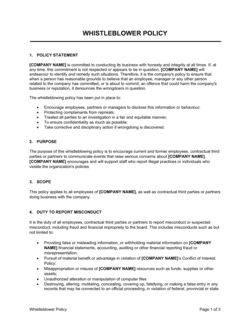
A whistleblower policy establishes how employees can report suspected misconduct β€” including undisclosed conflicts of interest β€” without fear of retaliation. The conflict of interest policy defines what must be disclosed proactively; the whistleblower policy provides the mechanism for reporting when that obligation is not met. Both documents work together and are expected by IRS Form 990 for nonprofits.

vs Non-Disclosure Agreement

An NDA governs the confidentiality of information shared between parties and prevents unauthorized disclosure to third parties. A conflict of interest policy governs the internal disclosure of an employee's personal or financial interests to the organization. They address opposite information flows and serve entirely different governance purposes.

vs Employee Handbook

An employee handbook compiles all workplace policies β€” including a conflict of interest section β€” into a single reference document. A standalone conflict of interest policy is more detailed, requires its own signed acknowledgment, and can be updated independently without reissuing the full handbook. Use the standalone policy when regulatory scrutiny or board governance requires a separately executed document.

Industry-specific considerations

Nonprofit and charitable organizations

IRS Form 990 governance disclosures, grant-making recusal requirements, and board member relationships with grantees or contractors make a formal policy a near-mandatory governance tool.

Healthcare

Physician relationships with pharmaceutical and device companies, referral arrangements, and ownership interests in facilities create heavily regulated conflict scenarios under the Stark Law and Anti-Kickback Statute.

Financial services

Regulatory bodies including the SEC, FINRA, and FCA impose specific conflict disclosure requirements on investment advisers, brokers, and fund managers, making a documented policy essential for licensing and examination readiness.

Government contracting

Federal Acquisition Regulation requirements mandate organizational conflict of interest procedures for contractors; undisclosed conflicts can result in contract termination, debarment, or criminal referral.

Template vs pro β€” what fits your needs?

PathBest forCostTime
Use the templateSmall businesses, nonprofits, and startups building initial governance documentationFree1–2 hours to customize and distribute
Template + professional reviewOrganizations in regulated industries, government contractors, or nonprofits preparing for a 990 audit$300–$800 for a compliance officer or attorney review3–5 business days
Custom draftedPublic companies, financial services firms with SEC/FINRA obligations, or healthcare organizations under Stark Law compliance requirements$1,500–$5,000+2–4 weeks

Glossary

Conflict of Interest
A situation in which an individual's personal, financial, or professional interests could improperly influence their decisions on behalf of the organization.
Disclosure
The formal act of informing the organization about a potential conflict so it can be reviewed and managed before affecting a business decision.
Recusal
Voluntarily removing oneself from a decision-making process β€” vote, negotiation, or approval β€” because of a personal interest in the outcome.
Material Interest
A financial or personal stake in a transaction significant enough that a reasonable person would question whether it could influence the decision-maker's judgment.
Related Party
A family member, household member, or business associate of an employee or director whose interests may indirectly affect that person's decisions at work.
Acknowledgment Form
A signed document confirming that the recipient has read, understood, and agreed to comply with the conflict of interest policy.
Review Committee
The designated group β€” typically senior management, HR, or a board subcommittee β€” responsible for evaluating disclosed conflicts and determining the appropriate response.
Annual Certification
A yearly renewal of the acknowledgment process requiring covered individuals to confirm they have no undisclosed conflicts and that their prior disclosures remain accurate.
Arm's-Length Transaction
A transaction conducted between unrelated parties acting independently and in their own self-interest, used as the standard against which potentially conflicted transactions are measured.
Fiduciary Duty
The legal and ethical obligation to act in the best interest of the organization rather than in one's own personal interest.

Part of your Business Operating System

This document is one of 3,000+ business & legal templates included in Business in a Box.

  • Fill-in-the-blanks β€” ready in minutes
  • 100% customizable Word document
  • Compatible with all office suites
  • Export to PDF and share electronically

Create your document in 3 simple steps.

From template to signed document β€” all inside one Business Operating System.
1
Download or open template

Access over 3,000+ business and legal templates for any business task, project or initiative.

2
Edit and fill in the blanks with AI

Customize your ready-made business document template and save it in the cloud.

3
Save, Share, Send, Sign

Share your files and folders with your team. Create a space of seamless collaboration.

Save time, save money, and create top-quality documents.

β˜…β˜…β˜…β˜…β˜…

"Fantastic value! I'm not sure how I'd do without it. It's worth its weight in gold and paid back for itself many times."

Managing Director Β· Mall Farm
Robert Whalley
Managing Director, Mall Farm Proprietary Limited
β˜…β˜…β˜…β˜…β˜…

"I have been using Business in a Box for years. It has been the most useful source of templates I have encountered. I recommend it to anyone."

Business Owner Β· 4+ years
Dr Michael John Freestone
Business Owner
β˜…β˜…β˜…β˜…β˜…

"It has been a life saver so many times I have lost count. Business in a Box has saved me so much time and as you know, time is money."

Owner Β· Upstate Web
David G. Moore Jr.
Owner, Upstate Web

Run your business with a system β€” not scattered tools

Stop downloading documents. Start operating with clarity. Business in a Box gives you the Business Operating System used by over 250,000 companies worldwide to structure, run, and grow their business.

Start freeΒ Β·Β No credit card required