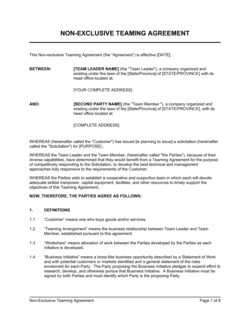
Teaming Agreement Template

Free Word download β€’ Edit online β€’ Save & share with Drive β€’ Export to PDF

8 pagesβ€’30–40 min to fillβ€’Difficulty: Complexβ€’Signature requiredβ€’Legal review recommended
Learn more ↓
FreeTeaming Agreement Template

At a glance

What it is
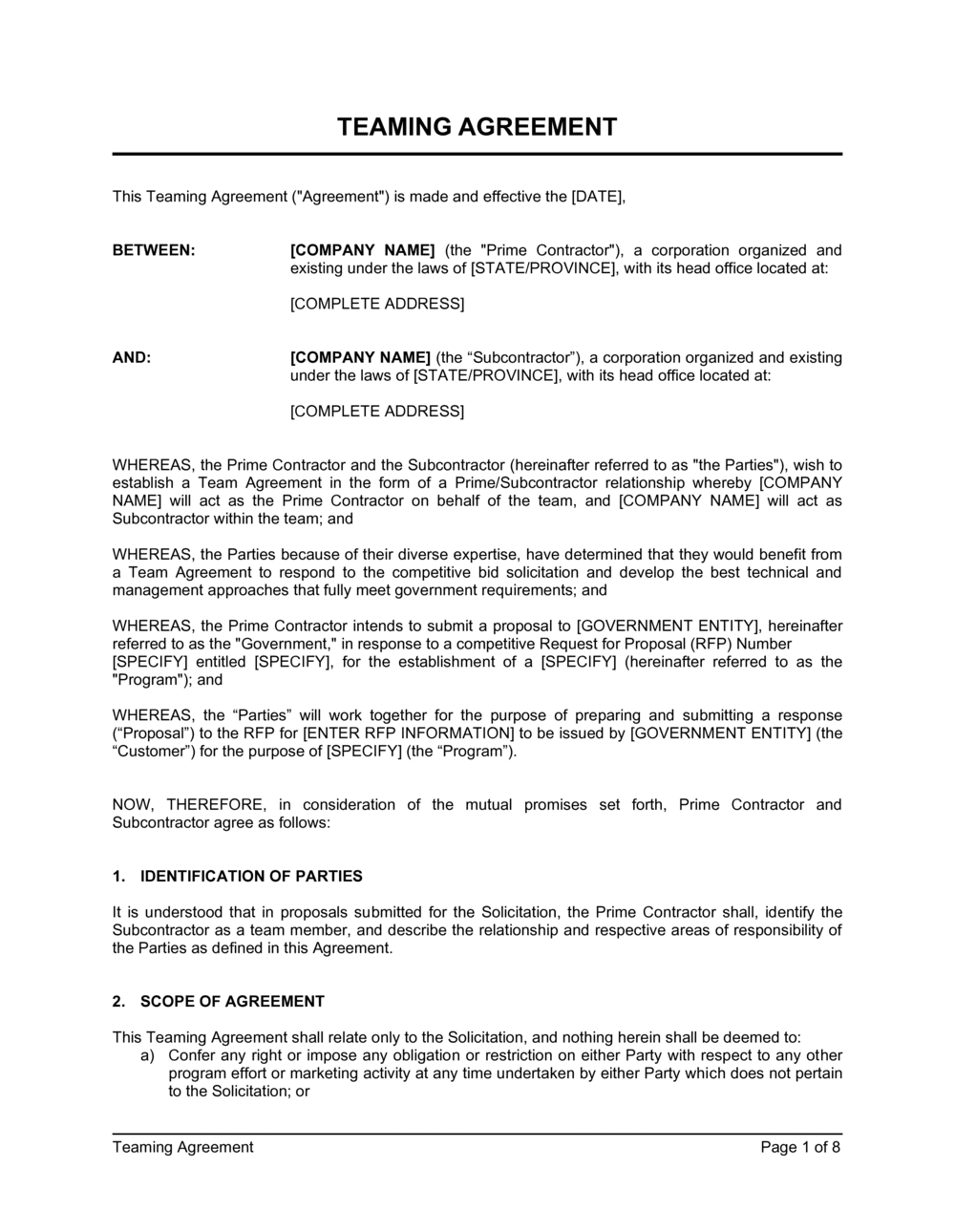
A Teaming Agreement is a legally binding contract between two or more companies that agree to collaborate in pursuing a specific contract award β€” most commonly a government or large institutional procurement. This free Word download lets you define each party's role, responsibilities, and protections before a proposal is submitted, and is editable online for export as PDF.
When you need it
Use it when two or more businesses plan to submit a joint bid or proposal and need to establish the prime-subcontractor relationship, exclusivity obligations, and information-sharing rules before the solicitation closes. It is also used when a larger prime contractor needs a specialty firm's qualifications or certifications to satisfy solicitation requirements.
What's inside
Scope of collaboration and designated roles, exclusivity and non-compete provisions, confidentiality and IP ownership, subcontract commitment language, work-share allocation, proposal cost responsibilities, and termination triggers β€” all structured to govern the relationship from proposal pursuit through contract award and into performance.

What is a Teaming Agreement?

A Teaming Agreement is a legally binding contract between two or more companies that agree to collaborate in pursuing a specific contract opportunity β€” defining each party's role, responsibilities, exclusivity obligations, and IP rights before a proposal is submitted. Most commonly used in government and large institutional procurement, a teaming agreement establishes a prime contractor who holds the client relationship and one or more subcontractors who contribute specialized capabilities, certifications, or capacity the prime needs to compete. Unlike a joint venture, a teaming agreement does not create a new legal entity or merge the parties' businesses β€” each company remains independent, and the agreement governs only the pursuit and performance of the named opportunity.

Why You Need This Document

Without a signed teaming agreement, a collaborative bid leaves every party exposed. A subcontractor that invests weeks developing technical sections of an RFP response has no legal protection if the prime wins the contract and then awards the subcontract to a lower-cost competitor. A prime that shares its pricing strategy, proprietary methodology, or key personnel profiles with a teammate has no enforceable confidentiality protection if the relationship ends before award. The exclusivity each party expects β€” the assurance that their teammate is not simultaneously supporting a rival bid β€” exists only on paper unless it is contractually documented. A properly executed teaming agreement, signed before the proposal goes out, closes all of these gaps: it commits the prime to a defined subcontract scope, protects both parties' confidential information, and gives each party a clear exit if the opportunity disappears. This template gives you the structure to do that in under an hour.

Which variant fits your situation?

If your situation is…Use this template
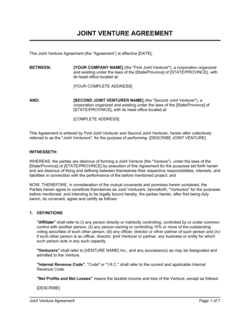
Pursuing a federal government contract with a defined prime and subcontractorTeaming Agreement (Federal)
Two equal partners co-bidding with no defined primeJoint Venture Agreement
Sharing confidential bid information before committing to a teamNon-Disclosure Agreement
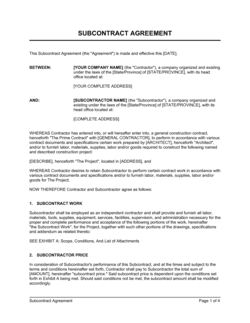
Contract has been awarded and subcontract work is ready to executeSubcontractor Agreement
Multiple firms pooling resources for a commercial consortium bidConsortium Agreement
Formalizing ongoing referral or channel partner arrangementsPartnership Agreement
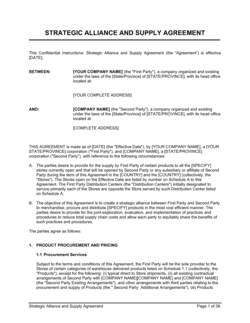
Long-term strategic alliance between two companies beyond a single bidStrategic Alliance Agreement

Common mistakes to avoid

❌ Using 'best efforts' for the subcontract commitment

Why it matters: Courts across multiple jurisdictions have held that 'best efforts to negotiate a subcontract' creates no enforceable obligation. After winning the prime contract, the prime can walk away from the teammate without legal consequence.

Fix: Replace 'best efforts' with 'shall award a subcontract' and specify a minimum work-share percentage. Include a dispute resolution mechanism if negotiation stalls after award.

❌ Omitting a no-award termination trigger

Why it matters: Without a trigger that ends the agreement when the solicitation is cancelled or awarded to a competitor, the exclusivity and confidentiality clauses can remain in force indefinitely, preventing each party from pursuing related opportunities.

Fix: Add explicit termination events covering: award to another offeror, agency withdrawal of the solicitation, and a long-stop calendar date regardless of outcome.

❌ Asymmetric exclusivity binding only the subcontractor

Why it matters: One-sided exclusivity likely lacks mutual consideration in common-law jurisdictions, making the restriction unenforceable and leaving the subcontractor exposed β€” locked out of competing teams while the prime has no corresponding obligation.

Fix: Make exclusivity mutual β€” both parties agree not to pursue the named solicitation through any other team. If the prime needs flexibility, negotiate a defined carve-out rather than eliminating the prime's obligation entirely.

❌ No background IP definition or schedule

Why it matters: Without a clear record of what each party owned before the teaming arrangement, a dispute over jointly developed proposal content β€” technical approaches, pricing models, methodologies β€” can result in one party claiming ownership of the other's pre-existing assets.

Fix: Attach a Schedule identifying each party's background IP by category or document name at the time of execution, and include language confirming that background IP remains the exclusive property of its owner.

❌ Vague work-share scope with no schedule

Why it matters: A subcontract commitment that says 'approximately 30% of work' without defining which work creates a negotiating conflict after award, when the prime has every incentive to interpret the scope narrowly.

Fix: Attach a work-share schedule identifying the specific contract line items, task areas, or labor categories allocated to the subcontractor, and tie the percentage to a defined base.

❌ Not addressing flow-down federal contract clauses

Why it matters: Federal prime contracts contain mandatory FAR and DFARS clauses that the prime must flow down to subcontractors. Failing to reference them in the teaming agreement can create compliance gaps and audit exposure for both parties after award.

Fix: Include a clause stating that the eventual subcontract will incorporate all applicable FAR and DFARS flow-down requirements, and conduct a preliminary review of the target contract's clause list before executing.

The 10 key clauses, explained

Parties, Purpose, and Opportunity

In plain language: Identifies each teaming party by legal name, designates who is the prime and who is the subcontractor, and names the specific procurement opportunity being pursued.

Sample language
This Teaming Agreement ('Agreement') is entered into as of [DATE] between [PRIME CONTRACTOR LEGAL NAME] ('Prime') and [SUBCONTRACTOR LEGAL NAME] ('Subcontractor') for the purpose of pursuing [SOLICITATION NAME / NUMBER] issued by [CLIENT / AGENCY NAME].

Common mistake: Describing the opportunity vaguely rather than referencing the exact solicitation number or RFP title. A vague scope lets either party argue the agreement covers β€” or doesn't cover β€” adjacent opportunities.

Roles and Responsibilities

In plain language: Assigns specific proposal and performance responsibilities to each party β€” who writes which sections, who holds the prime contract, and who performs which portions of the work.

Sample language
Prime shall serve as the prime contractor and shall be responsible for [PROPOSAL SECTIONS / WORK AREAS]. Subcontractor shall be responsible for [TECHNICAL VOLUME / SPECIFIC DELIVERABLES] and shall provide all qualified personnel required for [SCOPE DESCRIPTION].

Common mistake: Leaving responsibilities at a high level without attaching a work-share schedule. When the award comes through, vague role language generates disputes over who owns which deliverables.

Exclusivity

In plain language: Prevents either or both parties from teaming with a competing team for the same solicitation during the agreement term, protecting the integrity of the joint pursuit.

Sample language
During the term of this Agreement, Subcontractor shall not provide support, expertise, or qualifications to any other offeror pursuing [SOLICITATION NAME / NUMBER], and Prime shall not engage any other subcontractor to perform the scope assigned to Subcontractor herein without written consent.

Common mistake: Making exclusivity one-sided β€” binding the subcontractor but not the prime. Courts have found asymmetric exclusivity clauses to lack consideration, potentially voiding the entire restriction.

Confidentiality and Information Use

In plain language: Restricts each party's use of the other's proprietary data shared during proposal development to the pursuit of this specific opportunity only.

Sample language
Each party agrees to hold the other's Proprietary Information in strict confidence, to use it solely in connection with the pursuit and performance of [SOLICITATION NAME], and not to disclose it to any third party without prior written consent. This obligation survives termination for [X] years.

Common mistake: Not specifying a post-termination confidentiality period. If the clause simply ends when the agreement ends, a losing teammate can immediately share the prime's pricing strategy or technical approach with a competitor.

Intellectual Property

In plain language: Allocates ownership of background IP each party brings to the team and foreground IP created during the pursuit, and sets the terms for using each other's IP in the proposal.

Sample language
Each party retains ownership of its Background IP. Any Foreground IP created jointly by the parties in connection with this Agreement shall be owned [JOINTLY / BY PRIME / BY THE CREATING PARTY] as set forth in Schedule [X]. Each party grants the other a limited, non-exclusive license to use its Background IP solely for the purpose of performing obligations under this Agreement.

Common mistake: Omitting the background IP definition entirely, which allows a dispute over whether a proprietary methodology contributed to the proposal now belongs to the other party.

Subcontract Commitment and Work-Share

In plain language: States the prime's commitment to award a subcontract to the teammate if the prime wins, identifies the subcontract scope, and specifies the minimum work-share percentage.

Sample language
Upon award of the prime contract to Prime, Prime shall negotiate in good faith and award a subcontract to Subcontractor for no less than [X]% of the total contract value, covering [SCOPE DESCRIPTION], subject to agreement on mutually acceptable terms within [60] days of award.

Common mistake: Using 'best efforts to award' language instead of a firm commitment. Courts have consistently held that 'best efforts' subcontract promises are unenforceable β€” the subcontractor can be cut out after award with no remedy.

Proposal Costs and Expenses

In plain language: Clarifies that each party bears its own costs in preparing the proposal and that neither party owes the other reimbursement if the bid is unsuccessful.

Sample language
Each party shall bear its own costs and expenses incurred in connection with the preparation of the proposal. Neither party shall have any obligation to reimburse the other for proposal costs in the event the solicitation is not awarded to Prime.

Common mistake: Skipping this clause entirely. Without it, a subcontractor that spent significant resources on the proposal can argue for quantum meruit recovery if the bid is lost.

Term and Termination

In plain language: Sets the agreement's duration β€” typically from execution through contract award or a defined date β€” and specifies the events that trigger early termination.

Sample language
This Agreement shall remain in effect from the Effective Date until the earlier of: (a) award and execution of a subcontract between the parties; (b) written notice that [CLIENT / AGENCY] has selected a different offeror; (c) withdrawal of the solicitation; or (d) [DATE]. Either party may terminate for material breach upon [30] days' written notice if the breach remains uncured.

Common mistake: No termination trigger tied to a 'no-award' outcome. Without it, the agreement β€” including exclusivity and confidentiality β€” can linger indefinitely even after the opportunity is dead.

Non-Solicitation of Personnel

In plain language: Prevents each party from recruiting or hiring the other's employees who were involved in the pursuit for a defined period after the agreement ends.

Sample language
For a period of [12] months following termination or expiration of this Agreement, neither party shall directly solicit for employment any employee of the other party who participated in activities under this Agreement, without prior written consent.

Common mistake: Applying the non-solicit to all employees of both companies rather than limiting it to those who actually worked on the teaming effort. Overbroad non-solicits are frequently found unreasonable and struck down.

Governing Law, Disputes, and Entire Agreement

In plain language: Specifies which jurisdiction's law governs, how disputes are resolved (arbitration or litigation), and confirms the written agreement supersedes all prior discussions.

Sample language
This Agreement shall be governed by the laws of [STATE / PROVINCE / COUNTRY]. Any dispute arising hereunder shall be resolved by [binding arbitration / litigation] in [VENUE]. This Agreement constitutes the entire agreement between the parties with respect to the subject matter hereof and supersedes all prior negotiations, representations, and understandings.

Common mistake: Choosing a governing law state with no connection to either party's operations or the contract's performance location, which can make a court battle logistically and strategically disadvantageous.

How to fill it out

  1. 1

    Identify the opportunity and designate roles

    Enter the exact solicitation name, number, and issuing agency. Clearly designate which party is the prime contractor and which is the subcontractor. If roles are equal, consider a joint venture agreement instead.

    πŸ’‘ Reference the solicitation number exactly as it appears on the agency's procurement portal β€” even a minor variation can create ambiguity about which opportunity the agreement covers.

  2. 2

    Define each party's scope and responsibilities

    Attach a Schedule A listing the specific proposal sections, technical areas, or deliverables each party is responsible for. Be granular β€” 'technical volume sections 3 and 4' is better than 'technical support.'

    πŸ’‘ Align the responsibility schedule directly with the RFP's evaluation criteria so reviewers can see a clear mapping from team capability to solicitation requirements.

  3. 3

    Set the exclusivity terms and duration

    State whether exclusivity is mutual or one-directional. Define the period of exclusivity β€” typically from execution through contract award or solicitation withdrawal. Mutual exclusivity is more likely to be enforced.

    πŸ’‘ Include a carve-out allowing either party to pursue the opportunity independently if the other party fails to perform its proposal obligations within a defined cure period.

  4. 4

    Draft the subcontract commitment and work-share percentage

    State a firm minimum work-share percentage or dollar range for the subcontractor's scope. Avoid 'best efforts' language β€” use 'shall negotiate in good faith and award' paired with a specific floor percentage.

    πŸ’‘ For federal small business set-aside contracts, the work-share percentage must meet FAR 52.219 requirements β€” confirm the applicable minimum before filling in this field.

  5. 5

    Complete the confidentiality and IP allocation sections

    List categories of background IP each party is contributing. Decide whether jointly created foreground IP will be co-owned or owned by the creating party, and document the decision in a schedule.

    πŸ’‘ If either party has patents or registered trademarks relevant to the pursuit, name them explicitly in the schedule rather than relying on a general 'background IP' catch-all.

  6. 6

    Set the term and termination triggers

    Enter the expected solicitation close date and award date as reference points. Include all standard termination triggers: award to a different offeror, solicitation withdrawal, breach, and a long-stop date.

    πŸ’‘ Add a trigger for 'material change in solicitation requirements' β€” agencies frequently amend RFPs in ways that change which team member's qualifications are relevant, and you want a clean exit if the opportunity shifts substantially.

  7. 7

    Review flow-down obligations from the target contract

    If the target contract is a federal contract, identify FAR and DFARS clauses that must flow down to subcontractors β€” such as equal opportunity, audit rights, and small business subcontracting plans β€” and reference them in the agreement.

    πŸ’‘ The agency's draft contract or prior contract for the same work is often publicly available via USASpending.gov or FPDS β€” review it before executing to avoid surprises.

  8. 8

    Execute before submitting the proposal

    Both parties must sign the teaming agreement before the proposal is submitted. Post-submission signatures raise enforceability questions and may violate agency disclosure requirements if the agreement's existence must be certified.

    πŸ’‘ Some agencies require the teaming agreement to be attached to the proposal or disclosed upon request β€” confirm the solicitation's instructions for contractor team arrangements before finalizing.

Frequently asked questions

What is a teaming agreement?

A teaming agreement is a legally binding contract between two or more companies that agree to collaborate in pursuing a specific contract opportunity β€” most often a government or large institutional procurement. It establishes who is the prime contractor, who are the subcontractors, how work will be divided, and what obligations each party owes the others during the proposal and performance phases. It is not a joint venture and does not create a new legal entity.

When should a teaming agreement be signed?

A teaming agreement should be signed before the proposal is submitted β€” ideally as soon as the parties agree to pursue the opportunity together. Executing after proposal submission raises enforceability issues under common law and may conflict with agency certification requirements. Some federal solicitations require disclosure of teaming arrangements or attachment of the agreement with the proposal, so early execution is essential.

Is a teaming agreement legally enforceable?

A teaming agreement is generally enforceable when it contains mutual obligations, a defined scope, and clear consideration β€” but the subcontract commitment clause is historically the most litigated provision. Courts in the US have frequently held that a promise to use 'best efforts' to negotiate a subcontract is too indefinite to enforce. To maximize enforceability, use firm commitment language with a minimum work-share percentage and a good-faith negotiation obligation with a deadline.

What is the difference between a teaming agreement and a joint venture?

A teaming agreement is a pre-award collaboration agreement between a prime and one or more subcontractors to pursue a specific contract β€” it does not create a new legal entity or shared profit structure. A joint venture creates a new legal entity (or contractual arrangement) where two or more parties share ownership, profits, losses, and liability for a venture. For federal small business set-aside purposes, a joint venture has specific SBA regulatory requirements that a teaming arrangement does not.

What should a teaming agreement include?

A complete teaming agreement should include: identification of the opportunity by solicitation number, designation of prime and subcontractor roles, a scope and work-share schedule, mutual exclusivity provisions, confidentiality and IP ownership terms, a firm subcontract commitment with a minimum percentage, proposal cost allocation, term and termination triggers, non-solicitation of personnel, and governing law. Missing any of these creates gaps that courts fill in unpredictable ways.

Do teaming agreements apply only to government contracts?

No. Teaming agreements are most common in federal and state government contracting, where solicitations frequently require capabilities no single firm can provide alone. However, they are also used in large commercial construction projects, infrastructure bids, IT system integrations, and any complex procurement where two or more companies collaborate to submit a joint proposal. The legal structure and enforceability standards are the same regardless of whether the client is a government agency or a private buyer.

What happens if the team loses the bid?

If the prime contract is awarded to a different offeror, the teaming agreement should terminate automatically under a properly drafted no-award termination trigger. Each party bears its own proposal costs per the expense clause, and confidentiality obligations continue for the survival period specified in the agreement β€” typically two to five years. Exclusivity ends at termination, freeing both parties to pursue other opportunities.

Can a prime contractor exclude a teammate after winning the contract?

In practice, primes have attempted to cut out teammates after award, particularly when the teaming agreement contains only a 'best efforts' subcontract commitment. Courts have generally allowed this when the commitment language is indefinite. A subcontractor can protect itself by insisting on a firm subcontract commitment with a specific work-share floor, a negotiation deadline after award, and a dispute escalation mechanism. Some states, including Virginia and Maryland, have court decisions specifically addressing this risk in government contracting contexts.

Do I need a lawyer to draft a teaming agreement?

For straightforward domestic pursuits with a single subcontractor, a high-quality template is usually sufficient for initial execution. Legal review is strongly recommended when the target contract involves classified work, significant IP, a federal small business set-aside program, cross-border parties, or a subcontract commitment exceeding $500K. The cost of a 1–2 hour attorney review ($300–$700) is small relative to the value of most contract opportunities where a teaming agreement is warranted.

How this compares to alternatives

vs Joint Venture Agreement

A joint venture creates a new legal entity or shared profit structure where both parties share ownership, liability, and financial outcomes. A teaming agreement is a pre-award arrangement that preserves each party's independence β€” no new entity is formed, and profits are not shared. Use a joint venture when the collaboration will extend beyond a single contract or when SBA regulations require a formal JV for a set-aside pursuit.

vs Subcontractor Agreement

A subcontractor agreement governs the actual performance of work after the prime contract has been awarded. A teaming agreement governs the pre-award pursuit β€” defining who teams with whom and on what terms. The teaming agreement typically converts into or is replaced by a subcontractor agreement once the prime contract is in hand.

vs Non-Disclosure Agreement

An NDA covers only the confidential exchange of information and does not address roles, work share, exclusivity, or subcontract commitments. A teaming agreement includes its own confidentiality provisions plus all the commercial terms of the collaboration. Use a standalone NDA before parties are ready to commit to a team, and upgrade to a teaming agreement once the pursuit is confirmed.

vs Strategic Alliance Agreement

A strategic alliance agreement governs a long-term cooperative relationship across multiple opportunities, markets, or geographies. A teaming agreement is narrow β€” it covers a single, named solicitation or procurement. If two companies plan to pursue multiple contracts together over time, they typically use both: a strategic alliance agreement for the overarching relationship and individual teaming agreements for each specific opportunity.

Industry-specific considerations

Defense and Aerospace

DFARS flow-down requirements, export control (ITAR/EAR) handling, classified information protocols, and long-program-duration work-share commitments spanning multi-year contracts.

Information Technology and Cybersecurity

Proprietary software licensing, data security obligations under federal standards like FedRAMP and CMMC, and clear IP ownership for jointly developed technical solutions.

Construction and Engineering

Bonding and insurance requirements flowing through to subcontractors, licensed trade work allocations, DBE/WBE participation requirements, and milestone-based work-share tied to construction phases.

Professional Services and Consulting

Personnel key-person designations, clearance requirements, non-solicitation of consultants post-award, and work-share expressed as labor category hours rather than dollar percentages.

Jurisdictional notes

United States

Federal teaming agreements are governed by FAR 9.6, which recognizes Contractor Team Arrangements and permits them for most federal procurements. Virginia and Maryland courts β€” home to the largest concentration of federal contractors β€” have the most developed case law on subcontract commitment enforceability. Non-compete and exclusivity provisions must be reasonable in scope; California, Minnesota, and Oklahoma apply heightened scrutiny. SBA regulations (13 CFR Part 125) impose specific work-share minimums for small business set-asides.

Canada

Public Works and Government Services Canada recognizes teaming and consortium arrangements for federal procurements. Provincial procurement rules vary; Ontario and British Columbia have the most active procurement environments for teaming structures. Quebec-based parties should ensure the agreement is available in French for provincially regulated contexts. Canadian courts apply a reasonableness standard to exclusivity and non-compete provisions, similar to the UK approach.

United Kingdom

Teaming agreements are commonly used in UK defence and public sector procurement governed by the Defence and Security Public Contracts Regulations. UK courts are generally willing to enforce exclusivity and confidentiality provisions if reasonable in scope and duration. Post-employment and post-collaboration restrictions must not go beyond what is necessary to protect legitimate business interests. The UK's post-Brexit procurement framework now operates under the Procurement Act 2023 for public contracts.

European Union

EU procurement law (Directive 2014/24/EU) expressly permits consortium and teaming bids for public contracts above EU threshold values. Exclusivity provisions must be assessed against EU competition law (Article 101 TFEU) β€” overly broad market-allocation clauses can be void and expose parties to fines. IP provisions involving cross-border data transfers must comply with GDPR. Member state implementations vary; Germany, France, and the Netherlands each have specific guidance on consortium arrangements in public tenders.

Template vs lawyer β€” what fits your deal?

PathBest forCostTime
Use the templateDomestic commercial or state government pursuits with a single subcontractor and a contract value under $500KFree30–60 minutes
Template + legal reviewFederal contracts, small business set-aside programs, cross-border parties, or complex IP and work-share arrangements$300–$700 for a 1–2 hour attorney review2–5 business days
Custom draftedClassified contracts, ITAR-controlled work, multi-prime arrangements, or subcontract values exceeding $1M$1,500–$5,000+1–3 weeks

Glossary

Prime Contractor
The company that holds the primary contract with the client and bears ultimate responsibility for performance and delivery.
Subcontractor
A company engaged by the prime contractor to perform a defined portion of the work under the prime contract.
Teaming Arrangement
A pre-award collaboration between two or more firms to pursue a specific contract opportunity together, governed by a teaming agreement.
Work Share
The defined percentage or scope of contract work allocated to each teaming party, typically expressed as a percentage of total contract value.
Exclusivity Clause
A provision preventing a teaming party from pursuing the same contract opportunity with any competing team or prime contractor during the agreement term.
Good Faith Negotiation
An obligation requiring parties to negotiate the subcontract terms honestly and without deceptive tactics after a contract is awarded.
Best Efforts
A contractual standard requiring a party to take all reasonable steps to achieve a stated goal, short of the absolute obligation to guarantee the outcome.
Proprietary Information
Confidential technical, financial, or business data shared between teaming parties for proposal purposes that must not be disclosed to third parties.
Non-Compete Obligation
A restriction preventing a teaming party from supporting a competing bid for the same procurement during or after the teaming relationship.
Solicitation
A formal request from a government or institutional buyer for proposals, bids, or quotations β€” commonly issued as an RFP, RFQ, or IFB.
Subcontract Commitment
The prime contractor's written promise to award a subcontract to the teammate upon winning the prime contract, subject to negotiated terms.
Flow-Down Clause
A prime contract requirement that the prime contractor passes down to its subcontractors, such as federal labor standards, safety requirements, or audit rights.

Part of your Business Operating System

This document is one of 3,000+ business & legal templates included in Business in a Box.

  • Fill-in-the-blanks β€” ready in minutes
  • 100% customizable Word document
  • Compatible with all office suites
  • Export to PDF and share electronically

Create your document in 3 simple steps.

From template to signed document β€” all inside one Business Operating System.
1
Download or open template

Access over 3,000+ business and legal templates for any business task, project or initiative.

2
Edit and fill in the blanks with AI

Customize your ready-made business document template and save it in the cloud.

3
Save, Share, Send, Sign

Share your files and folders with your team. Create a space of seamless collaboration.

Save time, save money, and create top-quality documents.

β˜…β˜…β˜…β˜…β˜…

"Fantastic value! I'm not sure how I'd do without it. It's worth its weight in gold and paid back for itself many times."

Managing Director Β· Mall Farm
Robert Whalley
Managing Director, Mall Farm Proprietary Limited
β˜…β˜…β˜…β˜…β˜…

"I have been using Business in a Box for years. It has been the most useful source of templates I have encountered. I recommend it to anyone."

Business Owner Β· 4+ years
Dr Michael John Freestone
Business Owner
β˜…β˜…β˜…β˜…β˜…

"It has been a life saver so many times I have lost count. Business in a Box has saved me so much time and as you know, time is money."

Owner Β· Upstate Web
David G. Moore Jr.
Owner, Upstate Web

Run your business with a system β€” not scattered tools

Stop downloading documents. Start operating with clarity. Business in a Box gives you the Business Operating System used by over 250,000 companies worldwide to structure, run, and grow their business.

Free Forever PlanΒ Β·Β No credit card required