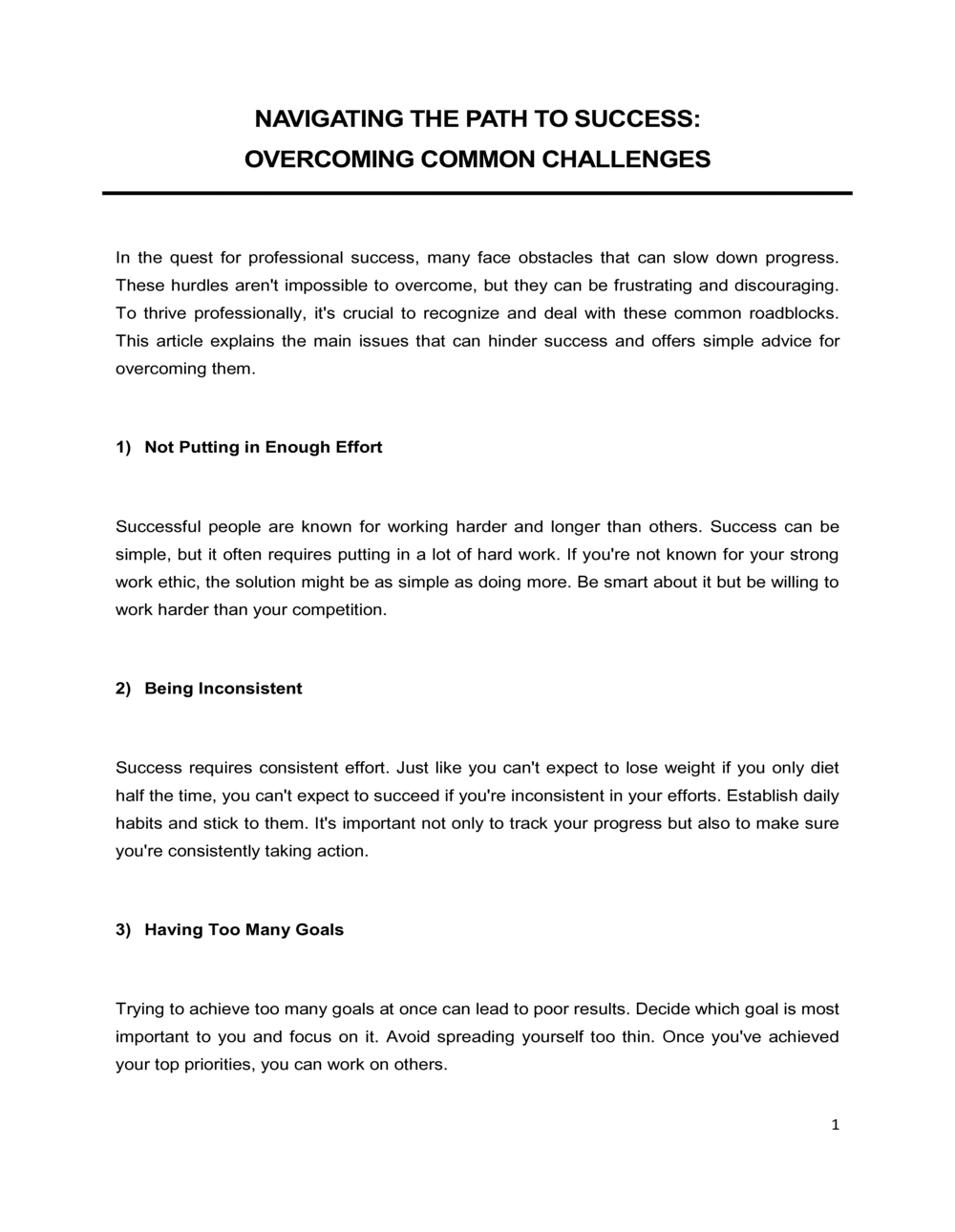
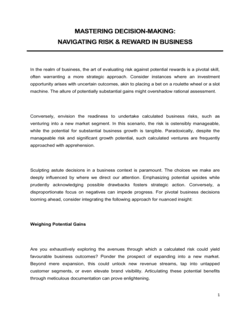
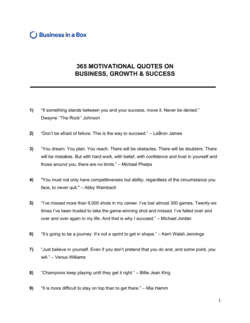
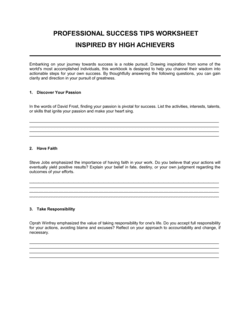
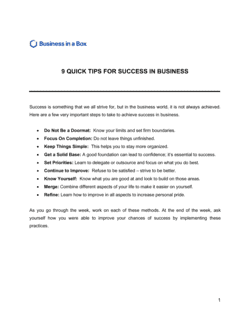
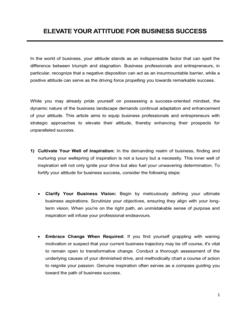
Navigating The Path To Success Overcoming Common Challenges Template

Free to read β€’ Save or share with one click

FreeNavigating The Path To Success Overcoming Common Challenges Template

At a glance

What it is
Navigating The Path To Success: Overcoming Common Challenges is a structured operational document that guides teams and leaders through identifying core business obstacles, defining success benchmarks, and building an actionable roadmap to move past recurring pain points. This free Word download gives you a ready-to-edit framework you can adapt to any business context and share with your leadership team or stakeholders as a PDF.
When you need it
Use it when your organization is facing growth plateaus, operational inefficiencies, team alignment gaps, or recurring setbacks that lack a structured resolution process. It is equally useful during annual planning cycles, post-mortem reviews, or when onboarding new leadership.
What's inside
The template covers a current-state assessment, challenge identification and root-cause analysis, goal-setting with measurable benchmarks, prioritized action planning, resource and accountability mapping, risk mitigation strategies, and a progress review framework to keep execution on track.

What is a Navigating The Path To Success: Overcoming Common Challenges Document?

A Navigating The Path To Success: Overcoming Common Challenges document is a structured operational plan that helps businesses and teams move from recognizing persistent problems to resolving them through a disciplined, accountable process. It combines a current-state diagnosis with root cause analysis, measurable goal-setting, and a task-level action plan β€” giving leaders a single document that captures the problem, the strategy, the owners, and the review process in one place. Unlike a strategic plan, which sets long-term direction, this document zeroes in on the specific obstacles blocking progress today and maps the concrete steps needed to get past them. It is a working document meant to be actively referenced, updated, and reviewed throughout its execution period.

Why You Need This Document

Without a structured plan for addressing business challenges, the same problems resurface quarter after quarter β€” costing time, revenue, and team morale each time they reappear. Informal troubleshooting rarely reaches the root cause, which means solutions treat symptoms while the underlying issue continues to drive the same outcomes. Teams without a written accountability structure drift between competing priorities, and without a defined review cadence, even well-intentioned improvement efforts lose momentum within weeks of launch. This template gives you a disciplined framework for turning chronic challenges into resolved, documented outcomes β€” with named owners, measurable benchmarks, and a built-in process for catching execution gaps before they become missed targets.

Which variant fits your situation?

If your situation is…Use this template
Addressing a specific operational bottleneck in a single departmentProcess Improvement Plan
Recovering from a project that missed its targetsPost-Mortem Report
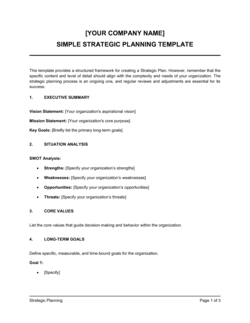
Aligning leadership around a 3-year growth strategyStrategic Planning Template
Defining measurable goals for the coming fiscal yearBusiness Goals and Objectives Template
Presenting a turnaround plan to a board or investorsBusiness Recovery Plan
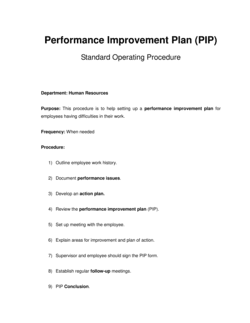
Improving individual employee performance and removing blockersPerformance Improvement Plan
Mapping out risks that could derail business objectivesRisk Management Plan

Common mistakes to avoid

❌ Treating symptoms as root causes

Why it matters: Action plans built on symptoms address the visible problem while leaving the underlying cause intact β€” the same challenge resurfaces within one or two quarters, eroding team confidence in planning exercises.

Fix: Run a formal root cause analysis (5 Whys or fishbone) for every priority challenge before writing a single action item. Document the full chain of causation, not just the first observable effect.

❌ Listing challenges without prioritizing them

Why it matters: Teams that attempt to resolve six or more challenges simultaneously typically make partial progress on all of them and measurable progress on none, while burning out the people doing the work.

Fix: Score every challenge on impact and urgency, select the top three to five, and explicitly defer lower-priority items to the next planning cycle with a documented rationale.

❌ Assigning tasks to groups instead of individuals

Why it matters: When a task belongs to 'the marketing team' or 'leadership,' no single person monitors its status, and it reliably misses its deadline without triggering any escalation.

Fix: Every task in the action plan must carry a single named owner. Collaborators can be listed, but one person is accountable for the outcome and for raising the flag if a blocker appears.

❌ Skipping the resource and budget section

Why it matters: An action plan with no resource allocation is a wish list β€” tasks that require budget, headcount, or tooling will stall the moment an owner discovers the resources were never secured.

Fix: Complete the resource section before distributing the plan and obtain formal approval for any spend or headcount additions. Flag unresolved resource gaps explicitly rather than assuming they will sort themselves out.

❌ No defined review cadence or escalation path

Why it matters: Plans without a built-in accountability process are reviewed once at launch and then left to decay β€” six months later, half the tasks are incomplete and no one remembers why the plan existed.

Fix: Set recurring review meetings at launch, assign a facilitator to each, and define a clear escalation trigger β€” for example, any task more than ten business days behind schedule automatically escalates to the plan owner.

❌ Writing vague goals that cannot be measured

Why it matters: A goal like 'improve team communication' has no finish line β€” the team cannot tell when it has succeeded or failed, which makes accountability impossible and progress invisible.

Fix: Rewrite every goal in SMART format with a specific metric, a current baseline value, a target value, and a deadline. If the metric does not yet exist, make establishing it the first task in the action plan.

The 9 key sections, explained

Executive overview

Current-state assessment

Challenge identification and prioritization

Root cause analysis

Success benchmarks and SMART goals

Action plan and task assignments

Risk identification and mitigation

Resource and budget requirements

Progress review and accountability cadence

How to fill it out

  1. 1

    Complete the executive overview

    Write two to three sentences naming the specific challenges the plan addresses, who commissioned it, and the intended outcome. This orients every reader before they reach the detail.

    πŸ’‘ Write this section last β€” after every other section is complete, the overview practically writes itself from the material already documented.

  2. 2

    Gather data for the current-state assessment

    Pull quantified performance data from your reporting tools β€” sales dashboards, HR systems, financial statements, or project trackers. Cite the source and date for each data point.

    πŸ’‘ If you do not have a metric for a known problem area, add 'establish baseline measurement by [DATE]' as the first task in the action plan.

  3. 3

    List and rank your challenges

    Brainstorm all current pain points, then score each one on a 1–3 scale for both impact and urgency. Focus the plan on challenges that score high on both dimensions.

    πŸ’‘ Limit the plan to three to five prioritized challenges. A plan that tries to solve everything solves nothing.

  4. 4

    Run root cause analysis for each priority challenge

    For each challenge, ask 'why does this exist?' at least three to five times in sequence. Document the chain of answers until you reach a cause you can actually act on.

    πŸ’‘ A fishbone (Ishikawa) diagram works well visually for team workshops β€” it surfaces contributing factors from people, process, technology, and environment simultaneously.

  5. 5

    Set SMART goals tied to each root cause

    For each root cause, write one goal that is specific, measurable, achievable, relevant, and time-bound. Confirm with the goal owner that the target is realistic given current resources.

    πŸ’‘ If a goal cannot be measured with an existing tool or report, build the measurement infrastructure before the deadline β€” not after.

  6. 6

    Build the action plan with named owners and deadlines

    Break each goal into three to seven specific tasks. Assign a single named owner to each task, set a clear deadline, and list any dependencies between tasks.

    πŸ’‘ Use a simple traffic-light status system (red / amber / green) so progress is visible at a glance during review meetings without lengthy updates.

  7. 7

    Complete the risk and resource sections

    For each action item, ask what could prevent completion and what it will cost in time, money, or headcount. Document both the mitigation and the contingency for each risk.

    πŸ’‘ Presenting resource requirements in a single consolidated table makes budget approval conversations faster and reduces the chance that a task stalls for lack of tools or budget.

  8. 8

    Schedule and communicate the review cadence

    Set recurring calendar invites for weekly check-ins and monthly milestone reviews before the plan is distributed. Naming a facilitator and an escalation owner at launch prevents accountability gaps later.

    πŸ’‘ Share a one-page summary of the plan with all stakeholders at launch β€” not the full document β€” so the key goals and owners are visible without requiring everyone to read the entire plan.

Frequently asked questions

What is a 'Navigating The Path To Success' business document?

It is a structured operational plan that guides an organization or team through identifying its most significant challenges, diagnosing their root causes, setting measurable improvement goals, and building a step-by-step action plan to overcome them. It functions as both a diagnostic tool and an execution roadmap, giving leaders a single document that captures the problem, the plan, and the accountability structure in one place.

When should a business use this type of challenge-navigation plan?

Use it during annual or quarterly planning cycles, after a period of missed targets, when onboarding new leadership, or when recurring operational issues have resisted informal resolution. It is also effective as a workshop facilitation tool when a team needs a structured process for aligning on priorities and agreeing on who owns what.

How is this document different from a strategic plan?

A strategic plan defines where the business wants to be in three to five years and the broad initiatives to get there. A challenge-navigation plan is narrower and more immediate β€” it focuses on specific obstacles that are blocking progress right now and builds a detailed action plan with named owners and deadlines. The two documents complement each other: the strategic plan sets direction; the challenge plan removes the barriers to moving in that direction.

How long should this type of plan be?

For most small to mid-size businesses, ten to twenty pages is the practical range β€” enough to document the current state, root causes, goals, and action plan in sufficient detail without becoming a document no one reads. Organizations addressing three to five challenges with multiple sub-tasks may run longer. The key is that every section earns its page count with specific, actionable content, not filler.

Who should be involved in creating this plan?

At minimum, the plan should be created with input from the people closest to each identified challenge β€” department heads, team leads, or frontline employees who experience the problem directly. A senior leader or facilitator should own the overall document, but a plan written in isolation without input from those who will execute it typically fails at the implementation stage due to missing context or lack of buy-in.

How do I prioritize which challenges to include?

Score each candidate challenge on two dimensions: impact (how significantly it affects revenue, efficiency, or team performance) and urgency (how quickly it needs to be resolved before it compounds). Challenges that score high on both dimensions go into the plan first. Limit the plan to three to five challenges β€” attempting more typically dilutes focus and produces no meaningful progress on any of them.

What is root cause analysis and why does it matter for this plan?

Root cause analysis is a structured method for tracing a problem back to its underlying origin rather than its visible symptom. It matters because action plans built on symptoms β€” for example, 'fix the support backlog' without understanding why the backlog grew β€” resolve the immediate pressure without preventing recurrence. The 5 Whys technique, which asks 'why does this exist?' five times in sequence, is the most practical starting point for teams without specialist training.

How often should this plan be reviewed and updated?

Weekly check-ins on task-level progress and monthly reviews of milestone achievement are the standard cadence for an active challenge plan. The plan itself should be formally updated whenever a task is completed, a goal is revised, or a new blocking risk emerges. At the end of the defined planning period, a post-mortem review should capture what worked, what did not, and what carries forward into the next cycle.

Can this template be used for individual professional development, not just organizational challenges?

Yes β€” the same structure applies to individual or team-level development goals. Replace organizational metrics with personal performance indicators, swap departmental owners for individual accountability, and use the root cause and goal-setting sections to diagnose and address career or skill development obstacles. Executive coaches and HR development leads frequently adapt this format for one-on-one coaching engagements.

How this compares to alternatives

vs Strategic Planning Template

A strategic plan sets a 3–5 year organizational direction with broad initiatives and resource allocation. A challenge-navigation plan is shorter-horizon and obstacle-specific β€” it diagnoses what is blocking progress now and assigns ownership for removing those blockers. The two work best together: the strategic plan defines where you are going; the challenge plan clears the road.

vs Performance Improvement Plan

A performance improvement plan (PIP) addresses an individual employee's performance deficiencies within a formal HR process, typically with documented consequences. A challenge-navigation plan addresses organizational or team-level obstacles without a disciplinary framing. Use a PIP for individual performance management; use this document for systemic operational issues that affect multiple people or processes.

vs Risk Management Plan

A risk management plan is forward-looking β€” it identifies threats that have not yet occurred and builds mitigation strategies. A challenge-navigation plan is present-focused β€” it addresses challenges that are already affecting the business and builds a resolution roadmap. Both include a risk register, but their primary purpose and starting point differ significantly.

vs Business Recovery Plan

A business recovery plan responds to a specific crisis β€” a data breach, financial loss, or operational failure β€” with urgent, time-sensitive restoration steps. A challenge-navigation plan addresses chronic, systemic issues through a measured, iterative improvement process. Recovery plans are reactive and immediate; challenge plans are proactive and structural.

Industry-specific considerations

Professional Services

Used to address client retention gaps, utilization rate decline, and inconsistent service delivery quality across project teams.

Technology / SaaS

Applied to engineering velocity blockers, customer churn root causes, and go-to-market misalignment between product and sales teams.

Retail / E-commerce

Deployed to resolve inventory management failures, order fulfillment delays, and customer experience breakdowns at peak demand periods.

Manufacturing

Used to diagnose production throughput bottlenecks, quality control failure rates, and supply chain dependency risks.

Healthcare

Applied to patient intake process inefficiencies, staff retention challenges, and compliance gap remediation planning.

Education and Training

Used to address learner engagement drop-off, curriculum delivery inconsistencies, and instructor performance development needs.

Template vs pro β€” what fits your needs?

PathBest forCostTime
Use the templateSmall business owners, team leads, and managers addressing operational challenges without specialist supportFree4–8 hours to complete, depending on the number of challenges addressed
Template + professional reviewOrganizations tackling cross-functional challenges that require external facilitation or an independent perspective$500–$2,500 for a business consultant or facilitator session1–2 weeks including workshop and review cycles
Custom draftedLarge organizations or turnaround situations requiring a fully facilitated diagnostic, stakeholder interviews, and a custom implementation framework$5,000–$20,000+ for a management consulting engagement4–12 weeks

Glossary

Root Cause Analysis
A structured method for tracing a problem back to its underlying origin rather than addressing only its visible symptoms.
SMART Goals
Goals that are Specific, Measurable, Achievable, Relevant, and Time-bound β€” the standard framework for setting benchmarks that can be objectively tracked.
Action Plan
A sequenced list of specific tasks, owners, and deadlines that converts a strategy into day-to-day execution steps.
KPI (Key Performance Indicator)
A quantified metric used to track progress toward a defined business objective β€” for example, customer churn rate or revenue per employee.
Accountability Matrix
A table mapping each task or deliverable to the person responsible, the reviewer, and the deadline β€” similar in function to a RACI chart.
Risk Mitigation
Proactive steps taken to reduce the probability or impact of identified risks before they materialize into actual problems.
Current-State Assessment
A snapshot of where the business or team stands today β€” documenting existing processes, performance gaps, and environmental factors β€” before prescribing any change.
Milestone
A clearly defined checkpoint in a project or plan that signals meaningful progress β€” typically tied to a deliverable, decision point, or measurable outcome.
Stakeholder Alignment
The process of ensuring that all parties with a stake in a plan understand, agree on, and are committed to its goals and their individual roles.
Progress Review Cadence
A predetermined schedule β€” weekly, monthly, or quarterly β€” for reviewing actual results against planned targets and adjusting the approach as needed.

Part of your Business Operating System

This document is one of 3,000+ business & legal templates included in Business in a Box.

  • Fill-in-the-blanks β€” ready in minutes
  • Compatible with all office suites
  • Export to PDF and share electronically

Create your document in 3 simple steps.

From template to signed document β€” all inside one Business Operating System.
1
Download or open template

Access over 3,000+ business and legal templates for any business task, project or initiative.

2
Edit and fill in the blanks with AI

Customize your ready-made business document template and save it in the cloud.

3
Save, Share, Send, Sign

Share your files and folders with your team. Create a space of seamless collaboration.

Save time, save money, and create top-quality documents.

β˜…β˜…β˜…β˜…β˜…

"Fantastic value! I'm not sure how I'd do without it. It's worth its weight in gold and paid back for itself many times."

Managing Director Β· Mall Farm
Robert Whalley
Managing Director, Mall Farm Proprietary Limited
β˜…β˜…β˜…β˜…β˜…

"I have been using Business in a Box for years. It has been the most useful source of templates I have encountered. I recommend it to anyone."

Business Owner Β· 4+ years
Dr Michael John Freestone
Business Owner
β˜…β˜…β˜…β˜…β˜…

"It has been a life saver so many times I have lost count. Business in a Box has saved me so much time and as you know, time is money."

Owner Β· Upstate Web
David G. Moore Jr.
Owner, Upstate Web

Run your business with a system β€” not scattered tools

Stop downloading documents. Start operating with clarity. Business in a Box gives you the Business Operating System used by over 250,000 companies worldwide to structure, run, and grow their business.

Start freeΒ Β·Β No credit card required