1
Define the scope and identify excluded transactions
Name the legal entity the policy covers and list every loan type in scope — employee advances, shareholder loans, intercompany lending. Then explicitly list what is excluded, such as trade credit or operating-lease obligations.
💡 A clear exclusion list prevents scope disputes during audits far more reliably than a broad inclusion statement.
2
Set approval authority tiers with specific dollar thresholds
Create at least three tiers — manager, CFO, and board — with dollar ranges for each. Ensure the thresholds reflect your organization's actual transaction sizes so the policy is used in practice.
💡 Set the board-approval threshold 20–30% above your largest likely single loan, so routine transactions don't require a special board meeting.
3
Define borrower eligibility and disqualification rules
State minimum tenure, employment status (permanent vs. contract), and any automatic disqualifiers such as active disciplinary proceedings or prior loan defaults with the organization.
💡 Run this section past HR before finalizing — eligibility rules that conflict with employment policies create grievance risk.
4
List required documentation with a pre-disbursement checklist
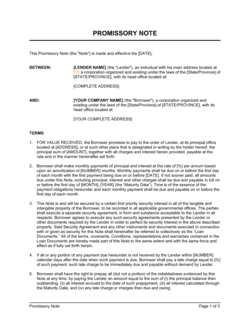
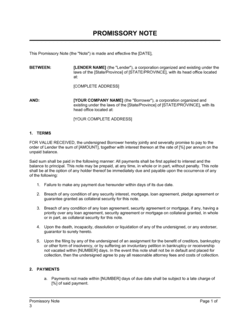
Enumerate every document required before a loan is funded and build it into a checklist that the approving officer signs. Common items: signed loan agreement, promissory note, proof of purpose, and collateral documentation.
💡 Attach the checklist as a policy appendix rather than embedding it in the body — it is easier to update independently as requirements change.
5
Set the interest-rate floor linked to the current AFR
State the minimum rate as 'the short-term IRS Applicable Federal Rate for the month of disbursement' rather than a fixed percentage, so the policy stays compliant as rates change.
💡 Task the CFO to document the AFR on the date of each disbursement and attach it to the loan file — this is the primary evidence in an IRS audit of below-market loan claims.
6
Specify collateral thresholds and perfect security interests
State the loan size above which collateral is required, the minimum LTV ratio, and acceptable collateral types. Include a requirement that a UCC-1 financing statement or equivalent lien be filed before disbursement for secured loans.
💡 Never rely on a promise to provide collateral after disbursement — by that point there is no practical way to enforce it without suing the borrower.
7
Write the related-party lending section last and have it reviewed
Draft the related-party section after all other sections are finalized so you can cross-reference the standard terms. Require independent director approval and annual financial-statement disclosure for all related-party loans.
💡 For nonprofits, mirror the language from IRS Form 990, Part VI, Schedule L — it will satisfy the form's disclosure requirements directly.
8
Obtain board adoption and schedule an annual review
Present the completed policy to the board for formal adoption by resolution, record the adoption date, and set a calendar reminder for annual review — particularly to update the AFR reference and approval thresholds.
💡 Version-control the policy with a header showing the adoption date and next scheduled review date so auditors can confirm it is current.