Request to Locate Former Employee Template

Free Word download β€’ Edit online β€’ Save & share with Drive β€’ Export to PDF

1 pageβ€’20–25 min to fillβ€’Difficulty: Standard
Learn more ↓
FreeRequest to Locate Former Employee Template

At a glance

What it is
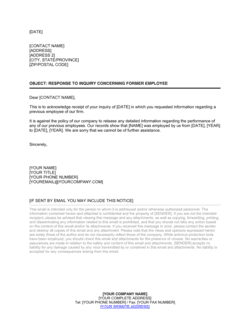
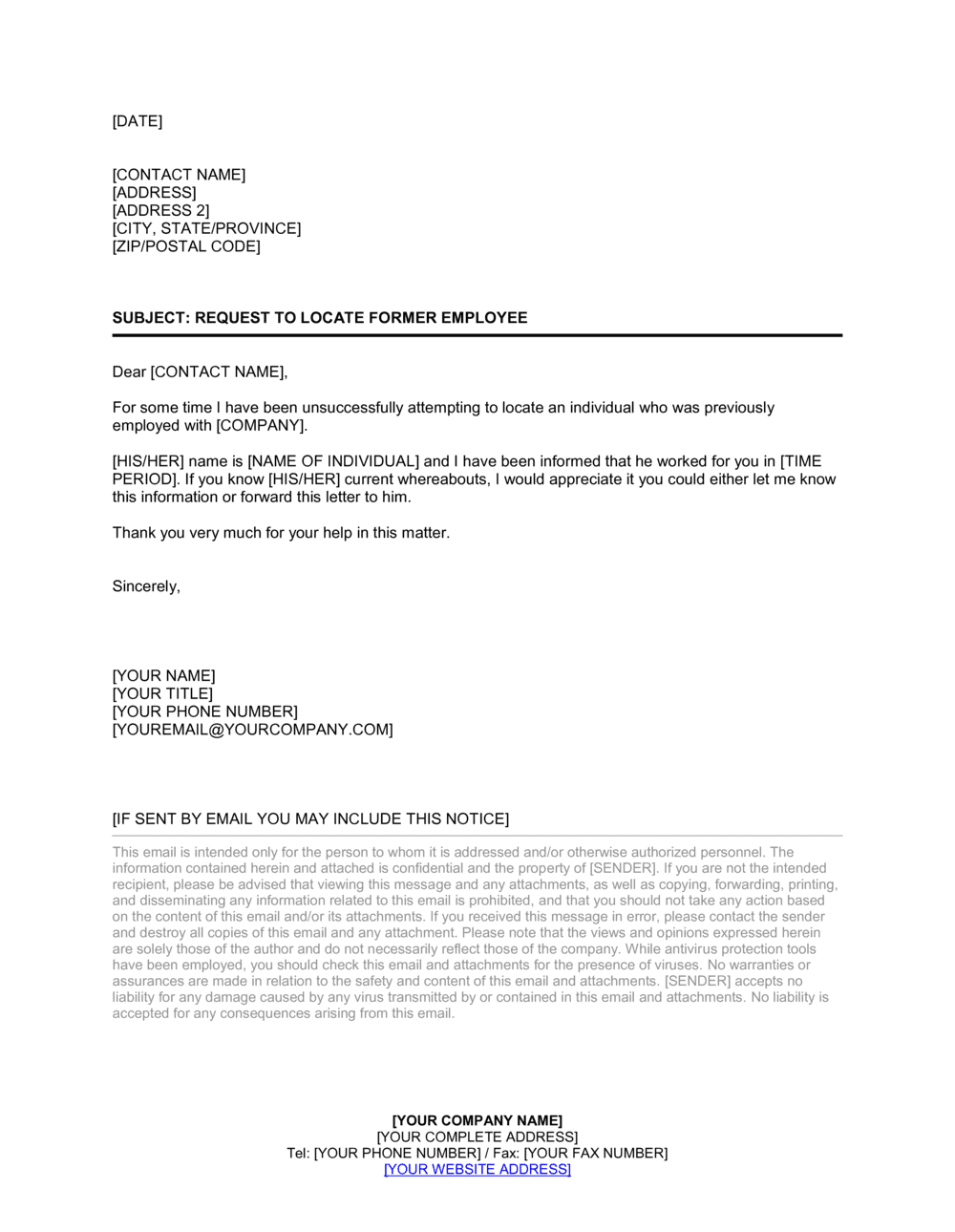
A Request To Locate Former Employee is a formal business letter sent to a third party β€” such as a previous employer, staffing agency, government body, or professional association β€” asking for assistance in identifying the current contact information or whereabouts of a former employee. This free Word download gives you a ready-to-send letter you can edit online and export as PDF in minutes.
When you need it
Use it when you need to reach a former employee for a specific, legitimate business reason β€” such as delivering unclaimed wages, pension benefits, tax documents, or a legal notice β€” and direct contact details are no longer on file.
What's inside
A clear statement of the requestor's identity and authority, the full identifying details of the former employee being sought, the stated purpose of the location request, a request for the recipient's cooperation, and a professional closing with contact details for the response.

What is a Request To Locate Former Employee?

A Request To Locate Former Employee is a formal business letter sent by an employer β€” or an authorized representative such as an HR manager, payroll officer, or legal counsel β€” to a third party asking for assistance in identifying the current contact information or mailing address of a former staff member. The letter is not sent directly to the former employee (whose address is unknown) but to an intermediary likely to hold updated records, such as a previous employer, union hall, professional licensing board, or staffing agency. It states a clear, legitimate business purpose for the search, provides enough identifying information for the recipient to search their records, and includes a confidentiality assurance to satisfy the recipient's own data-protection obligations.

Why You Need This Document

When a former employee's contact details go stale, the employer's administrative obligations do not disappear with them. Unclaimed final paychecks, undelivered W-2 forms, vested pension benefits, and legal notices all require a documented, good-faith attempt to reach the individual β€” and in many US states, that effort must be on record before unclaimed funds can legally be transferred to the state through escheatment. A professionally drafted location request letter creates exactly that paper trail. Without it, regulators treating a failed escheatment filing as a lack of due diligence can issue penalties, and unresolved benefit obligations remain on the books indefinitely. This template gives you a letter structured to maximize cooperation from privacy-conscious recipients, reduce back-and-forth by including every detail the third party needs to search their records on the first read, and demonstrate compliance if the matter is ever reviewed.

Which variant fits your situation?

If your situation is…Use this template
Requesting location assistance from a government labor or tax authorityRequest To Locate Former Employee (Government)
Notifying a former employee of unclaimed wages through a formal letterUnclaimed Wages Notice Letter
Formally terminating the employment relationship in writingEmployee Termination Letter
Requesting employment history verification from a previous employerEmployment Verification Letter
Sending a general reference inquiry about a former staff memberReference Check Letter
Notifying an employee of outstanding document or equipment returnLetter Requesting Return of Company Property
Reaching a former contractor or freelancer for a tax or payment matterRequest for Updated Contact Information Letter

Common mistakes to avoid

❌ Vague statement of purpose

Why it matters: Recipients β€” especially HR departments β€” are instructed to decline requests that do not clearly articulate a legitimate business need. A vague letter will be ignored or refused.

Fix: Name the specific reason in the letter body: unclaimed wages, a W-2, pension entitlement, or a legal notice. One precise sentence is more effective than a paragraph of generalities.

❌ Omitting the privacy and confidentiality assurance

Why it matters: Institutions that hold personal data on former employees face their own privacy obligations. Without a written assurance of appropriate use, most will not share contact details.

Fix: Include a dedicated paragraph confirming that information will be used only for the stated purpose and handled in compliance with applicable data protection law.

❌ Using personal contact details instead of official company information

Why it matters: A letter with a Gmail address or home address will be treated as a personal inquiry rather than an official business communication, reducing the likelihood of cooperation dramatically.

Fix: Use company letterhead and a business email address. If the company does not have formal letterhead, ensure the company name and registered address appear prominently in the header.

❌ Sending the letter to the wrong contact at a large organization

Why it matters: A letter addressed to a general mailbox or the wrong department can sit unacted upon for weeks, causing you to miss statutory deadlines for unclaimed property filings or legal service.

Fix: Call the recipient organization before sending to confirm the correct department, contact name, and preferred delivery method. Address the letter to a named individual wherever possible.

The 9 key clauses, explained

Sender identification block

In plain language: States the full legal name, title, organization, address, phone, and email of the person sending the letter.

Sample language
[SENDER FULL NAME] | [JOB TITLE] | [COMPANY LEGAL NAME] | [STREET ADDRESS, CITY, STATE, ZIP] | [PHONE NUMBER] | [EMAIL ADDRESS]

Common mistake: Using a personal email address or home address instead of official company contact details β€” this undermines the letter's authority and may cause the recipient to discard it as informal or fraudulent.

Date and recipient address

In plain language: Records the date of the letter and the full name and address of the third party being asked to assist with the location request.

Sample language
[DATE] | [RECIPIENT NAME OR ORGANIZATION] | [RECIPIENT TITLE, IF APPLICABLE] | [STREET ADDRESS, CITY, STATE, ZIP]

Common mistake: Omitting the recipient's title or department when writing to a large organization. The letter may sit unrouted in a general mailbox for weeks.

Subject line

In plain language: A brief, specific heading that tells the recipient immediately what the letter concerns and who the subject individual is.

Sample language
Re: Request to Locate Former Employee β€” [FORMER EMPLOYEE FULL NAME], [FORMER EMPLOYEE ID / SSN LAST 4 IF APPLICABLE]

Common mistake: Writing a vague subject like 'HR Inquiry' instead of naming the former employee. A specific subject line speeds routing and prevents the letter from being treated as junk mail.

Purpose statement

In plain language: Clearly explains why the sender is attempting to locate the former employee and the legitimate business reason behind the request.

Sample language
[COMPANY NAME] is attempting to contact [FORMER EMPLOYEE FULL NAME], a former employee who separated from our organization on [SEPARATION DATE], in order to deliver [UNCLAIMED WAGES / TAX DOCUMENTS / BENEFIT INFORMATION / OTHER PURPOSE].

Common mistake: Stating the purpose in vague terms such as 'a business matter.' Without a specific reason, recipients β€” especially HR departments and privacy-conscious institutions β€” will typically decline to assist.

Former employee identifying details

In plain language: Provides enough detail about the individual being sought β€” name, last known address, dates of employment β€” for the recipient to match their records without disclosing unnecessary personal data.

Sample language
Former employee: [FULL NAME] | Last known address: [ADDRESS] | Date of birth: [DOB, IF REQUIRED] | Dates of employment: [START DATE] to [END DATE] | Former job title: [TITLE]

Common mistake: Including a full Social Security number in writing when only the last four digits are needed for identification. Full SSNs in correspondence create unnecessary data-exposure risk for both parties.

Request for cooperation

In plain language: Politely but directly asks the recipient to share any updated contact information they may hold, within the bounds of applicable privacy law.

Sample language
We respectfully request that, if you hold current contact information for [FORMER EMPLOYEE FULL NAME], you forward this letter to them or provide us with their current mailing address so that we may fulfill our legal obligation to [PURPOSE].

Common mistake: Demanding contact information as if the recipient is obligated to provide it. Third parties share personal data voluntarily and in compliance with their own privacy policies β€” a demanding tone causes refusals.

Confidentiality and privacy assurance

In plain language: Confirms that any information provided will be used solely for the stated purpose and handled in accordance with applicable privacy requirements.

Sample language
Any information you provide will be used exclusively for the purpose described above and will be handled in accordance with all applicable privacy and data protection laws. We will not disclose any information you share to unauthorized third parties.

Common mistake: Omitting this clause entirely. Many HR and legal departments are instructed not to share personal information without a privacy assurance β€” skipping it guarantees a refusal from cautious recipients.

Response instructions

In plain language: Tells the recipient exactly how and where to respond β€” by phone, email, or mail β€” and provides a deadline if applicable.

Sample language
Please direct your response to [CONTACT NAME] at [EMAIL ADDRESS] or [PHONE NUMBER] by [RESPONSE DEADLINE DATE, IF APPLICABLE]. If you have any questions regarding this request, do not hesitate to contact us.

Common mistake: Providing only one contact method, such as a fax number no longer monitored. Always include at least an email address and a phone number.

Closing and authorized signature block

In plain language: A professional closing followed by the sender's printed name, title, and the company's official name β€” establishing that the letter is authorized and official.

Sample language
Thank you for your assistance with this matter. Sincerely, [SENDER FULL NAME] | [JOB TITLE] | [COMPANY LEGAL NAME]

Common mistake: Closing without stating the sender's title or the company name. A letter that appears to come from an unnamed individual rather than an organization will be treated with far less credibility.

How to fill it out

  1. 1

    Complete the sender identification block

    Enter your full legal name, job title, company name, official mailing address, direct phone number, and business email address at the top of the letter.

    πŸ’‘ Use your company's official letterhead if available β€” printed letterhead increases response rates by signaling the request is institutional, not personal.

  2. 2

    Date the letter and address it to the right recipient

    Enter today's date and the full name, title, and address of the third party you are contacting. If writing to a large organization, address it to the HR or Records department by name.

    πŸ’‘ Call ahead to confirm the correct department and contact name β€” a correctly routed letter can cut response time from weeks to days.

  3. 3

    Write a specific subject line

    Include the former employee's full name and, if appropriate, the last four digits of their employee ID or Social Security number in the subject line so the recipient can search their records immediately.

    πŸ’‘ Avoid abbreviations in the subject line β€” spell out the full name exactly as it appeared on employment records, since records may be filed under a former name.

  4. 4

    State the purpose clearly and specifically

    In one to two sentences, explain the exact reason you are looking for this individual β€” unclaimed wages, pension benefits, tax document delivery, or a legal matter. Be direct and factual.

    πŸ’‘ Citing the specific legal obligation driving the search (e.g., state unclaimed property law) gives your request additional weight with cautious recipients.

  5. 5

    Enter the former employee's identifying details

    Provide the individual's full name, last known address, dates of employment, and job title. Include date of birth only if the recipient specifically needs it to differentiate between employees with the same name.

    πŸ’‘ Never include a full Social Security number in a mailed or emailed letter β€” use only the last four digits if identification disambiguation is needed.

  6. 6

    Add the confidentiality and privacy assurance

    Confirm in writing that any information provided will be used only for the stated purpose and handled in compliance with applicable privacy law. This single paragraph significantly increases cooperation rates.

    πŸ’‘ If your organization is subject to a specific privacy regulation β€” such as GDPR or CCPA β€” name it explicitly. It demonstrates that you take data handling seriously.

  7. 7

    Provide clear response instructions

    State your preferred response method (email is fastest), provide a direct contact name, and include a response-by date if the matter is time-sensitive. Include both email and phone as options.

    πŸ’‘ A response deadline of 15–20 business days is reasonable for routine requests; flag any statutory deadlines (e.g., escheatment filing dates) explicitly if they apply.

  8. 8

    Sign and send on company letterhead

    Close with a professional salutation, your printed name, and your official title. Send via traceable delivery β€” certified mail or a delivery-confirmation email β€” and retain a copy for your HR records.

    πŸ’‘ Log the date sent and the method of delivery in your HR records so you can demonstrate due diligence if the matter later involves unclaimed property compliance or litigation.

Frequently asked questions

What is a request to locate a former employee?

A request to locate a former employee is a formal business letter sent to a third party β€” such as a previous employer, staffing agency, union, or professional association β€” asking for help identifying the current mailing address or contact information of an individual who has left an organization. It is used when an employer needs to reach the former employee for a specific, documented business reason and no current contact details are on file.

When should I send a request to locate a former employee?

The most common triggers are unclaimed wages or final paychecks that were returned undelivered, W-2 or tax forms that could not be sent, vested pension or retirement benefits the individual has not claimed, and legal notices or subpoena-related communications. Some jurisdictions require employers to make documented good-faith efforts to contact former employees before transferring unclaimed funds to the state.

What information should I include about the former employee in the letter?

Include the individual's full name as it appeared on employment records, their last known mailing address, their dates of employment, and their former job title. Include date of birth only when needed to distinguish between individuals with the same name. Never include a full Social Security number in a written letter β€” use only the last four digits if disambiguation is required.

Who should I send this letter to?

Common recipients include the former employee's most recent previous employer listed on their personnel file, a union or trade association they belonged to, a professional licensing board, a staffing or placement agency that placed them, or a government labor authority that may hold updated address records. Choose the recipient most likely to have current contact information based on the individual's industry and employment history.

Does this letter need to be signed by a specific person?

The letter should be signed by an authorized representative of the organization β€” typically an HR manager, payroll director, or legal officer. The signer's full name and title must appear in the closing block to confirm the request is official. A letter signed only by a first name or with no title will be treated with far less credibility by the recipient.

What happens if the third party refuses to share information?

Third parties are not legally required to disclose personal information in response to this type of letter. If a direct outreach fails, consider engaging a licensed skip-tracing or people-search service, consulting state unclaimed property databases (which may have updated addresses on file), or working with legal counsel to determine if a formal process β€” such as a court order β€” is appropriate given the circumstances.

How does this letter support unclaimed property compliance?

Most US states require employers to make a documented good-faith attempt to notify holders of unclaimed wages or benefits before escheating the funds to the state. Sending a request to locate letter β€” and retaining a copy β€” creates the paper trail that demonstrates you fulfilled the due diligence requirement. Without this documentation, regulators may find that you failed to make adequate contact efforts.

Should I send this letter by regular mail or certified mail?

Use certified mail with return receipt, or a traceable email with a read-receipt or delivery confirmation, for any request tied to a legal obligation or statutory deadline. For routine administrative matters with no deadline pressure, first-class mail or a professional email is sufficient. Retain the delivery confirmation in your HR records regardless of which method you use.

How this compares to alternatives

vs Employment Verification Letter

An employment verification letter confirms that an individual worked for an organization and is typically sent to a third party at the employee's request. A request to locate former employee is sent by the employer to a third party seeking the individual's current contact details β€” it is an outbound search, not a confirmation. The two letters serve opposite directions of the same relationship.

vs Employee Dismissal Letter

An employee dismissal letter formally ends the employment relationship and is sent directly to the employee at the time of separation. A request to locate former employee is sent months or years later, to a third party, when the employer can no longer reach the individual directly. One closes the relationship; the other attempts to reopen a communication channel.

vs Reference Check Letter

A reference check letter asks a previous employer to comment on a candidate's work history and performance β€” it serves a hiring function. A request to locate former employee asks a third party for contact details to fulfill an administrative or legal obligation. The subjects and purposes are entirely different, though both involve formal communication between organizations about an individual.

vs Demand Letter

A demand letter asserts a legal claim and demands a specific action or payment from the recipient. A request to locate former employee is a cooperative request with no legal demand β€” it asks for assistance finding someone, not for compliance. If the location effort succeeds and a legal matter follows, a demand letter may come next, but the two documents serve distinct sequential purposes.

Industry-specific considerations

Healthcare

Hospitals and medical practices frequently need to reach former clinical staff to deliver licensing-related documents or pension plan communications for vested employees who left before retirement age.

Construction and Trades

High turnover and seasonal employment mean unclaimed final paychecks and unreturned benefit credits are common; union halls are a primary third-party contact for locating former tradespeople.

Professional Services

Law firms, accounting practices, and consulting agencies use this letter to deliver tax documents to former partners or associates, particularly those who worked across multiple office locations.

Manufacturing

Long-tenured plants with pension obligations routinely need to locate former employees who vested decades ago but never claimed their retirement benefits before moving or changing contact details.

Template vs pro β€” what fits your needs?

PathBest forCostTime
Use the templateHR managers and payroll administrators handling routine unclaimed wage or tax document deliveryFree10–15 minutes
Template + professional reviewMatters with statutory unclaimed property deadlines or involving sensitive personal data requiring privacy-law compliance review$100–$300 for an HR consultant or attorney review1–2 business days
Custom draftedComplex situations involving litigation, cross-border privacy regulations, or formal legal service attempts$300–$8002–5 business days

Glossary

Requestor
The individual or organization sending the location request letter β€” typically an employer, HR department, or authorized agent.
Former Employee
An individual who previously worked for the requesting organization and whose current contact information is no longer on file.
Unclaimed Wages
Compensation earned by an employee but not collected β€” including final paychecks, accrued vacation payouts, or expense reimbursements β€” that the employer is legally required to attempt to deliver.
Escheatment
The process by which unclaimed funds held by a business are transferred to the state after a statutory dormancy period, typically 1–5 years depending on jurisdiction.
Last Known Address
The most recent mailing address on file for a former employee, used as the starting point for any location effort.
Third-Party Locator
An agency, association, or institution β€” such as a union, professional registry, or former employer β€” contacted to help identify the current whereabouts of an individual.
Privacy Compliance
Adherence to applicable laws β€” such as GDPR, CCPA, or PIPEDA β€” governing how personal data about a former employee may be shared or disclosed in response to a location request.
Legitimate Business Purpose
A documented, lawful reason for seeking someone's contact information β€” required both to justify the request and to satisfy privacy law standards in most jurisdictions.
Employee Separation
The formal end of the employment relationship, whether through resignation, termination, retirement, or layoff β€” the event that typically originates the need for a location request.
Authorized Representative
A person explicitly empowered to act on behalf of an organization, whose signature or name on the letter establishes that the request is official and not a personal inquiry.

Part of your Business Operating System

This document is one of 3,000+ business & legal templates included in Business in a Box.

  • Fill-in-the-blanks β€” ready in minutes
  • 100% customizable Word document
  • Compatible with all office suites
  • Export to PDF and share electronically

Create your document in 3 simple steps.

From template to signed document β€” all inside one Business Operating System.
1
Download or open template

Access over 3,000+ business and legal templates for any business task, project or initiative.

2
Edit and fill in the blanks with AI

Customize your ready-made business document template and save it in the cloud.

3
Save, Share, Send, Sign

Share your files and folders with your team. Create a space of seamless collaboration.

Save time, save money, and create top-quality documents.

β˜…β˜…β˜…β˜…β˜…

"Fantastic value! I'm not sure how I'd do without it. It's worth its weight in gold and paid back for itself many times."

Managing Director Β· Mall Farm
Robert Whalley
Managing Director, Mall Farm Proprietary Limited
β˜…β˜…β˜…β˜…β˜…

"I have been using Business in a Box for years. It has been the most useful source of templates I have encountered. I recommend it to anyone."

Business Owner Β· 4+ years
Dr Michael John Freestone
Business Owner
β˜…β˜…β˜…β˜…β˜…

"It has been a life saver so many times I have lost count. Business in a Box has saved me so much time and as you know, time is money."

Owner Β· Upstate Web
David G. Moore Jr.
Owner, Upstate Web

Run your business with a system β€” not scattered tools

Stop downloading documents. Start operating with clarity. Business in a Box gives you the Business Operating System used by over 250,000 companies worldwide to structure, run, and grow their business.

Start freeΒ Β·Β No credit card required