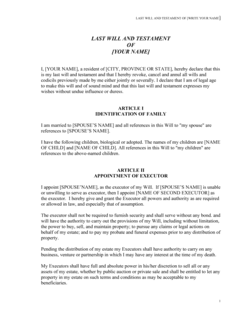
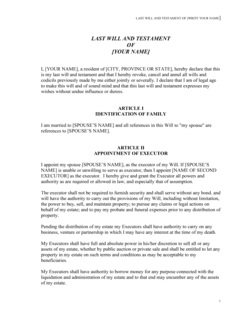
Last Will and Testament - Single with Children Template

Free Word download • Edit online • Save & share with Drive • Export to PDF

5 pages25–35 min to fillDifficulty: ComplexSignature requiredLegal review recommended
Learn more ↓
FreeLast Will and Testament - Single with Children Template

At a glance

What it is
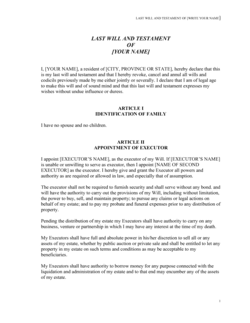
A Last Will and Testament for a Single Person with Children is a legally binding document in which an unmarried individual (the testator) records how their assets should be distributed after death, names a guardian for their minor children, and appoints an executor to administer the estate. This free Word download gives you a structured, jurisdiction-aware starting point you can edit online and export as PDF to sign and store with your important documents.
When you need it
Use it any time you are an unmarried parent — whether divorced, widowed, or never married — who wants to control what happens to your estate and your children if you die. It is especially urgent if the children's other parent is deceased, absent, or unable to care for them.
What's inside
Testator declaration and revocation of prior wills, appointment of executor and successor executor, guardian nomination for minor children, specific and residuary bequests, debt and expense payment instructions, trust provisions for minor beneficiaries, no-contest clause, and governing law and execution block with witness attestation.

What is a Last Will and Testament for a Single Person With Children?

A Last Will and Testament for a Single Person With Children is a legally binding document in which an unmarried parent — whether divorced, widowed, or never married — records their instructions for distributing assets after death, nominates a guardian for any minor children, and appoints an executor to carry out those instructions. Because there is no surviving spouse to serve as a default caregiver or inheritor, this version of a will must directly address guardian selection and trust provisions for minors that a married-couple will can defer to the survivor. When signed with the required witnesses in place, it becomes the governing document for the testator's estate and provides a court with the parent's expressed preferences for their children's care.

Why You Need This Document

Dying without a will as a single parent means a court decides who raises your children — without knowing your wishes, your values, or your relationships with family members who may be competing to take custody. It also means your assets may transfer directly to minor children at age 18 with no trustee oversight, or be distributed under your state's intestacy formula to relatives you would not have chosen. Disputes between grandparents, siblings, and the other biological parent over both custody and money are far more common — and more expensive — when no written instructions exist. A properly executed last will and testament eliminates that uncertainty: it names the guardian you trust, holds your children's inheritance in a managed trust until they are mature enough to handle it, and gives your executor the authority to act efficiently without repeated court approval. This template provides the legal framework in a format that takes roughly 30 to 60 minutes to complete — one of the highest-value documents a single parent can have in place.

Which variant fits your situation?

If your situation is…Use this template
Unmarried individual with no childrenLast Will and Testament (Single, No Children)
Married individual with childrenLast Will and Testament (Married With Children)
Complex estate requiring a testamentary trust for multiple childrenTestamentary Trust Will
Parent who also needs a healthcare proxy in placeHealthcare Power of Attorney
Parent who wants to name a financial agent while aliveDurable Power of Attorney
Estate with significant assets that need probate avoidanceRevocable Living Trust
Parent needing end-of-life medical instructions alongside the willLiving Will / Advance Directive

Common mistakes to avoid

❌ Naming a beneficiary as a witness

Why it matters: In most US states and Canadian provinces, a witness who is also a beneficiary loses their bequest — and in some jurisdictions the entire will is voided. The estate may then pass under intestacy.

Fix: Use two independent adults who receive nothing under the will as witnesses. Ask neighbors, colleagues, or the attorney's staff rather than family members named in the document.

❌ No guardian nomination for minor children

Why it matters: If no guardian is named, a court decides who raises your children — potentially choosing a relative you would not have selected, or triggering a contested custody proceeding between competing family members.

Fix: Name a primary guardian and an alternate guardian in the will and discuss your wishes with both choices before signing.

❌ Failing to update the will after major life changes

Why it matters: A will drafted before a child was born, before a divorce was finalized, or before significant assets were acquired may distribute property in ways that no longer reflect the testator's intentions.

Fix: Review the will whenever you have another child, experience a change in relationship status, acquire or sell major assets, or a named executor or guardian dies or becomes unavailable.

❌ Storing the original will in a bank safe-deposit box

Why it matters: In most US states, a safe-deposit box is sealed at death — the executor needs a court order to retrieve the will, which is circular because the court needs the will to begin probate.

Fix: Store the original in a fireproof home safe, a filing cabinet with your important documents, or leave it with your attorney. Give the executor the exact location in writing.

❌ Setting the child trust distribution age at 18

Why it matters: An 18-year-old inheriting a substantial estate is statistically likely to exhaust it within a few years. There is no mechanism to protect the funds once distributed outright.

Fix: Set the distribution age at 21, 25, or in staged distributions (e.g., one-third at 21, one-third at 25, balance at 30) and grant the trustee discretion to release funds earlier for education or medical needs.

❌ Omitting the residuary clause

Why it matters: Any asset not covered by a specific bequest — including property acquired after the will was written — passes under intestacy rules if there is no residuary clause, overriding the testator's intent for a significant portion of the estate.

Fix: Include a broad residuary clause that catches all property not otherwise disposed of and directs it to your children or a named alternate beneficiary.

The 10 key clauses, explained

Testator declaration and revocation of prior wills

In plain language: Opens the document by identifying the testator by full legal name and residence, declaring them to be of sound mind, and expressly revoking all prior wills and codicils.

Sample language
I, [TESTATOR FULL NAME], residing at [ADDRESS], [CITY], [STATE/PROVINCE], being of legal age and sound mind, hereby make this my Last Will and Testament and revoke all prior wills and codicils previously made by me.

Common mistake: Failing to revoke prior wills in writing — if an older will exists and no revocation clause is present, courts may treat both documents as valid and attempt to reconcile conflicting provisions, creating confusion and litigation.

Appointment of executor and successor executor

In plain language: Names the primary person responsible for carrying out the will's instructions and a backup executor in case the primary is unable or unwilling to serve.

Sample language
I appoint [EXECUTOR FULL NAME] of [CITY, STATE] as Executor of this Will. If [EXECUTOR FULL NAME] is unable or unwilling to serve, I appoint [SUCCESSOR EXECUTOR FULL NAME] of [CITY, STATE] as successor Executor.

Common mistake: Naming only one executor with no successor — if that person dies, moves abroad, or becomes incapacitated before the estate is settled, the court must appoint an administrator, adding cost and delay.

Guardian nomination for minor children

In plain language: Names the adult who will assume physical and legal custody of the testator's minor children and, optionally, a backup guardian.

Sample language
I nominate [GUARDIAN FULL NAME] of [CITY, STATE] as guardian of the person and property of my minor children. If [GUARDIAN FULL NAME] is unable or unwilling to serve, I nominate [ALTERNATE GUARDIAN FULL NAME] of [CITY, STATE] as alternate guardian.

Common mistake: Naming a guardian without confirming their willingness to serve — a guardian who declines causes a court to appoint one of its choosing, which may not align with the testator's wishes.

Payment of debts and final expenses

In plain language: Directs the executor to pay all valid debts, funeral costs, and estate administration expenses from estate funds before distributing assets to beneficiaries.

Sample language
I direct my Executor to pay all my legally enforceable debts, funeral expenses, and costs of administering this estate as soon as reasonably practicable after my death.

Common mistake: Instructing the executor to pay 'all debts' without qualification — some debts, such as disputed claims or time-barred amounts, should not be paid automatically, and a blanket direction can disadvantage beneficiaries unnecessarily.

Specific bequests

In plain language: Lists individual gifts of named property, money, or accounts to named people or organizations before the residue of the estate is distributed.

Sample language
I give and bequeath to [BENEFICIARY NAME] the sum of $[AMOUNT] / my [DESCRIPTION OF PROPERTY]. If [BENEFICIARY NAME] does not survive me by 30 days, this bequest shall lapse and become part of the residuary estate.

Common mistake: Making specific bequests of property that may no longer exist at death (ademption) — the named beneficiary receives nothing if the item was sold or destroyed, so include language directing a cash substitute or noting the gift lapses.

Residuary estate clause

In plain language: Disposes of all estate property not covered by specific bequests — typically directing the remainder to the testator's children in equal shares, with per stirpes distribution if a child predeceases the testator.

Sample language
I give, devise, and bequeath the rest, residue, and remainder of my estate to my children [CHILD 1 NAME], [CHILD 2 NAME], and [CHILD 3 NAME], in equal shares, per stirpes.

Common mistake: Omitting a residuary clause entirely — any property not specifically bequeathed passes under intestacy rules if there is no residuary clause, defeating the purpose of having a will.

Testamentary trust for minor beneficiaries

In plain language: Establishes a trust inside the will to hold a minor child's inheritance until they reach a specified age, with a named trustee managing funds for their health, education, and support in the meantime.

Sample language
If any beneficiary is under age [18/21/25] at the time of distribution, their share shall be held in trust by [TRUSTEE NAME] until such beneficiary attains age [AGE], to be used for their health, education, maintenance, and support.

Common mistake: Setting the distribution age too low (e.g., 18) without considering whether the child is financially mature enough to manage a significant inheritance — age 21 or 25 is common and allows a trustee to manage funds during the child's early adult years.

Executor powers clause

In plain language: Grants the executor broad authority to manage, sell, invest, and distribute estate assets without requiring court approval for each action, streamlining administration.

Sample language
My Executor shall have full power and authority to sell, lease, invest, reinvest, and otherwise manage estate property; to settle claims; and to take all actions necessary to administer this estate, without court approval unless required by law.

Common mistake: Omitting broad executor powers — without this clause, executors in many jurisdictions must seek court approval for routine transactions such as selling real estate, causing significant delays and legal fees.

No-contest clause

In plain language: Provides that any beneficiary who contests the validity of the will forfeits their entire inheritance, discouraging frivolous legal challenges.

Sample language
If any beneficiary under this Will contests its validity or any of its provisions, that person shall forfeit any interest they would otherwise receive under this Will, and such interest shall be distributed as if that beneficiary had predeceased me.

Common mistake: Including a no-contest clause in jurisdictions where they are not enforceable (e.g., Florida) — the clause provides a false sense of protection while potentially antagonizing beneficiaries unnecessarily.

Execution block and witness attestation

In plain language: The testator's signature block, the date and place of signing, and the attestation of at least two disinterested witnesses who confirm the testator signed voluntarily and appeared to be of sound mind.

Sample language
Signed by [TESTATOR FULL NAME] as their Last Will on [DATE], in the presence of the undersigned witnesses, who sign below in the testator's presence and in the presence of each other. Witness 1: [NAME, ADDRESS]. Witness 2: [NAME, ADDRESS].

Common mistake: Having a beneficiary or their spouse serve as a witness — in most jurisdictions this voids the bequest to that person, and in some it invalidates the entire will.

How to fill it out

  1. 1

    Enter your full legal name and residence

    Complete the testator declaration with your full legal name exactly as it appears on government-issued ID, your current residential address, and the state or province whose laws will govern the will.

    💡 Use the jurisdiction where you are domiciled — not a secondary property address — because domicile determines which state's probate laws apply.

  2. 2

    Name your executor and a successor

    Choose a trusted adult — typically a sibling, close friend, or adult child — as executor. Name a successor in case your first choice is unable to serve. Include their full legal name and city of residence.

    💡 Confirm verbally that both choices are willing to serve before naming them; an executor who renounces adds weeks to probate.

  3. 3

    Nominate a guardian for your minor children

    Name the adult you want to raise your children if you die before they turn 18. Include an alternate guardian. Courts give strong weight to a parent's written nomination but are not absolutely bound by it.

    💡 Discuss the nomination directly with your chosen guardian — they need to understand your wishes for the children's upbringing, education, and values.

  4. 4

    List specific bequests for named assets

    Identify any specific property, accounts, or sums you want to leave to particular people before the residue is distributed. Include a 30-day survivorship clause so an item does not go to an estate-in-process if the beneficiary dies shortly after you.

    💡 Avoid bequeathing accounts or vehicles by name if they may not exist at your death — consider leaving cash equivalents or simply using the residuary clause.

  5. 5

    Draft the residuary clause for your children

    Direct the remainder of your estate to your children in equal shares, per stirpes. If one child has special needs, consider a separate supplemental needs trust rather than an outright bequest to preserve government benefit eligibility.

    💡 Per stirpes means a deceased child's share passes to their own children (your grandchildren) — confirm this reflects your intent before finalizing.

  6. 6

    Set up the testamentary trust for minor children

    Choose the age at which each child should receive their full inheritance outright — commonly 21, 25, or even 30 for large estates. Name a trustee and an alternate, and specify the trustee's discretion to use funds for health, education, and support.

    💡 The trustee of a child's testamentary trust does not need to be the same person as the guardian — separating the roles provides a financial check on how funds are used.

  7. 7

    Review jurisdiction-specific execution requirements

    Confirm how many witnesses your state or province requires (typically two), whether a self-proving affidavit is available, and whether holographic (handwritten) wills are recognized in your jurisdiction if typed execution is not possible.

    💡 A self-proving affidavit signed by the witnesses before a notary eliminates the need to locate witnesses during probate — include one where your jurisdiction permits it.

  8. 8

    Sign in front of witnesses and store the original safely

    Sign the will in the simultaneous physical presence of both witnesses. Both witnesses must sign immediately after, in each other's presence. Store the original in a fireproof location and tell your executor exactly where it is.

    💡 Never leave the only signed original in a safe-deposit box the executor cannot access without a court order — a fireproof home safe or attorney's office is better.

Frequently asked questions

What is a last will and testament for a single person with children?

A last will and testament for a single person with children is a legally binding document in which an unmarried parent records how their assets should be distributed after death, names a guardian for minor children, and appoints an executor to administer the estate. Unlike a will for a married person, it must address what happens to the children if no surviving spouse is present to assume default custody, making the guardian nomination one of the most critical provisions.

What happens if a single parent dies without a will?

Dying without a will is called dying intestate. Each state or province has default intestacy rules that determine who inherits — typically children split the estate equally — but the court also decides who raises the children, without the guidance of the parent's written preference. Assets may pass to minor children outright at age 18 with no trust protection, and administration costs are typically higher than when a clear executor is named.

Can a last will and testament name a guardian for my children?

Yes — naming a guardian is one of the primary purposes of a will for a single parent. Courts give significant weight to a parent's written guardian nomination but are not absolutely bound by it if the nominated person is deemed unsuitable. Naming a primary guardian and an alternate, and discussing your wishes with both of them in advance, gives your choice the best chance of being honored.

Does a last will and testament need to be notarized?

In most US states and Canadian provinces, a will does not need to be notarized to be valid — it requires only the testator's signature and the signatures of two disinterested witnesses signed in each other's presence. However, many jurisdictions allow a self-proving affidavit signed before a notary, which simplifies the probate process by eliminating the need to locate witnesses later. Requirements vary by jurisdiction, so confirm the rules in your state or province.

How many witnesses does a will require?

Most US states and Canadian provinces require two adult witnesses who are not beneficiaries under the will. Louisiana requires a notary and two witnesses. Some US states recognize holographic (entirely handwritten and signed) wills without witnesses. The UK also requires two witnesses. Witnesses must sign in each other's presence and in the testator's presence — remote signing is generally not accepted unless specific pandemic-era or legislative exceptions apply in your jurisdiction.

What is a testamentary trust and when should I include one?

A testamentary trust is a trust created inside the will that activates on death and holds a beneficiary's inheritance until they reach a specified age. For single parents, it is the primary mechanism for preventing a minor child from receiving a large sum outright at 18. The trustee manages the funds for the child's health, education, and support in the meantime. Include one whenever minor children are beneficiaries — which is the case for almost every will in this category.

Can I write my own last will and testament without a lawyer?

A template-based will is legally valid in most jurisdictions when properly executed with the required signatures and witnesses. For a straightforward estate — one or two minor children, standard assets, no business interests, and no blended-family complications — a high-quality template covers the essential provisions. However, legal review is strongly recommended if your estate exceeds the federal estate tax exemption threshold, you have a child with special needs, you own a business interest, or you have complex beneficiary situations.

How often should I update my last will and testament?

Review your will whenever you have another child, adopt a child, your relationship status changes (marriage, divorce, or the death of a partner), a named executor or guardian becomes unavailable, you acquire or sell major assets, or you move to a different state or country. As a general rule, a full review every three to five years is prudent even if no major life event has occurred. An outdated will can distribute assets in ways that no longer reflect your wishes and may fail to name all of your children.

What is the difference between a will and a living will?

A last will and testament governs what happens to your assets and children after you die. A living will — also called an advance directive — records your medical treatment preferences in the event you are incapacitated but still alive. They are separate documents that serve different functions. Single parents with minor children typically need both: the will to protect the children's inheritance and guardian nomination, and the living will to direct medical care if they are unconscious or unable to communicate.

How this compares to alternatives

vs Last Will and Testament (Married With Children)

The married-with-children version assumes a surviving spouse will first inherit and care for the children, simplifying the residuary distribution. This single-parent version must directly address guardian nomination, minor-child trusts, and executor authority without a spousal backstop. Use this template any time you are unmarried, divorced, widowed, or legally separated with dependent children.

vs Revocable Living Trust

A revocable living trust holds assets during the testator's lifetime and transfers them directly to beneficiaries at death, bypassing probate entirely. A last will and testament requires probate in most jurisdictions but is simpler and less expensive to create. Single parents with modest estates typically start with a will; those with significant real estate or multi-state assets often benefit from pairing a living trust with a pour-over will.

vs Living Will / Advance Directive

A living will governs medical treatment decisions while the testator is alive but incapacitated — it has no effect on asset distribution or child custody. A last will and testament takes effect only at death. Single parents need both: the living will to direct healthcare if they are incapacitated, and the last will to protect children and assets after death.

vs Durable Power of Attorney

A durable power of attorney authorizes a named agent to manage financial and legal affairs during the testator's lifetime incapacity — it terminates at death. A last will and testament activates only at death. Together, the two documents cover both incapacity and death; relying on only one leaves a significant gap in the estate plan.

Industry-specific considerations

Small business and entrepreneurship

Business interests — shares, LLC membership units, or a sole proprietorship — need explicit disposition instructions and often a buy-sell agreement cross-reference to prevent forced liquidation or probate complications.

Real estate

Real property passes through probate unless held in trust or as joint tenancy — the will should explicitly direct whether property is sold or held in trust for children, and name who makes that decision.

Healthcare and social services

Professionals in this sector often work with families managing special-needs children, making supplemental needs trust provisions and coordination with government benefit programs a distinctive drafting consideration.

Financial services

Retirement accounts, brokerage accounts, and life insurance typically pass by beneficiary designation outside the will — financial professionals should confirm that will provisions align with account-level designations to avoid contradictory outcomes.

Jurisdictional notes

United States

Execution requirements vary by state — most require two disinterested adult witnesses; Louisiana requires a notary and two witnesses. Many states allow a self-proving affidavit to streamline probate. Non-compete and no-contest clauses are unenforceable in Florida. California, Indiana, and several other states restrict or void no-contest clauses. State estate taxes apply in a dozen states at thresholds well below the federal exemption.

Canada

Each province has its own Wills and Succession Act or equivalent — most require two witnesses who are not beneficiaries. Quebec requires a notarial will (authenticated before a notary) or a witnessed holograph will; standard common-law wills are not recognized in Quebec. Guardian nominations are subject to court approval under each province's child welfare legislation. Ontario's Succession Law Reform Act governs intestacy and dependent relief claims.

United Kingdom

The Wills Act 1837 governs execution in England and Wales — the testator must sign in the presence of two witnesses who both sign in each other's presence. Witnesses and their spouses cannot be beneficiaries. Scotland follows separate rules under the Succession (Scotland) Act 1964, including 'prior rights' for cohabitants. Courts have discretion to override will provisions under the Inheritance (Provision for Family and Dependants) Act 1975 if dependants are not adequately provided for.

European Union

EU Succession Regulation (Brussels IV) generally applies the law of the country where the deceased was habitually resident, though testators may elect their nationality's law instead. Forced heirship rules in France, Germany, Spain, and most other member states guarantee children a reserved portion (réserve héréditaire or Pflichtteil) that cannot be fully overridden by the will. Guardian nominations are governed by each member state's family law and are subject to judicial review under the child's best-interest standard.

Template vs lawyer — what fits your deal?

PathBest forCostTime
Use the templateSingle parents with a straightforward estate — standard bank and investment accounts, one or two children, clear guardian choice, and no business interestsFree30–60 minutes
Template + legal reviewSingle parents with real estate, a small business interest, blended-family beneficiaries, or a child with special needs$300–$7001–3 days
Custom draftedEstates approaching or exceeding the federal estate tax exemption ($13.6M in 2024), multi-state real property, complex trusts, or cross-border assets$1,500–$5,000+2–4 weeks

Glossary

Testator
The person who makes and signs a will — in this document, the unmarried parent whose estate is being planned.
Executor
The person or institution named in the will to administer the estate — collecting assets, paying debts, and distributing property to beneficiaries.
Guardian
The adult named in the will to assume physical and legal care of minor children if the testator dies while the children are still under 18.
Beneficiary
A person or organization designated to receive a specific asset or share of the estate under the will.
Residuary Estate
All estate property not disposed of by a specific bequest — the 'everything else' portion distributed under the residuary clause.
Specific Bequest
A gift of a particular named item or sum of money to a named person, such as 'my 2019 Honda Accord to [NAME].'
Testamentary Trust
A trust created inside the will that takes effect on death, typically used to hold assets for minor children until they reach a specified age.
Intestacy
The legal condition of dying without a valid will, causing the state's default inheritance rules to govern asset distribution — which may not match the testator's wishes.
Probate
The court-supervised process of validating a will and overseeing asset distribution — required in most jurisdictions before estate property can be legally transferred.
No-Contest Clause
A provision that disinherits any beneficiary who legally challenges the validity of the will, used to deter frivolous disputes.
Codicil
A formally executed amendment to an existing will that modifies, adds to, or revokes specific provisions without replacing the whole document.
Per Stirpes
A distribution method meaning a deceased beneficiary's share passes to their own descendants rather than being redistributed among surviving beneficiaries.

Part of your Business Operating System

This document is one of 3,000+ business & legal templates included in Business in a Box.

  • Fill-in-the-blanks — ready in minutes
  • 100% customizable Word document
  • Compatible with all office suites
  • Export to PDF and share electronically

Create your document in 3 simple steps.

From template to signed document — all inside one Business Operating System.
1
Download or open template

Access over 3,000+ business and legal templates for any business task, project or initiative.

2
Edit and fill in the blanks with AI

Customize your ready-made business document template and save it in the cloud.

3
Save, Share, Send, Sign

Share your files and folders with your team. Create a space of seamless collaboration.

Save time, save money, and create top-quality documents.

★★★★★

"Fantastic value! I'm not sure how I'd do without it. It's worth its weight in gold and paid back for itself many times."

Managing Director · Mall Farm
Robert Whalley
Managing Director, Mall Farm Proprietary Limited
★★★★★

"I have been using Business in a Box for years. It has been the most useful source of templates I have encountered. I recommend it to anyone."

Business Owner · 4+ years
Dr Michael John Freestone
Business Owner
★★★★★

"It has been a life saver so many times I have lost count. Business in a Box has saved me so much time and as you know, time is money."

Owner · Upstate Web
David G. Moore Jr.
Owner, Upstate Web

Run your business with a system — not scattered tools

Stop downloading documents. Start operating with clarity. Business in a Box gives you the Business Operating System used by over 250,000 companies worldwide to structure, run, and grow their business.

Start free · No credit card required