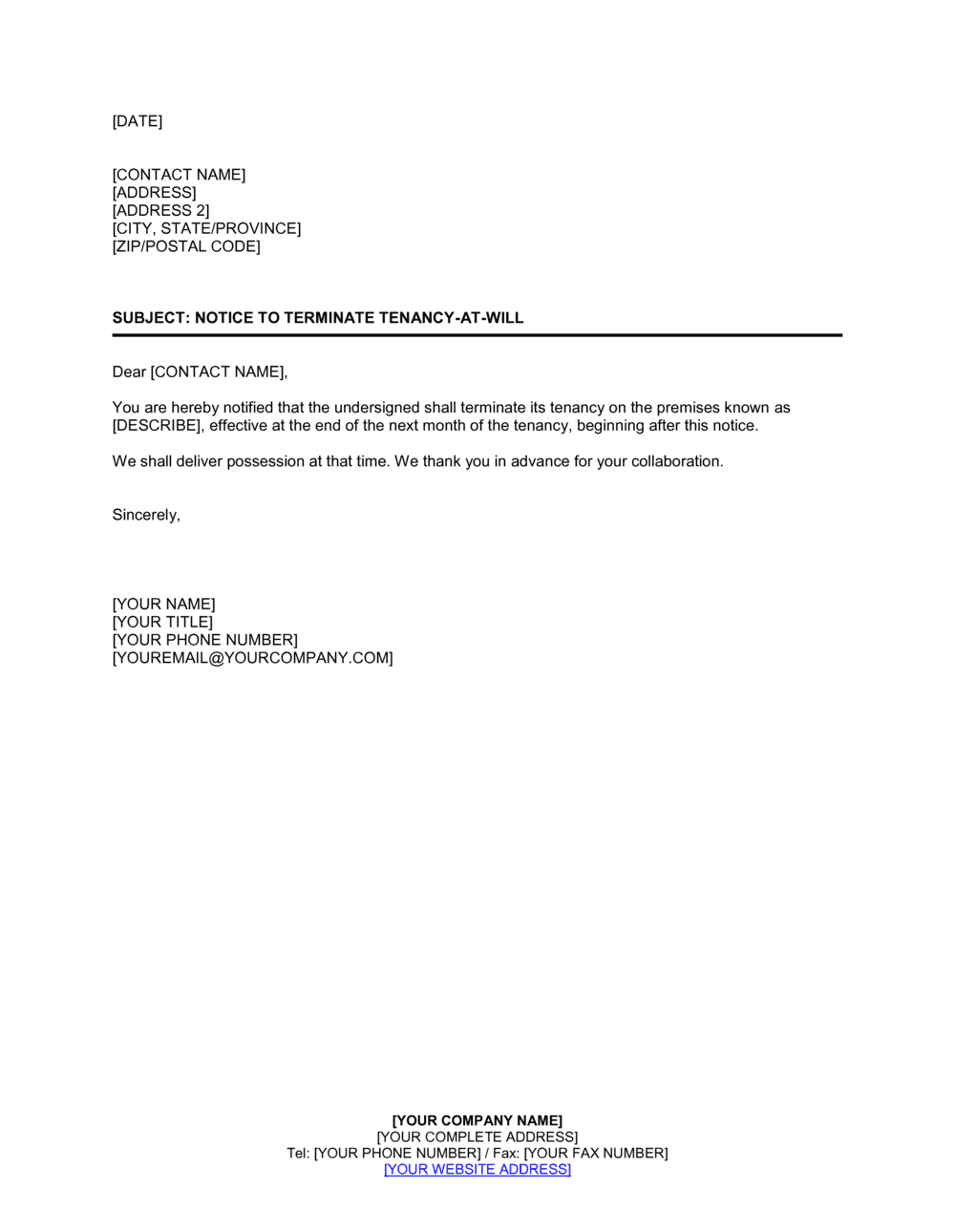
Notice to Terminate Tenancy_At-Will by Tenant Template

Free Word download β€’ Edit online β€’ Save & share with Drive β€’ Export to PDF

1 pageβ€’15–25 min to fillβ€’Difficulty: Standard
Learn more ↓
FreeNotice to Terminate Tenancy_At-Will by Tenant Template

At a glance

What it is
A Notice to Terminate Tenancy at Will by Tenant is a formal written letter a tenant sends to their landlord to end a month-to-month or at-will rental arrangement. This free Word download lets you fill in the key details β€” property address, notice period, and intended move-out date β€” and send a clean, professional letter that creates a clear paper trail for both parties.
When you need it
Use it when you are renting under a month-to-month or at-will arrangement and want to end the tenancy on a specific date. It is also appropriate when a fixed-term lease has expired and converted to a periodic tenancy that either party can end with proper notice.
What's inside
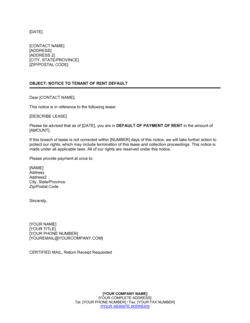
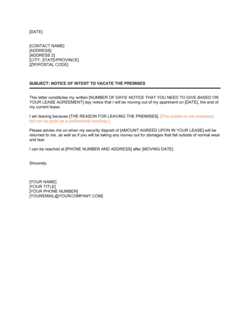
Date and address block, landlord identification, property address, notice period statement, intended vacate date, key-return and move-out logistics, forwarding address for deposit return, and tenant signature block.

What is a Notice to Terminate Tenancy at Will by Tenant?

A Notice to Terminate Tenancy at Will by Tenant is a formal written letter a tenant sends to their landlord to end a month-to-month or at-will rental arrangement on a specific date. Unlike breaking a fixed-term lease, terminating a tenancy at will requires no landlord consent and carries no financial penalty β€” as long as the tenant provides the minimum notice period required by the rental agreement or applicable law, typically 30 days. The letter identifies the property, states the intended vacate date, confirms the notice period has been satisfied, and provides the tenant's forwarding address for the security deposit return.

Why You Need This Document

Ending a month-to-month tenancy without a written notice leaves you exposed in three concrete ways. First, without a dated, delivered letter, the landlord can claim the notice period never started β€” keeping you liable for rent beyond the date you moved out. Second, informal verbal notice creates no paper trail for deposit-return disputes, which are among the most common small-claims court filings between tenants and landlords. Third, most jurisdictions require written notice as a legal precondition to a valid termination β€” an oral conversation simply does not satisfy the requirement, regardless of what the landlord agrees to in the moment. This template gives you a clear, professional letter that covers every required element β€” parties, property, notice period, vacate date, key return, and forwarding address β€” so you can move out cleanly, protect your deposit, and avoid being billed for rent you no longer owe.

Which variant fits your situation?

If your situation is…Use this template
Ending a residential month-to-month tenancyNotice to Terminate Tenancy at Will by Tenant
Landlord ending a month-to-month tenancyNotice to Terminate Tenancy at Will by Landlord
Tenant breaking a fixed-term lease earlyEarly Lease Termination Letter
Giving 60-day notice on a longer-term periodic tenancy60-Day Notice to Vacate
Vacating a commercial lease at term endCommercial Lease Termination Letter
Responding to a landlord's notice with a counter-noticeTenant Response to Notice to Quit

Common mistakes to avoid

❌ Giving insufficient notice

Why it matters: Giving fewer days than required by law or your rental agreement means the tenancy does not legally terminate on your intended date, potentially leaving you liable for an extra month's rent.

Fix: Check both your rental agreement and your jurisdiction's residential tenancy statute before setting the vacate date. When in doubt, give one additional week of buffer.
❌ Using vague or conditional language

Why it matters: Phrases like 'I am planning to leave' or 'I hope to vacate by' do not constitute formal notice and can be dismissed by a landlord as a preliminary inquiry, not a binding termination.

Fix: Use direct, present-tense language: 'I hereby provide [X] days' written notice of termination, effective [DATE].'

❌ Not sending by a verifiable delivery method

Why it matters: If a dispute arises over whether you gave proper notice, an undelivered or unacknowledged letter leaves you with no proof the notice period ever started running.

Fix: Send by certified mail with return receipt, email with a read receipt, or hand-deliver with a dated acknowledgment signed by the landlord or their agent.

❌ Omitting the forwarding address

Why it matters: Without a forwarding address, landlords in many jurisdictions are permitted to delay returning the security deposit, or may mail it to the vacated property where you will never receive it.

Fix: Always include your new mailing address in the letter, even if it is temporary. You can update it later with a separate written notice.

The 9 key clauses, explained

Date and address block

In plain language: Records the date the notice is written and the full mailing addresses of both the tenant and the landlord.

Sample language
[DATE] | From: [TENANT FULL NAME], [TENANT CURRENT ADDRESS] | To: [LANDLORD FULL NAME / PROPERTY MANAGEMENT COMPANY], [LANDLORD ADDRESS]

Common mistake: Using the date the letter will be delivered rather than the date it is written β€” creating ambiguity about when the notice period started.

Subject line and property identification

In plain language: Clearly identifies the rental property by full address so there is no ambiguity about which unit or premises the notice applies to.

Sample language
Re: Notice of Termination of Tenancy at Will β€” [FULL PROPERTY ADDRESS INCLUDING UNIT NUMBER, CITY, STATE, ZIP]

Common mistake: Listing only the street address without the unit number for multi-family buildings, causing the notice to apply to the wrong unit in the landlord's records.

Opening statement of intent

In plain language: States directly that the tenant is providing formal notice of their intent to vacate and terminate the tenancy.

Sample language
I, [TENANT FULL NAME], hereby provide [NUMBER] days' written notice of my intent to terminate my tenancy at will at the above-referenced property, effective [VACATE DATE].

Common mistake: Phrasing the opening as a request rather than a notice β€” writing 'I would like to end my tenancy' rather than 'I hereby give notice,' which may be treated as an inquiry rather than a binding termination.

Notice period confirmation

In plain language: Explicitly states the number of days' notice being provided and confirms it meets or exceeds the minimum required by the rental agreement or applicable law.

Sample language
This notice is being provided [NUMBER] days prior to the intended vacate date, satisfying the [30 / 60]-day notice requirement set out in our rental agreement dated [ORIGINAL AGREEMENT DATE].

Common mistake: Failing to confirm the notice period in writing, leaving a dispute risk if the landlord claims insufficient notice was given.

Intended vacate date

In plain language: States the exact calendar date the tenant will have completely vacated the property and returned it to the landlord.

Sample language
I intend to vacate the premises in full and return all keys no later than [SPECIFIC DATE, e.g., June 30, 2026].

Common mistake: Setting a vacate date that falls mid-month without checking whether the rental agreement requires the date to align with the last day of a rental period.

Move-out and key-return logistics

In plain language: Describes how the tenant will return keys and who to contact to arrange a move-out inspection.

Sample language
I will return all keys, access cards, and garage openers to [LANDLORD NAME / PROPERTY MANAGER] at [ADDRESS / OFFICE] by [TIME] on [DATE]. I request a joint move-out inspection be scheduled at a mutually convenient time before that date.

Common mistake: Omitting any reference to key return, which can give the landlord grounds to claim the tenancy was not formally surrendered on the stated date.

Security deposit forwarding address

In plain language: Provides the tenant's new mailing address so the landlord can send the security deposit refund and any itemized deduction statement within the statutory deadline.

Sample language
Please direct my security deposit refund and any correspondence to my forwarding address: [NEW FULL ADDRESS].

Common mistake: Leaving the forwarding address blank or writing 'TBD,' which can delay deposit return and complicate disputes about whether the landlord met the statutory refund deadline.

Closing acknowledgment and request for confirmation

In plain language: Closes the letter professionally and requests written confirmation from the landlord that the notice has been received.

Sample language
Please confirm receipt of this notice in writing at your earliest convenience. I appreciate our tenancy and intend to leave the property in clean condition. Thank you for your time.

Common mistake: Sending the notice without any request for acknowledgment and then having no evidence the landlord received it β€” always send by a method that provides proof of delivery.

Tenant signature block

In plain language: The tenant's printed name, signature, and the date of signing to authenticate the document.

Sample language
Sincerely, [TENANT SIGNATURE] | [TENANT PRINTED NAME] | Date: [DATE]

Common mistake: Signing with a nickname or initials rather than the full legal name as it appears on the rental agreement, creating a mismatch the landlord can use to dispute the notice's validity.

How to fill it out

  1. 1

    Check your required notice period

    Review your rental agreement and your state or province's residential tenancy law to confirm the minimum notice period β€” typically 30 days for month-to-month tenancies, but sometimes 60 days for tenancies over a certain duration.

    πŸ’‘ Some jurisdictions require that the notice period align with the rental payment cycle β€” a 30-day notice given on the 10th may not expire until the last day of the following full rental month.

  2. 2

    Enter the date and both parties' addresses

    Write today's date at the top, then fill in your full name and current address as tenant, followed by the landlord's full legal name and mailing address.

    πŸ’‘ Use the landlord's name exactly as it appears on your lease or rental agreement to avoid any confusion about who the notice is addressed to.

  3. 3

    Identify the property with full address and unit number

    Enter the complete rental property address in the subject line, including unit or suite number. For commercial premises, include the floor and suite reference.

    πŸ’‘ If you have a lease or rental agreement number, include it in the subject line for easy cross-referencing by the landlord's property management system.

  4. 4

    State your intent and the notice period clearly

    Write a direct opening sentence that gives formal notice of termination, states the number of days' notice you are providing, and references your original rental agreement date.

    πŸ’‘ Use definitive language β€” 'I hereby give notice' β€” not conditional language like 'I am planning to' or 'I intend to consider.'

  5. 5

    Set a specific vacate date

    Calculate your vacate date based on today's date plus the required notice period and enter it as a specific calendar date. Confirm it falls on the last day of a rental period if your agreement requires it.

    πŸ’‘ Give yourself two to three extra days of buffer if possible β€” vacating a day early is always easier than needing a one-day extension.

  6. 6

    Include key-return and move-out inspection details

    State where, when, and to whom you will return all keys and access devices, and request a joint move-out inspection to document the property condition before you leave.

    πŸ’‘ Requesting a joint inspection in writing creates a record that you invited the landlord to inspect β€” this protects you from disputed damage claims later.

  7. 7

    Add your forwarding address and sign

    Enter your new mailing address for the security deposit refund, sign with your full legal name, and date the letter.

    πŸ’‘ Send the completed letter by a delivery method that provides proof of receipt β€” certified mail, email with read receipt, or hand delivery with a witness.

Frequently asked questions

What is a notice to terminate tenancy at will by tenant?

It is a formal written letter a tenant sends to their landlord to end a month-to-month or at-will rental arrangement. It states the tenant's intent to vacate, the specific move-out date, and confirms that the required notice period has been satisfied. It creates a clear, dated record that protects both parties if a dispute arises over rent owed or deposit return.

How much notice does a tenant need to give to end a tenancy at will?

In most US states, 30 days is the standard minimum for month-to-month tenancies, though some states require 60 days if the tenant has rented for more than one year. In Canada, notice periods vary by province β€” 60 days is the most common minimum for residential tenancies. Always check both your rental agreement and the residential tenancy legislation in your jurisdiction before setting a vacate date.

Does the notice to terminate need to be signed?

While a handwritten or printed signature strengthens the document's authenticity, most jurisdictions do not require a wet signature for a termination notice to be legally valid. What matters most is that the notice is in writing, clearly identifies the parties and the property, states a specific vacate date, and is delivered to the landlord by a verifiable method.

Can a landlord refuse to accept a tenant's termination notice?

A landlord cannot legally refuse a valid termination notice that meets the required notice period and complies with the rental agreement. If a landlord claims not to have received the notice, your proof of delivery β€” certified mail receipt, email read confirmation, or a signed acknowledgment β€” is what protects you. Send the notice by a method that generates a paper trail.

What happens if I vacate before the notice period expires?

Leaving before the notice period ends does not automatically end your rent obligation. In most jurisdictions, you remain liable for rent until the vacate date stated in your notice, or until the landlord re-lets the unit β€” whichever comes first. Some jurisdictions impose a duty on the landlord to mitigate damages by actively seeking a new tenant.

What is the difference between a notice to terminate tenancy at will and a notice to quit?

Both documents end a tenancy, but they are typically issued in different contexts. A notice to quit is most often issued by a landlord demanding the tenant leave β€” sometimes for non-payment or a lease violation. A notice to terminate tenancy at will by tenant is issued voluntarily by the tenant to end a periodic tenancy on their chosen date. The legal effect is similar, but the initiating party and context differ.

Should I request a move-out inspection in the notice?

Yes. Requesting a joint move-out inspection in your written notice creates a record that you invited the landlord to document the property's condition before you left. This protects you from disputed damage claims made after you have vacated and have no opportunity to respond or remedy the issue.

Can I rescind my termination notice after sending it?

You can request to rescind the notice, but the landlord is not obligated to agree. Once a valid termination notice has been delivered, the landlord may have already started advertising the unit or made other plans. Any agreement to cancel the notice should be confirmed in writing by both parties to avoid confusion about whether the tenancy continues.

Do I need a lawyer to send a notice to terminate tenancy at will?

No. For a standard month-to-month residential tenancy, a clearly written notice using a quality template is sufficient. Consider consulting a tenant-rights organization or lawyer if your landlord disputes the notice, if you are leaving early due to habitability issues, or if your tenancy involves a commercial property with complex lease terms.

How this compares to alternatives

vs Notice to terminate tenancy at will by landlord

This template is issued by the tenant to voluntarily end a periodic tenancy. A landlord-initiated version is used when the property owner wants to reclaim possession β€” for redevelopment, sale, or the tenant's breach. The notice period requirements and legal consequences differ depending on which party initiates termination.

vs Early lease termination letter

An early lease termination letter is used when a tenant wants to break a fixed-term lease before its natural expiry β€” often triggering a penalty or requiring the landlord's consent. A notice to terminate tenancy at will requires no landlord consent and carries no early-termination penalty, because month-to-month tenancies are designed to end with proper notice.

vs Notice to vacate

A notice to vacate is typically a landlord-to-tenant document demanding the tenant leave β€” sometimes due to non-payment or end of lease. A notice to terminate tenancy at will by tenant is a voluntary, tenant-to-landlord communication. Although both result in the property being vacated, they originate from opposite sides of the tenancy relationship.

vs Lease renewal letter

A lease renewal letter extends or formalizes the continuation of a tenancy, while a notice to terminate tenancy at will ends it. If you are unsure whether to renew or vacate, resolving that decision before sending either letter is important β€” a termination notice, once received, is difficult to rescind without the landlord's written agreement.

Industry-specific considerations

Residential Real Estate

Month-to-month apartment and house tenancies are the most common use case, with notice periods governed by state or provincial residential tenancy statutes.

Commercial Real Estate

Small businesses vacating office, retail, or warehouse space on periodic commercial tenancies use the letter to formally end occupancy and start the landlord's re-letting timeline.

Property Management

Property managers receiving tenant termination notices track the notice date and vacate date to schedule turnover inspections, cleaning, and marketing for re-letting.

Corporate Housing and Relocation

Employers managing short-term housing for relocating staff use tenant termination notices to formally end furnished rental arrangements tied to assignment end dates.

Template vs pro β€” what fits your needs?

PathBest forCostTime
Use the templateAny tenant ending a standard residential or small commercial month-to-month tenancyFree10 minutes
Template + professional reviewTenants leaving due to habitability issues, landlord harassment, or disputes about the notice period$0–$150 (tenant-rights clinic or brief paralegal review)1–2 days
Custom draftedCommercial tenants with complex lease terms, holdover situations, or potential litigation over deposit or damages$200–$600 (real estate attorney)2–5 days

Glossary

Tenancy at Will
A rental arrangement with no fixed end date that either party can terminate at any time by giving proper notice β€” typically 30 days.
Month-to-Month Tenancy
A periodic tenancy that renews automatically each month and can be ended by either party with one full rental period's written notice.
Notice Period
The minimum number of days' advance written notice required by law or the rental agreement before a tenancy can be legally terminated.
Vacate Date
The specific calendar date by which the tenant agrees to leave the property, return keys, and surrender possession to the landlord.
Security Deposit
A refundable sum held by the landlord during the tenancy, typically returned within 14–30 days of move-out once any deductions for damages are itemized.
Holdover Tenant
A tenant who remains in the property after a valid termination notice has expired without the landlord's renewed consent β€” potentially liable for double rent in some jurisdictions.
Notice to Quit
A formal demand β€” issued by either a landlord or a tenant β€” requiring the other party to end the tenancy by a specific date.
Surrender of Possession
The act of returning physical control of the rental property to the landlord, typically completed by handing over all keys on or before the vacate date.
Forwarding Address
The tenant's new mailing address provided in the termination notice so the landlord can send the security deposit refund and any final correspondence.

Part of your Business Operating System

This document is one of 3,000+ business & legal templates included in Business in a Box.

  • Fill-in-the-blanks β€” ready in minutes
  • 100% customizable Word document
  • Compatible with all office suites
  • Export to PDF and share electronically

Create your document in 3 simple steps.

From template to signed document β€” all inside one Business Operating System.
1
Download or open template

Access over 3,000+ business and legal templates for any business task, project or initiative.

2
Edit and fill in the blanks with AI

Customize your ready-made business document template and save it in the cloud.

3
Save, Share, Send, Sign

Share your files and folders with your team. Create a space of seamless collaboration.

Save time, save money, and create top-quality documents.

β˜…β˜…β˜…β˜…β˜…

"Fantastic value! I'm not sure how I'd do without it. It's worth its weight in gold and paid back for itself many times."

Managing Director Β· Mall Farm
Robert Whalley
Managing Director, Mall Farm Proprietary Limited
β˜…β˜…β˜…β˜…β˜…

"I have been using Business in a Box for years. It has been the most useful source of templates I have encountered. I recommend it to anyone."

Business Owner Β· 4+ years
Dr Michael John Freestone
Business Owner
β˜…β˜…β˜…β˜…β˜…

"It has been a life saver so many times I have lost count. Business in a Box has saved me so much time and as you know, time is money."

Owner Β· Upstate Web
David G. Moore Jr.
Owner, Upstate Web

Run your business with a system β€” not scattered tools

Stop downloading documents. Start operating with clarity. Business in a Box gives you the Business Operating System used by over 250,000 companies worldwide to structure, run, and grow their business.

Start freeΒ Β·Β No credit card required