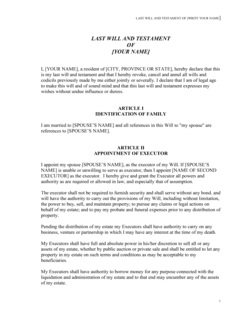
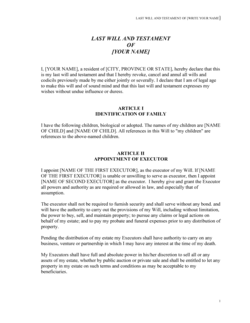
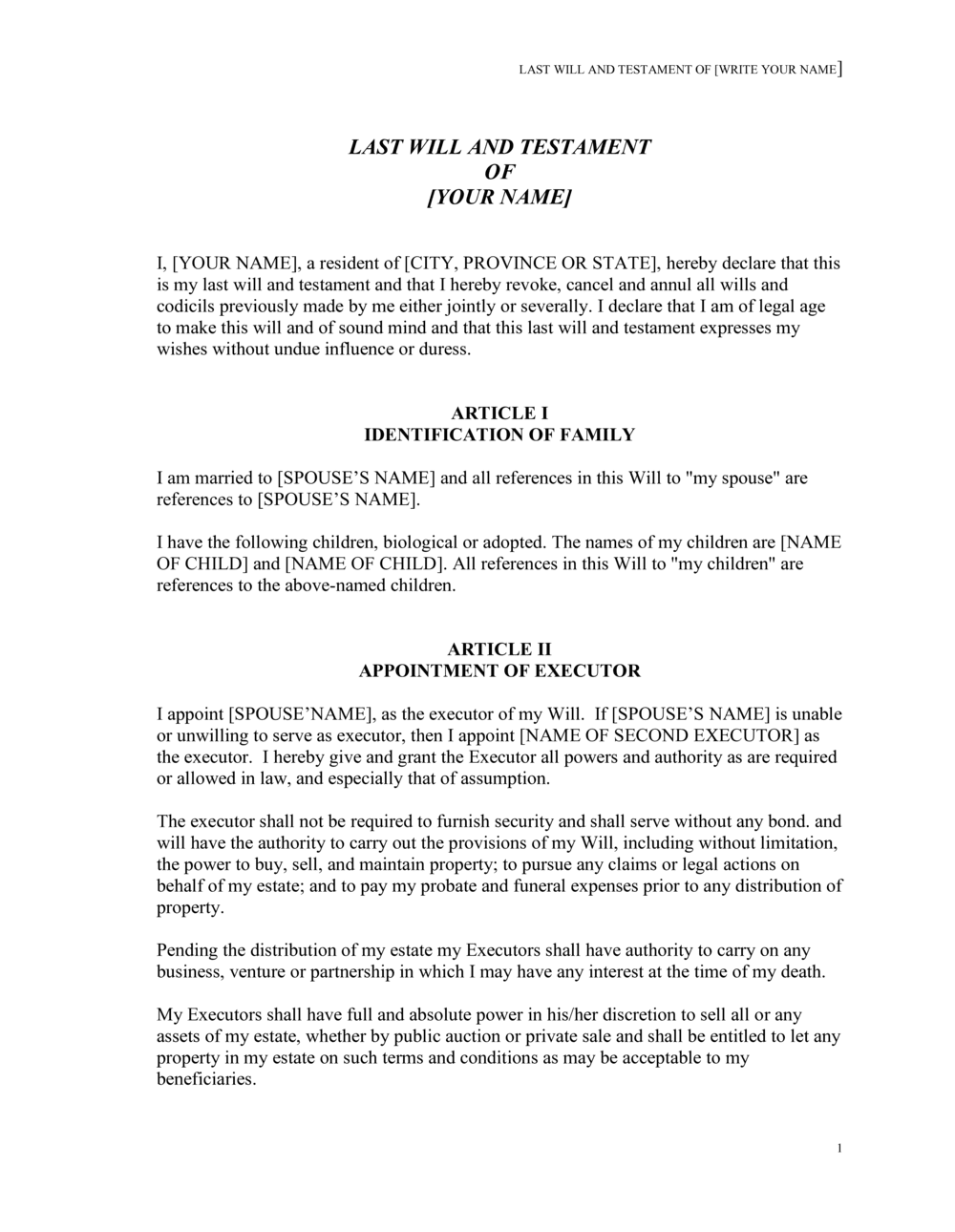
Last Will and Testament - Married with Children Template

Free Word download • Edit online • Save & share with Drive • Export to PDF

5 pages25–35 min to fillDifficulty: ComplexSignature requiredLegal review recommended
Learn more ↓
FreeLast Will and Testament - Married with Children Template

At a glance

What it is
A Last Will and Testament for a married individual with children is a legally binding document that directs how your estate — property, accounts, personal belongings, and business interests — will be distributed after your death, names a guardian for your minor children, and appoints an executor to carry out your wishes. This free Word download gives you a complete, attorney-reviewed starting point you can edit online and export as PDF before signing in accordance with your jurisdiction's execution requirements.
When you need it
Use it when you are married with one or more children — biological, adopted, or stepchildren you intend to include — and want to ensure your estate passes to the right people on the right terms rather than under your jurisdiction's default intestacy rules. It is especially urgent after the birth of a first child, a significant asset acquisition, or a change in family structure.
What's inside
The template covers testator identification and declarations, spouse and children provisions, specific and residual bequests, guardian and alternate guardian designations, executor and alternate executor appointments, testamentary trust provisions for minor beneficiaries, debt and tax payment instructions, digital asset directives, and the execution block with witness and notary acknowledgment language.

What is a Last Will and Testament (Married With Children)?

A Last Will and Testament for a Married Individual With Children is a legally binding document that controls how your estate — real property, bank and investment accounts, personal belongings, and any business interests — is distributed after your death, who is appointed to raise your minor children if both parents are gone, and who is authorized to carry out all of it. Unlike a generic will, this variant is structured specifically for the dual objectives that married parents face: providing for a surviving spouse first, then ensuring children are protected if the spouse also dies. It works by establishing a clear distribution waterfall — spouse first, children second through direct bequest or testamentary trust — and by giving a court your explicit nomination for a guardian, which courts give significant weight in any custody determination.

The document is effective only after death and must be executed according to the formal requirements of your jurisdiction — typically a signed original witnessed by two disinterested adults — before it carries any legal authority.

Why You Need This Document

Dying without a valid will does not mean the state takes your assets — it means the state decides who gets them according to a formula written for the average family, not yours. In most US states, an intestate married parent's estate is split between the surviving spouse and children in fixed statutory shares, which can result in a child receiving a portion of the family home before the surviving parent is financially stable. Courts also decide who raises your children without any parental input, sometimes resolving genuine family disputes in hearings that take months and cost thousands of dollars. A properly executed will eliminates that uncertainty in one document. It also activates a testamentary trust that holds assets for your children until they are mature enough to manage them — rather than releasing a lump sum to an 18-year-old. For married parents, this is not an optional estate planning step. It is the foundational document that protects your family when you are no longer able to.

Which variant fits your situation?

If your situation is…Use this template
Single individual with children but no spouseLast Will and Testament — Single With Children
Married couple with no childrenLast Will and Testament — Married Without Children
Single individual with no childrenLast Will and Testament — Single Without Children
Avoiding probate and managing assets for minor childrenRevocable Living Trust
Directing assets to charity alongside familyLast Will and Testament With Charitable Bequest
Transferring a business interest at death with succession termsBusiness Succession Plan
Nominating a healthcare proxy if incapacitated before deathDurable Power of Attorney

Common mistakes to avoid

❌ Using a beneficiary as a witness

Why it matters: In most US states, UK, and Canadian provinces, a witness who is also a beneficiary forfeits their bequest — or worse, the will's validity is challenged entirely. The estate then passes by intestacy.

Fix: Use two disinterested adult witnesses who receive nothing under the will and have no financial stake in the estate. Ask neighbors, colleagues, or friends rather than family members named in the document.

❌ Not naming an alternate guardian

Why it matters: If the primary guardian nominee dies before you, is incapacitated, or refuses the role, a court appoints a guardian without any parental guidance — often among competing family members with different ideas about child-rearing.

Fix: Always name at least one alternate guardian and confirm both nominees are willing to serve before executing the will.

❌ Omitting a survivorship period on the spousal bequest

Why it matters: Without a survivorship clause, if a spouse survives by only hours or days after a joint accident, the entire estate passes through their estate under different rules — triggering double probate and potentially reaching unintended heirs.

Fix: Add a 30-to-90-day survivorship condition on the spousal bequest and ensure the alternate distribution clause kicks in automatically if the condition fails.

❌ Setting the testamentary trust termination age at 18

Why it matters: Eighteen-year-olds legally qualify to receive inheritances, but a lump-sum distribution of substantial assets at that age frequently results in rapid dissipation. Courts cannot override a clearly stated age without evidence of incapacity.

Fix: Set the outright distribution age at 25 or older, or use staggered distributions tied to multiple ages to balance access with maturity.

❌ Failing to update the will after a major life event

Why it matters: A will drafted before a second marriage, adoption, or acquisition of significant property may disinherit a new spouse or child by accident, or direct assets to an ex-spouse or deceased beneficiary.

Fix: Review and update your will after every significant life event — marriage, divorce, birth of a child, adoption, death of a named beneficiary, or acquisition of major property.

❌ Relying on the will alone to transfer retirement accounts and life insurance

Why it matters: Beneficiary designations on 401(k), IRA, and life insurance policies override the will entirely. A will that leaves everything to your children is overridden by a 10-year-old policy beneficiary designation naming an ex-spouse.

Fix: Review and update beneficiary designations on all retirement accounts, life insurance policies, and payable-on-death bank accounts every time the will is updated — they must be consistent.

The 10 key clauses, explained

Testator declaration and revocation of prior wills

In plain language: Opens the document by identifying the testator by full legal name and place of residence, declaring testamentary capacity, and expressly revoking all prior wills and codicils.

Sample language
I, [FULL LEGAL NAME], residing at [ADDRESS], [CITY], [STATE/PROVINCE], being of legal age and sound mind, hereby make this my Last Will and Testament and expressly revoke all prior wills and codicils made by me.

Common mistake: Omitting the revocation clause when replacing an older will. Without it, prior wills can be admitted alongside the new one, creating conflicting instructions that courts must resolve — often expensively.

Identification of spouse and children

In plain language: Names the testator's spouse and all children — biological, adopted, and any intentionally excluded — so beneficiary designations are unambiguous and omissions cannot be construed as accidental disinheritance.

Sample language
I am married to [SPOUSE FULL NAME]. I have the following children: [CHILD 1 FULL NAME], born [DATE]; [CHILD 2 FULL NAME], born [DATE]. References to 'my children' include all children now living and any born or adopted hereafter.

Common mistake: Failing to list all children by name. In many jurisdictions, a child not named in a will may claim a statutory 'pretermitted heir' share on the assumption they were accidentally omitted — even if the omission was intentional.

Bequest to surviving spouse

In plain language: States what the surviving spouse receives — typically the entire residual estate — and the conditions that apply if the spouse does not survive the testator by a specified period (the survivorship period).

Sample language
I give, devise, and bequeath my entire residual estate to my spouse, [SPOUSE FULL NAME], if they survive me by [30] days. If my spouse does not survive me by [30] days, the residual estate shall pass as provided in Article [X] of this Will.

Common mistake: Omitting a survivorship period. Without one, if both spouses die in a common accident, the estate may pass briefly to the dying spouse and then through their estate under different rules — triggering double probate and unintended distribution.

Bequest to children — alternate distribution

In plain language: Directs how the estate passes if the spouse does not survive, typically dividing the residual estate equally among children or into a testamentary trust for minor children.

Sample language
If my spouse does not survive me, I give my residual estate to my children in equal shares, per stirpes. If any child is under the age of [25] at my death, that child's share shall be held in trust as provided in Article [TRUST ARTICLE NUMBER] of this Will.

Common mistake: Using a per capita instead of per stirpes distribution without understanding the difference. Per stirpes ensures a deceased child's share flows to their own children; per capita would redistribute it among surviving siblings — likely not the intended outcome.

Specific bequests

In plain language: Lists any particular items — real property, vehicles, jewelry, accounts, or business interests — given to specific named individuals or organizations, and states what happens if the item no longer exists at death (ademption).

Sample language
I give [DESCRIPTION OF PROPERTY, e.g., my 2021 Ford F-150, VIN XXXXXXXXXXXXXXXXX] to [BENEFICIARY FULL NAME]. If this property is not owned by me at my death, this bequest lapses and the recipient receives nothing in substitution.

Common mistake: Describing property too vaguely — 'my car' or 'my jewelry' — when multiple items match the description. Courts apply rules of construction that may not match the testator's actual intent, and disputes among beneficiaries are common.

Guardian designation for minor children

In plain language: Nominates a guardian of the person and an alternate guardian to care for minor children if both parents die, and states any parenting or religious preferences the testator wants considered.

Sample language
I nominate [GUARDIAN FULL NAME], of [ADDRESS], as guardian of the person of my minor children. If [GUARDIAN FULL NAME] is unable or unwilling to serve, I nominate [ALTERNATE GUARDIAN FULL NAME] as alternate guardian. Any court appointing a guardian shall give strong preference to my nominees.

Common mistake: Naming a guardian without naming an alternate. If the primary nominee is unable or unwilling to serve and no alternate is named, the court appoints a guardian without any guidance from the parents — often among competing relatives.

Testamentary trust for minor beneficiaries

In plain language: Establishes a trust inside the will to hold a minor child's share until they reach a specified age, names a trustee and alternate trustee, and sets distribution standards (health, education, maintenance, and support).

Sample language
If any beneficiary is under the age of [25] at the time of distribution, their share shall be held in trust by [TRUSTEE FULL NAME] ('Trustee'). The Trustee may distribute principal and income for the beneficiary's health, education, maintenance, and support. The trust shall terminate and distribute outright when the beneficiary reaches age [25].

Common mistake: Setting the trust termination age at 18 — the age of legal majority — when most 18-year-olds lack the financial maturity to manage a meaningful inheritance responsibly. Ages 25–30 are more common in estate planning practice.

Executor appointment and powers

In plain language: Names an executor and alternate executor, grants powers to administer the estate (sell assets, pay taxes, continue a business, hire counsel), and states whether bond is waived.

Sample language
I appoint [EXECUTOR FULL NAME] as Executor of this Will. If [EXECUTOR FULL NAME] is unable or unwilling to serve, I appoint [ALTERNATE EXECUTOR FULL NAME] as alternate Executor. My Executor shall serve without bond and shall have full authority to sell, lease, mortgage, or otherwise manage estate assets as needed to administer this Will.

Common mistake: Failing to waive the executor bond requirement. Courts in many jurisdictions require executors to post a surety bond — which costs the estate money — unless the will expressly waives it.

Payment of debts, taxes, and expenses

In plain language: Directs the executor to pay valid debts, funeral expenses, and estate taxes from the estate before distributing to beneficiaries, and identifies whether a specific fund or asset class should bear the tax burden.

Sample language
I direct my Executor to pay all of my legally enforceable debts, funeral and burial expenses, and costs of estate administration as soon as reasonably practicable after my death. Estate, inheritance, and succession taxes, if any, shall be paid from the residual estate.

Common mistake: Leaving the tax-apportionment source unspecified. Without direction, some jurisdictions default to apportioning taxes pro rata across all beneficiaries — which can reduce specific bequests to family members unintentionally.

Execution block — signatures and witnesses

In plain language: Contains the testator's signature line, the date and location of signing, and the witness attestation — confirming the testator signed voluntarily and appeared competent, as required for a valid will in most jurisdictions.

Sample language
IN WITNESS WHEREOF, I have signed this Last Will and Testament on [DATE], at [CITY], [STATE/PROVINCE/COUNTRY]. [TESTATOR SIGNATURE LINE]. We, the undersigned witnesses, declare that the Testator signed this Will in our presence and appeared to be of sound mind and under no undue influence. [WITNESS 1 SIGNATURE AND ADDRESS] [WITNESS 2 SIGNATURE AND ADDRESS].

Common mistake: Using a beneficiary as a witness. In most jurisdictions, a witness who is also a beneficiary loses their bequest — or the entire will's validity is jeopardized. Witnesses should be disinterested adults with no stake in the estate.

How to fill it out

  1. 1

    Enter your full legal name and residential address

    Use the exact name on your government-issued ID and your current primary residence address. The testator identification clause anchors the document's legal identity.

    💡 If you have used multiple names (maiden name, prior legal name), include all variants with a 'also known as' notation to prevent identity challenges during probate.

  2. 2

    List your spouse and all children by full name and date of birth

    Name every child you have — including those from prior relationships — whether you intend to include or intentionally exclude them. Include a catch-all phrase covering future-born or adopted children if you plan to have more.

    💡 Intentional exclusion of a child should be stated explicitly ('I make no provision for [NAME], and this omission is intentional') to defeat a pretermitted heir claim.

  3. 3

    Define the spousal bequest and survivorship period

    State what your spouse receives — typically the entire residual estate — and choose a survivorship period of 30 to 90 days to avoid the double-probate problem in simultaneous-death scenarios.

    💡 Some couples use 45 days rather than 30 to allow time for the first estate to be properly administered before assets pass again.

  4. 4

    Complete the alternate distribution clause for your children

    Decide how the estate is divided if your spouse does not survive: equal shares per stirpes is the most common choice for families. Specify the age at which a child's share passes outright — rather than being held in trust.

    💡 Consider staggered distributions (one-third at 25, one-half the balance at 30, remainder at 35) rather than a single lump-sum release.

  5. 5

    Name a guardian and an alternate guardian for minor children

    Choose an adult who shares your values, is willing to serve, and is financially stable enough to raise your children. Name an alternate in case your first choice predeceases you or declines.

    💡 Have a direct conversation with your proposed guardian before naming them — courts occasionally see nominees who had no idea they were named and are unwilling to serve.

  6. 6

    Appoint an executor and set their powers

    Name a trusted adult — ideally someone organized and local — as executor and name an alternate. Expressly waive the bond requirement and grant broad administrative powers to avoid court approval for routine estate decisions.

    💡 Your executor and guardian do not need to be the same person. Separating the roles can reduce conflict between financial management and child-rearing decisions.

  7. 7

    List any specific bequests with precise descriptions

    Identify each specific item by make, model, VIN, account number, or legal property description. Name the recipient and state what happens if the item no longer exists at your death.

    💡 For real property, use the exact legal description from the deed rather than just the street address to avoid title disputes.

  8. 8

    Sign with two disinterested witnesses present simultaneously

    All parties — testator and both witnesses — must be physically present at the same time during signing. Witnesses must be adults who receive nothing under the will. Some jurisdictions also require a notary acknowledgment for self-proving affidavit status.

    💡 After signing, store the original in a fireproof safe or with your attorney and tell your executor exactly where it is — an unfound will is legally the same as no will.

Frequently asked questions

What is a last will and testament for married individuals with children?

A last will and testament for a married individual with children is a legally binding document that directs how your estate — real property, bank accounts, investments, personal belongings, and business interests — will be distributed after your death. It also names a guardian for any minor children and appoints an executor to administer the estate. Without one, your estate passes under your jurisdiction's intestacy laws, which may distribute assets in ways that do not reflect your intentions.

Do I need a lawyer to make a valid will?

In most jurisdictions, a will is legally valid if it meets the formal execution requirements — signed by the testator with two disinterested adult witnesses present — without an attorney's involvement. A template is sufficient for straightforward estates. However, estates involving blended families, special needs beneficiaries, significant business interests, cross-border assets, or complex tax considerations benefit materially from attorney review, which typically costs $500–$1,500 for a standard will package.

What happens if I die without a will?

If you die intestate — without a valid will — your estate passes under your jurisdiction's statutory distribution scheme. In most US states, this means a portion goes to your spouse and a portion to your children in fixed statutory shares, which may not match what you intended. Intestacy laws never name a guardian for your children; a court makes that decision without your input. Assets may also pass to relatives you would have intentionally excluded.

Can a will be used to name a guardian for my children?

Yes. Naming a guardian in your will is the primary legal mechanism by which parents express their preference for who should raise their minor children. Courts are not legally bound by the nomination but give it strong weight unless there is a compelling reason — such as unfitness — to appoint someone else. Without a will naming a guardian, the court decides entirely among competing family members without parental guidance.

What is the difference between a will and a living trust?

A will takes effect only at death and must typically pass through probate before assets are distributed. A revocable living trust holds assets during your lifetime, avoids probate on those assets, and distributes them directly according to the trust's terms after death. Many estate plans use both: a living trust for significant assets and a 'pour-over' will to capture anything not transferred into the trust. A will is generally simpler and cheaper to draft; a trust offers more privacy and probate avoidance.

How many witnesses does a will require?

Most US states, Canadian provinces, and the UK require two adult witnesses who are present simultaneously when the testator signs and who are not beneficiaries under the will. Louisiana and some other civil-law jurisdictions have different requirements. Some jurisdictions allow a notarized 'self-proving affidavit' attached to the will that simplifies probate by eliminating the need to locate witnesses after the testator's death. Check the specific requirement in your state or province before signing.

Can I change or revoke my will after signing it?

Yes. A will can be revoked or amended at any time while the testator is alive and competent. Minor changes are made through a formally executed codicil; significant changes are best handled by revoking the old will entirely and executing a new one. The new will should include an express revocation clause. Never cross out or handwrite changes on a signed will — this can void the entire document or create ambiguity about which version controls.

Does a will avoid probate?

No. A will does not avoid probate — it controls what happens during probate. Assets held solely in the decedent's name and not passing by beneficiary designation or joint tenancy must go through the probate process, which a court supervises. Assets that do avoid probate include jointly held property with right of survivorship, retirement accounts and life insurance with named beneficiaries, payable-on-death bank accounts, and assets held in a living trust. A comprehensive estate plan typically coordinates all of these alongside the will.

What is a testamentary trust and when should I use one?

A testamentary trust is a trust created inside the will that activates at the testator's death and holds assets for a beneficiary — typically a minor child — until they reach a specified age. It is appropriate whenever a beneficiary is too young to manage an outright inheritance responsibly, has special needs that must be protected, or when the estate is large enough that professional management during the beneficiary's minority is warranted. The trustee manages distributions for health, education, maintenance, and support until the trust terminates.

How this compares to alternatives

vs Last Will and Testament — Married Without Children

The married-without-children will focuses on spousal bequests, secondary beneficiaries, and executor designation without guardian or testamentary trust provisions. The married-with-children variant adds guardian nomination, minor beneficiary trust provisions, and per stirpes distribution language — which are legally unnecessary when no children are involved. Use this template whenever you have children you intend to provide for.

vs Revocable Living Trust

A revocable living trust holds and distributes assets without going through probate, offering privacy and faster distribution. A last will and testament is simpler to draft and costs less to create, but assets must pass through probate. Most estate planners recommend a 'pour-over' will alongside a living trust to catch assets not transferred into the trust during the testator's lifetime. Use the will alone for smaller estates or as a companion to a trust.

vs Durable Power of Attorney

A durable power of attorney authorizes someone to manage your financial and legal affairs while you are alive but incapacitated. A last will and testament takes effect only at death and has no authority during incapacity. Both documents are part of a complete estate plan — the power of attorney handles incapacity; the will handles death. Having one without the other leaves a significant gap.

vs Last Will and Testament — Single With Children

The single-with-children will omits the spousal bequest structure and survivorship clause, distributing the entire estate directly to children or into trust. It places greater weight on the guardian nomination since no surviving parent exists by default. Use the married version when you have a living spouse you intend to provide for; use the single version if you are unmarried, divorced, or widowed.

Industry-specific considerations

Real estate

Directing specific property addresses by legal description to a surviving spouse or into trust, coordinating with joint tenancy title, and addressing mortgaged property.

Small business ownership

Specifying whether a business interest is to be sold, transferred to a co-owner under a buy-sell agreement, or placed in trust — preventing forced liquidation at death.

Financial services and investment

Coordinating will bequests with beneficiary designations on retirement accounts, brokerage accounts, and life insurance policies to prevent contradictory distributions.

Healthcare and medicine

Professionals with professional liability exposure and significant retirement assets need careful coordination between will provisions, trust planning, and creditor protection strategies.

Jurisdictional notes

United States

Will execution requirements vary by state but most require two disinterested adult witnesses signing in the testator's presence. Holographic (handwritten, unwitnessed) wills are valid in about half of states. Non-compete and community property rules differ significantly — the nine community property states (CA, TX, AZ, NV, WA, ID, NM, LA, WI) treat marital assets differently, affecting what the testator can actually bequest. A notarized self-proving affidavit expedites probate in most states and is strongly recommended.

Canada

Each province and territory has its own Wills Act or Succession Law Reform Act setting execution formalities — generally two adult witnesses who are not beneficiaries or their spouses. Quebec follows the Civil Code and requires a notarial will or holograph will rather than a witnessed will. Spousal rights on death vary by province; Ontario, BC, and Alberta have specific rules on the effect of marriage and divorce on a prior will. Review provincial legislation before executing.

United Kingdom

The Wills Act 1837 governs execution in England and Wales: the testator must sign in the presence of two witnesses who sign simultaneously. Scotland has different rules under the Requirements of Writing (Scotland) Act 1995 — one witness suffices for a valid will. Inheritance (Provision for Family and Dependants) Act 1975 allows spouses and dependent children to apply for reasonable financial provision from the estate regardless of the will's terms, which can override specific bequests.

European Union

The EU Succession Regulation (EU) No 650/2012 governs cross-border estates within the EU: the default rule applies the law of the member state where the deceased was habitually resident at death, but the testator may elect to apply the law of their nationality instead. Forced heirship rules in France, Germany, Spain, and Italy reserve a 'réserve héréditaire' or 'Pflichtteil' for children and spouses regardless of the will's instructions. International families with EU property should obtain local legal advice to understand the interaction of the Regulation with local forced-share rules.

Template vs lawyer — what fits your deal?

PathBest forCostTime
Use the templateMarried individuals with straightforward estates — a home, retirement accounts, and minor children — in a single jurisdictionFree30–60 minutes to complete; execution requires two witnesses
Template + legal reviewBlended families, estates with business interests, special needs beneficiaries, or assets in multiple states or provinces$500–$1,500 for attorney review and execution guidance3–7 business days
Custom draftedHigh-net-worth estates, multi-jurisdiction property, complex trusts, or significant estate-tax planning requirements$2,000–$10,000+ for a comprehensive estate plan with pour-over will, living trust, and powers of attorney2–6 weeks

Glossary

Testator
The person who creates and signs a will — in this template, the married individual with children whose estate will be distributed.
Executor
The person named in the will to gather estate assets, pay debts and taxes, and distribute what remains to beneficiaries according to the will's instructions.
Beneficiary
Any person or organization named in the will to receive a specific asset or a share of the residual estate.
Guardian
The adult appointed in the will to assume legal responsibility for raising the testator's minor children if both parents die.
Intestacy
The legal condition that arises when a person dies without a valid will, causing the estate to pass under the jurisdiction's default distribution rules — which often do not match the deceased's actual wishes.
Probate
The court-supervised process of validating a will, settling debts, and distributing estate assets — required in most jurisdictions for assets held solely in the decedent's name.
Residual Estate
All property remaining in the estate after specific bequests, debts, taxes, and administration costs have been satisfied.
Testamentary Trust
A trust created inside the will that activates at the testator's death, holding assets for minor or other beneficiaries until they reach a specified age.
Per Stirpes
A distribution method directing that if a named beneficiary dies before the testator, that beneficiary's share passes to their own descendants rather than lapsing or going to surviving beneficiaries.
Specific Bequest
A gift of a named, identifiable item — a particular property address, bank account, or family heirloom — to a named beneficiary.
Codicil
A formally executed amendment to an existing will that modifies, adds to, or revokes specific provisions without replacing the entire document.
Pour-Over Will
A will that directs any assets not already in a living trust at the testator's death to 'pour over' into that trust at probate, consolidating the estate under the trust's terms.

Part of your Business Operating System

This document is one of 3,000+ business & legal templates included in Business in a Box.

  • Fill-in-the-blanks — ready in minutes
  • 100% customizable Word document
  • Compatible with all office suites
  • Export to PDF and share electronically

Create your document in 3 simple steps.

From template to signed document — all inside one Business Operating System.
1
Download or open template

Access over 3,000+ business and legal templates for any business task, project or initiative.

2
Edit and fill in the blanks with AI

Customize your ready-made business document template and save it in the cloud.

3
Save, Share, Send, Sign

Share your files and folders with your team. Create a space of seamless collaboration.

Save time, save money, and create top-quality documents.

★★★★★

"Fantastic value! I'm not sure how I'd do without it. It's worth its weight in gold and paid back for itself many times."

Managing Director · Mall Farm
Robert Whalley
Managing Director, Mall Farm Proprietary Limited
★★★★★

"I have been using Business in a Box for years. It has been the most useful source of templates I have encountered. I recommend it to anyone."

Business Owner · 4+ years
Dr Michael John Freestone
Business Owner
★★★★★

"It has been a life saver so many times I have lost count. Business in a Box has saved me so much time and as you know, time is money."

Owner · Upstate Web
David G. Moore Jr.
Owner, Upstate Web

Run your business with a system — not scattered tools

Stop downloading documents. Start operating with clarity. Business in a Box gives you the Business Operating System used by over 250,000 companies worldwide to structure, run, and grow their business.

Free Forever Plan · No credit card required