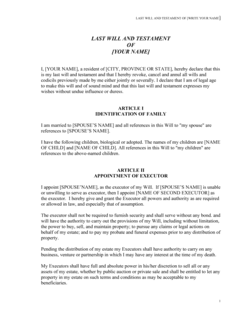
Last Will and Testament - Married with No Children Template

Free Word download • Edit online • Save & share with Drive • Export to PDF

4 pages25–30 min to fillDifficulty: ComplexSignature requiredLegal review recommended
Learn more ↓
FreeLast Will and Testament - Married with No Children Template

At a glance

What it is
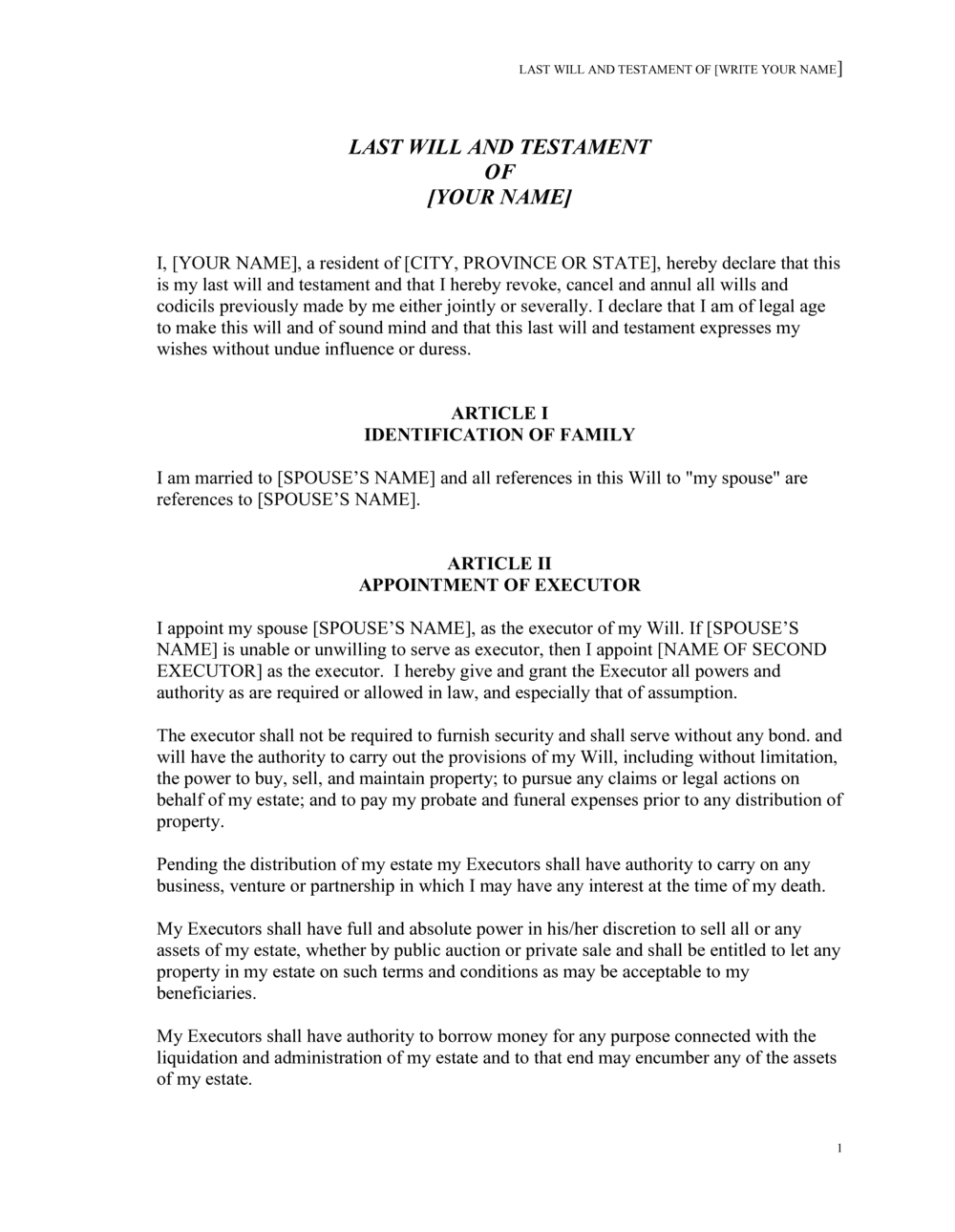
A Last Will and Testament for a married person with no children is a legally binding document that records your instructions for distributing your estate after death — naming your spouse as primary beneficiary, designating alternate beneficiaries, appointing an executor, and expressing wishes for personal property and funeral arrangements. This free Word download is pre-structured for the most common married-without-children scenario and can be edited online and exported as PDF in under an hour.
When you need it
Use it any time you own property, hold financial accounts, or have specific wishes about how your estate should be handled — particularly if you want assets to pass to named beneficiaries rather than intestate succession defaults, which vary significantly by jurisdiction. It is especially important when your spouse is not the sole heir you intend, or when you want to designate alternate beneficiaries in case your spouse predeceases you.
What's inside
Testator identification and declaration of testamentary capacity, revocation of prior wills, spouse and beneficiary designations, specific bequests of real and personal property, executor appointment and powers, residuary estate clause, funeral and burial instructions, and signature and witness attestation block.

What is a Last Will and Testament for a Married Person With No Children?

A Last Will and Testament for a Married Person With No Children is a legally binding document that records a married individual's instructions for distributing their estate after death when they have no children to name as heirs. It designates the surviving spouse as the primary beneficiary — typically of the entire estate — names one or more alternate beneficiaries in case the spouse does not survive, appoints a trusted executor to administer the estate, directs specific assets to named recipients, and expresses wishes for funeral arrangements. Because there are no children requiring guardianship designations or testamentary trusts, this version of a will is simpler in structure than a family will but no less important to have properly executed.

Why You Need This Document

Dying without a valid will — even as a married person — does not guarantee your spouse receives everything you intended. Intestate succession laws in many US states, Canadian provinces, and EU member states automatically divert a portion of a childless estate to the deceased's parents or siblings, regardless of how long the couple was married. Beyond distribution, the absence of a will means a court appoints an administrator of its choosing rather than the person you would have named — adding months and legal fees to the process. Without a named executor and clear bequest language, financial institutions freeze accounts, specific items go to the wrong people, and family disputes over sentimental property become legal proceedings. A properly executed last will takes approximately one hour to complete using this template and eliminates all of these risks for the cost of two witnesses and, ideally, a short legal review.

Which variant fits your situation?

If your situation is…Use this template
Married with minor or adult children who need to be named as heirsLast Will and Testament — Married With Children
Single individual with no spouse or childrenLast Will and Testament — Single Person
Creating a more comprehensive estate plan with a trustRevocable Living Trust Agreement
Both spouses want reciprocal wills on identical termsMirror Will (Mutual Will) Template
Protecting estate from probate for a surviving spouseLiving Trust Agreement
Formalizing instructions for healthcare decisions before deathLiving Will (Advance Healthcare Directive)
Granting a trusted person authority to manage affairs while alivePower of Attorney

Common mistakes to avoid

❌ No alternate beneficiary named

Why it matters: If the spouse predeceases the testator and no alternate is designated, the estate passes intestate — courts distribute assets under default rules that frequently send property to unintended relatives.

Fix: Always name at least one, ideally two, alternate beneficiaries and verify they are still living and contactable when you review the will annually.

❌ Using a beneficiary as a witness

Why it matters: In most common-law jurisdictions, a witness who is also a beneficiary automatically forfeits their bequest, and some courts void the entire will on this basis.

Fix: Use two disinterested adults — neighbors, colleagues, or friends — who receive nothing under the will and have no financial relationship with the estate.

❌ Vague descriptions of specific bequests

Why it matters: Descriptions like 'my watch' or 'the family car' are unenforceable when the testator owns multiple items matching the description, creating costly disputes among beneficiaries.

Fix: Identify each item with the specificity of an insurance policy: make, model, serial number, account number, or property address as applicable.

❌ Failing to update the will after major life events

Why it matters: A will written five years before a property purchase, inheritance, or change in relationship status may distribute assets in ways the testator would no longer intend — and cannot be corrected after death.

Fix: Review the will annually and after every major life event — property acquisition, inheritance, divorce, remarriage, or death of a named beneficiary or executor.

❌ Omitting executor powers

Why it matters: Without a broad executor-powers clause, the executor may need court approval for routine actions like selling property or closing accounts, adding months and legal fees to estate settlement.

Fix: Include an explicit powers clause granting the executor authority to sell, lease, invest, and manage estate assets without court order for each individual transaction.

❌ Storing the will where the executor cannot find it

Why it matters: A valid but unfindable will is functionally equivalent to no will at all — the estate proceeds to intestacy while courts wait the required period for the will to surface.

Fix: Tell your executor the exact storage location in writing, provide them with a copy, and consider registering the will in any jurisdiction that offers a wills registry.

The 9 key clauses, explained

Testator identification and declaration

In plain language: Establishes who is making the will — full legal name, residence, and an express statement that the testator is of legal age and sound mind.

Sample language
I, [FULL LEGAL NAME], a resident of [CITY, STATE/PROVINCE], being of legal age and sound and disposing mind and memory, do hereby make, publish, and declare this to be my Last Will and Testament.

Common mistake: Using a nickname or abbreviated name instead of the exact legal name on government-issued ID. If the name does not match probate records, courts may require additional proceedings to confirm identity before the will is admitted.

Revocation of prior wills

In plain language: Formally cancels all previously made wills and codicils so there is no ambiguity about which document controls the estate.

Sample language
I hereby revoke all former wills, codicils, and testamentary dispositions previously made by me and declare this instrument to be my sole and only Last Will and Testament.

Common mistake: Omitting this clause when the testator has signed a prior will. Conflicting documents create costly probate disputes, and courts in several jurisdictions give partial effect to earlier instruments if revocation is not explicit.

Spousal beneficiary designation

In plain language: Names the surviving spouse as the primary beneficiary of the entire estate, or of specific assets, and defines the share they receive.

Sample language
I give, devise, and bequeath all of my estate, real and personal, of whatever kind and wherever situated, to my beloved spouse, [SPOUSE FULL LEGAL NAME], if they survive me by [30] days.

Common mistake: Failing to include a survivorship period. Without one, if both spouses die in a common accident, assets may pass through two estates in rapid succession, doubling probate costs and triggering unintended distribution.

Alternate beneficiary clause

In plain language: Names one or more backup beneficiaries to receive the estate if the spouse does not survive the testator or the survivorship period lapses.

Sample language
If my spouse does not survive me by [30] days, I give, devise, and bequeath my entire estate to [ALTERNATE BENEFICIARY NAME], or if they shall not survive me, then to [SECONDARY ALTERNATE NAME].

Common mistake: Naming only the spouse with no alternate. If the spouse predeceases the testator, the estate falls into intestacy — potentially distributing assets to in-laws or other relatives the testator never intended to benefit.

Specific bequests

In plain language: Lists particular items — jewelry, vehicles, artwork, accounts — going to named individuals or organizations, separate from the general estate.

Sample language
I give and bequeath my [DESCRIPTION OF ITEM] to [BENEFICIARY NAME]. I give the sum of $[AMOUNT] to [ORGANIZATION/PERSON NAME] for [PURPOSE, IF ANY].

Common mistake: Describing items too vaguely. 'My car' is ambiguous if the testator owns two vehicles at death. Use year, make, model, and VIN for vehicles; account numbers or last four digits for financial accounts.

Residuary estate clause

In plain language: Captures everything not addressed by specific bequests — the catch-all provision that directs what happens to the remainder of the estate.

Sample language
I give, devise, and bequeath the rest, residue, and remainder of my estate, of whatever kind and wherever situated, to [RESIDUARY BENEFICIARY NAME], or if they shall not survive me, to [ALTERNATE RESIDUARY BENEFICIARY].

Common mistake: No residuary clause at all. Assets acquired after the will is drafted, or assets whose specific bequest fails, become intestate property — distributed by the court under default rules regardless of the testator's likely intent.

Executor appointment and powers

In plain language: Names the person or institution responsible for administering the estate and grants them the specific powers needed to act — selling property, managing accounts, and paying debts — without returning to court for each action.

Sample language
I appoint [EXECUTOR FULL NAME] as Executor of this Will. If [EXECUTOR NAME] is unable or unwilling to serve, I appoint [ALTERNATE EXECUTOR NAME] as successor Executor. My Executor shall have full power to sell, lease, mortgage, or otherwise manage estate assets without court approval.

Common mistake: Naming a sole executor with no alternate. If the named executor dies, becomes incapacitated, or declines to serve, the court appoints an administrator — a process that delays estate settlement by months and can override the testator's preferences.

Funeral and burial instructions

In plain language: Records the testator's preferences for disposition of remains — burial, cremation, memorial service — and any specific wishes about arrangements.

Sample language
I direct that my remains be [buried / cremated] and request that my Executor arrange a [memorial service / funeral] consistent with my wishes as expressed to them personally. I request interment at [LOCATION, IF KNOWN].

Common mistake: Treating the will as the primary vehicle for funeral instructions. Wills are often not read until days after death — well after burial decisions are made. Communicate these wishes directly to your spouse and executor in addition to documenting them here.

Signature and witness attestation

In plain language: The testator's signature and date, followed by signatures from two or three disinterested adult witnesses who confirm the testator signed voluntarily and appeared competent.

Sample language
IN WITNESS WHEREOF, I have hereunto set my hand to this, my Last Will and Testament, on [DATE]. Signed by [TESTATOR NAME] in our presence and attested by us in [his/her] presence and in the presence of each other: [WITNESS 1 SIGNATURE / NAME / ADDRESS] | [WITNESS 2 SIGNATURE / NAME / ADDRESS].

Common mistake: Having a beneficiary or the spouse serve as a witness. In most jurisdictions, a witness who is also a beneficiary forfeits their bequest — or invalidates the entire will. Always use disinterested adults with no stake in the estate.

How to fill it out

  1. 1

    Enter testator and spouse legal names

    Use your exact full legal name as it appears on government-issued ID, and your spouse's full legal name. Confirm the names match your marriage certificate, property titles, and financial account records.

    💡 If you have a hyphenated or recently changed name, use the name on your most recent government ID and note any prior names in parentheses to avoid identity disputes during probate.

  2. 2

    Define the spousal inheritance and survivorship period

    Confirm whether your spouse inherits the entire estate or only specified assets. Set a survivorship period — typically 30 days — to prevent a double-probate scenario if both spouses die close together.

    💡 A 30-day survivorship period is the most common standard; some jurisdictions use 120 hours (the Uniform Simultaneous Death Act default). Check your jurisdiction's default before setting a custom period.

  3. 3

    Name alternate beneficiaries

    Designate at least one alternate beneficiary for the full estate in case your spouse does not survive the survivorship period. Consider naming a secondary alternate for additional protection.

    💡 Siblings, parents, close friends, or charities are common alternates. If you name a charity, include its full legal name and tax registration number to prevent disputes over identity.

  4. 4

    List specific bequests with precise descriptions

    For each item you want directed to a specific person or organization, write a complete description — account numbers, vehicle VINs, property addresses — alongside the beneficiary's full name and relationship.

    💡 Keep a separate letter of instruction (not part of the will) for sentimental items under $500. Courts do not need to administer minor personal property, and a letter is easier to update than a will.

  5. 5

    Appoint an executor and an alternate executor

    Choose a trusted adult — often the surviving spouse for a primary executor — who is organized, financially responsible, and willing to serve. Name an alternate in case the primary cannot or will not act.

    💡 Discuss the role with your chosen executor before finalizing. An executor who is surprised by the appointment and unprepared for the duties can significantly slow estate settlement.

  6. 6

    Record funeral and burial preferences

    Note whether you prefer burial or cremation, any preferred location, and whether you want a religious or secular service. Keep this brief — the will is not the right place for detailed event planning.

    💡 Tell your spouse and executor your preferences verbally and in writing outside the will. Funeral homes typically need decisions within 24–48 hours of death, long before the will is formally read.

  7. 7

    Execute with two disinterested witnesses

    Sign and date the will in the presence of at least two adult witnesses who are not beneficiaries under the will and have no financial interest in your estate. Both witnesses must sign the attestation clause while observing you sign.

    💡 In many US states, having the will notarized with a self-proving affidavit eliminates the need for witnesses to appear in probate court — a significant time and cost saving.

  8. 8

    Store the original and register if available

    Keep the signed original in a fireproof safe or safety deposit box, and tell your executor exactly where it is. In jurisdictions with a wills registry (several Canadian provinces, parts of Europe), register the will for a small fee.

    💡 Providing your executor with a certified copy and the storage location in writing prevents the single most common post-death complication: a valid will that cannot be located.

Frequently asked questions

What is a last will and testament for a married person with no children?

It is a legal document that records how a married person with no children wants their estate distributed after death. It typically names the surviving spouse as primary beneficiary of the full estate, designates alternate beneficiaries in case the spouse does not survive, appoints an executor to administer the estate, and expresses wishes for personal property and funeral arrangements. Without it, the estate passes under intestate succession rules that may not align with the testator's intentions.

Do married couples with no children really need a will?

Yes. Intestate succession laws in most jurisdictions do pass the estate to a surviving spouse — but not always the entire estate. In many US states and Canadian provinces, a portion automatically goes to parents or siblings of the deceased if there are no children. A will ensures the spouse receives exactly what the testator intends, names an executor the testator trusts, and addresses specific assets, charitable gifts, and alternate heirs if the spouse does not survive.

What is the difference between a will and a living will?

A last will and testament takes effect after death and governs the distribution of your estate. A living will (also called an advance healthcare directive) takes effect during your lifetime if you become incapacitated and cannot communicate medical decisions. Both are essential estate planning documents, but they serve entirely different purposes and are governed by different legal rules. Many estate attorneys recommend executing both at the same time.

Does a will need to be notarized to be valid?

In most US states, a will does not need to be notarized to be valid — two adult witness signatures are typically sufficient. However, having the will notarized with a self-proving affidavit is strongly recommended: it allows the will to be admitted to probate without requiring witnesses to appear in court, which saves time and cost. In Canada, the UK, and the EU, requirements vary by jurisdiction — some require a notary, others do not. Always confirm the witnessing and notarization rules for your specific jurisdiction.

Can I write my own will without a lawyer?

In most jurisdictions, a properly executed will written without a lawyer is legally valid. A high-quality template covers the standard provisions for a married-without-children scenario. However, legal review is strongly recommended when the estate includes business interests, real property in multiple jurisdictions, significant assets subject to estate tax, or any complexity in the beneficiary structure. The cost of a lawyer reviewing a completed template — typically $150–$400 — is a fraction of the cost of a contested probate proceeding.

How many witnesses does a will require?

Most US states and Canadian provinces require two adult witnesses who are not beneficiaries under the will. Some jurisdictions accept one witness or a notary as a substitute. The UK requires two independent witnesses who both sign in the testator's presence and in each other's presence. Louisiana follows a civil-law tradition requiring a notary and two witnesses. Always check the specific execution requirements for your jurisdiction — failure to meet them renders the will invalid regardless of its content.

What happens to our joint assets if my spouse survives me?

Assets held in joint tenancy with right of survivorship — most family homes, joint bank accounts, and jointly titled vehicles — pass directly to the surviving spouse outside the will and without probate. The will governs assets held solely in your name. This means that for many married couples, the will primarily controls individually-owned property, named beneficiary accounts (which also pass outside the will), and any assets not jointly titled.

How often should I update my will?

Review your will at minimum once a year and after every significant life event — purchasing real property, receiving an inheritance, acquiring business interests, changing residence to a new jurisdiction, or the death of a named executor or beneficiary. A will that reflects outdated circumstances can distribute assets in unintended ways and cannot be corrected after the testator's death. Updating via a formal codicil or a complete redraft (recommended for substantial changes) is the only legally effective way to modify a signed will.

What is the difference between a will and a trust?

A will takes effect at death and requires probate — a public court process that can take months or years and generates attorney and court fees. A revocable living trust also governs asset distribution at death but bypasses probate entirely, keeping the process private and faster. Trusts generally cost more to establish but reduce long-term administration costs for larger estates. Many married couples use both: a trust for major assets and a pour-over will to capture anything not transferred into the trust during life.

How this compares to alternatives

vs Last Will and Testament — Married With Children

A will for married couples with children must address guardianship of minor children, testamentary trusts to hold assets until children reach a specified age, and per-stirpes distribution across multiple beneficiaries. The married-without-children version is simpler: the spouse receives the estate outright, and alternate beneficiaries replace the children's provisions. If you have or plan to have children, use the with-children variant.

vs Revocable Living Trust Agreement

A revocable living trust achieves similar distribution goals to a will but bypasses probate, keeps the estate private, and typically settles faster. A will requires probate court supervision; a trust does not. For estates above roughly $150,000 in probate-eligible assets, the long-term cost of a trust is often lower than the probate fees on a will alone. Many married couples use a pour-over will alongside a trust rather than treating them as alternatives.

vs Living Will (Advance Healthcare Directive)

A living will governs medical decisions while you are alive but incapacitated — end-of-life care, resuscitation, and life-support preferences. A last will governs what happens to your estate after death. They are complementary documents that should be executed together, but they serve entirely different legal purposes and are triggered by different events.

vs Power of Attorney

A power of attorney authorizes a trusted person to manage your financial or legal affairs while you are still alive — signing contracts, managing bank accounts, or handling property transactions if you are incapacitated. A last will takes over only after death. A power of attorney has no effect after the principal dies; the will then controls. Both documents are essential components of a complete estate plan.

Industry-specific considerations

Professional Services

Married professionals often hold business interests, partnership shares, or professional corporation equity that require specific bequest language and executor powers tailored to business asset management.

Real Estate

Property owners need precise legal descriptions of real estate in the will, and may benefit from a pour-over mechanism directing real property into a trust to avoid multi-jurisdiction probate on out-of-state holdings.

Financial Services

Investment portfolios, brokerage accounts, and retirement funds require coordination between beneficiary designations on accounts (which override the will) and the will's residuary clause to avoid unintended distributions.

Healthcare

Healthcare professionals often pair a last will with a living will and healthcare power of attorney, and may have malpractice insurance proceeds or professional corporation assets that require specialized bequest and executor guidance.

Jurisdictional notes

United States

Will execution requirements vary by state — most require two disinterested adult witnesses; Louisiana requires a notary and two witnesses. Adding a self-proving affidavit (notarized at signing) allows probate admission without witness testimony. Intestate succession rules for married-without-children couples differ significantly: in some states, parents or siblings of the deceased receive a share even when a surviving spouse exists. Community property states (California, Texas, Arizona, and others) apply different ownership rules to assets acquired during marriage, which can affect what passes under the will versus automatically.

Canada

Each province and territory has its own Wills Act or equivalent, with different execution requirements — most require two adult witnesses, but British Columbia allows a single witness in some circumstances. Quebec follows civil law and requires a notarial will or a holograph will; the standard attested will used in other provinces is not valid in Quebec without modification. Intestate succession laws vary by province — in Ontario, a surviving spouse receives the full estate only if there are no children; a married-without-children testator in Ontario who dies intestate would typically leave the entire estate to the spouse, but a will remains essential to appoint an executor, address specific bequests, and name alternates.

United Kingdom

The Wills Act 1837 (as amended) governs execution in England and Wales: the testator must sign in the presence of two witnesses who both sign in the testator's presence and in each other's presence. Beneficiaries and their spouses must not act as witnesses — doing so forfeits their gift. Scotland follows separate rules under the Requirements of Writing (Scotland) Act 1995, requiring one witness. Under the Inheritance (Provision for Family and Dependants) Act 1975, certain individuals — including spouses — can challenge a will if it fails to make reasonable financial provision for them, even in a no-children scenario.

European Union

EU Succession Regulation No. 650/2012 applies to cross-border estates within the EU, generally applying the law of the deceased's habitual residence at death. Testators with assets in multiple member states can elect their national law to govern the entire estate by express declaration in the will. Most EU member states follow civil law traditions that impose forced heirship rules — in France, Germany, Spain, and others, a surviving spouse is entitled to a reserved portion (réserve héréditaire / Pflichtteil) of the estate by law, which the will cannot override. Notarization requirements vary: France and Germany typically require a notarial will or registration with a national wills registry.

Template vs lawyer — what fits your deal?

PathBest forCostTime
Use the templateMarried individuals with no children, straightforward asset structures, and a single primary jurisdiction of residenceFree30–60 minutes
Template + legal reviewEstates with real property, business interests, significant retirement accounts, or a spouse in a different jurisdiction$150–$500 for a one-hour attorney review2–5 days
Custom draftedHigh-net-worth estates subject to estate tax, multi-jurisdiction property, complex beneficiary structures, or business succession planning$800–$3,000+1–3 weeks

Glossary

Testator
The person who creates and signs a will, declaring how their estate should be distributed after death.
Executor
The individual or institution named in a will to administer the estate — paying debts, filing taxes, and distributing assets according to the will's instructions.
Beneficiary
A person or organization designated to receive a specific asset or share of the estate under the terms of the will.
Residuary Estate
Everything remaining in the estate after specific bequests, debts, taxes, and administration costs have been paid — typically the largest portion of the estate.
Intestate Succession
The legal default process that distributes a deceased person's estate when they die without a valid will, following jurisdiction-specific rules that may not align with the deceased's wishes.
Probate
The court-supervised process of validating a will, settling debts, and transferring assets to beneficiaries — can take months to years and involves public record.
Bequest
A specific gift of a named asset — money, property, or personal item — to a named beneficiary under the terms of a will.
Testamentary Capacity
The legal standard requiring a testator to be of legal age and sound mind at the time of signing — understanding the nature of the document, the extent of their property, and who their natural heirs are.
Codicil
A formal written amendment to an existing will that changes or adds specific provisions without replacing the entire document.
Per Stirpes
A distribution method specifying that if a beneficiary dies before the testator, that beneficiary's share passes to their own descendants rather than lapsing or redistributing equally.
Attestation Clause
The section signed by witnesses confirming they observed the testator sign the will and that the testator appeared competent and acted voluntarily.
Letters Testamentary
A court-issued document that authorizes the named executor to act on behalf of the estate after the will has been admitted to probate.

Part of your Business Operating System

This document is one of 3,000+ business & legal templates included in Business in a Box.

  • Fill-in-the-blanks — ready in minutes
  • 100% customizable Word document
  • Compatible with all office suites
  • Export to PDF and share electronically

Create your document in 3 simple steps.

From template to signed document — all inside one Business Operating System.
1
Download or open template

Access over 3,000+ business and legal templates for any business task, project or initiative.

2
Edit and fill in the blanks with AI

Customize your ready-made business document template and save it in the cloud.

3
Save, Share, Send, Sign

Share your files and folders with your team. Create a space of seamless collaboration.

Save time, save money, and create top-quality documents.

★★★★★

"Fantastic value! I'm not sure how I'd do without it. It's worth its weight in gold and paid back for itself many times."

Managing Director · Mall Farm
Robert Whalley
Managing Director, Mall Farm Proprietary Limited
★★★★★

"I have been using Business in a Box for years. It has been the most useful source of templates I have encountered. I recommend it to anyone."

Business Owner · 4+ years
Dr Michael John Freestone
Business Owner
★★★★★

"It has been a life saver so many times I have lost count. Business in a Box has saved me so much time and as you know, time is money."

Owner · Upstate Web
David G. Moore Jr.
Owner, Upstate Web

Run your business with a system — not scattered tools

Stop downloading documents. Start operating with clarity. Business in a Box gives you the Business Operating System used by over 250,000 companies worldwide to structure, run, and grow their business.

Free Forever Plan · No credit card required