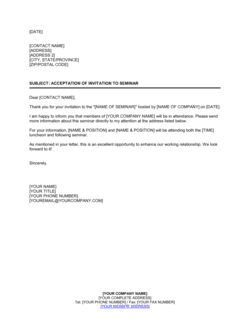
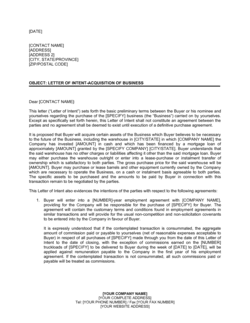
Invitation to Demo New Product Line Template

Free Word download • Edit online • Save & share with Drive • Export to PDF

1 page20–30 min to fillDifficulty: StandardSignature requiredLegal review recommended
Learn more ↓
FreeInvitation to Demo New Product Line Template

At a glance

What it is
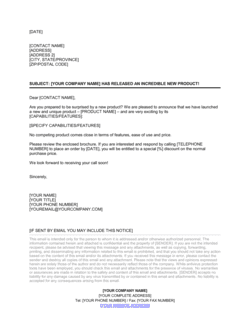
An Invitation to Demo New Product Line is a formal written communication a company sends to a prospective buyer, distributor, or strategic partner to schedule a structured demonstration of a new product line. It sets the agenda, confirms participation, establishes confidentiality expectations for any proprietary information disclosed during the demo, and creates a documented record of the engagement. This free Word download gives you a professionally structured template you can edit online and export as PDF.
When you need it
Use it when launching a new product line and inviting key accounts, distributors, or procurement contacts to attend a live or virtual demonstration before a formal sales proposal is made. It is also appropriate when the demo will involve disclosure of unreleased features, pricing structures, or trade secrets that require confidentiality protection before an NDA is executed.
What's inside
Identification of both parties, the demo scope and format, a proposed schedule, confidentiality obligations for information shared during the session, RSVP and acceptance terms, liability limitations for the demonstration itself, and a follow-up action framework.

What is an Invitation to Demo New Product Line?

An Invitation to Demo New Product Line is a formal document a company issues to a prospective buyer, distributor, or strategic partner to schedule a structured demonstration of a new product line. It functions simultaneously as a scheduling instrument and a light legal framework — defining the scope of what will be shown, confirming the invitee's attendance, establishing confidentiality obligations for any proprietary information disclosed during the session, and creating a documented record of the engagement before the first product specification or pricing detail changes hands. Unlike an informal email, a signed invitation creates enforceable obligations on both sides and protects the presenting company's trade secrets and commercial information from the moment the demo begins.

Why You Need This Document

Conducting a product demonstration without a signed invitation document is a common and costly oversight. Sales teams routinely share unreleased pricing, product roadmaps, and proprietary specifications with prospects who have made no written commitment to treat that information confidentially — leaving the presenting company with no documented basis to pursue a breach if the invitee shares the information with a competitor. Beyond confidentiality, an undocumented demo creates ambiguity about what was promised: verbal performance claims made by enthusiastic presenters can become actionable misrepresentation if the final product differs. A signed invitation document closes these gaps by establishing a clear scope, a confidentiality obligation that attaches before disclosure, and an explicit no-commitment clause that prevents attendance from being treated as partial contract formation. This template gives you a professionally structured, legally grounded starting point that takes under 30 minutes to complete — protecting months of product development work with a document that scales from a local retail buyer meeting to a cross-border distributor preview.

Which variant fits your situation?

If your situation is…Use this template
Inviting a retail buyer to a showroom product previewInvitation To Demo New Product Line
Requesting a confidential briefing before the demo requires a standalone NDANon-Disclosure Agreement
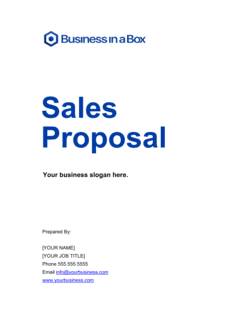
Following up the demo with a formal sales offerSales Proposal
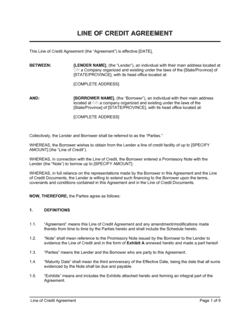
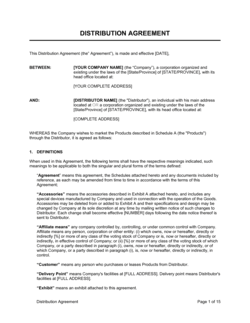
Formalizing a distribution arrangement after the demoDistribution Agreement
Confirming a product purchase after a successful demoPurchase Agreement
Inviting a partner to evaluate a software product specificallySoftware Evaluation Agreement
Scheduling a trade show product presentation with multiple attendeesEvent Participation Agreement

Common mistakes to avoid

❌ Sharing proprietary information before the invitation is signed

Why it matters: Sending pricing sheets, product specs, or roadmap decks with the invitation email — rather than after execution — means confidentiality obligations attach after the disclosure, not before, leaving early disclosures unprotected.

Fix: Send only non-confidential teaser content with the unsigned invitation. Deliver detailed materials only after the invitee has signed and returned the document.

❌ Omitting the no-commitment clause

Why it matters: Without explicit language, conduct following the demo — requesting samples, discussing terms, or exchanging follow-up emails — can be interpreted as the start of a binding commercial arrangement in some jurisdictions.

Fix: Include a clear no-commitment clause and reference it again in any post-demo follow-up communications until a formal agreement is executed.

❌ Using an informal email instead of a signed document

Why it matters: An email invitation creates no enforceable confidentiality obligation and no documented record of the scope of information shared, making it nearly impossible to prove a breach if the invitee misuses disclosed information.

Fix: Always use a signed invitation document — even a simple eSignature exchange — before conducting any demonstration that involves non-public product information.

❌ No RSVP deadline or defined acceptance mechanism

Why it matters: Without a deadline, sales teams cannot finalize preparation, and invitees who tentatively agreed verbally may appear without a signed document in place, stripping the session of confidentiality protection.

Fix: Set a firm RSVP deadline at least five business days before the demo and treat non-responses as a decline, rescheduling if needed.

❌ Verbal performance guarantees during the demo without a prior disclaimer

Why it matters: Sales representatives who demonstrate prototype features and verbally promise delivery timelines or performance benchmarks may create actionable misrepresentation or warranty claims if the final product differs.

Fix: Brief all demo presenters on the disclaimer clause before the session and ensure they use qualified language — 'targeted for' or 'expected to' rather than 'will' or 'guaranteed to.'

❌ Signing authority not verified before execution

Why it matters: If the invitee's signatory lacks actual or apparent authority to bind their organization, the confidentiality obligations and follow-up commitments in the document may be unenforceable.

Fix: Request confirmation of the signatory's title and authority before sending the signature-ready document. For larger organizations, ask whether a procurement or legal team approval is required.

The 10 key clauses, explained

Parties and Identification

In plain language: Identifies the company extending the invitation and the company or individual being invited, including legal names, addresses, and authorized contact persons.

Sample language
This Invitation to Demo is issued by [INVITING COMPANY LEGAL NAME], a [STATE/PROVINCE] [ENTITY TYPE] ('Presenter'), to [INVITEE COMPANY LEGAL NAME] ('Invitee'), represented by [AUTHORIZED CONTACT NAME], [TITLE].

Common mistake: Using a trade name instead of the registered legal entity name — if a dispute arises over confidential information shared during the demo, enforcing obligations against the wrong entity creates significant procedural obstacles.

Product Line Description and Demo Scope

In plain language: Describes the specific product line being demonstrated and sets clear boundaries on what is included — and explicitly excluded — from the session.

Sample language
The demonstration will cover [PRODUCT LINE NAME], including [LIST OF SPECIFIC PRODUCTS / SKUs / FEATURES]. The following items are expressly excluded from this demonstration: [EXCLUSIONS]. No representations are made regarding products or features outside this defined scope.

Common mistake: Leaving scope undefined so the invitee expects to see the full catalog when only select SKUs are being shown — mismatched expectations damage the relationship before a sale begins.

Date, Time, Format, and Location

In plain language: States the proposed date, start and end times, the format (in-person, virtual, or hybrid), and the specific location or platform link.

Sample language
The demonstration is scheduled for [DATE] from [START TIME] to [END TIME] [TIMEZONE] at [LOCATION / PLATFORM URL]. Presenter will provide access credentials or venue directions no later than [X] business days prior.

Common mistake: Omitting the time zone on virtual demos — attendees in different regions routinely show up an hour late or early, wasting preparation time and damaging first impressions.

Confidentiality of Information Disclosed

In plain language: Obligates the invitee to treat all non-public information seen, heard, or received during the demonstration as confidential and to use it solely to evaluate the product line.

Sample language
Invitee agrees that all information disclosed during the demonstration, including product specifications, pricing, roadmaps, and business terms ('Confidential Information'), shall be held in strict confidence and used solely to evaluate a potential commercial relationship. Invitee shall not disclose Confidential Information to any third party without Presenter's prior written consent.

Common mistake: Relying on a later NDA to cover demo disclosures — by the time a standalone NDA is signed, the information has already been shared without protection.

RSVP and Acceptance Terms

In plain language: Requires the invitee to confirm attendance by a specified deadline and specifies the method of acceptance — email, signed return, or online form.

Sample language
To confirm attendance, Invitee must provide written acceptance to [CONTACT NAME] at [EMAIL] no later than [RSVP DEADLINE DATE]. Failure to respond by this date will be treated as a decline and Presenter reserves the right to reschedule or withdraw the invitation.

Common mistake: Not including an RSVP deadline — without one, sales teams cannot finalize attendee lists, prepare demo quantities, or allocate presenter time, leading to last-minute scrambles.

Demonstration Disclaimer and No Warranty

In plain language: Limits the presenter's liability for prototype functionality, pre-release features, or performance claims made during the demonstration, and confirms that the demo is not a binding representation of final product capabilities.

Sample language
The demonstration may include pre-release products, prototype features, or projected specifications. All such elements are provided 'as is' for evaluation purposes only. Presenter makes no warranty, express or implied, regarding product performance, availability, or final pricing shown during the demonstration.

Common mistake: Allowing sales representatives to make verbal performance guarantees during the demo without disclaiming them — those statements can become enforceable representations under contract law in several jurisdictions.

No-Commitment and No-Obligation Clause

In plain language: Confirms that attending the demonstration does not create any obligation on either party to enter into a purchase, licensing, distribution, or partnership agreement.

Sample language
This invitation and Invitee's attendance at the demonstration do not create any obligation on the part of either party to enter into any commercial agreement. No binding commitment shall arise unless and until a separate written agreement is executed by both parties.

Common mistake: Omitting this clause and relying on an informal understanding — without explicit language, conduct during and after the demo (follow-up emails, sample requests) can be interpreted as partial contract formation.

Follow-Up Action Framework

In plain language: Sets out what each party agrees to do after the demonstration — for example, the presenter commits to sending a written proposal within a defined period and the invitee commits to responding with feedback.

Sample language
Within [X] business days following the demonstration, Presenter shall provide Invitee with a written product catalog and pricing sheet. Invitee agrees to provide written feedback or a letter of intent within [Y] business days of receiving such materials.

Common mistake: No follow-up timeline at all — demos that end without defined next steps lose momentum, and prospects who intended to move forward stall indefinitely.

Governing Law and Dispute Resolution

In plain language: Specifies which jurisdiction's law governs the invitation and its obligations, and how any dispute arising from a breach — particularly of the confidentiality clause — will be resolved.

Sample language
This Invitation shall be governed by and construed in accordance with the laws of [STATE / PROVINCE / COUNTRY], without regard to conflict-of-law principles. Any dispute shall be resolved by [binding arbitration / litigation] in [CITY], and the prevailing party shall be entitled to recover reasonable attorneys' fees.

Common mistake: Choosing a governing law with no connection to where either party operates — courts in the designated jurisdiction may decline to hear the case or apply local law regardless.

Signature and Authorization Block

In plain language: Provides signature lines for authorized representatives of both parties, confirming that they have read, understood, and agreed to the terms of the invitation.

Sample language
By signing below, each party confirms that its authorized representative has read this Invitation, has authority to bind the respective organization, and agrees to its terms. [INVITING COMPANY NAME]: _________________________ Name: [NAME] Title: [TITLE] Date: [DATE]. [INVITEE COMPANY NAME]: _________________________ Name: [NAME] Title: [TITLE] Date: [DATE].

Common mistake: Having an employee without signing authority execute the document — obligations may be unenforceable if the signatory lacked actual or apparent authority to bind the organization.

How to fill it out

  1. 1

    Identify both parties with their legal entity names

    Enter the full registered names of the presenting company and the invitee organization, along with the authorized contact persons and their titles. Confirm legal entity names against business registry records.

    💡 Ask the invitee for their legal entity name before drafting — many companies operate under a trade name that differs from their registered corporate name.

  2. 2

    Define the product line scope precisely

    List the specific product models, SKUs, or feature sets that will be demonstrated. Explicitly exclude anything that will not be shown to avoid mismatched expectations.

    💡 If you are showing a pre-release product, note its development stage (e.g., 'beta' or 'prototype') in the scope section so the disclaimer clause applies clearly.

  3. 3

    Set the date, time zone, format, and location

    Enter the confirmed date and start-to-end time with an explicit time zone. For virtual demos, paste the meeting platform URL. For in-person events, include the full venue address and any entry instructions.

    💡 Block 15–30 minutes of buffer after the stated end time so a running demo does not cut off a productive Q&A session.

  4. 4

    Tailor the confidentiality clause to what you will disclose

    Review the list of information you plan to share during the demo — pricing, roadmap, unreleased specifications — and ensure each category is covered in the confidentiality clause. Add or remove categories to match the actual scope of disclosure.

    💡 If the demo involves particularly sensitive trade secrets, consider requiring the invitee to execute a standalone NDA before the session in addition to the confidentiality clause in this document.

  5. 5

    Set the RSVP deadline and confirmation method

    Choose a deadline at least five business days before the demo to allow preparation time. Specify whether acceptance must come by email, signed return, or an online portal.

    💡 Send a calendar invitation alongside the signed document — a formal invitation without a calendar entry is frequently forgotten.

  6. 6

    Complete the follow-up action framework with specific timelines

    Enter the number of business days within which the presenter will send post-demo materials (catalog, pricing sheet, or proposal) and the period within which the invitee will respond.

    💡 A 5-business-day proposal turnaround and a 10-business-day invitee response window is a practical starting point for most B2B product demos.

  7. 7

    Select the governing law and dispute resolution method

    Choose the jurisdiction where the presenting company is headquartered as the governing law. Decide between arbitration (faster and private) and litigation (court-based) for dispute resolution.

    💡 For international invitees, consider including a clause that expressly excludes the UN Convention on Contracts for the International Sale of Goods (CISG) to avoid unintended application.

  8. 8

    Obtain signatures before the demo date

    Send the document to the invitee's authorized representative for signature at least three to five business days before the scheduled demo. Confirm that the signatory has actual authority to bind their organization.

    💡 Use an eSignature tool so both parties receive a timestamped, fully executed copy automatically — a missing original copy is one of the most common enforcement problems.

Frequently asked questions

What is an Invitation to Demo New Product Line?

An Invitation to Demo New Product Line is a formal document a company sends to a prospective buyer, distributor, or partner to schedule a structured demonstration of a new product line. It confirms participation, defines what will and will not be shown, establishes confidentiality obligations for non-public information disclosed during the session, and creates a documented record of the engagement. Unlike a casual email invite, a signed document creates enforceable obligations on both sides before any proprietary information changes hands.

Is an Invitation to Demo a legally binding document?

Yes — a signed Invitation to Demo is generally enforceable with respect to the obligations it creates, particularly the confidentiality clause and RSVP acceptance. However, it expressly does not create a binding obligation to purchase, distribute, or enter into any other commercial arrangement. The document is designed to govern the demonstration event itself, not the downstream commercial relationship. As with any legal document, enforceability depends on proper execution by authorized representatives in the applicable jurisdiction.

Do I need a separate NDA if the invitation has a confidentiality clause?

For many standard product demonstrations, the confidentiality clause within the invitation is sufficient to protect information disclosed during the session. However, if the demo will involve disclosure of highly sensitive trade secrets, unpublished patents, proprietary formulations, or material non-public financial information, consider requiring the invitee to execute a standalone NDA before the session. A standalone NDA typically provides broader protection, longer duration, and more detailed remedy provisions than a clause embedded in an invitation.

What should I include in the product line description section?

List the specific product models, SKUs, feature sets, or service tiers that will be demonstrated — and explicitly state what is excluded. If the demo covers pre-release or prototype items, note their development stage (beta, prototype, or limited release) so the disclaimer clause applies clearly. A precise scope definition prevents invitee expectations from exceeding what the demo can deliver, which protects the commercial relationship and limits misrepresentation exposure.

Can this document be used for virtual product demos?

Yes. The template accommodates in-person, virtual, and hybrid formats. For virtual demos, insert the meeting platform URL and access credentials in the date and location clause. Include the time zone explicitly, as virtual attendees in different regions frequently misinterpret times when no zone is specified. All other provisions — confidentiality, no-commitment, follow-up obligations, and governing law — apply equally regardless of the demo format.

What happens if the invitee does not respond by the RSVP deadline?

The RSVP clause should state that non-response by the deadline is treated as a decline, freeing the presenter to reschedule or withdraw the invitation. This matters practically because demo preparation — arranging samples, allocating presenter time, and preparing materials — cannot be finalized without confirmed attendance. From a legal standpoint, an unsigned invitation creates no confidentiality obligation, so a non-responding invitee who attends anyway would not be bound by the document's terms.

How does this document protect against misuse of information shown during the demo?

The confidentiality clause obligates the invitee to use disclosed information solely to evaluate a potential commercial relationship and prohibits disclosure to third parties without prior written consent. This creates a documented basis to seek injunctive relief or damages if the invitee shares pricing, product specifications, or roadmap information with a competitor. The clause is most effective when the document is signed before the demo begins and when the presenter can document exactly what was disclosed during the session.

Should the invitation include a follow-up timeline?

Yes — a follow-up action framework with defined timelines significantly improves conversion rates and prevents deals from stalling after the demo. A typical framework commits the presenter to sending a written proposal or pricing sheet within five business days and asks the invitee to respond with feedback or a letter of intent within ten business days. Without a defined next step, many procurement teams deprioritize follow-up and momentum is lost within two weeks of the event.

Which jurisdiction's law should govern this document?

In most cases, choose the jurisdiction where the presenting company is headquartered, as that is typically where any enforcement action would be initiated. For cross-border demos involving parties in different countries, consider adding a clause expressly excluding the CISG and specifying that disputes will be resolved by arbitration in a neutral jurisdiction. The key is to choose a governing law with a genuine connection to at least one of the parties — courts may disregard a governing law clause that has no meaningful link to the transaction or the parties.

Does the invitee's attendance automatically create a sales contract?

No — the no-commitment clause expressly confirms that attendance does not create any obligation on either party to enter into a purchase, licensing, distribution, or partnership agreement. A separate written agreement, signed by authorized representatives of both parties, is required before any binding commercial commitment exists. This protection is critical because verbal statements made during or after a demo can otherwise be treated as binding offers or representations under general contract principles in several jurisdictions.

How this compares to alternatives

vs Non-Disclosure Agreement

An NDA is a standalone confidentiality contract covering all information exchanged across an entire relationship or project. An Invitation to Demo is scoped to a single demonstration event and combines scheduling, scope, RSVP, and confidentiality in one document. For a routine product demo, the invitation's confidentiality clause is generally sufficient. For an ongoing relationship involving repeated sensitive disclosures, a standalone NDA provides broader and more durable protection.

vs Sales Proposal

A Sales Proposal is the commercial document sent after a demo to present pricing, terms, and a purchase recommendation. The invitation comes first — it sets the context and establishes confidentiality — while the proposal formalizes the offer. The two documents work in sequence: invitation governs the demo, proposal governs the commercial conversation that follows.

vs Distribution Agreement

A Distribution Agreement is a binding commercial contract that governs a long-term supply and distribution relationship including territory, pricing, minimums, and IP licensing. An Invitation to Demo is a pre-commercial document with no purchase or distribution obligations. The demo invitation typically precedes and facilitates the negotiation of a distribution agreement.

vs Letter of Intent

A Letter of Intent expresses a party's serious intention to enter into a commercial transaction and may create some binding obligations around exclusivity or confidentiality during negotiations. An Invitation to Demo is explicitly non-binding with respect to commercial outcomes — its purpose is to govern the demo event itself, not to signal commitment to a deal. If a demo leads to serious negotiation, a letter of intent is the appropriate next document.

Industry-specific considerations

Manufacturing and Wholesale

Retail buyer previews of new seasonal lines where pricing and exclusivity terms shared during the demo must remain confidential until the formal catalog release.

Technology / SaaS

Pre-release software or hardware demos for enterprise prospects where unreleased feature sets and roadmap details are disclosed under confidentiality before a paid pilot is proposed.

Consumer Goods / Retail

Trade show and showroom product previews where multiple buyer contacts attend and scope must be tightly defined to prevent competitors from learning about unannounced product lines.

Healthcare / MedTech

Demonstrations of medical devices or diagnostics to hospital procurement teams where regulatory status, clinical data, and pricing are sensitive and the disclaimer clause is particularly important.

Professional Services

Showcasing new service methodologies or proprietary frameworks to prospective clients where the follow-up action framework drives the transition from demo to formal engagement proposal.

Food and Beverage

New product line tastings and presentations to distributor and grocery chain buyers where formulas, pricing tiers, and launch timing are disclosed under confidentiality before a distribution agreement is signed.

Jurisdictional notes

United States

Trade secret protection during product demos is governed by the Defend Trade Secrets Act (DTSA) at the federal level and by individual state statutes — most follow the Uniform Trade Secrets Act. The confidentiality clause in this document supports a DTSA misappropriation claim, but the information shared must qualify as a trade secret and the presenter must have taken reasonable steps to protect it. Non-compete and non-solicitation obligations triggered by the demo itself are unlikely to be enforceable without a separate employment or commercial agreement.

Canada

Canadian courts enforce confidentiality obligations in pre-contractual documents where the parties clearly intended to be bound. Quebec's civil law system may interpret the scope of confidentiality clauses differently from the common-law provinces — consider adding bilingual provisions for invitees headquartered in Quebec. Canada's Anti-Spam Legislation (CASL) does not typically affect a signed invitation, but follow-up commercial electronic messages triggered by the demo may require CASL-compliant consent.

United Kingdom

UK courts recognize and enforce pre-contractual confidentiality obligations, particularly where a document is signed by both parties. The Misrepresentation Act 1967 is relevant if verbal claims made during the demo later prove inaccurate — the disclaimer clause in this template helps limit exposure under that Act. Post-Brexit, UK data protection law (UK GDPR) applies if personal data is processed during the demo event, including attendee details shared between parties.

European Union

The EU Trade Secrets Directive (2016/943) harmonizes trade secret protection across member states and supports enforcement of confidentiality obligations like those in this document. GDPR applies to any personal data exchanged during the demo — attendee names, contact details, and company affiliations should be processed in accordance with each party's privacy policy. In jurisdictions such as Germany and France, pre-contractual duties of good faith (culpa in contrahendo) may impose additional disclosure obligations on the presenter beyond those stated in the document.

Template vs lawyer — what fits your deal?

PathBest forCostTime
Use the templateStandard product demos to buyers, distributors, or retail accounts where the information disclosed is commercially sensitive but not highly proprietaryFree15–30 minutes
Template + legal reviewDemos involving trade secrets, patent-pending technology, unreleased software, or cross-border invitees in regulated industries$200–$5001–2 days
Custom draftedHigh-value enterprise demos involving material non-public information, complex multi-party attendance, or jurisdictions with strict trade secret or data protection laws$800–$2,500+3–7 days

Glossary

Demo Scope
The defined boundaries of what will and will not be demonstrated during the session, including specific product models, features, or pricing tiers.
Confidential Information
Non-public information disclosed during or in connection with the demonstration, including product specifications, pricing, roadmaps, and trade secrets.
RSVP Clause
A provision requiring the invited party to confirm attendance by a specified date, creating a documented record of acceptance.
Demonstration Disclaimer
A statement limiting the presenter's liability for prototype features, pre-release functionality, or performance representations made during the demo.
Follow-Up Obligation
A clause defining what actions either party agrees to take after the demonstration — such as providing a written proposal or responding with feedback within a set timeframe.
No-Commitment Clause
A provision confirming that attending the demonstration does not obligate either party to enter into a purchase, distribution, or partnership agreement.
Authorized Representative
The named individual from each party who has authority to accept the invitation terms, attend the demo, and receive confidential information on behalf of their organization.
Demo Format
The method by which the demonstration will be conducted — in-person at a showroom or facility, virtual via video conference, or hybrid — as specified in the invitation.
Residual Rights
The right of a party to use general knowledge and skills retained in the unaided memory of attendees, even if that knowledge was acquired from confidential information shared during the demo.
Governing Law
The jurisdiction whose laws will be used to interpret and enforce the invitation and any obligations it creates, typically the seller's home state, province, or country.

Part of your Business Operating System

This document is one of 3,000+ business & legal templates included in Business in a Box.

  • Fill-in-the-blanks — ready in minutes
  • 100% customizable Word document
  • Compatible with all office suites
  • Export to PDF and share electronically

Create your document in 3 simple steps.

From template to signed document — all inside one Business Operating System.
1
Download or open template

Access over 3,000+ business and legal templates for any business task, project or initiative.

2
Edit and fill in the blanks with AI

Customize your ready-made business document template and save it in the cloud.

3
Save, Share, Send, Sign

Share your files and folders with your team. Create a space of seamless collaboration.

Save time, save money, and create top-quality documents.

★★★★★

"Fantastic value! I'm not sure how I'd do without it. It's worth its weight in gold and paid back for itself many times."

Managing Director · Mall Farm
Robert Whalley
Managing Director, Mall Farm Proprietary Limited
★★★★★

"I have been using Business in a Box for years. It has been the most useful source of templates I have encountered. I recommend it to anyone."

Business Owner · 4+ years
Dr Michael John Freestone
Business Owner
★★★★★

"It has been a life saver so many times I have lost count. Business in a Box has saved me so much time and as you know, time is money."

Owner · Upstate Web
David G. Moore Jr.
Owner, Upstate Web

Run your business with a system — not scattered tools

Stop downloading documents. Start operating with clarity. Business in a Box gives you the Business Operating System used by over 250,000 companies worldwide to structure, run, and grow their business.

Start free · No credit card required