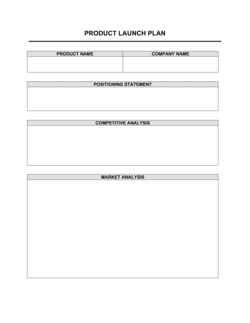
New Product Development Process Explained

Free Word download • Edit online • Save & share with Drive • Export to PDF

3 pages25–30 min to fillDifficulty: StandardSignature requiredLegal review recommended
Learn more ↓
FreeNew Product Development Process Explained Template

At a glance

What it is
The New Product Development Process Explained is a structured governing document that defines the binding obligations, stage-gate approvals, intellectual property ownership, confidentiality requirements, and decision rights for every phase of bringing a new product from concept to commercial launch. This free Word download gives product teams, development partners, and stakeholders a legally enforceable framework that can be edited online and exported as PDF for execution and filing.
When you need it
Use it when engaging co-development partners, contract manufacturers, design firms, or internal cross-functional teams on a new product initiative where IP ownership, milestone accountability, and launch authority must be clearly defined before work begins.
What's inside
Stage-gate definitions and approval rights, IP assignment and joint ownership provisions, confidentiality obligations, development milestones and deliverables, quality and compliance requirements, termination and wind-down procedures, and governing law clauses covering all phases from ideation through commercial release.

What is a New Product Development Process Document?

A New Product Development Process document is a legally binding agreement that governs every material obligation in bringing a new product from initial concept to commercial release. It defines the stage-gate structure through which development must pass, assigns ownership of all intellectual property created during the engagement, establishes confidentiality obligations for technical and commercial information shared between parties, and sets the milestone-based payment schedule that ties fees to measurable deliverables. Unlike a project plan or internal roadmap, this document creates enforceable rights and obligations — including IP assignment, acceptance criteria, and termination consequences — that protect both the commissioning company and its development partners throughout the entire product development lifecycle.

Why You Need This Document

Without a formal new product development agreement, the default rules of IP law apply — and those defaults almost never favor the company paying for the development. Contractors and external developers typically own the copyright in work product they create unless a written assignment exists; patent rights vest in the inventor, not the employer, absent a signed clause. A product your company funded and directed can legally belong to the developer who built it. Beyond IP, undefined stage-gate approvals let projects drift indefinitely without a binding mechanism to halt failing work before further costs accumulate. Undefined compliance responsibilities mean a finished product arrives unable to enter its target market. This template closes all four gaps — IP ownership, stage governance, quality accountability, and payment structure — in a single document executed before any development work begins, protecting your investment and preserving your right to commercialize what you paid to create.

Which variant fits your situation?

If your situation is…Use this template
Developing a product with an external engineering or design firmJoint Development Agreement
Engaging a contract manufacturer to produce a finalized designManufacturing Agreement
Protecting confidential product concepts shared with potential partnersNon-Disclosure Agreement
Licensing an existing technology to incorporate into a new productTechnology License Agreement
Documenting only the internal project plan without binding legal termsProduct Launch Plan
Managing a product development project with formal deliverables and payment milestonesProduct Development Agreement
Commissioning software or digital product development from an external vendorSoftware Development Agreement

Common mistakes to avoid

❌ Starting development before the agreement is signed

Why it matters: Work product created before a written IP assignment exists may remain legally owned by the developer under default copyright and patent law, regardless of what a later-signed contract says.

Fix: Execute the full agreement — including all schedules — before any technical work begins or any confidential information changes hands.

❌ Leaving stage-gate approval authority undefined

Why it matters: When no individual or role is named as the approving authority, stage approvals stall indefinitely as each party defers to the other, causing cascading timeline and payment disputes.

Fix: Name a specific title — 'VP Product' or 'Program Director' — as the Company's approval authority in Schedule B, and set a response deadline with a deemed-approval default if no response is given.

❌ No Background IP schedule

Why it matters: Without a documented list of each party's pre-existing IP, a developer can claim that foundational technology is Background IP after delivery and demand a royalty license to commercialize the finished product.

Fix: Complete Schedule A with a specific, itemized list of each party's Background IP before signing — descriptions like 'all pre-existing IP' are legally insufficient.

❌ Tying 100% of payment to final acceptance

Why it matters: Developers with no interim payments face severe cash-flow pressure, and the Company loses all leverage to enforce milestone quality because the developer is not financially invested in intermediate deliverables.

Fix: Structure payments across at least four milestones — execution, prototype completion, testing sign-off, and final acceptance — with 10–15% held at final acceptance as a quality retention.

❌ Omitting a kill fee for convenience termination

Why it matters: A developer who can be terminated at any time without compensation beyond work completed has no incentive to invest in tooling, team capacity, or long-lead procurement — reducing the quality and reliability of the development program.

Fix: Set a kill fee of 10–25% of remaining fees for convenience termination, payable within 30 days of the termination notice, and pair it with a clean IP handover obligation.

❌ Generic compliance language without named standards or responsible party

Why it matters: A clause requiring the product to 'meet all applicable laws and regulations' without naming specific standards or assigning responsibility for certification leads directly to a blame dispute when a product fails regulatory review at launch.

Fix: List every applicable standard, certification, and target market in Schedules D and E, and assign certification responsibility by party and by development stage.

The 10 key clauses, explained

Parties, Recitals, and Definitions

In plain language: Identifies the developer, the commissioning company, and any sub-contractors, and defines the key terms used throughout the agreement — including what constitutes Background IP, Foreground IP, Confidential Information, and a Milestone Deliverable.

Sample language
This New Product Development Agreement is entered into as of [DATE] between [COMPANY LEGAL NAME], a [STATE/COUNTRY] [ENTITY TYPE] ('Company'), and [DEVELOPER LEGAL NAME], a [STATE/COUNTRY] [ENTITY TYPE] ('Developer'). Capitalized terms have the meanings set out in Schedule A (Definitions).

Common mistake: Using informal names or trade names instead of registered legal entity names — if the Developer entity differs from the signing individual, IP assignment clauses may be unenforceable.

Development Scope and Stage-Gate Structure

In plain language: Defines the full product development scope, breaks it into numbered stages (ideation, feasibility, design, prototype, testing, pre-production, launch), and specifies the deliverables and acceptance criteria required to exit each stage.

Sample language
The project shall proceed through the following Stages as set out in Schedule B: Stage 1 — Concept Definition; Stage 2 — Feasibility Assessment; Stage 3 — Prototype Development; Stage 4 — Validation and Testing; Stage 5 — Pre-Production and Launch. The Company shall issue written Stage Approval within [10] business days of receiving a compliant Stage Deliverable.

Common mistake: Defining stages without specifying who has authority to approve progression — ambiguous approval rights cause stages to stall indefinitely while both parties wait for a sign-off that was never formally assigned.

Intellectual Property Ownership

In plain language: Specifies who owns Foreground IP created during the project, addresses joint inventions, confirms that Background IP remains with its original owner, and grants the necessary licenses for each party to perform their obligations.

Sample language
All Foreground IP created by Developer solely or jointly in the performance of this Agreement is hereby irrevocably assigned to Company upon creation. Developer retains ownership of Background IP and grants Company a non-exclusive, royalty-free license to use Background IP solely to the extent necessary to commercialize the Product.

Common mistake: Failing to define Background IP specifically — without a clear list or description, a developer can later claim that key enabling technology is Background IP and demand a royalty to commercialize the finished product.

Confidentiality and Non-Disclosure

In plain language: Obligates both parties to protect each other's confidential information — technical specifications, business plans, customer data, and cost structures — during and for a defined period after the development engagement.

Sample language
Each party shall hold the other's Confidential Information in strict confidence and shall not disclose it to any third party without prior written consent. This obligation survives termination of this Agreement for a period of [5] years. Permitted disclosures are limited to employees and contractors with a need to know who are bound by equivalent obligations.

Common mistake: Setting a confidentiality term shorter than the product's commercial life cycle — a 1-year post-termination obligation does nothing to protect trade secrets that remain competitively sensitive for 5–10 years after launch.

Milestones, Timeline, and Change Orders

In plain language: Sets out the project schedule with specific dates for each milestone deliverable, defines the process for requesting and approving timeline or scope changes, and states consequences — typically a day-rate adjustment — for delays caused by either party.

Sample language
Developer shall deliver each Milestone Deliverable by the dates set out in Schedule C. If either party requires a change to Scope, Timeline, or Budget, they shall submit a written Change Order request. No out-of-scope work shall commence until both parties have signed the Change Order. Delays caused solely by Company shall extend the applicable milestone date by an equivalent number of days.

Common mistake: Omitting a change-order mechanism entirely — without it, verbal scope expansions go undocumented, the timeline slips, and disputes arise over what was actually agreed and whether additional fees are owed.

Fees, Payment Schedule, and Expenses

In plain language: Specifies the total development fee, the milestone-based payment schedule, the invoicing process, and which party bears specific development expenses such as tooling, testing fees, regulatory submissions, and materials.

Sample language
Company shall pay Developer a total development fee of $[AMOUNT] payable as follows: [X]% on execution; [X]% on Stage 2 approval; [X]% on Stage 4 completion; [X]% on final acceptance. Developer shall invoice upon achieving each milestone. Company shall reimburse pre-approved expenses within [30] days of submission with receipts.

Common mistake: Tying all payment to final acceptance with no interim milestones — this creates cash-flow pressure on the developer and incentivizes cutting corners to reach the final payment trigger quickly.

Quality, Compliance, and Regulatory Requirements

In plain language: Establishes the product quality standards the developer must meet, specifies applicable regulatory or certification requirements (e.g., FDA, CE mark, UL listing), and allocates responsibility for testing, certification costs, and compliance documentation.

Sample language
The Product shall meet the specifications set out in Schedule D and shall comply with all applicable regulatory requirements in the target markets listed in Schedule E, including [FDA 510(k) / CE Marking / UL Certification]. Developer shall maintain quality records for a minimum of [7] years and make them available to Company upon request.

Common mistake: Listing target markets without specifying which party is responsible for obtaining regulatory approval — this omission regularly results in a finished, certified-for-one-market product that cannot legally be sold in the intended primary market.

Representations and Warranties

In plain language: Both parties warrant that they have authority to enter the agreement, that the developer's work will not infringe third-party IP rights, and that deliverables will conform to the agreed specifications for a defined warranty period after acceptance.

Sample language
Developer warrants that: (a) it has full authority to enter this Agreement; (b) the Deliverables will not infringe any third-party IP rights; (c) Deliverables will conform to the Specifications for a period of [12] months following final acceptance ('Warranty Period'). Company warrants that it has authority to enter this Agreement and that Background IP provided to Developer does not infringe third-party rights.

Common mistake: No warranty period on deliverables — without one, defects discovered after final acceptance become a dispute rather than a contractual obligation, and the developer has no legal duty to fix them.

Termination, Wind-Down, and IP Reversion

In plain language: States the conditions under which either party may terminate — for cause (material breach, insolvency) or for convenience — the notice required, what happens to work in progress, and whether IP partially developed reverts to the Company or stays with the Developer until wind-down payments are made.

Sample language
Either party may terminate for cause upon [30] days' written notice if the other party commits a material breach and fails to cure within [15] days. Company may terminate for convenience upon [30] days' notice, in which case Developer shall be paid for all work completed plus a kill fee of [X]% of remaining fees. Upon any termination, Developer shall transfer all Foreground IP, work-in-progress, design files, and tooling to Company within [10] business days.

Common mistake: No kill fee for convenience termination — developers who have invested heavily in a project and face sudden termination without a kill fee have little incentive to deliver a clean handover or cooperate on IP transfer.

Governing Law, Dispute Resolution, and Limitations of Liability

In plain language: Specifies which jurisdiction's law governs the agreement, how disputes are handled (arbitration, mediation, or court), the seat and rules for arbitration, and caps each party's liability to the fees paid under the agreement.

Sample language
This Agreement is governed by the laws of [STATE/PROVINCE/COUNTRY]. Any dispute not resolved by good-faith negotiation within [30] days shall be submitted to binding arbitration administered by [AAA/JAMS/ICC] in [CITY]. Each party's total liability under this Agreement shall not exceed the total fees paid or payable in the [12] months preceding the claim.

Common mistake: Choosing a governing law with no connection to where either party operates or where the product will be commercialized — courts in some jurisdictions will disregard a disconnected governing-law clause and apply local law instead.

How to fill it out

  1. 1

    Identify and enter all party legal names and roles

    Enter the full registered legal names of the Company and the Developer — and any sub-contractors if applicable — in the Parties section. Include entity type, state or country of formation, and registered address.

    💡 Request a certificate of good standing or company registry printout for external partners before execution — an inactive or incorrectly named entity makes the IP assignment unenforceable.

  2. 2

    Define the development scope and stage structure in Schedule B

    List every stage by number and name, write a one-paragraph description of the activities in each stage, and specify the deliverable or approval event that closes each stage. Attach any technical specifications as a sub-schedule.

    💡 Keep stage descriptions outcome-focused — 'deliver a validated prototype passing Schedule D acceptance tests' rather than 'complete engineering work' — so approval decisions are objective.

  3. 3

    Allocate IP ownership for Background and Foreground IP

    List each party's Background IP in Schedule A with enough specificity that a court could distinguish it from Foreground IP. Confirm that all Foreground IP assigns to the Company and that the Background IP license is scoped to commercialization of the specific product only.

    💡 If the Developer is contributing significant pre-existing technology, negotiate a written list of Background IP before signing — disputes over this boundary are the leading cause of NPD litigation.

  4. 4

    Build the milestone and payment schedule in Schedule C

    Assign a specific calendar date and payment amount to each milestone. Express payment amounts as a percentage of total fee and as a dollar figure. Include the invoicing trigger and payment-due period for each milestone.

    💡 Tie at least 10–15% of total fees to final acceptance rather than pre-production completion — this preserves leverage to get the developer to address punch-list defects before full payment.

  5. 5

    Specify quality standards and regulatory requirements in Schedule D and E

    List every applicable standard (ISO, FDA, CE, UL, RoHS) and every target market. For each market, name the party responsible for obtaining certification and by which development stage it must be achieved.

    💡 For products requiring FDA clearance or CE marking, engage the regulatory consultant before finalizing Schedule D — specifications that don't align with the regulatory submission will require a change order that costs time and money.

  6. 6

    Set termination, kill-fee, and IP handover terms

    Define the notice periods for both for-cause and for-convenience termination. Set the kill fee as a percentage of remaining fees. List every category of IP asset and development file the Developer must transfer within 10 business days of termination.

    💡 Include design files, CAD files, tooling specifications, test reports, and regulatory submissions in the IP handover list — generic 'all IP' language routinely misses critical digital assets.

  7. 7

    Confirm governing law and dispute resolution forum

    Select the governing law of the jurisdiction where the Company is incorporated or where the primary development work occurs. Choose an arbitration institution and seat that both parties can reach. Confirm the liability cap equals total fees paid.

    💡 If the Developer is in a different country from the Company, choose a neutral arbitration seat — a seat in one party's home country signals bad faith to the other and can be a deal-breaker.

  8. 8

    Execute before any development work begins

    Both authorized signatories must sign the agreement — including all schedules — before the Developer performs any development work or receives access to the Company's confidential technical information.

    💡 Use a timestamped eSign platform and confirm the signatories' authority with a corporate resolution if the deal value exceeds $100K — a signature by someone without board authority can void the IP assignment.

Frequently asked questions

What is a new product development process document?

A new product development process document is a structured governing agreement that defines the stages, approvals, IP ownership, confidentiality obligations, and payment terms for bringing a new product from concept to commercial launch. It is used when a company engages external partners — design firms, engineers, contract manufacturers — or formalizes internal development governance. Unlike an informal project plan, it creates legally binding obligations enforceable in court or arbitration.

Why do I need a formal NPD agreement instead of a project plan?

A project plan documents what will happen; a development agreement governs what must happen and what the consequences are if it doesn't. Without binding IP assignment, confidentiality, and acceptance criteria, a developer can retain ownership of the product they built, disclose your trade secrets to competitors, or dispute whether a deliverable was ever accepted. For any development engagement involving proprietary technology or significant investment, a formal agreement is essential.

Who owns the IP created during a product development engagement?

Ownership depends entirely on the contract. Without an explicit IP assignment clause, copyright in work product typically belongs to the creator under default law in most jurisdictions — even if the commissioning company paid for it. A properly drafted development agreement assigns all Foreground IP to the commissioning company upon creation and defines the license terms for any Background IP the developer contributes. This is the single most consequential clause in any NPD agreement.

What is a stage-gate process and why does it belong in the contract?

A stage-gate process breaks product development into sequential phases — ideation, feasibility, design, prototype, validation, and launch — with a formal approval checkpoint at the end of each phase. Including stage gates in the contract creates binding checkpoints that prevent the project from advancing before key deliverables are accepted, ties payment to objective milestones, and gives both parties a clear mechanism to stop a failing project before further investment is made.

What is the difference between Background IP and Foreground IP?

Background IP is intellectual property that a party owned before the development engagement began — existing patents, software libraries, manufacturing processes, or trade secrets. Foreground IP is new IP created specifically during the project. The distinction matters because Foreground IP is typically assigned to the commissioning company, while Background IP remains with its original owner and is licensed only for use in the specific product. Failing to document both categories is a leading cause of post-launch IP disputes.

Is a new product development agreement required by law?

No jurisdiction mandates a written product development agreement for private commercial arrangements. However, without a written contract, IP ownership defaults to the creator, payment obligations are governed by vague oral terms, and confidentiality is unenforceable. In practice, any development engagement involving proprietary technology, co-investment, or regulatory requirements should be governed by a written agreement executed before work begins.

What happens to the IP if the development project is terminated early?

Under a well-drafted agreement, all Foreground IP, work-in-progress, design files, and tooling transfer to the Company within a defined period — typically 10 business days — following termination, regardless of whether the project was terminated for cause or for convenience. A kill fee compensates the developer for the convenience termination. Without explicit IP reversion language, a developer can withhold partially completed designs until additional payment is negotiated.

Do I need a lawyer to draft a new product development agreement?

For straightforward domestic engagements with a single developer, a high-quality template is a solid foundation. Engage a lawyer when the development involves significant proprietary technology, co-invention scenarios, regulatory submissions, cross-border arrangements, or a total engagement value above $250K. IP disputes in product development are expensive to litigate — a 2–4 hour legal review at $400–$800 per hour is a modest investment relative to the cost of losing ownership of your product.

How should regulatory compliance be handled in the development agreement?

The agreement should name every applicable standard — FDA, CE, UL, RoHS, or equivalent — in a compliance schedule, assign responsibility for obtaining each certification to a specific party, and set the development stage by which certification must be achieved. Costs for regulatory testing and submissions should be allocated explicitly. Leaving compliance language generic — 'the product shall meet all applicable regulations' — routinely results in disputes over who bears certification costs and who is responsible when a product fails regulatory review at launch.

What should a development milestone payment schedule look like?

A typical structure distributes payments across four to five trigger events: a deposit on execution (15–25%), a payment on prototype delivery (20–25%), a payment on successful validation testing (20–25%), a pre-production approval payment (15–20%), and a final retention on formal product acceptance (10–15%). Holding a retention at final acceptance preserves leverage to ensure the developer addresses punch-list defects before the relationship closes.

How this compares to alternatives

vs Non-Disclosure Agreement

An NDA protects confidential information shared during preliminary discussions but creates no development obligations, IP assignment, or payment terms. It is typically signed before an NPD agreement to cover initial concept sharing. An NPD agreement incorporates confidentiality as one of many clauses and governs the entire development relationship — use an NDA first, then replace or supplement it with a full NPD agreement once development begins.

vs Product Launch Plan

A product launch plan is an internal operational document covering go-to-market strategy, launch timelines, and marketing execution. It has no legal force and creates no binding obligations. An NPD agreement is a legally enforceable contract governing the development phase that precedes launch. Both documents serve different phases of the product lifecycle and are typically used together.

vs Software Development Agreement

A software development agreement governs the creation of digital products — applications, platforms, and APIs — with clauses tailored to source code ownership, version control, testing environments, and SLAs. An NPD agreement covers physical or hardware-software hybrid products where tooling, manufacturing, regulatory certification, and materials create obligations that a software agreement does not address.

vs Manufacturing Agreement

A manufacturing agreement governs the production of a finalized, already-designed product — it addresses volumes, pricing, quality control, and supply terms but does not cover the development process that produces the design. An NPD agreement governs the creation of the product design itself, including IP ownership and stage-gate approvals. The two agreements cover sequential phases and are often both needed for a complete product commercialization program.

Industry-specific considerations

Consumer Electronics

Hardware and firmware IP splits, UL and FCC certification allocation, rapid iteration cycles requiring structured change-order processes to avoid scope creep.

Medical Devices and HealthTech

FDA 510(k) or PMA pathway responsibility, design history file obligations, ISO 13485 quality system requirements, and post-market surveillance provisions.

Manufacturing and Industrial Products

Tooling ownership and cost allocation, production-ready prototype acceptance criteria, supplier qualification requirements, and CE or ATEX certification responsibilities.

SaaS and Software Products

Source code escrow requirements, open-source license compliance obligations, agile sprint-based stage gates, and SLA specifications embedded in acceptance criteria.

Food and Beverage

Recipe and formulation IP ownership, FDA GRAS and labeling compliance, co-manufacturing hygiene and audit rights, and shelf-life validation as a milestone deliverable.

Retail and Consumer Goods

Design patent protection timelines tied to launch dates, private-label confidentiality obligations, and retail packaging specification sign-off embedded in pre-production stage gate.

Jurisdictional notes

United States

Federal patent law governs invention ownership — absent a written assignment, an inventor-employee or contractor retains patent rights. California Labor Code §2870 limits employer claims on inventions developed entirely on the employee's own time without company resources. Work-for-hire doctrine under 17 U.S.C. §101 covers copyright in commissioned works only if the work falls into a statutory category and a written agreement exists. State trade-secret law (most states follow the Uniform Trade Secrets Act) supplements federal Defend Trade Secrets Act protections for confidential development information.

Canada

Canadian patent law vests initial ownership in the inventor, not the employer, unless a written IP assignment exists — making an explicit assignment clause critical for any development engagement. Quebec civil law applies different interpretive rules to contract ambiguity than common-law provinces, so agreements intended to operate in Quebec should be reviewed by a Quebec-qualified lawyer. Federal and provincial privacy laws (PIPEDA and provincial equivalents) may impose obligations on how confidential personal data shared during development is handled and stored.

United Kingdom

Under the Patents Act 1977, inventions made by employees in the normal course of employment belong to the employer — but contractor-created inventions belong to the contractor absent a written assignment. Post-Brexit, UK and EU regulatory certifications (CE mark vs. UKCA mark) are separate and must be allocated explicitly in the compliance schedule. Confidentiality obligations are generally enforceable if reasonable in scope and duration; courts apply a 'springboard' doctrine preventing a developer from using confidential information even after the confidentiality period expires.

European Union

EU member states vary significantly in how employment-related IP ownership is treated — Germany, France, and the Netherlands each have statutory rules that may limit the scope of employer IP assignment even when a written clause exists. GDPR obligations apply to any personal data exchanged during development, including user research, clinical trial data, or customer prototype feedback. CE marking responsibility must be explicitly allocated, as the EU product liability framework places obligations on the legal manufacturer — which may shift depending on how the development agreement defines each party's role.

Template vs lawyer — what fits your deal?

PathBest forCostTime
Use the templateDomestic development engagements with a single partner where total fees are below $100K and IP is straightforwardFree1–3 hours
Template + legal reviewEngagements above $100K, co-invention scenarios, regulated product categories, or cross-state development partners$600–$1,5002–5 days
Custom draftedCross-border development, joint ventures, regulated medical or food products, or total engagement value above $500K$3,000–$10,000+2–4 weeks

Glossary

Stage Gate
A decision checkpoint at the end of each development phase where a defined authority reviews deliverables and approves — or halts — progression to the next stage.
IP Assignment
A contractual clause transferring ownership of inventions, designs, or work product created during the development process to a specified party.
Joint Development Agreement
A contract between two or more parties to collaborate on creating a new product, specifying each party's contributions, costs, and ownership of resulting IP.
Design Freeze
A formal milestone at which the product's specifications are locked and no further design changes are permitted without a documented change-order process.
Work-for-Hire
A legal doctrine under which work product created by an employee or contractor within the scope of engagement is owned by the commissioning party from creation.
Milestone Deliverable
A specific, measurable output — prototype, test report, regulatory filing — that must be completed and accepted before the next development stage begins.
Background IP
Intellectual property owned by a party before the development engagement begins, which is licensed (not assigned) for use in the project.
Foreground IP
New intellectual property created specifically in the course of the development project, whose ownership is governed by the development agreement.
Acceptance Criteria
Pre-defined, measurable standards a deliverable must meet for the receiving party to formally approve it and trigger milestone payments or stage progression.
Change Order
A written amendment to the agreed development scope, timeline, or budget that both parties must sign before any out-of-scope work begins.
Termination for Convenience
A clause permitting either party to end the development agreement before completion without cause, subject to defined notice and wind-down payment obligations.

Part of your Business Operating System

This document is one of 3,000+ business & legal templates included in Business in a Box.

  • Fill-in-the-blanks — ready in minutes
  • 100% customizable Word document
  • Compatible with all office suites
  • Export to PDF and share electronically

Create your document in 3 simple steps.

From template to signed document — all inside one Business Operating System.
1
Download or open template

Access over 3,000+ business and legal templates for any business task, project or initiative.

2
Edit and fill in the blanks with AI

Customize your ready-made business document template and save it in the cloud.

3
Save, Share, Send, Sign

Share your files and folders with your team. Create a space of seamless collaboration.

Save time, save money, and create top-quality documents.

★★★★★

"Fantastic value! I'm not sure how I'd do without it. It's worth its weight in gold and paid back for itself many times."

Managing Director · Mall Farm
Robert Whalley
Managing Director, Mall Farm Proprietary Limited
★★★★★

"I have been using Business in a Box for years. It has been the most useful source of templates I have encountered. I recommend it to anyone."

Business Owner · 4+ years
Dr Michael John Freestone
Business Owner
★★★★★

"It has been a life saver so many times I have lost count. Business in a Box has saved me so much time and as you know, time is money."

Owner · Upstate Web
David G. Moore Jr.
Owner, Upstate Web

Run your business with a system — not scattered tools

Stop downloading documents. Start operating with clarity. Business in a Box gives you the Business Operating System used by over 250,000 companies worldwide to structure, run, and grow their business.

Free Forever Plan · No credit card required