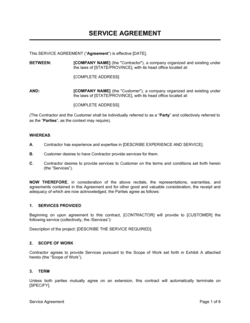
Investment Advisory Agreement Template

Free Word download • Edit online • Save & share with Drive • Export to PDF

5 pages25–35 min to fillDifficulty: ComplexSignature requiredLegal review recommended
Learn more ↓
FreeInvestment Advisory Agreement Template

At a glance

What it is
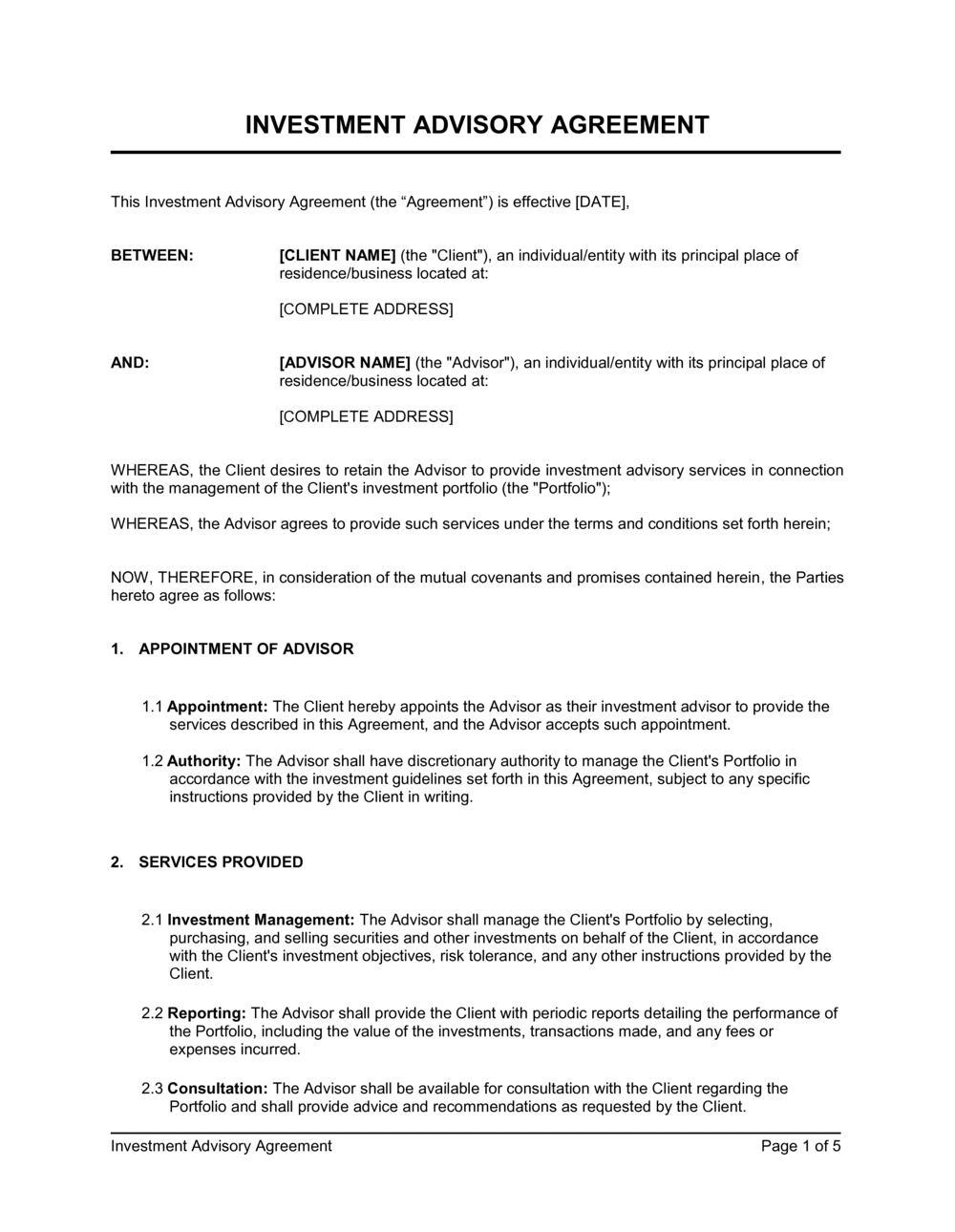
An Investment Advisory Agreement is a legally binding contract between an investment adviser and a client that governs how the adviser will manage or provide guidance on the client's investment portfolio. This template is a free Word download you can edit online — covering scope of services, fee structures, discretionary authority, fiduciary obligations, risk disclosures, and termination — then export as PDF and execute before advisory services begin.
When you need it
Use it whenever a registered investment adviser, financial planner, or portfolio manager is retained by an individual, family office, or institutional client to manage assets or provide ongoing investment guidance. It is required before any fee-based advisory relationship begins and must be in place prior to the adviser exercising any authority over client funds.
What's inside
Scope of advisory services and investment objectives, fee schedule and billing method, discretionary versus non-discretionary authority, fiduciary duty acknowledgment, risk disclosures, client representations, termination and notice provisions, and governing law.

What is an Investment Advisory Agreement?

An Investment Advisory Agreement is a legally binding contract between a registered investment adviser and a client that defines every material term of the advisory relationship: the scope of services, the client's investment objectives and risk tolerance, whether the adviser holds discretionary authority to execute trades, the fee structure and billing mechanics, fiduciary obligations, conflict-of-interest disclosures, and how either party may terminate the arrangement. Under the Investment Advisers Act of 1940 in the United States — and equivalent securities legislation in Canada, the UK, and the European Union — this written agreement is a regulatory requirement, not merely a best practice. It must be executed, and Form ADV Part 2 (or its jurisdictional equivalent) must be delivered, before the adviser takes any action on the client's account or charges any fee. Beyond regulatory compliance, the agreement functions as the operational blueprint for the relationship: it documents what the adviser is authorized to do, what the client expects in return, and how disputes will be resolved if expectations diverge.

Why You Need This Document

Operating an investment advisory practice without a signed written agreement exposes the adviser to regulatory sanctions, fee disgorgement, and civil liability simultaneously. Regulators — the SEC, FINRA, and state securities divisions — treat the absence of a written client agreement as a standalone violation, separate from any investment outcome. For clients, the absence of a documented investment mandate means there is no objective standard against which to evaluate the adviser's decisions: disputes over unsuitable allocations, undisclosed conflicts, or unexpected fees become credibility contests rather than contract interpretation. A properly executed investment advisory agreement prevents all of this by creating a clear, enforceable record of what was agreed before a single trade is placed. This template gives advisers a compliant, professionally structured starting point — covering discretionary authority limits, specific conflict disclosure, pro-rated termination fees, and risk acknowledgments — that reduces both regulatory exposure and client disputes from day one.

Which variant fits your situation?

If your situation is…Use this template
Adviser has full authority to buy and sell without client approval on each tradeDiscretionary Investment Advisory Agreement
Adviser provides recommendations only; client approves each transactionNon-Discretionary Investment Advisory Agreement
Adviser manages a pooled fund rather than individual client accountsInvestment Management Agreement (Fund)
Engaging a sub-adviser to manage a portion of assets on behalf of the primary adviserSub-Advisory Agreement
Providing fee-only financial planning without ongoing portfolio managementFinancial Planning Services Agreement
Retaining an adviser to manage a retirement account such as an IRA or 401(k)Retirement Account Advisory Agreement
One-time consultation or project-based engagement with no ongoing managementConsulting Agreement

Common mistakes to avoid

❌ Vague or missing Investment Policy Statement

Why it matters: Without documented investment objectives and restrictions, there is no objective standard against which to measure whether the adviser followed the client's mandate — making performance disputes nearly impossible to resolve.

Fix: Attach a completed IPS as a signed exhibit before services begin, covering risk tolerance, time horizon, target allocation, and any specific restrictions in concrete, measurable terms.

❌ Generic conflict-of-interest disclosure

Why it matters: The SEC and state securities regulators treat a boilerplate 'conflicts may exist' clause as the equivalent of no disclosure — it does not satisfy the specific conflict disclosure requirements of Regulation Best Interest or Form ADV Part 2.

Fix: List each actual material conflict by name — revenue sharing, affiliated broker, 12b-1 fees, soft dollars — and explain how each is managed. Match the language to the disclosures in Form ADV Part 2A.

❌ No pro-ration formula for fees on termination

Why it matters: When an agreement is silent on how fees are calculated for a partial billing period, disputes over a few hundred dollars routinely escalate into FINRA arbitration or regulatory complaints that cost thousands to resolve.

Fix: Include a specific pro-ration formula — 'fees for any partial quarter shall be calculated based on actual days elapsed divided by the total number of days in the calendar quarter' — to make the calculation mechanical and unambiguous.

❌ Signing after advisory services have already begun

Why it matters: Under SEC and state RIA rules, collecting advisory fees or exercising investment discretion before a written agreement is in place is a regulatory violation that can result in fines, disgorgement of fees, and reputational damage.

Fix: Execute the agreement — and deliver Form ADV Part 2 — before the adviser takes any action on the account or invoices any fee. Note the execution date in the client file.

❌ Granting unlimited discretionary authority with no documented restrictions

Why it matters: Without documented concentration limits, prohibited security types, or asset class restrictions, the adviser has no contractual guardrail, and any extreme allocation — even if technically suitable — can become the basis of a client dispute.

Fix: Include at minimum a concentration limit, a list of prohibited instruments (e.g., leveraged ETFs, options), and a statement that the adviser will follow the asset allocation in the attached IPS.

❌ Omitting the client's obligation to update material changes

Why it matters: If a client's financial situation changes significantly — a large inheritance, job loss, or divorce — and the adviser is not notified, the continued management strategy may become unsuitable, creating regulatory and civil liability for the adviser.

Fix: Include an explicit clause requiring the client to notify the adviser in writing within [30] days of any material change in financial situation, investment objectives, risk tolerance, or tax status.

The 10 key clauses, explained

Parties and appointment

In plain language: Identifies the investment adviser and client as legal entities, states the date of the agreement, and formally appoints the adviser to provide services on the terms set out.

Sample language
This Investment Advisory Agreement ('Agreement') is entered into as of [DATE] between [ADVISER FIRM NAME], a registered investment adviser ('Adviser'), and [CLIENT LEGAL NAME] ('Client'). Client hereby appoints Adviser, and Adviser hereby accepts appointment, to provide the investment advisory services described herein.

Common mistake: Using a trade name instead of the adviser's legal registered entity. If the registered name differs from the brand name, regulatory filings and client accounts may not align, creating compliance exposure.

Scope of services and investment objectives

In plain language: Defines what the adviser will and will not do — portfolio management, financial planning, tax advice — and references the client's investment objectives and risk tolerance as set out in the Investment Policy Statement.

Sample language
Adviser shall provide discretionary investment management services for the Account in accordance with the Investment Policy Statement attached as Exhibit A, which sets out Client's investment objectives, risk tolerance, time horizon, and restrictions. Adviser shall not provide tax or legal advice.

Common mistake: Omitting an attached Investment Policy Statement and leaving objectives undefined in the body of the agreement. Without documented objectives, there is no objective basis to evaluate whether the adviser met their mandate.

Discretionary or non-discretionary authority

In plain language: States clearly whether the adviser has authority to execute transactions without prior client approval (discretionary) or must obtain approval for each trade (non-discretionary), and defines any limitations on that authority.

Sample language
Client hereby grants Adviser [discretionary / non-discretionary] authority to invest and reinvest assets held in the Account, subject to the guidelines in Exhibit A. Adviser shall not hold client funds or securities directly and shall not have authority to withdraw funds from the Account except to debit agreed advisory fees.

Common mistake: Granting full discretionary authority without any documented investment restrictions or concentration limits. An absence of guardrails exposes both parties if the adviser makes a suitable-but-extreme allocation the client later disputes.

Fees, billing, and expenses

In plain language: Sets out the advisory fee structure — percentage of AUM, flat fee, hourly rate, or performance fee — how and when fees are calculated and billed, and which expenses the client bears directly.

Sample language
Client shall pay Adviser an annual advisory fee of [X]% of AUM (equivalent to [X] basis points), calculated quarterly in arrears on the average daily balance of the Account. Fees shall be debited directly from the Account unless Client elects to pay by check. Third-party custodial and transaction costs are borne by Client and are not included in the advisory fee.

Common mistake: Describing fees in the agreement as a flat percentage without disclosing the dollar-equivalent amount at current AUM levels, as required by SEC and most state RIA regulations for written fee disclosure.

Fiduciary duty and conflicts of interest

In plain language: Acknowledges the adviser's fiduciary obligation to act in the client's best interest and discloses any material conflicts of interest — such as compensation from third-party product providers — that could affect that obligation.

Sample language
Adviser acknowledges its fiduciary duty to act in Client's best interest at all times in providing services under this Agreement. Adviser discloses the following material conflicts of interest: [LIST OR 'None at this time']. Adviser will promptly notify Client of any new material conflict arising during the term of this Agreement.

Common mistake: Including a generic fiduciary acknowledgment without disclosing specific conflicts. The SEC's Regulation Best Interest and Form ADV Part 2 both require specific, not general, conflict disclosure.

Client representations and responsibilities

In plain language: Records the client's representations about their financial situation, investment experience, and authority to enter the agreement — and places responsibility on the client to promptly notify the adviser of any material changes.

Sample language
Client represents that: (a) Client has full authority to enter this Agreement and to direct the investment of the Account; (b) the financial information provided to Adviser is accurate and complete; and (c) Client will promptly notify Adviser of any material change in Client's financial situation, investment objectives, or risk tolerance.

Common mistake: Omitting the client's obligation to update material changes. If a client's circumstances shift — inheritance, divorce, job loss — and the adviser is not notified, the mandate may no longer be suitable, creating liability for both parties.

Proxy voting and corporate actions

In plain language: Specifies who is responsible for voting proxies on securities held in the account and how the adviser handles corporate actions such as tender offers, rights offerings, and mergers.

Sample language
Unless otherwise instructed in writing, Adviser shall vote proxies for securities held in the Account in accordance with Adviser's Proxy Voting Policy, a copy of which is available upon request. Client shall retain the right to direct proxy votes on any specific security by providing written notice to Adviser at least [5] business days before the voting deadline.

Common mistake: Leaving proxy voting authority unaddressed. Unvoted proxies can affect governance outcomes for clients with concentrated positions, and undocumented proxy handling creates a regulatory gap in the adviser's Form ADV Part 2 disclosures.

Risk disclosures and no guarantee of performance

In plain language: Discloses the inherent risks of investing — including loss of principal — and clearly states that the adviser makes no guarantee of returns or protection against loss.

Sample language
Client acknowledges that all investments involve risk, including the possible loss of principal. Past performance is not indicative of future results. Adviser makes no warranty or guarantee of any specific level of performance, return, or preservation of capital. Adviser shall not be liable for investment losses except in cases of gross negligence, willful misconduct, or fraud.

Common mistake: Using vague risk language like 'markets can go up or down' without specifying that loss of principal is possible and that the adviser's liability is limited. Courts apply a higher standard of specificity to risk disclosure in regulated advisory relationships.

Termination and transition

In plain language: Sets out how either party may end the agreement, the required notice period, how fees are pro-rated on termination, and the adviser's obligations to facilitate an orderly transition of account management.

Sample language
Either party may terminate this Agreement upon [30] days' written notice. Upon termination, Adviser shall cease all investment activity for the Account and shall cooperate with Client to transfer account records and facilitate transition to a successor adviser. Advisory fees shall be pro-rated to the date of termination; any prepaid fees shall be refunded within [15] business days.

Common mistake: No pro-ration formula on termination. If the agreement is silent, a dispute over fees for a partial quarter frequently results in arbitration or regulatory complaint — a costly outcome for a relatively minor billing question.

Governing law, arbitration, and regulatory compliance

In plain language: Specifies the jurisdiction whose law governs the agreement, the mechanism for resolving disputes — typically FINRA arbitration or AAA arbitration — and each party's agreement to comply with applicable securities laws and regulations.

Sample language
This Agreement is governed by the laws of [STATE]. Any dispute arising under this Agreement shall be resolved by binding arbitration under the rules of [FINRA / AAA] in [CITY], except that either party may seek injunctive relief in a court of competent jurisdiction. Both parties agree to comply with all applicable federal and state securities laws and regulations.

Common mistake: Selecting a governing law state with no meaningful connection to where the adviser operates or is registered. State RIA registration requirements apply based on the adviser's principal office and client locations — a mismatched governing law clause can create regulatory ambiguity.

How to fill it out

  1. 1

    Enter the adviser's legal registered name and client details

    Use the adviser's full legal entity name exactly as it appears on the Form ADV registration, not a DBA or brand name. Enter the client's legal name — individual, trust, LLC, or other entity — along with account numbers if known.

    💡 Cross-reference the adviser name against the SEC's Investment Adviser Public Disclosure (IAPD) database to confirm the exact registered name before execution.

  2. 2

    Define the scope of services and attach an Investment Policy Statement

    Specify whether services include discretionary portfolio management, financial planning, or both. Complete and attach an Investment Policy Statement as Exhibit A covering the client's investment objectives, risk tolerance, time horizon, liquidity needs, and any specific restrictions or exclusions.

    💡 An IPS drafted in plain English — rather than boilerplate — significantly reduces disputes about whether the adviser followed the mandate, because the objectives are concrete and measurable.

  3. 3

    Select discretionary or non-discretionary authority and set limits

    Choose the authority type that matches the engagement. If discretionary, define any investment restrictions — asset class limits, concentration caps, prohibited securities — directly in the IPS or in a Schedule attached to the agreement.

    💡 Even for fully discretionary accounts, adding a concentration limit (e.g., no single security exceeding 10% of the portfolio) gives both parties a documented guardrail against extreme allocations.

  4. 4

    Complete the fee schedule with specific rates and billing mechanics

    Enter the advisory fee as both a percentage and a dollar-equivalent at current AUM. Specify the billing frequency (monthly, quarterly), billing method (debit from account or invoice), and the calculation basis (end-of-period balance, average daily balance, or beginning balance).

    💡 State the fee in basis points as well as percentage — '75 basis points (0.75% per annum)' — to avoid any ambiguity between 0.75% and 7.5%.

  5. 5

    Disclose all material conflicts of interest specifically

    List each material conflict — revenue-sharing arrangements, affiliated broker-dealer relationships, 12b-1 fees, soft dollar arrangements — in the conflicts clause. If there are none, state that explicitly. Generic disclosures do not satisfy SEC or state RIA requirements.

    💡 Review Form ADV Part 2A before completing this clause — the conflicts listed there should match the conflicts disclosed in the client agreement exactly.

  6. 6

    Set the termination notice period and pro-ration formula

    Enter the notice period (30 days is standard), the pro-ration method for partial-period fees (daily pro-ration based on days elapsed divided by total days in the billing period is clearest), and the timeline for returning any prepaid fees.

    💡 Specify the exact method for calculating the pro-rated refund amount — 'daily pro-ration based on actual days elapsed' eliminates billing disputes on termination.

  7. 7

    Confirm registration status and regulatory references

    Confirm whether the adviser is SEC-registered (typically required above $100M AUM), state-registered, or operating under an exemption. Reference the applicable regulatory framework in the governing law clause and ensure the Form ADV Part 2 brochure is delivered to the client at or before execution.

    💡 Delivery of Form ADV Part 2 at least 48 hours before signing — or at signing with a 5-day right to terminate — is required under SEC Rule 204-3. Note the delivery date in your file.

  8. 8

    Execute before any advisory services or fees commence

    Both parties must sign the agreement before the adviser takes any action on the account or charges any fees. Have the client initial the Investment Policy Statement and any attached schedules separately.

    💡 Use a timestamped eSign platform to create an auditable execution record — regulators frequently ask for evidence of the date the client agreement was signed relative to the date advisory services began.

Frequently asked questions

What is an investment advisory agreement?

An investment advisory agreement is a legally binding contract between a registered investment adviser and a client that defines the terms of the advisory relationship — scope of services, investment objectives, fee structure, fiduciary duty, discretionary authority, and termination conditions. It is required by SEC and state securities regulations before an adviser may charge fees or exercise any discretion over client assets.

Is an investment advisory agreement required by law?

Yes. SEC Rule 204-3 and comparable state RIA regulations require that investment advisers have a written client agreement in place before providing advisory services or collecting fees. The agreement must be accompanied by delivery of the adviser's Form ADV Part 2 brochure at or before execution. Operating without a written agreement exposes the adviser to regulatory sanctions, fee disgorgement, and civil liability.

What is the difference between a discretionary and non-discretionary investment advisory agreement?

A discretionary agreement grants the adviser authority to execute trades on the client's behalf without obtaining prior approval for each transaction. A non-discretionary agreement requires the adviser to present recommendations and obtain client approval before any trade is made. Discretionary arrangements are more common for ongoing portfolio management; non-discretionary arrangements are typical for financial planning or consulting relationships where the client makes final decisions.

What fees are typically covered in an investment advisory agreement?

The most common structure is an annual fee expressed as a percentage of AUM — typically 0.50% to 1.50% for individual clients — billed quarterly in arrears. Some advisers charge a flat annual retainer, an hourly rate, or a performance fee above a benchmark. The agreement must clearly state the fee basis, calculation method, billing frequency, and which costs (trading commissions, custodial fees) the client bears separately.

What is a fiduciary duty in an investment advisory agreement?

A fiduciary duty requires the adviser to act solely in the client's best interest when providing investment advice — placing the client's financial welfare above the adviser's own interests or compensation. Registered investment advisers are fiduciaries under the Investment Advisers Act of 1940. Broker-dealers operating under FINRA's Regulation Best Interest are subject to a similar but distinct standard. The agreement should acknowledge this obligation explicitly and disclose any conflicts that might affect it.

Can I terminate an investment advisory agreement early?

Yes. Most investment advisory agreements are terminable at will by either party upon written notice, typically 30 days. Upon termination, the adviser must cease all trading activity, cooperate with account transfer, and refund any prepaid fees on a pro-rated basis. Some agreements require a minimum engagement period — if so, early termination fees must be disclosed in both the agreement and Form ADV Part 2.

What is Form ADV and how does it relate to the advisory agreement?

Form ADV is the registration document that all SEC- and state-registered investment advisers must file and maintain. Part 2A is the adviser's disclosure brochure — covering services, fees, conflicts, and disciplinary history — and must be delivered to clients at or before execution of the advisory agreement. The advisory agreement and Form ADV Part 2 should be consistent; conflicts or fee structures that appear in one but not the other create regulatory exposure for the adviser.

Do I need a lawyer to draft an investment advisory agreement?

For straightforward individual client relationships with standard AUM-based fees, a high-quality template reviewed by a securities lawyer is typically sufficient. Engage a lawyer for institutional mandates, performance fee arrangements, multi-jurisdiction clients, sub-advisory relationships, or any engagement involving complex conflict structures. Given the regulatory consequences of a deficient agreement, a one-to-two hour securities attorney review ($400–$800) is worthwhile for most new advisory practices.

How often should an investment advisory agreement be updated?

The agreement itself typically does not require annual updates unless services, fees, or material terms change. However, the attached Investment Policy Statement should be reviewed with the client at least annually and updated whenever the client's financial situation, objectives, or risk tolerance changes materially. Form ADV Part 2 must be updated annually and delivered to clients within 120 days of the adviser's fiscal year end.

How this compares to alternatives

vs Brokerage account agreement

A brokerage account agreement governs the execution of transactions at the client's direction and subjects the broker to Regulation Best Interest, not the fiduciary standard. An investment advisory agreement establishes an ongoing advisory relationship, a fiduciary duty, and fee-based compensation for advice — not commissions per trade. The two documents reflect fundamentally different regulatory frameworks and compensation models.

vs Portfolio management agreement

A portfolio management agreement is often used synonymously with a discretionary investment advisory agreement, but in institutional contexts it tends to be more detailed on investment guidelines, benchmark targets, and reporting obligations. For individual clients, investment advisory agreement is the standard term. Use a portfolio management agreement format for institutional mandates with formal IPS attachments and compliance reporting requirements.

vs Financial planning agreement

A financial planning agreement covers a defined scope of advice — retirement, tax, estate, insurance — typically for a flat fee or hourly rate, without ongoing portfolio management authority. An investment advisory agreement governs continuous asset management with discretionary or non-discretionary authority. Clients who need both a financial plan and ongoing portfolio management often sign both documents.

vs Consulting agreement

A general consulting agreement is not suitable for investment advisory relationships because it lacks the regulatory disclosures, fiduciary language, risk disclaimers, and Form ADV references required by securities law. Using a consulting agreement to document an advisory fee relationship can constitute a regulatory violation. Always use a securities-specific investment advisory agreement when managing or advising on investments for compensation.

Industry-specific considerations

Wealth management

AUM-based tiered fee schedules, consolidated household billing across multiple accounts, and integrated trust and estate planning coordination.

Institutional asset management

Sub-advisory mandates, ERISA fiduciary obligations for pension assets, and performance fee arrangements with high-water marks and hurdle rates.

Family offices

Multi-generational investment policies, alternative asset allocations including private equity and real assets, and coordination with tax and legal counsel.

Registered investment adviser (RIA) firms

Standardized client onboarding across dozens of advisers, compliance with SEC Rule 204-3 delivery requirements, and systematic IPS documentation workflows.

Jurisdictional notes

United States

Investment advisers managing $110M or more in AUM must register with the SEC under the Investment Advisers Act of 1940; those below the threshold register at the state level. SEC Rule 204-3 requires delivery of Form ADV Part 2 to clients at or before execution. Regulation Best Interest applies to broker-dealers but not RIAs, who are held to the full fiduciary standard. Non-compete and non-solicit clauses in advisory agreements are subject to state law enforceability rules.

Canada

Portfolio managers and investment counsellors in Canada are registered with provincial securities regulators under National Instrument 31-103. Client agreements must comply with NI 31-103 requirements for account opening, Know Your Client obligations, and suitability assessments. Quebec requires French-language client documents for provincially regulated firms. The Client Focused Reforms (CFRs), effective 2021, impose conflict-of-interest and best-interest obligations similar to the US fiduciary standard.

United Kingdom

Investment advisers in the UK are authorised and regulated by the Financial Conduct Authority (FCA) under the Financial Services and Markets Act 2000. COBS (Conduct of Business Sourcebook) rules require that client agreements be in a durable medium and that advisers disclose costs, charges, and conflicts in accordance with MiFID II requirements. The Consumer Duty, effective July 2023, imposes a higher standard of client care for retail clients. Discretionary portfolio managers must comply with COBS 4 and COBS 6 on suitability and appropriateness.

European Union

Investment services across the EU are governed by MiFID II (Markets in Financial Instruments Directive), implemented at the member-state level. Written client agreements are mandatory and must include a description of services, fee disclosure, conflicts policy, and information on the adviser's authorisation. GDPR applies to all personal data processed in connection with the advisory relationship and must be addressed in the agreement or a linked privacy notice. Performance fee structures are subject to ESMA guidelines and must include a high-water mark mechanism for retail clients.

Template vs lawyer — what fits your deal?

PathBest forCostTime
Use the templateEstablished RIA practices onboarding individual clients with standard AUM-based fees and no complex conflict structuresFree30–45 minutes per client
Template + legal reviewNew RIA firms, advisers adding performance fees or alternative investments, or practices onboarding first institutional clients$400–$800 for a securities attorney review3–5 business days
Custom draftedSub-advisory mandates, ERISA-governed pension accounts, multi-jurisdiction institutional clients, or performance fee structures with complex high-water mark provisions$2,000–$8,000+2–4 weeks

Glossary

Fiduciary Duty
A legal obligation requiring the adviser to act solely in the client's best interest, placing the client's financial welfare above the adviser's own.
Discretionary Authority
Permission granted by the client allowing the adviser to buy and sell securities on their behalf without obtaining prior approval for each transaction.
Non-Discretionary Advisory
An arrangement where the adviser recommends investments but the client must approve every transaction before it is executed.
Assets Under Management (AUM)
The total market value of investments the adviser manages on behalf of a client, typically used as the basis for calculating advisory fees.
Investment Policy Statement (IPS)
A document attached to or referenced in the advisory agreement that defines the client's investment objectives, risk tolerance, time horizon, and asset allocation targets.
Wrap Fee
An all-inclusive annual fee covering advisory services, transaction costs, and custodial charges — expressed as a percentage of AUM.
Basis Points (bps)
A unit equal to one-hundredth of one percent (0.01%), used to express advisory fees and investment returns precisely — 100 basis points equals 1%.
Suitability
The regulatory standard requiring that investment recommendations be appropriate for the client's specific financial situation, goals, and risk tolerance.
Best Execution
The obligation to execute client transactions at the most favorable terms reasonably available, considering price, speed, and likelihood of execution.
Soft Dollars
Arrangements under which an adviser directs client brokerage to a broker in exchange for research or other services — must be disclosed to clients.
Form ADV
The SEC registration document that all registered investment advisers must file and provide to clients, disclosing business practices, fees, conflicts of interest, and disciplinary history.

Part of your Business Operating System

This document is one of 3,000+ business & legal templates included in Business in a Box.

  • Fill-in-the-blanks — ready in minutes
  • 100% customizable Word document
  • Compatible with all office suites
  • Export to PDF and share electronically

Create your document in 3 simple steps.

From template to signed document — all inside one Business Operating System.
1
Download or open template

Access over 3,000+ business and legal templates for any business task, project or initiative.

2
Edit and fill in the blanks with AI

Customize your ready-made business document template and save it in the cloud.

3
Save, Share, Send, Sign

Share your files and folders with your team. Create a space of seamless collaboration.

Save time, save money, and create top-quality documents.

★★★★★

"Fantastic value! I'm not sure how I'd do without it. It's worth its weight in gold and paid back for itself many times."

Managing Director · Mall Farm
Robert Whalley
Managing Director, Mall Farm Proprietary Limited
★★★★★

"I have been using Business in a Box for years. It has been the most useful source of templates I have encountered. I recommend it to anyone."

Business Owner · 4+ years
Dr Michael John Freestone
Business Owner
★★★★★

"It has been a life saver so many times I have lost count. Business in a Box has saved me so much time and as you know, time is money."

Owner · Upstate Web
David G. Moore Jr.
Owner, Upstate Web

Run your business with a system — not scattered tools

Stop downloading documents. Start operating with clarity. Business in a Box gives you the Business Operating System used by over 250,000 companies worldwide to structure, run, and grow their business.

Start free · No credit card required