1
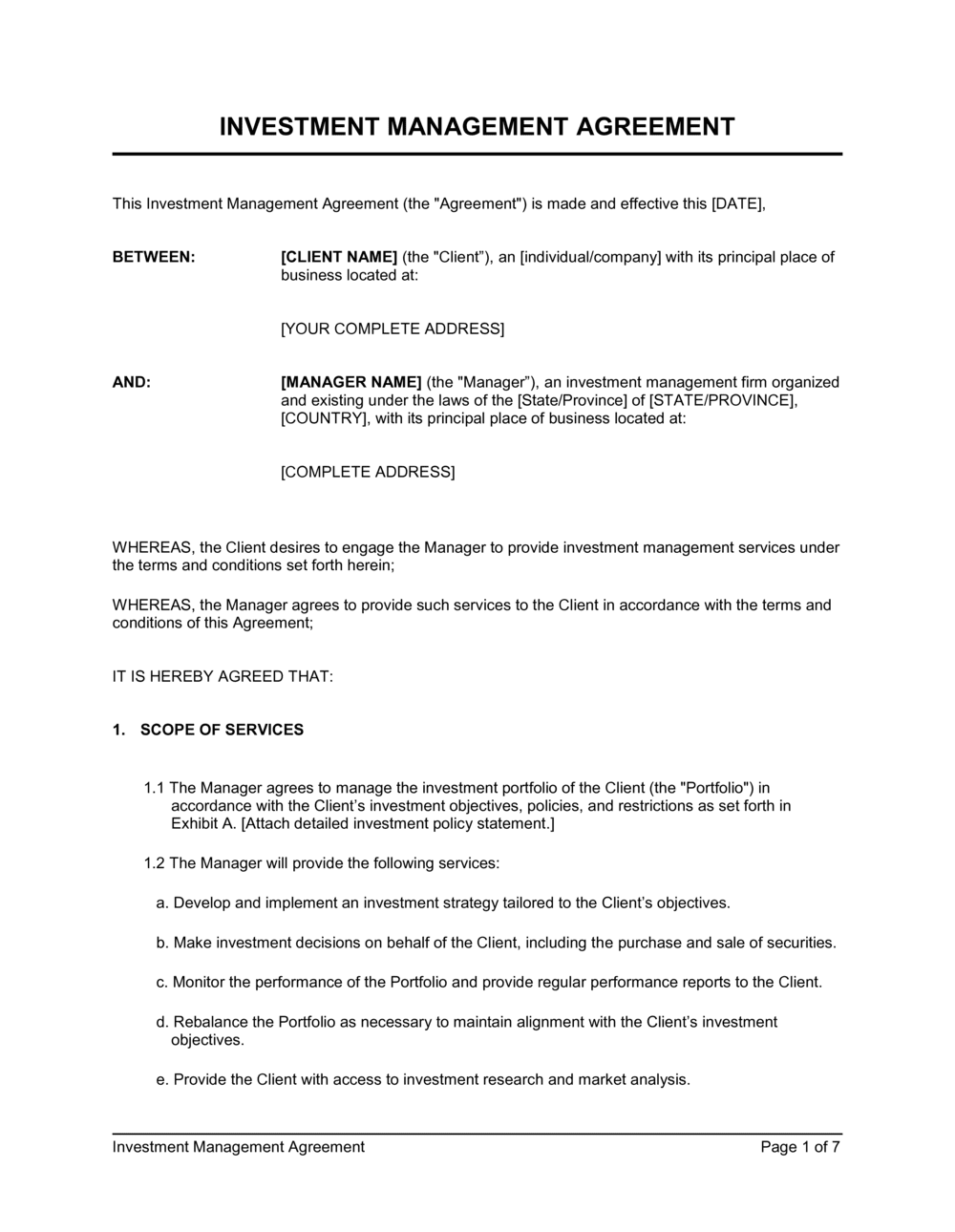
Identify both parties with full legal names
Enter the client's registered legal name — trust, LLC, individual, or institution — and the manager's full legal entity name and registration number (e.g., SEC RIA number or provincial registration). Confirm that the client name matches the custodial account title exactly.
💡 Pull the manager's name directly from their Form ADV or equivalent regulatory filing to ensure the registered name matches the agreement.
2
Define the mandate, objectives, and permitted instruments
Choose a mandate type (growth, balanced, income, or capital preservation) and list the permitted and excluded asset classes in Schedule A. Tie these directly to the client's stated risk tolerance and time horizon.
💡 A one-page Investment Policy Statement attached as Schedule A creates a clear accountability framework and is the single most effective tool for preventing mandate drift.
3
Choose discretionary or non-discretionary authority
Decide whether the manager may transact without prior approval for each trade (discretionary) or must receive client sign-off (non-discretionary). Discretionary is standard for professional managers; non-discretionary suits clients who want transaction-level control.
💡 If granting discretionary authority, include a written list of any investment restrictions — prohibited sectors, concentration limits, ESG screens — directly in Schedule A to bound the manager's latitude.
4
Complete the fee schedule in full
Enter the annual management fee rate, the billing frequency and calculation method, any performance fee rate, the benchmark or hurdle rate, and whether a high-water mark applies. Specify which expenses (brokerage, custody, audit) are charged to the account separately.
💡 Express the management fee as an annual rate and state the billing frequency explicitly — 'billed quarterly in arrears on the average daily balance' eliminates calculation disputes at invoice time.
5
Set reporting frequency and valuation methodology
Specify how often the manager must provide account statements, performance reports, and portfolio valuations. For any illiquid holdings, define the valuation methodology in Schedule B.
💡 Quarterly performance reports that include a benchmark comparison give clients an early warning of style drift — require them contractually so you are not dependent on the manager's goodwill.
6
Disclose specific conflicts of interest
List all material conflicts specific to the manager's business — affiliated brokers, proprietary fund recommendations, soft-dollar arrangements, and cross-trading policies. Reference the manager's Form ADV Part 2A or equivalent disclosure document.
💡 Generic conflict-of-interest language fails regulatory review. List each conflict by name, even if the risk is low — a comprehensive specific list protects both parties.
7
Set termination notice and transition obligations
Enter the notice period (30 days is standard), the conditions for immediate termination for cause, the proration method for fees on early termination, and the manager's transition duties — timeline to cease trading, deliver final statements, and cooperate with a successor.
💡 A 15-business-day transition window for the manager to cooperate with account transfer is a reasonable and enforceable standard; shorter windows often cause settlement failures.
8
Select governing law and sign before assets are transferred
Choose the jurisdiction whose law applies — typically the state or country where the manager is registered or where the client is domiciled. Both parties must sign before the manager begins trading the account.
💡 Never allow the manager to begin transacting before the agreement is fully executed — an unsigned agreement provides no authority for discretionary trading and no liability framework for either party.