1
Complete the position identification block
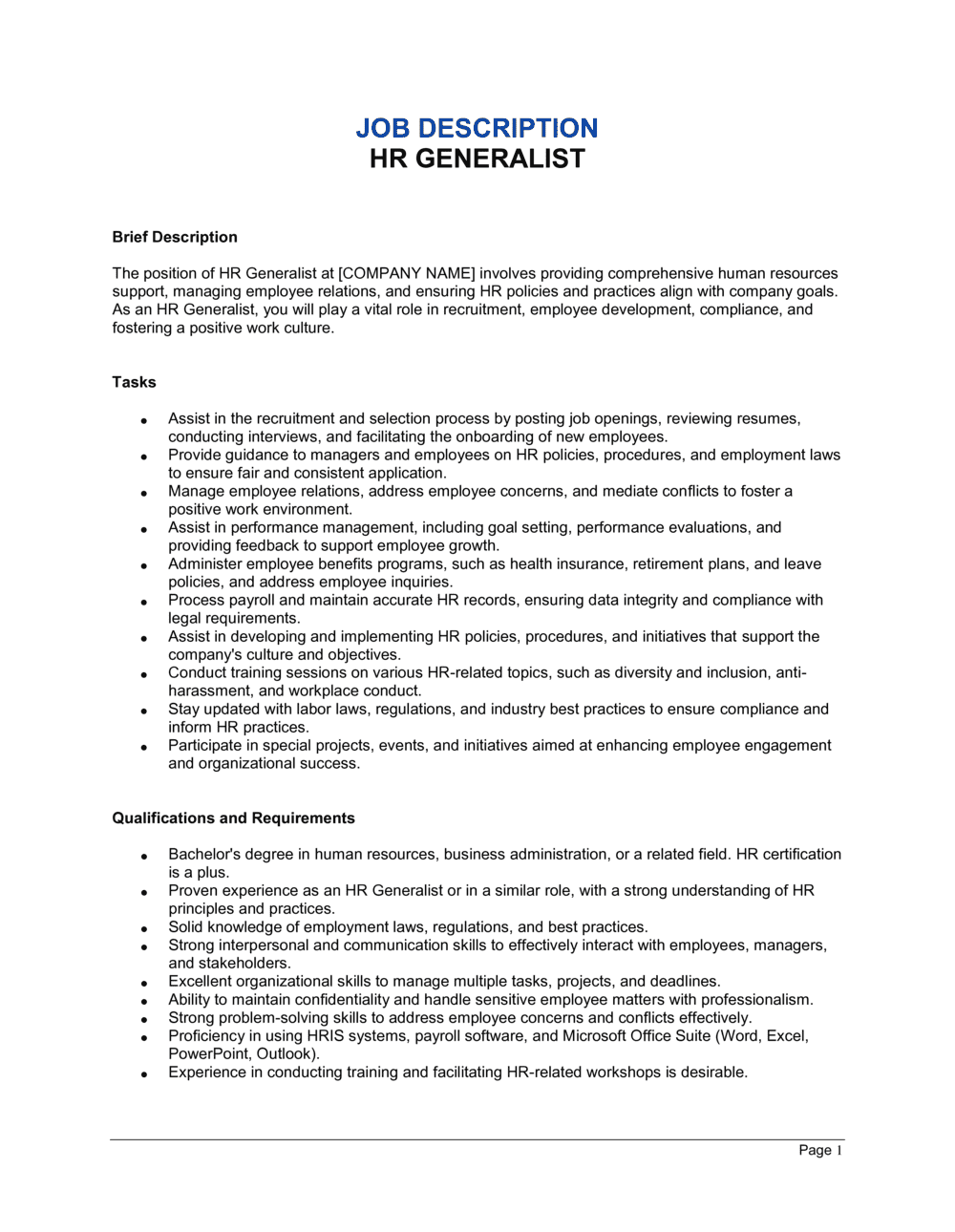
Enter the exact job title, department, reporting line, FLSA classification (exempt or non-exempt), and work location. Cross-reference your payroll system to confirm the FLSA status is consistent with how you pay the role.
💡 If the HR Generalist will be classified as exempt, document the specific exemption basis — administrative exemption under the FLSA requires a salary of at least $684/week (2024 threshold) and primary duties involving office work directly related to management.
2
Write a specific position summary
Draft 3–5 sentences covering the role's primary purpose, the employee population supported, and the key HR functions in scope. Name the reporting relationship and any key cross-functional partnerships.
💡 Anchor the summary to a specific headcount range (e.g., 'supporting 75–150 employees') — this scopes the role meaningfully and helps set compensation expectations.
3
List essential functions in order of importance
Write each essential function as a separate line item beginning with an action verb. Order them from most to least time-consuming. Separate any marginal or occasional duties into a distinct section labeled 'Additional responsibilities.'
💡 The EEOC recommends listing no more than 10–12 essential functions. A longer list dilutes the definition of 'essential' and weakens your position in an ADA accommodation analysis.
4
Define required qualifications with business-necessity justification
For each required qualification — degree, years of experience, certification, software skill — be prepared to document why it is necessary. Avoid blanket degree requirements for roles where experience is a genuine substitute.
💡 Several states and federal contractors have adopted skills-based hiring policies that restrict degree requirements. Review applicable rules before finalizing required qualifications.
5
Add the compensation range and benefits summary
Enter the salary band approved for the role, note whether it is discretionary or guaranteed at any minimum, and list the key benefits. Check your jurisdiction for pay transparency disclosure requirements before posting.
💡 In Colorado (EPEWA), California (SB 1162), New York, and Washington, posting a role without a salary range carries per-violation fines. Several other states have pending legislation — check current requirements before publishing.
6
Describe working conditions and physical requirements accurately
State whether the role is on-site, hybrid, or remote, the expected office hours or schedule, travel requirements as a percentage of time, and any genuine physical demands. Every physical requirement listed should reflect actual job duties.
💡 If the role is hybrid, specify the minimum number of in-office days required per week — vague hybrid language generates disputes after hire.
7
Verify and insert the EEO statement
Use your organization's approved EEO statement, or adapt the template language to reflect all protected categories under applicable federal, state, and local law. If you operate in multiple states, use the broadest version.
💡 Some municipalities — New York City, for example — require the EEO statement to reference local protected categories such as caregiver status and lawful source of income. Include these if you post in covered jurisdictions.
8
Obtain signatures before or on the first day of employment
Have the employee and an authorized employer representative sign the acknowledgment block before or on the employee's first day. File the signed copy in the employee's personnel file and provide the employee with a copy.
💡 Pair the signed job description with the employment contract at onboarding — both documents together establish agreed duties, classification, and compensation in a single defensible package.