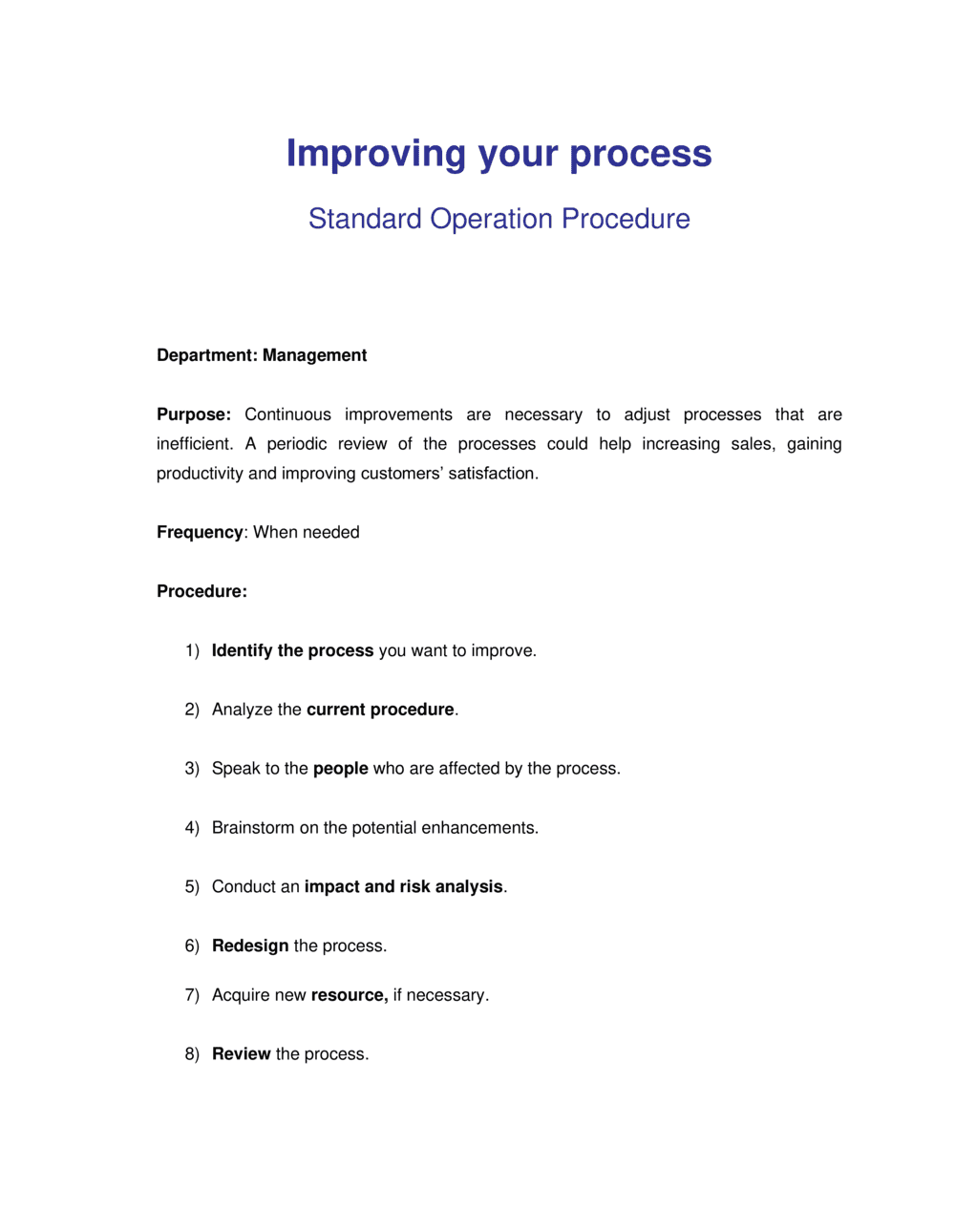
How to Improve any Business Process

Free to read β€’ Save or share with one click

FreeHow to Improve any Business Process Template

At a glance

What it is
How To Improve Any Business Process is a structured operational template that guides teams through diagnosing a broken or underperforming process, mapping its current state, identifying root causes, and building a concrete action plan to reach a measurable target state. This free Word download covers every phase from problem framing to implementation tracking, and can be exported as PDF for stakeholder review or team rollout.
When you need it
Use it when a recurring operational bottleneck, quality issue, or efficiency gap is costing time or money and informal fixes have failed to hold. It is equally suited to proactive improvement initiatives before a problem becomes a crisis.
What's inside
Process scope definition, current-state mapping, performance baseline, root-cause analysis, gap analysis, improvement objectives, action plan with owners and deadlines, implementation timeline, and a measurement and review framework.

What is a How To Improve Any Business Process Template?

A How To Improve Any Business Process template is a structured operational document that guides teams through every phase of a process improvement initiative β€” from defining scope and mapping the current state through root-cause analysis, gap analysis, action planning, and post-implementation measurement. Rather than offering general advice, it provides a repeatable framework with fillable sections that produce a concrete, evidence-based improvement plan any team member can follow and any manager can hold people accountable to. The template works for any business process β€” finance, HR, operations, customer service, or technology β€” because the analytical structure is the same regardless of what is being improved.

Why You Need This Document

Without a structured improvement framework, most process fixes are symptomatic: a workaround that holds for a few weeks before the original problem resurfaces under a slightly different label. Teams waste hours in recurring problem-solving meetings because no one has documented the root cause, assigned a single owner, or set a measurable target that would let everyone agree the problem is actually solved. This template replaces that cycle with a single document that forces the team to quantify the current problem, trace it to its real cause, and commit to specific actions with named owners and deadlines. The post-implementation measurement section closes the loop β€” making it possible to confirm that the improvement held, justify the effort to leadership, and decide whether a further iteration is needed.

Which variant fits your situation?

If your situation is…Use this template
Improving a single high-volume transactional process end to endStandard Operating Procedure (SOP)
Visualizing a process flow before improvement work beginsBusiness Process Flowchart
Diagnosing systemic quality failures across a product lineRoot Cause Analysis Report
Running a full operational audit across multiple departmentsBusiness Process Audit Report
Tracking ongoing continuous improvement initiatives across teamsContinuous Improvement Plan
Presenting improvement findings and recommendations to leadershipBusiness Process Review Report
Aligning improvement goals with company-wide strategic prioritiesStrategic Planning Template

Common mistakes to avoid

❌ Defining scope too broadly

Why it matters: A vague scope like 'improve operations' produces findings that apply everywhere and nowhere. Teams lose focus within weeks and default to familiar workarounds.

Fix: Narrow scope to a single process with a clear start event, end output, and at least one quantifiable KPI before any analysis begins.

❌ Documenting the intended process instead of the actual one

Why it matters: The gap between what the policy says and what people actually do is often where the real problem lives. Mapping the policy version produces recommendations that miss the true causes.

Fix: Observe the process running in real time with real workers. Interview at least three people who do it regularly and compare their accounts β€” differences reveal undocumented variation.

❌ Stopping root-cause analysis at 'human error'

Why it matters: Human error is almost always a symptom of a missing procedure, inadequate training, or a tool that makes mistakes easy. Labeling it as the root cause leads to blame rather than a fix.

Fix: Ask why the human error keeps occurring. Trace it to the system, process design, or training gap that makes the error predictable and preventable.

❌ Automating before fixing the underlying process

Why it matters: Automation locks in the current process logic. If that logic is broken, the automation produces broken outputs faster and at greater scale β€” with less human ability to catch and correct them.

Fix: Redesign and stabilize the manual process first. Only then evaluate whether automation of the stabilized process would deliver additional value.

❌ Assigning actions to teams rather than individuals

Why it matters: When everyone owns a task, no one does. Group ownership produces missed deadlines at far higher rates than individual accountability because each person assumes someone else is handling it.

Fix: Name one individual as accountable for each action item. Others may support, but only one person is responsible for completion by the due date.

❌ Skipping the post-implementation measurement

Why it matters: Without a post-implementation review against the original baseline, there is no way to confirm the improvement worked, justify the effort to leadership, or identify whether a second iteration is needed.

Fix: Schedule a 30-day and 60-day review before the rollout begins. Assign a named owner to collect and report the post-improvement KPI data on those dates.

The 9 key sections, explained

Process scope and objective

Current-state process map

Performance baseline

Root-cause analysis

Gap analysis

Improvement recommendations

Action plan with owners and deadlines

Implementation timeline

Measurement and review framework

How to fill it out

  1. 1

    Define the process scope and write a measurable objective

    Name the specific process, identify its start and end points, and state the improvement target as a number β€” not a direction. Confirm who the process owner is before proceeding.

    πŸ’‘ A well-formed objective follows this pattern: reduce [METRIC] from [X] to [Y] by [DATE]. If you cannot fill in all three variables, the scope is still too broad.

  2. 2

    Map the current-state process by observing it, not describing it

    Walk through the process with the people who actually do it. Record every step, every tool used, and every handoff point. Note where people deviate from the official procedure β€” those deviations are often where problems live.

    πŸ’‘ Record at least three real instances of the process running rather than relying on one walk-through. Variation between instances is itself a finding.

  3. 3

    Collect quantified baseline data

    Pull at least 4 weeks of real performance data for the process KPIs you plan to improve. Calculate averages and note any significant outliers.

    πŸ’‘ If data does not exist, spend one to two weeks collecting it before starting the analysis. Starting without a baseline makes it impossible to prove the improvement worked.

  4. 4

    Conduct root-cause analysis using the 5 Whys

    State the problem clearly, then ask 'why does this happen?' five times in sequence. Stop when you reach a cause you can actually control and change. Categorize the root cause as People, Process, Technology, or Environment.

    πŸ’‘ Run the 5 Whys with the people doing the work, not just with managers. Front-line workers know the real causes; managers often know only the reported symptoms.

  5. 5

    Complete the gap analysis with numbers

    List each KPI where current performance falls short of target, state the current and target values, calculate the gap, and assign a priority based on the business impact of closing it.

    πŸ’‘ Convert gaps to dollar impact where possible β€” even an estimate. A gap expressed as '$40,000 per year in rework cost' gets executive attention faster than '12% error rate.'

  6. 6

    Write recommendations that address root causes, not symptoms

    For each root cause, write one or more specific recommendations. Confirm each recommendation directly addresses a root cause identified in Step 4 β€” not just a symptom that appeared in the current-state map.

    πŸ’‘ If a recommendation does not trace back to a root cause, remove it. It is likely a workaround that will be undone within months.

  7. 7

    Assign every action to a named individual with a due date

    Convert each recommendation into one or more concrete tasks. Assign each to a single named person β€” not a team or role β€” and set a specific calendar date.

    πŸ’‘ Get verbal or written acknowledgment from each owner before publishing the plan. Owners who are surprised by their assignments miss deadlines at much higher rates.

  8. 8

    Set interim checkpoints in the measurement framework

    Define at least one checkpoint within the first two weeks of implementation to catch early deviations. Schedule a full post-implementation review 30–60 days after rollout against the original baseline.

    πŸ’‘ Publish the measurement framework to the full team before rollout begins β€” visible accountability raises follow-through significantly.

Frequently asked questions

What is a business process improvement template?

A business process improvement template is a structured document that guides a team through diagnosing an underperforming process, identifying its root causes, and building a concrete plan to reach a measurable target state. It covers current-state mapping, performance baseline, gap analysis, recommendations, an action plan with owners and deadlines, and a measurement framework β€” all in a single document that keeps improvement work organized and auditable.

When should I use a process improvement template?

Use it when a recurring operational problem β€” repeated errors, slow cycle times, high rework costs, or customer complaints β€” has not been resolved by informal fixes. It is also valuable proactively, when leadership wants to improve a process before it becomes a bottleneck during growth. Any process where the gap between current and desired performance can be quantified is a good candidate.

What is the difference between process improvement and a standard operating procedure?

A standard operating procedure (SOP) documents how a process should be executed consistently by trained staff. A process improvement template is used before or alongside an SOP update β€” it diagnoses why the current process underperforms and designs the improved version. Once the improved process is validated, the SOP is updated to reflect the new way of working. Process improvement produces the changes; the SOP documents them.

What tools are commonly used in root-cause analysis?

The 5 Whys is the most widely used tool β€” asking 'why' five times in sequence to move from symptom to root cause. The fishbone (Ishikawa) diagram maps causes across categories of People, Process, Technology, Materials, and Environment. Pareto analysis identifies which causes account for the largest share of the problem, allowing teams to prioritize the few changes that will produce most of the improvement. This template supports any of these methods in the root-cause section.

How long does a business process improvement project typically take?

A focused single-process improvement project typically runs 4–10 weeks from scope definition to initial results: 1–2 weeks to map the current state and collect baseline data, 1–2 weeks for root-cause and gap analysis, 1–2 weeks to develop the action plan, and 2–4 weeks to implement and run an initial measurement cycle. More complex, cross-departmental processes can take 3–6 months.

How do I measure whether a process improvement worked?

Compare the same KPIs measured in the performance baseline against data collected 30 and 60 days after the new process is fully operational. Common measures include cycle time reduction, error rate decrease, cost per transaction, and throughput volume. The improvement is confirmed when the target stated in the objective section is consistently met over at least two measurement periods, not just immediately after launch.

Can this template be used for any type of business process?

Yes β€” the template is designed to be process-agnostic. It has been applied to finance, HR, customer service, supply chain, IT operations, sales, and production processes without modification to the core structure. The process scope and KPI sections are filled with the specifics of whichever process is being improved.

What is the difference between this template and a project plan?

A project plan manages the delivery of a defined output β€” a product, system, or event β€” with tasks, milestones, and a budget. A process improvement template focuses specifically on diagnosing and redesigning how work flows through an organization. It includes analytical sections (root-cause analysis, gap analysis) that a project plan does not, and it is built around a before-and-after measurement structure rather than a delivery schedule.

Should I involve frontline staff in completing this template?

Yes β€” the current-state map and root-cause analysis sections are significantly more accurate when the people who actually perform the process contribute to them. Frontline staff know where the real bottlenecks and workarounds are. Including them early also increases buy-in for the changes in the action plan, which improves implementation follow-through compared to top-down mandates.

How this compares to alternatives

vs Standard Operating Procedure

A Standard Operating Procedure documents how a process should be performed consistently once it is working correctly. A process improvement template is used to diagnose why the current process underperforms and design the better version. The SOP is typically updated after the improvement template has identified and validated the changes to make.

vs Root Cause Analysis Report

A root-cause analysis report focuses exclusively on diagnosing the cause of a specific problem or incident. A process improvement template incorporates root-cause analysis as one section within a broader framework that also covers current-state mapping, gap analysis, action planning, and post-implementation measurement. Use the standalone RCA for incident investigation; use the process improvement template when the goal is end-to-end process redesign.

vs Business Process Review Report

A business process review report documents findings and recommendations from a completed audit of an existing process β€” it is an output document aimed at stakeholders. A process improvement template is a working document used by the team executing the improvement itself, from diagnosis through implementation. The review report communicates what was found; the improvement template drives what gets changed.

vs Strategic Planning Template

A strategic plan sets company-wide goals, priorities, and resource allocation at the organizational level over a 3–5 year horizon. A process improvement template operates at the process level within a single function or department over a 4–12 week horizon. Strategic plans identify which capabilities need to improve; process improvement templates are the mechanism for making those improvements happen.

Industry-specific considerations

Professional services

Improving proposal, billing, and client onboarding processes where cycle time directly affects revenue recognition and client satisfaction.

Manufacturing

Reducing defect rates, machine downtime, and production cycle time using root-cause analysis across materials, equipment, and operator steps.

Healthcare

Streamlining patient intake, discharge, or claims processing while maintaining compliance with clinical and regulatory requirements.

Retail and e-commerce

Cutting order fulfillment cycle time, reducing pick-and-pack error rates, and improving returns processing throughput during peak periods.

SaaS and technology

Improving engineering deployment pipelines, customer support ticket resolution workflows, and internal IT provisioning processes.

Financial services

Reducing loan origination cycle time, streamlining compliance review workflows, and cutting manual reconciliation steps in accounting processes.

Template vs pro β€” what fits your needs?

PathBest forCostTime
Use the templateOperations managers and team leads running a single-process improvement within one departmentFree4–8 weeks end to end
Template + professional reviewCross-functional processes touching multiple departments or systems where a neutral facilitator adds objectivity$500–$2,000 for a process consultant review or facilitation session6–10 weeks
Custom draftedEnterprise-wide process transformation, ISO certification preparation, or regulated industries requiring full audit trails$5,000–$25,000+ for a management consulting engagement3–6 months

Glossary

Current State
A documented description of how a process actually operates today, before any changes are made.
Future State
The target version of a process after improvements are applied, defined in terms of measurable outcomes.
Root Cause
The underlying reason a problem occurs, as opposed to its visible symptoms β€” identified through structured analysis rather than assumption.
Gap Analysis
A comparison between current-state performance and the desired future state, used to identify where and how much improvement is needed.
Process Owner
The individual accountable for the performance and continuous improvement of a specific business process.
KPI (Key Performance Indicator)
A quantitative metric used to measure whether a process is performing at the intended level β€” for example, cycle time, error rate, or cost per transaction.
Cycle Time
The total elapsed time from when a process starts to when it produces its output β€” a primary measure of process efficiency.
Bottleneck
The step in a process that limits overall throughput because it operates more slowly or with more errors than the steps around it.
Standard Operating Procedure (SOP)
A documented, step-by-step instruction set that defines how a process should be carried out consistently by any trained team member.
Continuous Improvement
An ongoing, incremental approach to refining processes over time rather than relying on one-time fixes.

Part of your Business Operating System

This document is one of 3,000+ business & legal templates included in Business in a Box.

  • Fill-in-the-blanks β€” ready in minutes
  • Compatible with all office suites
  • Export to PDF and share electronically

Create your document in 3 simple steps.

From template to signed document β€” all inside one Business Operating System.
1
Download or open template

Access over 3,000+ business and legal templates for any business task, project or initiative.

2
Edit and fill in the blanks with AI

Customize your ready-made business document template and save it in the cloud.

3
Save, Share, Send, Sign

Share your files and folders with your team. Create a space of seamless collaboration.

Save time, save money, and create top-quality documents.

β˜…β˜…β˜…β˜…β˜…

"Fantastic value! I'm not sure how I'd do without it. It's worth its weight in gold and paid back for itself many times."

Managing Director Β· Mall Farm
Robert Whalley
Managing Director, Mall Farm Proprietary Limited
β˜…β˜…β˜…β˜…β˜…

"I have been using Business in a Box for years. It has been the most useful source of templates I have encountered. I recommend it to anyone."

Business Owner Β· 4+ years
Dr Michael John Freestone
Business Owner
β˜…β˜…β˜…β˜…β˜…

"It has been a life saver so many times I have lost count. Business in a Box has saved me so much time and as you know, time is money."

Owner Β· Upstate Web
David G. Moore Jr.
Owner, Upstate Web

Run your business with a system β€” not scattered tools

Stop downloading documents. Start operating with clarity. Business in a Box gives you the Business Operating System used by over 250,000 companies worldwide to structure, run, and grow their business.

Start freeΒ Β·Β No credit card required