How To Find Good Business Ideas_startup Blueprints_chapter 1

Free to read β€’ Save or share with one click

FreeHow To Find Good Business Ideas_startup Blueprints_chapter 1 Template

At a glance

What it is
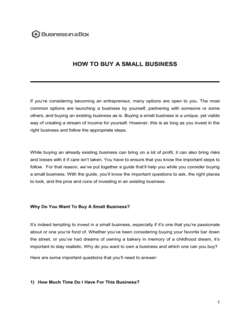
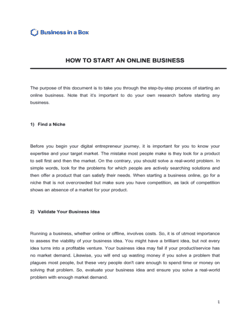
How To Find Good Business Ideas β€” Startup Blueprints Chapter 1 is a structured Word guide that walks aspiring entrepreneurs through a repeatable process for identifying, evaluating, and prioritizing viable business ideas before committing time or capital. This free Word download combines frameworks, worksheets, and scoring tools into a single editable document you can work through at your own pace and export as PDF.
When you need it
Use it when you want to start a business but haven't locked in a concept, when you're exploring a pivot from your current model, or when you need a structured way to compare several ideas side by side before choosing one to pursue.
What's inside
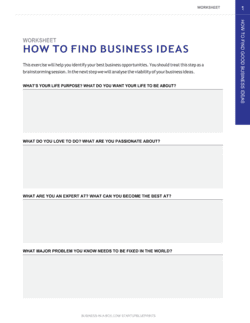
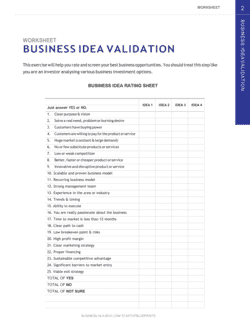
The guide covers personal asset mapping, problem and pain-point identification, market trend scanning, competitor gap analysis, and a weighted idea-scoring matrix. It also includes a go/no-go decision framework so you can move from a shortlist of ideas to a single validated concept ready for the next stage of planning.

What is How To Find Good Business Ideas β€” Startup Blueprints Chapter 1?

How To Find Good Business Ideas β€” Startup Blueprints Chapter 1 is a structured Word guide that takes aspiring entrepreneurs through a repeatable, step-by-step process for generating, scoring, and validating business ideas before committing time or capital. Rather than leaving idea discovery to chance or intuition, it applies a set of proven frameworks β€” personal asset mapping, pain-point identification, trend scanning, competitive gap analysis, and a weighted scoring matrix β€” to produce a shortlist of viable candidates and a single validated concept ready for the next stage of planning. It is the first chapter in the Startup Blueprints series, designed to be completed before writing a business plan.

Why You Need This Document

Most early-stage ventures fail not because founders execute poorly, but because they chose the wrong idea to execute. Without a structured ideation process, founders default to the first concept that excites them, skip competitive research, and confuse survey interest with real demand β€” arriving at the business plan stage with an unvalidated concept and months of wasted momentum. This guide closes that gap by forcing the idea-selection decision to be evidence-based rather than enthusiasm-driven. It gives you a documented reasoning trail for the idea you chose, which makes every downstream document β€” the business plan, the pitch deck, the financial model β€” faster to write and more credible to the people who read them.

Which variant fits your situation?

If your situation is…Use this template
You have an idea and need to validate market demand before buildingMarket Research Report
You are ready to write a full business plan after selecting an ideaBusiness Plan
You want a one-page snapshot of your chosen conceptOne-Page Business Plan
You need to assess strengths and weaknesses of a specific ideaSWOT Analysis
You want to map customer pain points before building a productCustomer Journey Map
You are comparing several business models and need a structured frameworkBusiness Model Canvas
You have selected an idea and need to plan the launchProduct Launch Plan

Common mistakes to avoid

❌ Jumping to solutions before defining the problem

Why it matters: Ideas generated before a pain point is clearly articulated tend to be solutions looking for a problem. They attract no customers because the market doesn't recognize the problem the founder is solving.

Fix: Write a one-sentence problem statement for each idea β€” naming who experiences it, how often, and what they currently do about it β€” before allowing yourself to describe the solution.

❌ Stopping the brainstorm at three or four ideas

Why it matters: The most obvious ideas are also the most competitive. Founders who stop early almost always end up in overcrowded markets with no differentiation.

Fix: Commit to generating at least 20 raw ideas before filtering. Use the structured prompts in the guide to push past the obvious options into underserved niches.

❌ Treating survey responses as market validation

Why it matters: People consistently say they would buy things they never actually purchase. Survey-based validation gives founders false confidence and leads to building products with no real demand.

Fix: Design a validation test that requires behavioral commitment β€” a deposit, a sign-up with a credit card, or a scheduled follow-up call β€” before counting any response as a positive signal.

❌ Ignoring founder-market fit in the scoring matrix

Why it matters: A large market with intense competition that you enter without relevant skills or network takes three to five times longer and costs far more to crack than a smaller market where you have genuine insider advantage.

Fix: Weight founder-market fit at 20–25% in the scoring matrix and be honest in the assessment. A score of 2/5 on fit should disqualify an idea regardless of its other scores.

❌ Skipping the go/no-go decision documentation

Why it matters: Undocumented decisions are reversible in hindsight. Founders who don't write down their reasoning at the go/no-go stage routinely revise their memories of what the evidence showed once they are emotionally invested in execution.

Fix: Write a 3–5 sentence decision memo at the go/no-go stage: what the evidence showed, what the biggest unresolved risk is, and what specific condition would cause you to reverse the decision.

❌ Using overly broad target customer definitions

Why it matters: Defining the customer as 'small businesses' or 'young professionals' makes it impossible to identify where to find the first 50 paying customers, which channels to use, or what message will resonate.

Fix: Write the target customer definition with enough specificity to name a real person: their industry, company size, job title, the trigger that makes them look for a solution, and the outcome they care most about.

The 9 key sections, explained

Personal asset inventory

Problem and pain-point identification

Market trend scanning

Idea generation brainstorm

Competitive landscape overview

Idea scoring matrix

Primary idea deep-dive

Early validation plan

Go/no-go decision framework

How to fill it out

  1. 1

    Complete the personal asset inventory

    List your five to eight most marketable skills, your relevant industry experience in years and context, your key professional contacts, your available startup capital, and the weekly hours you can commit.

    πŸ’‘ Be conservative on capital and time estimates β€” founders consistently overestimate both, and the ideas you shortlist should be viable at the lower number.

  2. 2

    Identify five to ten genuine pain points

    Draw from three sources: problems you've personally experienced at work or in daily life, complaints you've observed in online forums or communities, and frustrations voiced by colleagues or clients. Write each as a one-sentence problem statement before thinking about solutions.

    πŸ’‘ Reddit, G2 reviews, and Amazon one-star reviews are among the most reliable raw-material sources for real, unfiltered customer pain points.

  3. 3

    Scan for three to five macro trends

    Research demographic, regulatory, technological, and behavioral shifts affecting the industries where your pain points live. Use Google Trends, industry reports, and startup funding databases to confirm that others are betting on the same direction.

    πŸ’‘ A trend with a clear 3–5 year window is more actionable than a trend still 10 years out β€” you need enough momentum to find customers now.

  4. 4

    Run the brainstorm session and generate at least 20 ideas

    Use the structured prompts in the guide to generate a minimum of 20 raw ideas. Apply no filters during generation β€” quantity is the goal. Record every idea in the brainstorm table even if it seems implausible.

    πŸ’‘ Set a 45-minute timer and commit to reaching 20 before stopping. The constraint forces creative connections you wouldn't reach by thinking casually.

  5. 5

    Shortlist three to five ideas using the scoring matrix

    Enter your top candidates into the scoring matrix, adjust the weights to reflect your capital and time constraints, and calculate weighted totals. Carry the top three to five scores forward to the competitive landscape section.

    πŸ’‘ If two ideas score within 0.3 points of each other, don't discard the lower-scoring one yet β€” run both through the competitive landscape review before deciding.

  6. 6

    Complete the competitive landscape scan for each shortlisted idea

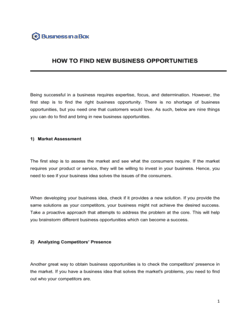
    For each shortlisted idea, identify at least four existing players or alternatives, map their pricing and target segment, and write one sentence on the gap you would exploit.

    πŸ’‘ Check both direct competitors (same product category) and indirect competitors (different product, same outcome) β€” customers always have a substitute, even if it's a spreadsheet.

  7. 7

    Select the primary idea and complete the deep-dive

    Choose the highest-scoring idea after the competitive scan and complete the deep-dive section β€” specific target customer, SAM estimate, value proposition statement, and top three risks with mitigation ideas.

    πŸ’‘ The value proposition template ('helps [customer] who [pain point] by [solution] so they can [outcome]') should be completable in one sentence β€” if it takes three, the concept needs further focus.

  8. 8

    Design and execute the 30-day validation plan

    Choose one validation method (customer interviews, landing page, pre-sales, or concierge MVP), set a specific success metric that involves real behavioral commitment, and execute within 30 days before moving to Chapter 2.

    πŸ’‘ Book the first five customer discovery interviews before finishing the document β€” scheduling friction is the most common reason validation never happens.

Frequently asked questions

What is the best way to find a good business idea?

The most reliable approach is to start with problems rather than solutions β€” specifically, problems you have direct experience with or that you observe recurring in a market you understand. Document at least ten genuine pain points before generating any solution ideas, then use a structured scoring matrix to rank candidates against market size, competitive intensity, and your own skills. Ideas that emerge from real frustration and founder expertise consistently outperform ideas generated purely from trend-chasing.

How do I know if a business idea is worth pursuing?

An idea is worth pursuing when it passes three tests: the pain point is real and recurring (not a one-off inconvenience), the market is large enough to support a viable business at your target revenue, and you have a credible reason why you can serve that market better than existing alternatives. The validation plan in this guide turns those tests into concrete actions β€” customer interviews, a landing page, or pre-sales β€” that produce evidence rather than assumptions.

How many business ideas should I generate before choosing one?

Generate a minimum of 15–20 raw ideas before applying any filters. Research on creative problem-solving consistently shows that the best options rarely appear in the first five. The scoring matrix in this guide is designed to work with a pool of 15–20 candidates and narrow them to three to five finalists before deep evaluation begins.

What is founder-market fit and why does it matter?

Founder-market fit describes how well your skills, experience, and network position you to win in a specific market. A founder with ten years in healthcare IT has genuine advantages entering a health-data startup β€” credibility with buyers, existing relationships, and regulatory fluency β€” that a generalist founder would spend years and significant capital acquiring. Ideas with strong founder-market fit reach their first paying customers faster and with less wasted effort.

Should I validate my idea before writing a business plan?

Yes. Validation comes before planning. A business plan built on an unvalidated idea is a detailed document built on assumptions that may be wrong. Run at least a lightweight validation test β€” five to ten customer discovery interviews, a landing page, or a pre-sale offer β€” before investing the time to write a full plan. The results will sharpen every section of the plan and prevent you from building a roadmap to the wrong destination.

What counts as real validation for a business idea?

Real validation requires behavioral commitment, not stated intention. A person agreeing in an interview that they "would probably" use your product is not validation. A person providing a credit card number, a deposit, or a signed letter of intent is. Design your validation test around the smallest possible commitment that represents genuine demand β€” even $1 paid for a waiting list spot is more meaningful than 100 survey responses.

How is this guide different from a full business plan?

This guide covers the idea-generation and validation stage that happens before a business plan is written. It helps you answer the question 'which idea should I pursue?' rather than 'how will I execute this idea?' Once you have completed this guide and selected a validated idea, the next step is Chapter 2 β€” the full business plan β€” which maps out execution, financials, and go-to-market strategy in detail.

Can this guide be used for a business pivot, not just a new startup?

Yes. The frameworks in this guide work equally well for founders evaluating a pivot from their current model. The personal asset inventory section is particularly useful for existing founders because it captures the operational knowledge, customer relationships, and infrastructure already built β€” assets that frequently point to adjacent opportunities that are faster and cheaper to pursue than starting from scratch.

What should I do after completing this guide?

After completing the go/no-go decision framework and confirming a validated idea, the next step is Chapter 2 of the Startup Blueprints series β€” the full business plan template. That document builds on the idea you selected here and adds market analysis, competitive positioning, financial projections, and a funding strategy. If the validation test returned a no-go result, return to the idea scoring matrix and advance the next-highest-scoring candidate.

How this compares to alternatives

vs Business Plan

A business plan details how you will execute a chosen idea β€” financials, go-to-market, operations, and team. This guide answers the earlier question of which idea to pursue and whether it is worth pursuing at all. Complete this guide first; use the business plan after validation confirms the idea is viable.

vs SWOT Analysis

A SWOT analysis evaluates the strengths, weaknesses, opportunities, and threats of a single known idea or business. This guide is used upstream β€” it generates and compares multiple candidate ideas before one is selected for deeper analysis. Use the SWOT analysis after this guide has produced a finalist.

vs Market Research Report

A market research report provides deep, evidence-based analysis of a specific market β€” customer segments, size, trends, and competitive dynamics. This guide covers a lighter-weight market scan across multiple idea candidates. Once an idea is selected using this guide, a full market research report provides the depth needed for a business plan or investor deck.

vs One-Page Business Plan

A one-page business plan captures the key elements of a chosen concept on a single structured canvas. It assumes the idea is already selected. This guide is the step before β€” the process of identifying, scoring, and validating ideas so the one-page plan reflects a concept with real market evidence behind it.

Industry-specific considerations

SaaS / Technology

Technical founders use the framework to move from 'we can build this' to 'someone will pay for this' β€” shifting from capability-led to problem-led ideation.

Professional Services

Consultants and agency founders use the personal asset inventory and founder-market fit scoring to identify productized service offerings built on their existing client expertise.

Retail / E-commerce

Product entrepreneurs use the competitive gap analysis and trend scanning sections to identify underserved niches before committing to inventory or supplier relationships.

Food & Beverage

F&B founders apply the pain-point identification and validation plan sections to test concepts with real customers before signing a lease or purchasing commercial equipment.

Template vs pro β€” what fits your needs?

PathBest forCostTime
Use the templateFirst-time founders, side-business explorers, and accelerator applicants working through idea generation independentlyFree1–2 weeks (10–20 hours)
Template + professional reviewFounders who want structured feedback on their shortlisted ideas from a mentor, advisor, or startup coach$200–$800 for 2–4 advisor sessions2–3 weeks
Custom draftedCorporate innovation teams or incubators running structured ideation sprints for multiple participants$2,000–$8,000 for a facilitated innovation workshop2–5 days (facilitated)

Glossary

Opportunity Gap
A space in the market where customer needs are unmet or poorly served by existing products and services.
Pain Point
A specific, recurring problem experienced by a defined group of people that is frustrating enough to motivate them to pay for a solution.
Idea Validation
The process of testing whether a business idea reflects real demand before committing significant resources to building or launching it.
Total Addressable Market (TAM)
The total revenue opportunity available if a product or service captured 100% of its target market.
Competitive Moat
A durable structural advantage β€” such as proprietary data, network effects, or switching costs β€” that makes a business position difficult to replicate.
Founder-Market Fit
The degree to which a founder's skills, experience, and network give them a credible edge in pursuing a specific market opportunity.
Minimum Viable Product (MVP)
The simplest version of a product that delivers enough value to attract early customers and generate actionable feedback.
Idea Scoring Matrix
A weighted table that ranks business ideas against criteria such as market size, competition level, capital required, and founder fit.
Trend Tailwind
A macro-level shift β€” demographic, technological, regulatory, or behavioral β€” that makes a particular market easier to enter and grow in today than it was five years ago.
Go/No-Go Decision
A structured checkpoint where a founder reviews all evidence and decides whether to advance an idea to the planning stage or return to idea generation.

Part of your Business Operating System

This document is one of 3,000+ business & legal templates included in Business in a Box.

  • Fill-in-the-blanks β€” ready in minutes
  • Compatible with all office suites
  • Export to PDF and share electronically

Create your document in 3 simple steps.

From template to signed document β€” all inside one Business Operating System.
1
Download or open template

Access over 3,000+ business and legal templates for any business task, project or initiative.

2
Edit and fill in the blanks with AI

Customize your ready-made business document template and save it in the cloud.

3
Save, Share, Send, Sign

Share your files and folders with your team. Create a space of seamless collaboration.

Save time, save money, and create top-quality documents.

β˜…β˜…β˜…β˜…β˜…

"Fantastic value! I'm not sure how I'd do without it. It's worth its weight in gold and paid back for itself many times."

Managing Director Β· Mall Farm
Robert Whalley
Managing Director, Mall Farm Proprietary Limited
β˜…β˜…β˜…β˜…β˜…

"I have been using Business in a Box for years. It has been the most useful source of templates I have encountered. I recommend it to anyone."

Business Owner Β· 4+ years
Dr Michael John Freestone
Business Owner
β˜…β˜…β˜…β˜…β˜…

"It has been a life saver so many times I have lost count. Business in a Box has saved me so much time and as you know, time is money."

Owner Β· Upstate Web
David G. Moore Jr.
Owner, Upstate Web

Run your business with a system β€” not scattered tools

Stop downloading documents. Start operating with clarity. Business in a Box gives you the Business Operating System used by over 250,000 companies worldwide to structure, run, and grow their business.

Start freeΒ Β·Β No credit card required