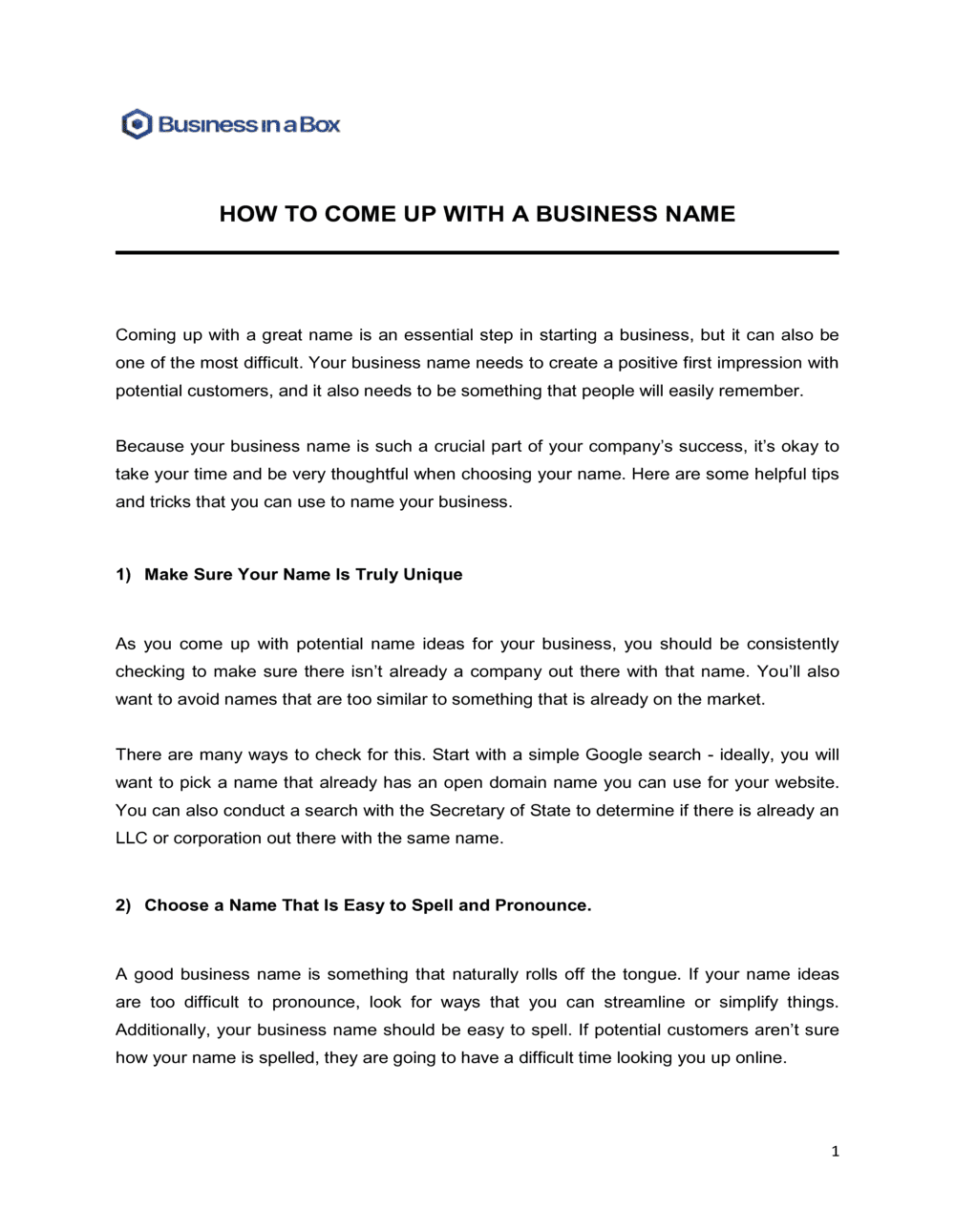
How To Come Up With A Business Name

Free to read β€’ Save or share with one click

FreeHow To Come Up With A Business Name Template

At a glance

What it is
How To Come Up With A Business Name is a structured operational guide that walks founders and entrepreneurs through a repeatable, step-by-step process for generating, evaluating, and finalizing a business name. This free Word download gives you a ready-to-use framework covering brainstorming techniques, screening criteria, trademark and domain checks, and a final decision scorecard β€” edit online and export as PDF to share with partners or advisors.
When you need it
Use it when launching a new business, rebranding an existing company, naming a new product line, or spinning off a division that needs its own identity. It is especially valuable when multiple stakeholders need to align on a name before legal registration and brand asset development begin.
What's inside
A brainstorming worksheet, naming criteria scorecard, trademark and domain availability checklist, competitor name audit, shortlist evaluation matrix, and final selection rationale β€” all structured so a solo founder or a cross-functional team can move from blank page to registered name in a single focused session.

What is a How To Come Up With A Business Name guide?

A How To Come Up With A Business Name guide is a structured operational document that walks founders, entrepreneurs, and brand teams through a repeatable process for generating, screening, and finalizing a business name. It combines brainstorming frameworks, legal availability checklists, domain and trademark search documentation, and a weighted evaluation matrix into a single workable template β€” moving the naming decision from an arbitrary creative exercise to a defensible, documented process. The guide covers everything from defining naming objectives and generating a raw candidate pool to running trademark searches and stress-testing top candidates with real target customers before any legal filings are made.

Why You Need This Document

Choosing a business name without a structured process is one of the most expensive mistakes an early-stage founder can make. A name that feels right in the moment but turns out to conflict with an existing trademark can force a rebrand after launch β€” costing thousands in new domain registrations, logo redesigns, printed materials, and lost brand recognition. A name that is hard to spell or pronounce creates a persistent word-of-mouth problem that no amount of marketing spend can fully correct. And a purely descriptive name β€” the default choice for founders who skip the process β€” provides virtually no legal protection, leaving the brand open to imitation from day one. This template gives you a documented, step-by-step framework that eliminates the most common failure modes, produces a shortlist of legally available, customer-tested candidates, and creates the paper trail you need when working with a trademark attorney or business registration agent.

Which variant fits your situation?

If your situation is…Use this template
Naming a new standalone business from scratchHow To Come Up With A Business Name
Rebranding an existing company after a pivot or acquisitionBrand Strategy Template
Naming a new product or service within an existing companyNew Product Launch Plan
Developing a full brand identity after the name is chosenBrand Identity Guidelines
Registering the chosen name as a trademarkTrademark Assignment Agreement
Evaluating a name as part of a broader business planBusiness Plan Template
Naming a nonprofit organization or charitable entityNonprofit Business Plan

Common mistakes to avoid

❌ Choosing a name you love without testing it with target customers

Why it matters: A name that resonates with the founder may mean nothing β€” or something negative β€” to the people who will actually buy the product. Misjudging this costs money in rebranding and lost early traction.

Fix: Test the final shortlist with at least five people from your target audience before making any legal filings. Use a structured survey, not casual conversation.

❌ Registering a domain before running a trademark search

Why it matters: Buying a domain provides no legal protection against a trademark owner with prior rights to the same name β€” you can be forced to surrender the domain and rebrand after launch.

Fix: Complete the USPTO TESS search (or national equivalent) before purchasing any domain or filing any business entity paperwork.

❌ Picking a purely descriptive name because it seems easy to understand

Why it matters: Descriptive names β€” 'Fast Loans,' 'Clean Cleaners,' 'Cheap Parts' β€” cannot be trademarked without years of acquired distinctiveness, leaving your brand legally unprotected and easy to imitate.

Fix: Choose a suggestive or coined name that implies the benefit without stating it literally β€” these are both more distinctive and significantly easier to trademark.

❌ Ignoring how the name abbreviates or looks as an acronym

Why it matters: A business name that abbreviates to something embarrassing or confusing will be shortened by customers regardless of your preference, creating a brand problem you cannot easily fix.

Fix: Write out the abbreviation and acronym of every shortlisted name before finalizing. If the initials spell something unintended, eliminate the name.

❌ Securing the .com domain weeks after announcing the name publicly

Why it matters: Domain squatters monitor business registration filings and social media announcements in real time β€” a gap of even 24 hours between public announcement and domain purchase can result in a squatting demand of thousands of dollars.

Fix: Register the .com domain and all primary social handles on the same day you finalize the name internally, before any public announcement.

❌ Not checking the name in all languages relevant to your target market

Why it matters: A name that is clean in English may be a common profanity, a competitor's brand, or a culturally offensive term in Spanish, French, Mandarin, or Portuguese β€” any of which can end your expansion into that market.

Fix: Before finalizing, commission a 30-minute review from a native speaker in each language your customers actually use, not a machine translation.

The 9 key sections, explained

Naming objectives and brand positioning

Brainstorming worksheet

Naming category selection

Preliminary screening checklist

Trademark and business name availability search

Domain and social handle availability check

Shortlist evaluation matrix

Stakeholder feedback and stress-testing

Final selection and registration rationale

How to fill it out

  1. 1

    Define your naming objectives before generating any names

    Fill in the brand positioning section first: who the customer is, what emotion or idea the name must convey, the geographic scope, and any hard constraints. This section acts as the filter for every step that follows.

    πŸ’‘ Keep the list of hard constraints short β€” three to five maximum. Too many constraints make every name a failure.

  2. 2

    Run a structured brainstorming session to generate at least 30 candidates

    Work through each brainstorming prompt in the worksheet β€” free association, metaphor mapping, root word combinations, and competitor contrast β€” and capture every idea without self-editing. Aim for quantity before quality.

    πŸ’‘ Set a timer for 20 minutes per technique. Stopping the clock forces output and prevents overthinking early in the process.

  3. 3

    Select a naming category that fits your brand strategy

    Review the five naming categories (descriptive, suggestive, coined, founder, geographic) and select the one that aligns with your positioning, timeline, and budget for brand building. Document your rationale.

    πŸ’‘ If you plan to expand internationally within five years, eliminate geographic names now β€” they create positioning problems and sometimes legal conflicts in other markets.

  4. 4

    Apply the preliminary screening checklist to eliminate obvious failures

    Run every candidate through the pass/fail checklist β€” offensive connotations, pronunciation difficulty, negative foreign-language meanings, and obvious brand conflicts. Remove any that fail a single criterion.

    πŸ’‘ Run the foreign-language check using a native speaker or a professional translator, not a translation tool β€” nuance and slang are missed by automated tools.

  5. 5

    Search trademark and business entity registries for your shortlist

    For the top 8–10 names that cleared the preliminary screen, run USPTO TESS searches (or the equivalent national registry), check the relevant state or province entity database, and document the results in the availability section.

    πŸ’‘ Search for phonetically similar names, not just exact matches β€” a name that sounds like an existing trademark can still generate an infringement claim.

  6. 6

    Check domain and social handle availability for each surviving candidate

    For names with clear trademark status, check .com availability and all primary social platforms. Record results in the domain and social handle section. Eliminate names where both .com and .co are taken.

    πŸ’‘ Use a bulk domain search tool to check multiple names simultaneously β€” this cuts this step from 30 minutes to five.

  7. 7

    Score surviving names in the evaluation matrix

    Enter each name that passed all prior steps into the evaluation matrix, score it on each criterion, apply the weights, and calculate totals. Your top three candidates should be clearly distinguishable by score.

    πŸ’‘ If two names are within 5 points of each other, the tiebreaker should always be trademark clearance, not aesthetics.

  8. 8

    Test top candidates with target customers and document final selection

    Present the top two or three names to five to ten people from your actual target audience and collect structured feedback. Record scores, note any surprises, and document the final selected name with rationale in the selection section. Immediately register the domain and secure social handles.

    πŸ’‘ Ask testers to spell the name aloud after hearing it spoken once β€” if more than two people misspell it, the name has a word-of-mouth problem.

Frequently asked questions

How do you come up with a good business name?

A good business name starts with clearly defined criteria β€” who the customer is, what the name should communicate, and what it must not imply β€” before any brainstorming begins. Generate at least 30 candidate names using structured techniques (free association, metaphor mapping, word combinations), then screen them against trademark availability, domain status, and pronunciation ease. The name that survives all screens and scores highest in a weighted evaluation matrix is almost always a stronger choice than the name the founder fell in love with on day one.

What makes a business name legally protectable?

Trademark law protects names that are distinctive β€” specifically those that are coined (invented words), arbitrary (real words unrelated to the product), or suggestive (words that hint at a benefit without describing it directly). Descriptive names β€” those that simply describe the product or service β€” receive little or no trademark protection until they acquire distinctiveness through years of use. Generic terms cannot be trademarked at all. Choosing a suggestive or coined name from the start gives you the strongest possible legal protection for your brand investment.

Should my business name include keywords for SEO?

Including a keyword in your business name can provide a minor initial SEO signal, but the benefit is outweighed by the legal and branding costs for most businesses. Keyword-heavy names (e.g., 'Chicago Plumbing Pros') are difficult to trademark, feel generic, and limit scalability if you expand beyond the keyword's scope. A distinctive brand name paired with strong on-page SEO and content strategy consistently outperforms keyword stuffing in the name within 12–18 months of launch.

How do I check if a business name is already taken?

Start with the USPTO Trademark Electronic Search System (TESS) at tess.uspto.gov for US trademark conflicts, then search your state's Secretary of State business entity database for LLC and corporation name conflicts. Check domain availability for the .com version of the name, then verify primary social media handles on Instagram, LinkedIn, X, and TikTok. In Canada, use the NUANS database for national trademark and corporate name searches. Running all four checks takes roughly 30–45 minutes per name.

How long should a business name be?

One to three syllables is the sweet spot for memorability and ease of pronunciation β€” think names like Stripe, Slack, or Zoom. Names up to four syllables work well if they are easy to spell and phonetically consistent. Names longer than five syllables consistently underperform in recall tests and create friction in word-of-mouth referrals. If your preferred name runs long, test whether it has a natural two-syllable abbreviation customers will default to regardless.

What is the difference between a business name and a trademark?

A business name (or trade name) is the name under which you operate, registered with a state, province, or local authority. A trademark is a federally (or nationally) registered right to exclusively use a name, logo, or slogan in connection with specific goods or services. Registering a business name does not give you trademark rights β€” it only prevents another entity from incorporating under the identical name in that jurisdiction. You need a separate trademark application to protect the name against use by competitors in your industry nationwide.

Can two businesses have the same name?

Yes, in many circumstances. Businesses operating in different industries or different geographic markets can legally share similar names without trademark conflict β€” 'Amazon' the bookstore and 'Amazon' the river tour company in a different state is a simplified example. Conflicts arise when two businesses in the same industry and geographic market use names that are identical or confusingly similar. Federal trademark registration provides the clearest nationwide protection and is the recommended step after finalizing your name.

Should I buy multiple domain extensions for my business name?

At minimum, secure the .com β€” it is the default extension customers type when they cannot remember your full URL. If your business operates in Canada, the UK, or Australia, also register the relevant country-code extension (.ca, .co.uk, .com.au). The .io extension is widely accepted in the technology sector as a credible alternative to .com for SaaS products. Buying every possible extension is rarely worth the cost for early-stage businesses; prioritize .com and your primary market's country-code extension.

How much does it cost to trademark a business name?

In the United States, USPTO filing fees run $250–$350 per class of goods or services when filing electronically through TEAS Plus or TEAS Standard. Most small businesses file in one or two classes, making the direct cost $250–$700. Adding a trademark attorney for the application typically costs $500–$1,500 in professional fees, bringing the total to $750–$2,200. Processing time is 8–12 months under normal conditions. In Canada, CIPO fees start at CAD $458 for the first class.

How this compares to alternatives

vs Brand Strategy Template

A brand strategy template defines the full brand identity system β€” positioning, voice, visual language, and messaging β€” after the name is chosen. The business naming guide is the upstream document that produces the name the brand strategy is built around. Complete the naming guide first, then use the brand strategy template to develop everything that flows from it.

vs Business Plan Template

A business plan includes a company overview section that references the business name, but it does not provide a naming process. The naming guide is a standalone tool for generating and validating the name itself; the business plan is where the finalized name is embedded into a broader strategic and financial narrative. Most founders complete the naming guide before drafting the business plan.

vs New Product Launch Plan

A product launch plan covers go-to-market strategy, positioning, pricing, and campaign execution for a specific product release. A business naming guide focuses specifically on generating and legally validating the name β€” whether for a business or a product line. For a product launch, the naming guide should be completed during the discovery phase, well before the launch plan is drafted.

vs One-Page Business Plan

A one-page business plan is a rapid-alignment tool for capturing the business model and strategy at a high level. It assumes a name already exists and does not include any naming process. Use the naming guide to finalize and validate the business name, then populate the one-page plan with that confirmed name and the rest of your model.

Industry-specific considerations

Technology / SaaS

Coined and invented names dominate because they are globally scalable, trademark-friendly, and avoid the geographic or descriptive limitations that constrain SaaS companies targeting international markets.

Professional Services

Founder-name and initials-based firm names are common for credibility signaling, but require a separate brand-name strategy when the founder exits or the firm grows beyond a single principal.

Retail / E-commerce

Memorable, short names with high search volume and clean .com availability are critical because organic search and direct type-in traffic drive a disproportionate share of e-commerce revenue.

Food and Beverage

Evocative sensory names that suggest taste, origin, or experience perform well, but geographic descriptors (e.g., 'Brooklyn' or 'Coastal') can create expansion friction when the brand moves beyond its home market.

Healthcare and Wellness

Names must avoid implying medical claims or treatments without regulatory approval, and should be checked against existing healthcare provider names in target states to avoid patient confusion and HIPAA-adjacent concerns.

Creative and Marketing Agencies

Agency names are often suggestive or abstract to signal creativity, but founders frequently underestimate the value of a name that is easy for clients to recall and spell correctly when referring the agency to colleagues.

Template vs pro β€” what fits your needs?

PathBest forCostTime
Use the templateSolo founders and small teams naming a new domestic business or product lineFree2–4 hours for a single focused session
Template + professional reviewBusinesses filing a trademark application or entering a competitive, brand-sensitive category$500–$1,500 for a trademark attorney clearance search and filing review3–7 days
Custom draftedEnterprise rebrands, international launches, or acquisitions where name equity is a material asset$5,000–$50,000+ for a professional naming agency engagement4–12 weeks

Glossary

DBA (Doing Business As)
A trade name or fictitious name under which a business operates that differs from its registered legal entity name.
Trademark
A word, phrase, symbol, or design registered with a government authority to exclusively identify a company's goods or services.
TESS (Trademark Electronic Search System)
The USPTO's free public database for searching existing registered and pending US trademarks before choosing a business name.
Domain Name
The web address (e.g., yourbusiness.com) associated with a business's online presence β€” availability should be confirmed before finalizing a name.
Nameability
A name's ease of pronunciation, spelling, and recall β€” high nameability reduces customer confusion and word-of-mouth friction.
Brand Positioning
The distinct value proposition and market niche a business occupies in the minds of its target customers, which the name should reinforce.
Generic Term
A common descriptive word for a product category β€” generic terms cannot be trademarked and make differentiation harder (e.g., naming a bakery 'The Bakery').
Coined Name
An invented word with no prior dictionary meaning, created specifically as a brand name β€” often the most trademark-friendly and globally scalable option.
Descriptive Name
A name that directly describes what a business does β€” easy for customers to understand but difficult or impossible to trademark without acquired distinctiveness.
Screening Matrix
A scoring table that evaluates each candidate name against a fixed set of criteria (memorability, availability, fit, scalability) to produce a ranked shortlist.

Part of your Business Operating System

This document is one of 3,000+ business & legal templates included in Business in a Box.

  • Fill-in-the-blanks β€” ready in minutes
  • Compatible with all office suites
  • Export to PDF and share electronically

Create your document in 3 simple steps.

From template to signed document β€” all inside one Business Operating System.
1
Download or open template

Access over 3,000+ business and legal templates for any business task, project or initiative.

2
Edit and fill in the blanks with AI

Customize your ready-made business document template and save it in the cloud.

3
Save, Share, Send, Sign

Share your files and folders with your team. Create a space of seamless collaboration.

Save time, save money, and create top-quality documents.

β˜…β˜…β˜…β˜…β˜…

"Fantastic value! I'm not sure how I'd do without it. It's worth its weight in gold and paid back for itself many times."

Managing Director Β· Mall Farm
Robert Whalley
Managing Director, Mall Farm Proprietary Limited
β˜…β˜…β˜…β˜…β˜…

"I have been using Business in a Box for years. It has been the most useful source of templates I have encountered. I recommend it to anyone."

Business Owner Β· 4+ years
Dr Michael John Freestone
Business Owner
β˜…β˜…β˜…β˜…β˜…

"It has been a life saver so many times I have lost count. Business in a Box has saved me so much time and as you know, time is money."

Owner Β· Upstate Web
David G. Moore Jr.
Owner, Upstate Web

Run your business with a system β€” not scattered tools

Stop downloading documents. Start operating with clarity. Business in a Box gives you the Business Operating System used by over 250,000 companies worldwide to structure, run, and grow their business.

Start freeΒ Β·Β No credit card required