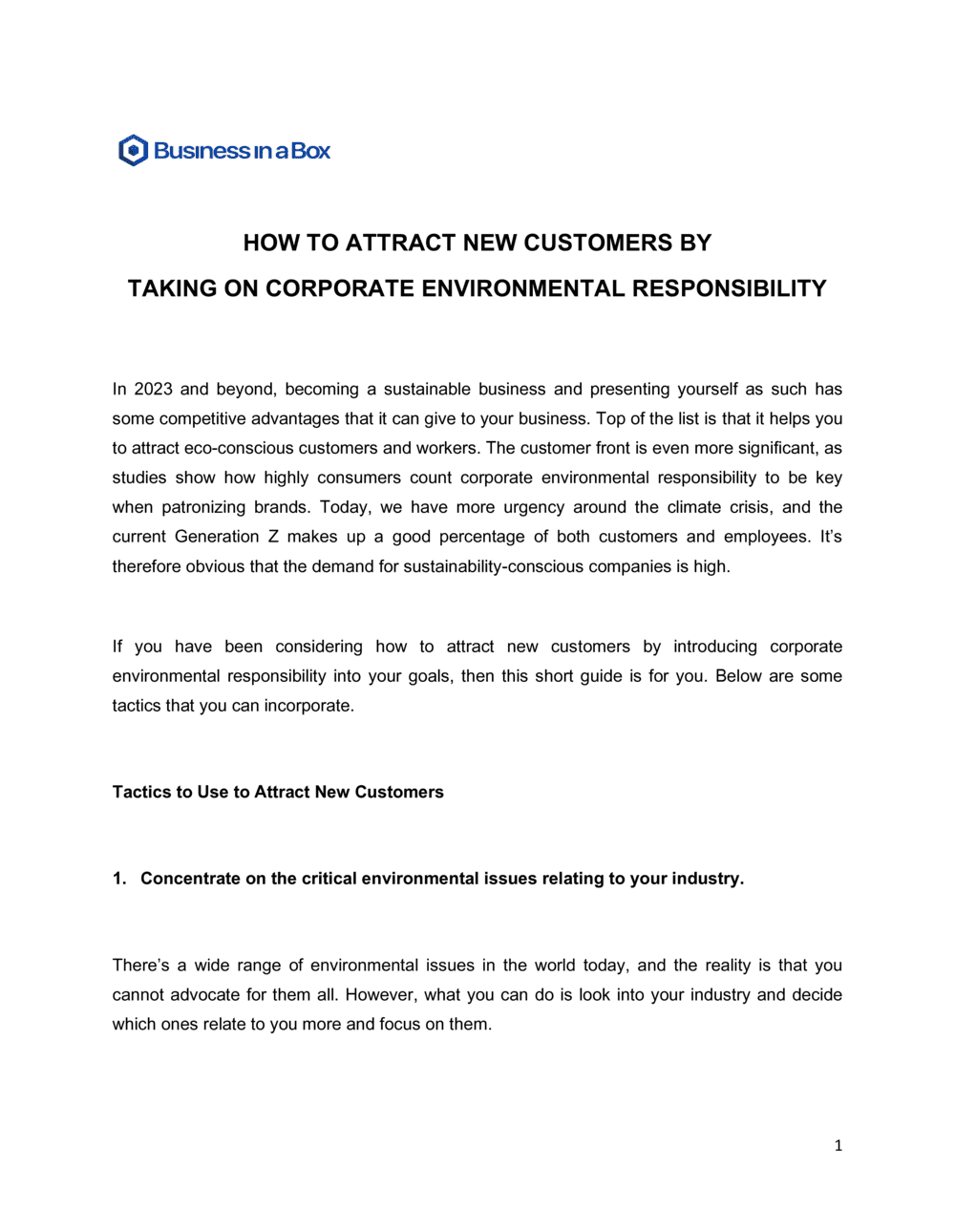
How To Attract New Customers By Taking Corporate Environmental Responsibility

Free Word download β€’ Edit online β€’ Save & share with Drive β€’ Export to PDF

3 pagesβ€’20–25 min to fillβ€’Difficulty: Standard
Learn more ↓
FreeHow To Attract New Customers By Taking Corporate Environmental Responsibility Template

At a glance

What it is
This is a structured Word template that guides businesses through building and communicating a corporate environmental responsibility strategy designed to attract new customers. It covers green initiative planning, customer-facing messaging, measurable targets, and reporting β€” available as a free download you can edit online and export as PDF.
When you need it
Use it when your business is ready to formalize its environmental commitments, differentiate from competitors on sustainability, or respond to customers and procurement teams asking for documented green practices.
What's inside
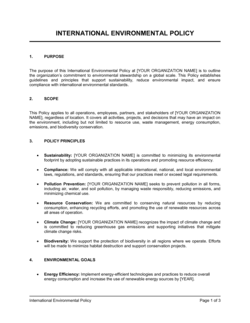
Environmental commitment statement, current impact baseline, green initiative roadmap, customer-facing messaging strategy, employee engagement plan, supplier and supply chain considerations, metrics and KPIs, and a reporting and communication framework.

What is a Corporate Environmental Responsibility Strategy?

A Corporate Environmental Responsibility Strategy is a structured plan that defines a business's environmental commitments, maps specific green initiatives to measurable targets, and connects those actions to a customer-facing communication approach. It goes beyond a mission statement by documenting the baseline impact, the roadmap for improvement, the metrics used to track progress, and the channels through which results are communicated to customers, suppliers, and partners. Businesses use it to turn environmental values into a documented, credible competitive differentiator rather than an informal internal aspiration.

Why You Need This Document

Without a written environmental responsibility plan, green claims made in proposals, on packaging, or in marketing copy are unsupported β€” and increasingly, enterprise procurement teams, regulators, and consumers are calling that out. In the US, the FTC's Green Guides set clear expectations for substantiated claims; in the EU, the Green Claims Directive introduces legal liability for unsubstantiated environmental marketing. Beyond compliance, a documented plan is now a practical sales tool: many corporate buyers require environmental documentation as a condition of supplier approval, and a well-structured plan is the difference between qualifying and being replaced by a competitor who has one. This template gives you the structure to build that plan in a single working session, producing a document you can share with prospects, customers, and procurement teams the moment they ask.

Which variant fits your situation?

If your situation is…Use this template
Full ESG strategy for investors and corporate stakeholdersESG Report
Establishing an internal environmental policy for employeesEnvironmental Policy Template
Tracking carbon footprint and emissions reductions over timeCarbon Footprint Report
Communicating sustainability progress to the public annuallyCorporate Social Responsibility Report
Responding to a specific customer or procurement sustainability questionnaireSupplier Code of Conduct
Launching a single focused green initiative like paperless operationsGreen Initiative Project Plan
Integrating sustainability into a broader business strategyStrategic Plan

Common mistakes to avoid

❌ Publishing claims before actions are in place

Why it matters: Environmental claims made ahead of actual initiatives expose the business to greenwashing accusations, regulatory scrutiny, and customer backlash that is harder to recover from than no claim at all.

Fix: Complete at least one measurable initiative before communicating it externally. Document the baseline and the result so the claim is substantiated at the moment of publication.

❌ Setting targets with no owners or review dates

Why it matters: Unowned targets drift β€” no one checks progress, the deadline passes quietly, and the document becomes a liability rather than an asset if customers ask for an update.

Fix: Assign every KPI and initiative to a named individual with a calendar reminder. Review at least quarterly and update the document when targets change.

❌ Ignoring supply chain emissions

Why it matters: For most businesses, Scope 3 emissions from suppliers, logistics, and customer use account for the majority of total environmental impact. Reporting only on direct operations understates impact and misleads stakeholders.

Fix: Add a supplier questionnaire requirement and at least one Scope 3 metric β€” such as packaging recyclability or freight emissions β€” to the KPI section.

❌ Treating the document as a one-time marketing exercise

Why it matters: Customers and procurement teams increasingly revisit environmental commitments at each contract renewal. A document that was accurate in Year 1 but never updated becomes a credibility problem in Year 2.

Fix: Schedule an annual review of the full document, update baseline data and KPI progress, and publish a summary of what changed and why.

The 8 key sections, explained

Environmental commitment statement

Current environmental impact baseline

Green initiative roadmap

Customer-facing messaging strategy

Employee engagement and training plan

Supplier and supply chain considerations

Environmental KPIs and targets

Reporting and external communication framework

How to fill it out

  1. 1

    Conduct a baseline environmental audit

    Before completing the template, gather 12 months of data on your energy bills, waste disposal invoices, water usage, and any known emissions sources. Enter these figures in the baseline section.

    πŸ’‘ Utility providers can supply historical usage data going back 24 months β€” request it before your first drafting session so you are not estimating.

  2. 2

    Write the commitment statement

    Draft a one-paragraph statement that names at least one specific, measurable goal (e.g., 'reduce electricity use by 20% by 2027') and states why the company is making this commitment.

    πŸ’‘ Tie the commitment to a business reason β€” customer expectations, cost savings, or talent attraction β€” not just ethics. It makes the statement more credible to skeptical buyers.

  3. 3

    Prioritize three to five green initiatives

    From your baseline, identify the highest-impact areas for improvement. For each initiative, assign an owner, a target date, and an expected outcome expressed as a number.

    πŸ’‘ Start with initiatives that have a financial payback β€” energy efficiency and waste reduction often cut costs within 12 months, making them easier to fund and sustain.

  4. 4

    Build the customer-facing messaging section

    For each initiative, draft a one-sentence customer claim and identify the supporting data or certification that makes it defensible. Map each claim to the channels where it will appear.

    πŸ’‘ Run claims past your legal or compliance team before publishing. Regulators in the US, UK, and EU are actively enforcing against unsubstantiated green claims.

  5. 5

    Define supplier environmental criteria

    List the minimum environmental requirements you will apply to new and existing suppliers β€” at minimum, a completed questionnaire. Set a deadline for current suppliers to respond.

    πŸ’‘ Start with your top 10 suppliers by spend β€” they typically account for 80%+ of your supply chain impact and the data is most actionable.

  6. 6

    Set KPIs and assign owners

    Enter each KPI in the metrics table with a baseline value, a target value, a target date, and a named owner. Choose no more than six KPIs to start β€” too many dilutes focus.

    πŸ’‘ Pick at least one KPI that is visible to customers β€” such as packaging recyclability percentage β€” so external audiences can see progress without waiting for an annual report.

  7. 7

    Establish the reporting cadence and format

    Decide whether you will publish an annual report, a webpage, a customer newsletter section, or all three. Enter the format, publication date, and responsible person in the reporting framework section.

    πŸ’‘ A simple public webpage updated annually outperforms a polished PDF published once β€” accessibility and regularity matter more than production quality.

  8. 8

    Review and align with leadership before distributing

    Share the completed template with whoever approves marketing commitments and operations budgets. Confirm that every target is funded and every owner has capacity before the document goes public.

    πŸ’‘ Get written sign-off from the CEO or equivalent β€” public environmental commitments made without executive backing are routinely abandoned when competing priorities arise.

Frequently asked questions

What is corporate environmental responsibility?

Corporate environmental responsibility (CER) is a company's voluntary commitment to operate in ways that reduce environmental harm β€” cutting emissions, minimizing waste, using resources efficiently, and sourcing responsibly. It goes beyond legal compliance to reflect what a business chooses to do above and beyond what it is required to do. Businesses that document and communicate these commitments consistently attract customers, employees, and suppliers who prioritize sustainability.

How does environmental responsibility help attract new customers?

Documented environmental practices influence purchasing decisions across B2B and B2C markets. Enterprise procurement teams routinely require sustainability documentation as part of supplier qualification. Consumer research consistently shows that a significant segment β€” particularly under-40 buyers β€” will pay a premium for or switch to a brand with credible environmental credentials. A structured plan gives you concrete claims to make in proposals, on packaging, and in marketing copy.

What is the difference between corporate environmental responsibility and ESG?

Corporate environmental responsibility is the environmental component of a broader ESG (Environmental, Social, Governance) framework. ESG covers all three pillars β€” environmental impact, social practices such as labor standards and community investment, and governance factors like board composition and ethics policies. CER is the right starting point for most small businesses before they are ready to address all three ESG dimensions.

What is greenwashing and how do I avoid it?

Greenwashing means making environmental claims that are vague, misleading, or unsupported by data β€” for example, calling a product 'eco-friendly' without specifying what that means or how it was measured. Regulators in the US (FTC Green Guides), UK (ASA), and EU (Green Claims Directive) are actively enforcing against it. To avoid it, only publish claims that are specific, measurable, and supported by documented evidence β€” and update them as your actual performance changes.

Do small businesses need a formal environmental responsibility document?

Not legally, in most jurisdictions β€” but practically, yes. Enterprise customers increasingly include environmental questionnaires in their supplier qualification process, and a documented plan lets you answer them quickly and credibly. Even a two-page plan with a baseline, three initiatives, and annual reporting outperforms a verbal commitment when a potential customer is comparing you to a competitor.

What environmental KPIs should a small business track?

Start with the metrics you can measure from existing data: total electricity consumption (kWh per month), waste sent to landfill (kg per month), water use if applicable, and business travel emissions. From these, set percentage-reduction targets over a 12-to-36-month horizon. As operations mature, add supply chain metrics such as percentage of packaging that is recyclable or recycled content.

How often should a corporate environmental responsibility plan be updated?

At minimum, review and update the plan annually β€” ideally aligned to your fiscal year so performance data is fresh. Update the baseline figures, report progress against each KPI, revise targets that were met or missed, and add new initiatives. If a significant operational change occurs β€” a new facility, a major supplier change, or a new product line β€” update the relevant sections immediately rather than waiting for the annual cycle.

Can environmental responsibility also reduce costs?

Yes, and this is often the most persuasive internal argument for the investment. Energy efficiency projects typically deliver 10–30% reductions in utility costs. Waste reduction cuts disposal fees. Packaging optimization reduces material spend. Many green initiatives pay back within 12–24 months, making the financial case alongside the customer attraction benefit straightforward to make to leadership.

What certifications can strengthen our environmental claims?

Relevant certifications depend on your industry and geography, but commonly cited ones include ISO 14001 (environmental management systems), B Corp certification (broad sustainability), Carbon Trust Standard (emissions), Energy Star (energy efficiency for US businesses), and industry-specific schemes such as FSC for paper or Rainforest Alliance for food. Third-party certification makes claims significantly harder to challenge and is increasingly requested in enterprise procurement.

How this compares to alternatives

vs Corporate Social Responsibility (CSR) Report

A CSR report documents past performance across environmental, social, and governance dimensions for external stakeholders β€” it looks backward at what was achieved. This template is a forward-looking strategy document that plans the initiatives and messaging needed to attract customers. Use this template to build the strategy, then use the CSR report to communicate results.

vs Environmental Policy

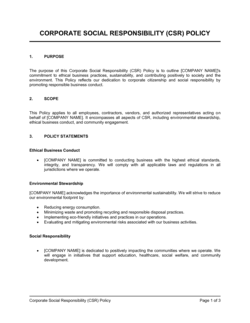
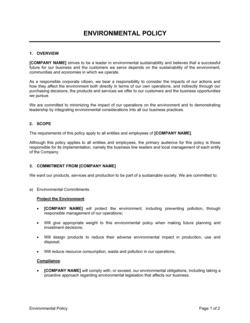
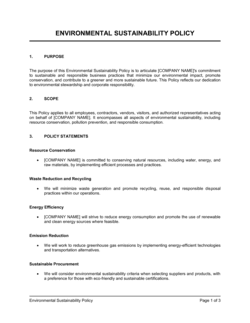
An environmental policy is a brief internal declaration of principles and rules β€” typically one to two pages β€” that governs how the business handles environmental obligations. This template goes further by connecting environmental actions to customer acquisition strategy, messaging, and KPIs. A policy sets the rules; this document builds the plan.

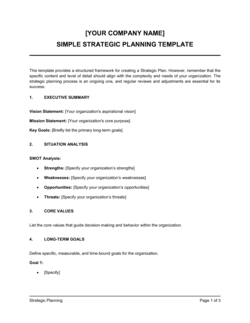
vs Strategic Plan

A strategic plan covers the full spectrum of business objectives β€” growth, operations, talent, and finance. This template focuses exclusively on environmental responsibility as a customer attraction lever. The two documents are complementary; environmental responsibility goals should be incorporated into the broader strategic plan once defined here.

vs Marketing Plan

A marketing plan defines channels, campaigns, and budgets for customer acquisition across all value propositions. This template is narrower β€” it builds the substantiated environmental narrative that feeds into the marketing plan. Without this document's foundations, green claims in a marketing plan risk being unsubstantiated.

Industry-specific considerations

Retail and e-commerce

Packaging recyclability, returns logistics emissions, and supplier environmental criteria are the most customer-visible areas for retail businesses to document and communicate.

Professional services

Business travel emissions, office energy use, and paperless operations are the primary focus areas, with enterprise clients increasingly requesting documented policies at contract renewal.

Manufacturing

Scope 1 emissions from production, raw material sourcing, waste-to-landfill ratios, and water consumption are the material metrics; ISO 14001 certification is commonly required by Tier 1 automotive and electronics buyers.

Food and beverage

Packaging sustainability, food waste reduction, supply chain traceability, and carbon labeling on products are the highest-impact customer-facing commitments in this sector.

Template vs pro β€” what fits your needs?

PathBest forCostTime
Use the templateSmall and mid-sized businesses building their first formal environmental responsibility planFree4–8 hours across 1–2 weeks including baseline data gathering
Template + professional reviewBusinesses making public environmental claims or responding to enterprise procurement requirements$500–$2,000 for a sustainability consultant review2–3 weeks
Custom draftedBusinesses pursuing ISO 14001 certification, B Corp status, or regulated industry environmental compliance$5,000–$20,000+ for a full sustainability consultant engagement2–4 months

Glossary

Corporate Environmental Responsibility (CER)
A company's voluntary commitment to operate in ways that minimize environmental harm and contribute positively to ecological health.
ESG (Environmental, Social, Governance)
A framework investors and buyers use to evaluate a company's non-financial performance across environmental impact, social practices, and governance structure.
Carbon Footprint
The total volume of greenhouse gases β€” primarily CO2 and methane β€” emitted directly or indirectly as a result of a company's activities, measured in tonnes of CO2 equivalent.
Greenwashing
The practice of making misleading or unsubstantiated environmental claims to attract customers or investors, which exposes businesses to reputational and regulatory risk.
Scope 1, 2, and 3 Emissions
A classification of greenhouse gas emissions: Scope 1 is direct emissions, Scope 2 is purchased energy, and Scope 3 covers the full value chain including suppliers and customer use.
Circular Economy
An economic model that eliminates waste by keeping materials in use β€” through reuse, repair, remanufacturing, and recycling β€” rather than the traditional take-make-dispose approach.
Green Procurement
A purchasing policy that prioritizes suppliers and materials with lower environmental impact, factoring sustainability into sourcing decisions alongside price and quality.
Materiality Assessment
A process for identifying which environmental and social issues are most significant to the business and its stakeholders, used to focus sustainability efforts where they have the greatest impact.
Net Zero
A state in which greenhouse gas emissions produced by an organization are balanced by equivalent removals or offsets, resulting in no net addition to atmospheric carbon.
Life Cycle Assessment (LCA)
An analysis of the environmental impact of a product or service across its full life cycle β€” from raw material extraction through production, use, and end-of-life disposal.

Part of your Business Operating System

This document is one of 3,000+ business & legal templates included in Business in a Box.

  • Fill-in-the-blanks β€” ready in minutes
  • 100% customizable Word document
  • Compatible with all office suites
  • Export to PDF and share electronically

Create your document in 3 simple steps.

From template to signed document β€” all inside one Business Operating System.
1
Download or open template

Access over 3,000+ business and legal templates for any business task, project or initiative.

2
Edit and fill in the blanks with AI

Customize your ready-made business document template and save it in the cloud.

3
Save, Share, Send, Sign

Share your files and folders with your team. Create a space of seamless collaboration.

Save time, save money, and create top-quality documents.

β˜…β˜…β˜…β˜…β˜…

"Fantastic value! I'm not sure how I'd do without it. It's worth its weight in gold and paid back for itself many times."

Managing Director Β· Mall Farm
Robert Whalley
Managing Director, Mall Farm Proprietary Limited
β˜…β˜…β˜…β˜…β˜…

"I have been using Business in a Box for years. It has been the most useful source of templates I have encountered. I recommend it to anyone."

Business Owner Β· 4+ years
Dr Michael John Freestone
Business Owner
β˜…β˜…β˜…β˜…β˜…

"It has been a life saver so many times I have lost count. Business in a Box has saved me so much time and as you know, time is money."

Owner Β· Upstate Web
David G. Moore Jr.
Owner, Upstate Web

Run your business with a system β€” not scattered tools

Stop downloading documents. Start operating with clarity. Business in a Box gives you the Business Operating System used by over 250,000 companies worldwide to structure, run, and grow their business.

Start freeΒ Β·Β No credit card required