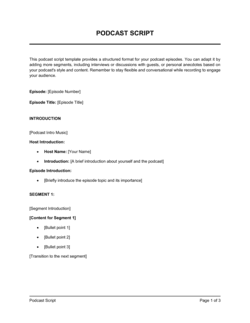
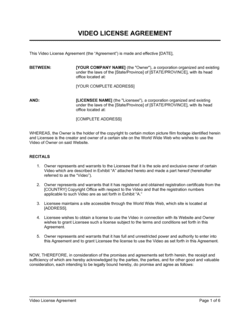
General Video Script Template

Free Word download β€’ Edit online β€’ Save & share with Drive β€’ Export to PDF

2 pagesβ€’20–30 min to fillβ€’Difficulty: Standardβ€’Signature requiredβ€’Legal review recommended
Learn more ↓
FreeGeneral Video Script Template

At a glance

What it is
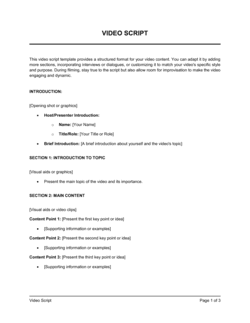
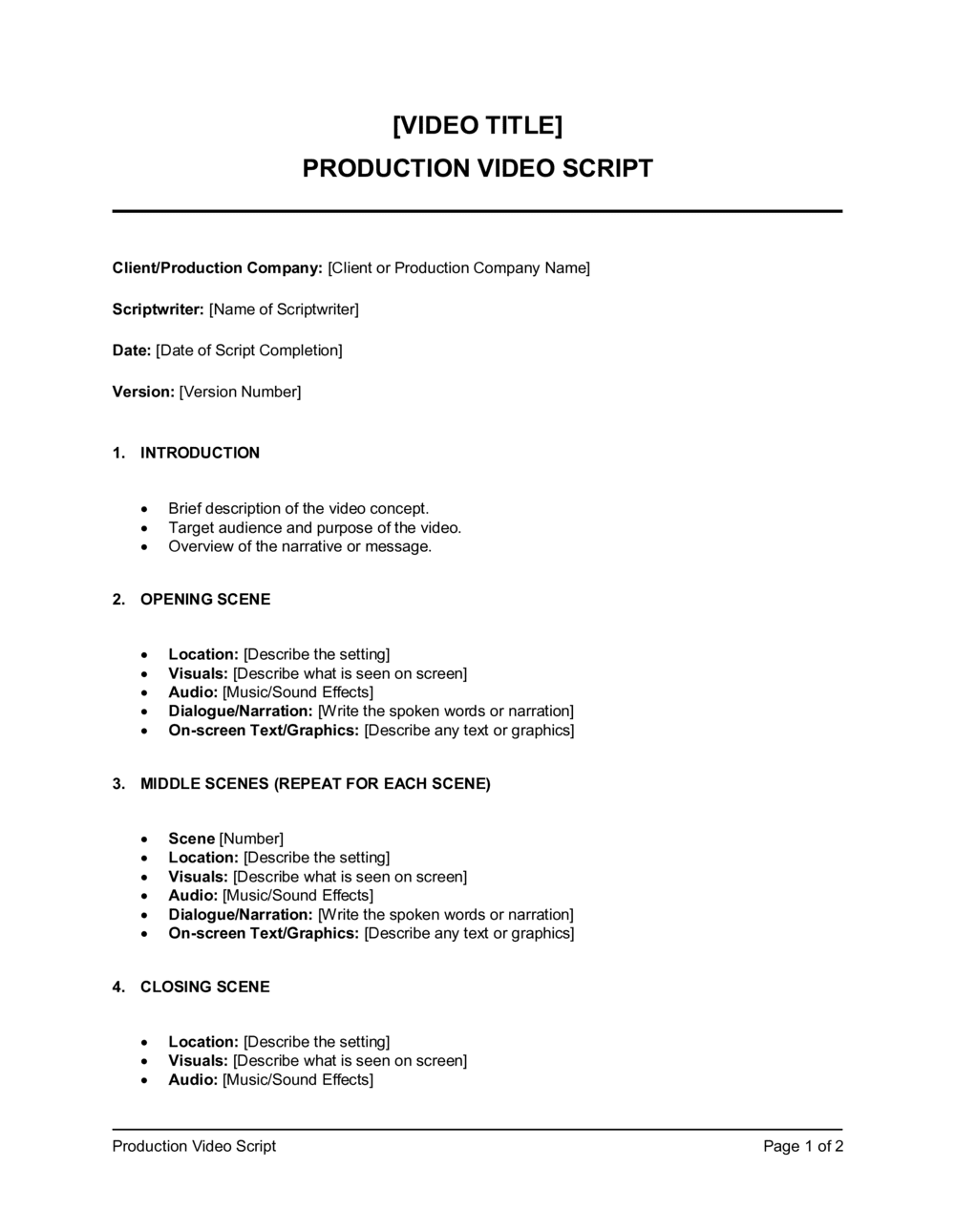
A General Video Script is a structured production and rights document that combines a formatted shooting script β€” scene headings, narration, on-screen dialogue, and visual directions β€” with binding provisions covering intellectual property ownership, talent usage rights, music and footage licensing, and permitted distribution channels. This free Word download gives you an editable, client-ready starting point you can adapt for corporate, promotional, training, or social-media video projects and export as PDF for approval and signature.
When you need it
Use it whenever you commission or produce a video for external distribution, client delivery, internal training, or commercial promotion β€” any situation where IP ownership, usage rights, or talent appearances need to be documented in writing before cameras roll.
What's inside
Scene-by-scene script blocks with dialogue, voiceover, and visual direction fields; IP assignment and work-for-hire clauses; talent release and usage rights provisions; music and stock footage licensing references; approval and revision procedures; permitted distribution channels; and governing law.

What is a General Video Script?

A General Video Script is a structured production and rights document that serves two functions simultaneously: it lays out the complete scene-by-scene shooting script β€” including scene headings, dialogue, voiceover narration, on-screen text, and visual direction β€” and it establishes the binding legal terms that govern who owns the finished content, who may appear in it, what music and footage can be used, and where the video may be distributed. Unlike an informal creative brief or an unsigned treatment, a properly executed video script agreement creates enforceable obligations on both the client and the producer from the moment work begins, anchoring IP ownership, revision scope, and payment milestones in a single document.

Why You Need This Document

Producing a video without a signed script agreement exposes both parties to a predictable set of disputes. Clients who commission video content and rely on verbal agreements or email sign-offs routinely discover that the producer retains copyright by default under most national copyright laws β€” meaning the client paid for a video they do not legally own. Producers who begin work without a revision cap find that fixed-fee projects expand indefinitely. Talent who appear on screen without a signed release can demand the video be removed from distribution after launch. Music tracks scripted without confirmed sync licenses get automatically detected and blocked by every major platform. This template closes all four gaps before production begins, giving the client clear IP ownership and defined usage rights, giving the producer a documented scope and payment schedule, and giving both parties a signed record of exactly what was agreed β€” before cameras roll.

Which variant fits your situation?

If your situation is…Use this template
Producing a commercial advertisement for broadcast or streamingCommercial Video Script
Creating a step-by-step employee training or onboarding videoTraining Video Script
Scripting a short-form promotional video for social mediaSocial Media Video Script
Commissioning a full video production including crew and post-productionVideo Production Agreement
Obtaining on-camera talent consent and appearance rightsVideo Release Form
Licensing existing footage or music for use in a new productionMedia License Agreement
Scripting a documentary or long-form narrative videoDocumentary Video Script

Common mistakes to avoid

❌ No work-for-hire designation before work begins

Why it matters: Under US copyright law, a commissioned script is only a work for hire if it falls within a statutory category AND both parties designate it as such in a written agreement signed before creation. Missing this, the creator retains copyright regardless of payment.

Fix: Include an explicit work-for-hire designation in the agreement and execute it before any scripting begins. Back this with an irrevocable assignment clause as a belt-and-suspenders measure.

❌ Unlimited revision rights with no cap

Why it matters: Without a defined revision limit, a client can request changes indefinitely at no extra cost, turning a fixed-fee project into an open-ended engagement that erodes the producer's margin entirely.

Fix: State the number of included revision rounds explicitly β€” typically two or three β€” and specify the hourly rate for additional revisions beyond that limit.

❌ Missing or unsigned talent releases

Why it matters: An on-camera individual without a signed release can demand the video be taken down after publication or pursue a right-of-publicity claim, potentially requiring expensive re-shoots or content removal.

Fix: Make executed talent releases a condition precedent to the shoot date. Attach a template release form as a schedule to the script agreement so nothing is left to informal verbal agreements.

❌ Listing music tracks without confirming sync licenses

Why it matters: Scripting a specific song does not create a license to use it. Without a valid sync license, platforms will automatically detect and mute or block the video β€” often on the day of launch.

Fix: Confirm sync license availability and cost before the script is finalized. If budget is a constraint, substitute royalty-free alternatives from a licensed library and document the specific license tier.

❌ Granting unlimited distribution rights by default

Why it matters: Producers who sign away all distribution rights unconditionally lose the ability to show the work in their portfolio, enter it in industry competitions, or use it as a production sample β€” standard business development tools.

Fix: Limit distribution rights to specified channels, territory, and duration. Add a separate portfolio and promotional use carve-out for the producer to show the work in professional contexts.

❌ Back-loading all payment to final delivery

Why it matters: If a client delays final approval or disputes the finished script, the producer has completed all work without receiving compensation and has limited leverage to compel resolution.

Fix: Structure payment across at least three milestones β€” signing, first draft, and final approval β€” with at least 30% due at execution. This aligns payment exposure with production progress.

The 10 key clauses, explained

Parties and project identification

In plain language: Names the commissioning party (client) and the script author or production company, and identifies the specific video project by title, purpose, and delivery date.

Sample language
This General Video Script Agreement is entered into on [DATE] between [CLIENT LEGAL NAME] ('Client') and [PRODUCER / WRITER LEGAL NAME] ('Producer'), for the production of a video tentatively titled '[VIDEO TITLE]' intended for [PURPOSE], with a target delivery date of [DATE].

Common mistake: Using a trade name instead of the legal entity name for either party. If ownership or payment disputes arise, enforcing the agreement against the correct legal entity becomes difficult.

Script content and scene structure

In plain language: Sets out the full scene-by-scene shooting script, including scene headings, dialogue, voiceover copy, on-screen text, and visual direction notes for each shot.

Sample language
SCENE [NUMBER] β€” INT. [LOCATION] β€” DAY VISUAL: [DESCRIPTION OF SHOT] VO: '[NARRATION TEXT]' ON SCREEN TEXT: '[TEXT OVERLAY]'

Common mistake: Leaving visual direction fields blank or writing only the dialogue. Incomplete directions force expensive reshoots or cause the finished video to diverge from the client's approved concept.

Intellectual property assignment

In plain language: Transfers ownership of the script, all derivative works, and the finished video to the client upon full payment, establishing it as a work made for hire where applicable.

Sample language
Upon receipt of full payment, Producer irrevocably assigns to Client all right, title, and interest β€” including copyright β€” in the Script and any derivative works. To the extent the Script qualifies as a work made for hire under applicable copyright law, it is hereby designated as such.

Common mistake: Omitting the work-for-hire designation. Without it, the creator retains a reversionary copyright interest that can resurface decades later, even after full payment.

Talent release and likeness rights

In plain language: Documents that all on-camera individuals have provided written consent for their appearance and specifies how their likeness may be used, for how long, and on which platforms.

Sample language
Client warrants that all individuals appearing on camera have executed a Talent Release Form granting [COMPANY NAME] the right to use their likeness in the Video for [CHANNELS] for a period of [DURATION / in perpetuity], a copy of which is attached as Schedule A.

Common mistake: Assuming a verbal agreement from on-camera talent is sufficient. Without a signed release, a talent can demand removal of the video from distribution β€” or seek damages β€” after publication.

Music and stock footage licensing

In plain language: Identifies all third-party music, stock footage, and media assets incorporated into the script, confirms appropriate licenses are in place, and allocates responsibility for obtaining them.

Sample language
All music and stock footage referenced in this Script shall be licensed by [CLIENT / PRODUCER] prior to production. Producer shall obtain sync licenses for all original compositions. Client shall obtain licenses for any stock media sourced through [PLATFORM / LIBRARY].

Common mistake: Listing a music track in the script without confirming a sync license has been obtained. Platforms including YouTube and Meta will automatically flag or mute unlicensed audio, making the finished video unpublishable.

Approval and revision procedure

In plain language: Defines the number of included revision rounds, the turnaround time for client feedback, and the process for approving the final script before production begins.

Sample language
Client shall have [NUMBER] rounds of script revisions at no additional cost. Client shall provide written feedback within [X] business days of receiving each draft. Revisions beyond the included rounds are billed at $[RATE] per hour. Silence for [X] business days constitutes approval.

Common mistake: No revision cap at all. Open-ended revision rights allow clients to request changes indefinitely, turning a fixed-fee script project into an unprofitable engagement.

Permitted distribution channels

In plain language: Specifies the exact platforms and media on which the finished video may be published, and whether use is exclusive, geographically limited, or time-limited.

Sample language
Client is granted the right to publish the Video on the following channels: [CHANNEL LIST]. Distribution is [exclusive / non-exclusive], limited to [GEOGRAPHIC TERRITORY], for a period of [DURATION / in perpetuity]. Use outside these channels requires a separate written license.

Common mistake: Granting unlimited distribution rights without specifying channels. Producers who later want to use the work in their portfolio or reel may find they have signed away all rights β€” including the right to show examples of their own work.

Payment terms and delivery milestones

In plain language: States the total fee, the payment schedule tied to script delivery milestones, and what happens if the client delays feedback or withholds approval.

Sample language
Total fee: $[AMOUNT]. Payment schedule: [X]% on execution ($[AMOUNT]), [X]% on delivery of first draft ($[AMOUNT]), [X]% on final approval ($[AMOUNT]). Delays in client feedback exceeding [X] business days reset the delivery timeline by an equivalent period.

Common mistake: Back-loading all payment to final delivery. If a client delays approval or disputes the final script, the producer is exposed to completing all work before receiving any compensation.

Confidentiality

In plain language: Prohibits both parties from disclosing the script content, project details, or client information to third parties without written consent before the video is publicly released.

Sample language
Both parties agree to keep the Script, project brief, and all associated materials confidential until public release of the Video. Neither party shall disclose the existence or content of this Agreement to third parties without prior written consent.

Common mistake: One-sided confidentiality clauses that bind only the producer. Client-side confidentiality matters too β€” script concepts disclosed before release can be copied by competitors.

Governing law and dispute resolution

In plain language: Specifies which jurisdiction's law governs the agreement and how disputes are resolved β€” typically arbitration, mediation, or litigation in a specified court.

Sample language
This Agreement is governed by the laws of [STATE / PROVINCE / COUNTRY]. Any dispute arising under this Agreement shall first be submitted to mediation, and if unresolved, to binding arbitration administered by [BODY] in [CITY]. Claims for injunctive relief may be brought in any court of competent jurisdiction.

Common mistake: Choosing a governing jurisdiction with no connection to either party's location. Courts in the chosen jurisdiction may decline to hear the case, leaving disputes unresolvable under the contract's own terms.

How to fill it out

  1. 1

    Enter the legal names of both parties and the project title

    Use the full registered legal name for both the client and the producer or writer β€” not a trade name or personal nickname. Record the video project title, its intended purpose, and the agreed delivery date.

    πŸ’‘ Confirm the client's registered entity name against their invoice or contract header before the agreement is signed β€” mismatched names create enforcement problems later.

  2. 2

    Complete the scene-by-scene script structure

    Fill in each scene block with a slug line (INT./EXT., location, time of day), visual direction describing the shot, dialogue or voiceover copy, and any on-screen text overlays. Leave no scene block fields blank.

    πŸ’‘ Number scenes sequentially from the start β€” it makes revision feedback and production scheduling significantly easier to manage.

  3. 3

    Confirm IP assignment and work-for-hire status

    Check whether the script qualifies as a work made for hire under the applicable jurisdiction's copyright law. If it does, designate it explicitly in the IP clause. In all cases, include an irrevocable assignment of copyright to the client upon full payment.

    πŸ’‘ In the US, a commissioned script only qualifies as work for hire if it falls within one of nine statutory categories and both parties sign a written agreement designating it as such before work begins.

  4. 4

    Attach or reference all talent release forms

    List every individual appearing on camera by name and confirm their release form is attached as a schedule. If talent has not yet been cast, include a covenant requiring the client to obtain releases before the shoot date.

    πŸ’‘ For employee testimonials or internal training videos, a simple one-page talent release signed before filming is sufficient β€” but it must be signed.

  5. 5

    Identify and license all music and stock media

    List every music track, sound effect, and stock footage clip referenced in the script. Allocate licensing responsibility to either the client or producer and confirm the license type (sync, master, royalty-free subscription) before production begins.

    πŸ’‘ Document the specific license tier for each stock platform β€” a subscription license on Getty or Shutterstock may cover web use but not broadcast; verify before scripting a paid media campaign.

  6. 6

    Set revision rounds, approval timelines, and the feedback process

    State the number of included revision rounds (typically two to three), the number of business days the client has to provide feedback on each draft, and what constitutes deemed approval if no feedback is received.

    πŸ’‘ A deemed-approval clause β€” 'silence for five business days constitutes approval' β€” prevents projects from stalling indefinitely when clients go quiet.

  7. 7

    Define the payment schedule and tie it to milestones

    Split the total fee across at least three milestones: execution, first draft delivery, and final approval. Express each payment as both a percentage and a dollar amount to eliminate ambiguity.

    πŸ’‘ Front-load at least 30–40% of the fee at signing to cover pre-production research and outline work β€” never begin substantive writing without a deposit in hand.

  8. 8

    Sign before production begins

    Both parties must execute the agreement before any scripting, shooting, or pre-production work begins. Post-commencement signatures create consideration and enforceability questions, particularly for IP assignment clauses.

    πŸ’‘ Use an e-signature tool that timestamps execution and stores the countersigned copy automatically β€” oral agreements and email approvals are inadequate for IP ownership documents.

Frequently asked questions

What is a general video script?

A general video script is a formatted document that combines a production script β€” scene headings, dialogue, voiceover copy, and visual directions β€” with binding legal provisions covering IP ownership, talent rights, music licensing, and distribution permissions. It functions as both the creative blueprint for a video production and the legal agreement governing who owns the finished work and where it can be published.

Do I need a talent release even for employees who appear on camera?

Yes. In most jurisdictions, an individual's right of publicity β€” the right to control commercial use of their likeness β€” exists independently of their employment relationship. A signed talent release is the only reliable way to document consent and define the scope of permitted use. This applies to employees, contractors, and external talent alike.

What licenses do I need for music used in a video?

For original compositions, you typically need both a synchronization license (to pair the music with visual content) and a master recording license (to use the specific recorded version). For royalty-free or library music, confirm that the subscription tier you hold covers the intended distribution channel β€” many library licenses exclude broadcast, paid social, or commercial use without an upgrade. Document the specific license for every track in the script agreement.

How many revision rounds should a video script agreement include?

Two to three revision rounds is the standard for most commercial video script projects. One round typically addresses structural and content feedback after the first draft; a second round polishes dialogue and visual directions after client review. A third round is a reasonable buffer for complex or highly regulated content. Beyond three rounds, additional revisions should be billed at a documented hourly rate.

What distribution channels should be specified in a video script agreement?

List every platform or medium where the video will be published β€” for example, the client's website, YouTube, LinkedIn, paid social (Meta, TikTok), broadcast TV, internal LMS, or trade show screens. Specify whether use is exclusive or non-exclusive, the geographic territory, and the duration of the license. Vague language like 'online channels' creates disputes when the client later wants to run the video as a paid TV spot.

Is a video script agreement enforceable without notarization?

In most jurisdictions, a video script agreement does not require notarization to be enforceable. A written agreement signed by both parties β€” including e-signatures under frameworks like the US ESIGN Act, Canada's PIPEDA, or the EU's eIDAS regulation β€” is generally sufficient. Notarization is typically only required for real property transactions and certain statutory instruments, not commercial creative agreements.

Can I use a video script template for a social media short-form video?

Yes. A general video script template is adaptable for short-form content β€” adjust the scene structure to reflect the condensed format (typically 15–60 seconds), simplify the visual direction fields, and confirm that the distribution rights clause specifically names the intended social platforms. The IP assignment, talent release, and music licensing clauses remain equally important regardless of video length.

What happens if a client refuses to give final approval after all revisions are complete?

Without a deemed-approval clause, a client who goes silent can indefinitely delay final payment while the producer has delivered all contracted work. A well-drafted script agreement includes a provision stating that if the client fails to provide written feedback or approval within a specified number of business days β€” typically five to ten β€” the script is deemed approved and the final payment milestone becomes due. This converts silence into a contractual outcome rather than an indefinite stalemate.

How this compares to alternatives

vs Video Production Agreement

A video production agreement governs the entire production engagement β€” crew, equipment, deliverables, post-production, and final delivery. A general video script agreement is narrower in scope, focused on the scripting phase, IP assignment, and usage rights for the written content. For complex productions, both documents are typically used in sequence: the script agreement first, followed by the production agreement once the script is approved.

vs Video Release Form

A video release form is a standalone document signed by an on-camera individual granting consent for use of their likeness. A general video script agreement covers the full production relationship, including IP ownership, payment, revisions, and distribution rights. The release form is typically attached as a schedule to the script agreement, not used as a substitute for it.

vs Creative Services Agreement

A creative services agreement is a broad master agreement covering any ongoing creative engagement β€” design, copywriting, content creation, or video. A general video script agreement is project-specific, with scene structure, visual direction fields, and video-specific licensing provisions built into the document. Use the creative services agreement for ongoing retainer relationships; use the video script agreement for discrete, defined video projects.

vs Non-Disclosure Agreement

An NDA protects confidential information shared during pre-production discussions before any formal agreement is signed. A general video script agreement includes confidentiality provisions as one clause within a broader rights and production framework. An NDA is appropriate at the pitch and briefing stage; the script agreement replaces it once the project is formally commissioned and terms are agreed.

Industry-specific considerations

Marketing and Advertising

Brand video scripts require explicit distribution channel rights tied to specific campaign media plans, including paid broadcast and digital placements, with defined usage durations aligned to campaign flight dates.

E-learning and Corporate Training

Training video scripts involve recurring-use rights across internal learning management systems, version control for script updates, and talent releases that cover multi-year deployment without re-shooting.

Technology / SaaS

Product explainer and demo video scripts for SaaS companies require IP assignment to be especially tight β€” product features shown on screen may constitute trade secrets and the script must include corresponding confidentiality obligations.

Healthcare and Pharmaceuticals

Regulatory compliance review is required for patient-facing or clinical video scripts in most jurisdictions; the script agreement should include a compliance review milestone and a clause permitting required regulatory disclosures to be added post-approval.

Jurisdictional notes

United States

US copyright law (17 U.S.C. Β§ 101) defines work for hire narrowly for commissioned works β€” a video script qualifies only if it falls within one of nine statutory categories and both parties sign a written work-for-hire agreement before creation. Right-of-publicity laws vary significantly by state: California and New York have the strongest protections, requiring explicit written releases for commercial use of a person's likeness. Sync licensing requirements apply to all music regardless of platform.

Canada

Canadian copyright law under the Copyright Act does not include a broad work-for-hire doctrine equivalent to the US statute β€” independent contractors typically retain copyright unless an explicit written assignment is included in the agreement. Quebec's Civil Code provides additional moral rights protections for creators. PIPEDA and provincial privacy laws may apply when video content features identifiable individuals, requiring consent that goes beyond a standard talent release.

United Kingdom

Under the Copyright, Designs and Patents Act 1988, copyright in a commissioned work created by an independent contractor vests in the contractor by default β€” not the commissioning party. A written IP assignment clause is therefore essential in all UK video script agreements. Moral rights (including the right of integrity) apply to literary and dramatic works; the creator must expressly waive them in writing if the client needs unrestricted editing rights. GDPR applies to video content featuring identifiable individuals distributed in the UK.

European Union

Most EU member states follow the author's-rights tradition, vesting copyright in the human creator by default and requiring an explicit written assignment for rights to transfer to a commissioning party. GDPR imposes strict requirements on the capture, storage, and use of video content featuring identifiable individuals β€” talent releases must satisfy GDPR consent standards, including the right to withdraw consent. The EU Copyright Directive (2019/790) introduces upload-filter obligations for large platforms that may affect distribution of commercially licensed video content.

Template vs lawyer β€” what fits your deal?

PathBest forCostTime
Use the templateFreelance video producers, small agencies, and in-house marketing teams commissioning standard promotional or training video scriptsFree30–45 minutes
Template + legal reviewProductions involving broadcast distribution, celebrity or professional talent, or scripts referencing proprietary product IP$300–$7002–4 days
Custom draftedHigh-value commercial productions, multi-territory distribution, regulated industries (pharma, finance), or complex IP portfolios$1,500–$5,000+1–3 weeks

Glossary

Work for Hire
A legal doctrine under which creative work produced by an employee or contracted party is owned by the commissioning party from creation, not the creator.
Usage Rights
The specific permissions granted to use a piece of content β€” defined by channel (TV, web, social), geography, duration, and exclusivity.
Talent Release
A signed consent from any individual appearing on camera granting the producer the right to use their likeness in the finished video.
Scene Heading (Slug Line)
The line at the start of each script scene that identifies whether the shot is interior or exterior, the location, and the time of day.
Voiceover (VO)
Narration recorded separately from the on-screen action and mixed into the final video, typically used to explain or guide the viewer.
Sync License
Permission from a music rights holder to pair a specific track with visual content for distribution β€” required even for royalty-free tracks on commercial platforms.
IP Assignment
A contractual clause transferring all intellectual property rights in the script and finished video from the creator to the commissioning party.
Revision Round
A contractually defined cycle of client feedback and script changes, with each round specified in the agreement to limit unlimited revision requests.
Distribution Channel
The specific platform or medium through which the finished video will be published β€” e.g., YouTube, internal LMS, broadcast TV, or paid social.
B-Roll
Supplementary footage cut alongside the main interview or narrative sequence, used to illustrate points visually without showing the primary speaker.
Final Cut Approval
A contractual right granted to the client or a named party to approve the finished edited video before it is published or delivered.

Part of your Business Operating System

This document is one of 3,000+ business & legal templates included in Business in a Box.

  • Fill-in-the-blanks β€” ready in minutes
  • 100% customizable Word document
  • Compatible with all office suites
  • Export to PDF and share electronically

Create your document in 3 simple steps.

From template to signed document β€” all inside one Business Operating System.
1
Download or open template

Access over 3,000+ business and legal templates for any business task, project or initiative.

2
Edit and fill in the blanks with AI

Customize your ready-made business document template and save it in the cloud.

3
Save, Share, Send, Sign

Share your files and folders with your team. Create a space of seamless collaboration.

Save time, save money, and create top-quality documents.

β˜…β˜…β˜…β˜…β˜…

"Fantastic value! I'm not sure how I'd do without it. It's worth its weight in gold and paid back for itself many times."

Managing Director Β· Mall Farm
Robert Whalley
Managing Director, Mall Farm Proprietary Limited
β˜…β˜…β˜…β˜…β˜…

"I have been using Business in a Box for years. It has been the most useful source of templates I have encountered. I recommend it to anyone."

Business Owner Β· 4+ years
Dr Michael John Freestone
Business Owner
β˜…β˜…β˜…β˜…β˜…

"It has been a life saver so many times I have lost count. Business in a Box has saved me so much time and as you know, time is money."

Owner Β· Upstate Web
David G. Moore Jr.
Owner, Upstate Web

Run your business with a system β€” not scattered tools

Stop downloading documents. Start operating with clarity. Business in a Box gives you the Business Operating System used by over 250,000 companies worldwide to structure, run, and grow their business.

Start freeΒ Β·Β No credit card required