Script Sample Template

Free Word download β€’ Edit online β€’ Save & share with Drive β€’ Export to PDF

2 pagesβ€’20–30 min to fillβ€’Difficulty: Standardβ€’Signature requiredβ€’Legal review recommended
Learn more ↓
FreeScript Sample Template

At a glance

What it is
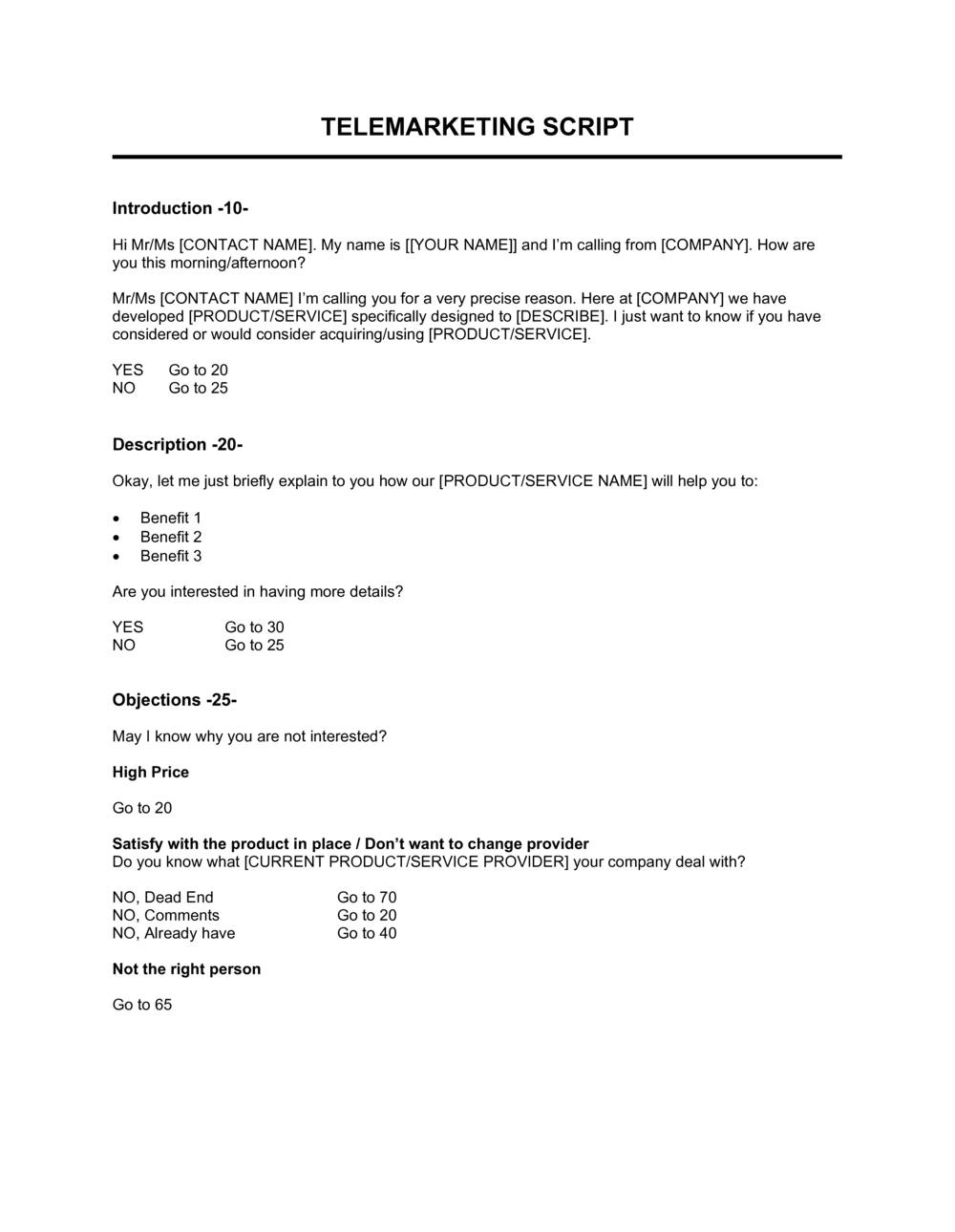
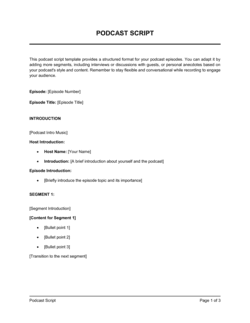
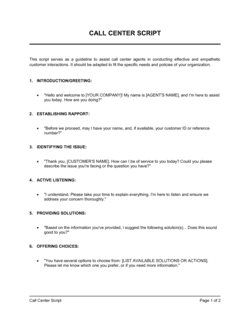
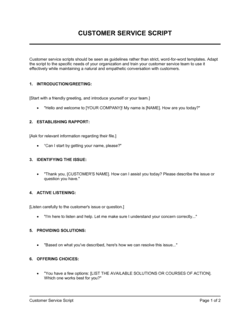
A Script Sample is a formally structured document used by writers, producers, studios, and creative agencies to present, submit, or license a scripted work β€” whether a screenplay, teleplay, commercial script, or stage play. This free Word download provides a professionally formatted starting point covering dialogue, scene directions, IP ownership, submission terms, and confidentiality, which you can edit online and export as PDF for submission or execution.
When you need it
Use it when submitting an original script to a production company, studio, or agency; when sharing a writing sample as part of a pitch or staffing process; or when a producer needs to formally request a script excerpt for development evaluation. It documents the terms under which the sample is shared and protects the writer's intellectual property during the review period.
What's inside
Party identification, script title and logline, format and genre classification, scene structure with sluglines and action lines, dialogue blocks, IP ownership and submission terms, confidentiality obligations, and signature block for acknowledgment of receipt and review terms.

What is a Script Sample?

A Script Sample is a formally presented scripted work β€” screenplay, teleplay, stage play, or commercial script β€” submitted by a writer to a producer, studio, agency, or other recipient for evaluation, development consideration, or creative staffing review. As a legal document, a script sample agreement governs the precise terms under which that material is shared: it confirms the writer retains all intellectual property rights, defines the recipient's permitted use of the material during a bounded review period, imposes confidentiality obligations, and includes the independent development disclaimer and no-obligation language that are standard in professional entertainment submissions. This free Word download gives writers and producers a professionally structured starting point that can be edited online and exported as PDF for immediate use.

Why You Need This Document

Submitting a script without a signed agreement is one of the most preventable risks in creative business. Once a recipient has the file, you have no written protection against unauthorized use, no defined timeline for a response, and no clear record of what rights β€” if any β€” were granted. Studios and production companies routinely require writers to sign their own submission release forms, which are drafted to protect the recipient, not the writer. A script sample agreement flips that dynamic: it confirms your ownership, limits the recipient's use to a specific purpose, sets an expiration date on the review period, and creates a contractual basis for action if the material is used without authorization. Combined with copyright or WGA registration, it is the foundational document that serious writers and producers use before any script changes hands.

Which variant fits your situation?

If your situation is…Use this template
Submitting a feature-length screenplay to a production companyScreenplay Submission Agreement
Sharing a script sample with an agent for representation considerationScript Sample (Talent Representation)
Optioning a script for development with a studioScript Option Agreement
Commissioning a writer to produce an original scriptScript Writing Agreement
Protecting script IP before formal submissionNon-Disclosure Agreement (Creative)
Presenting a commercial or branded video script to a clientCreative Brief and Script Template
Submitting a stage play to a theater or festivalStage Play Submission Template

Common mistakes to avoid

❌ Submitting the script before the agreement is signed

Why it matters: Once the recipient has the file, you have no leverage to negotiate terms and no written protection if the material is used without authorization. Verbal assurances have no standing.

Fix: Execute the agreement first β€” even a simple e-signature exchange takes under 10 minutes β€” and transmit the script only after you have a dated, signed copy in hand.

❌ No review period or expiration date

Why it matters: An open-ended submission ties up your script indefinitely. You cannot submit it elsewhere without risking a conflict, and the recipient faces no deadline to respond.

Fix: Set a specific review period β€” 30, 60, or 90 days β€” with a written notification requirement at expiration, and include a return or destruction obligation if the recipient passes.

❌ Broad purpose language that functions as an implied license

Why it matters: Phrases like 'for your review and any related purposes' have been interpreted as granting development rights without additional compensation. Courts read ambiguity in favor of the party who drafted the language.

Fix: Limit the stated purpose to a single, specific use β€” 'evaluation for potential acquisition only' β€” and add a clause stating no license is granted beyond that purpose.

❌ Omitting the independent development disclaimer

Why it matters: Without it, every future project the recipient develops with a similar premise is a potential infringement claim β€” even if the recipient never used the submitted script. This clause protects both parties.

Fix: Include the standard independent development disclaimer and pair it with a clause requiring the recipient to document the date the script was received and reviewed.

❌ No warranty that the script is original and unencumbered

Why it matters: If the script infringes underlying rights β€” a novel adaptation without a license, for example β€” the recipient can face third-party claims and will look to the writer for indemnification with no written basis to do so.

Fix: Include an explicit originality and non-infringement warranty and, if based on underlying material, attach documentation of the underlying rights or add a rider disclosing the limitation.

❌ Using a personal name instead of legal entity as the recipient

Why it matters: If a dispute arises, you need to enforce the agreement against an entity that can be sued β€” a production company, studio, or agency LLC β€” not an individual who may no longer be employed there.

Fix: Confirm the recipient's full registered legal entity name before signing and include a clause requiring notice to the writer if the reviewing entity changes through merger, acquisition, or assignment.

The 10 key clauses, explained

Parties and Script Identification

In plain language: Identifies the writer or rights holder and the recipient, and gives the script a formal title and registration reference to tie the document to a specific, identifiable work.

Sample language
This Script Sample Agreement is entered into as of [DATE] between [WRITER FULL NAME] ('Writer'), residing at [ADDRESS], and [RECIPIENT ENTITY NAME], a [STATE] [ENTITY TYPE] ('Recipient'). The script submitted herewith is titled '[SCRIPT TITLE]' (WGA Registration No. [XXXXX] / Copyright No. [XXXXX]) (the 'Work').

Common mistake: Identifying the script only by title without a registration or copyright reference. Titles are not protectable β€” without a registration number, proving which version of 'The Deal' was submitted becomes impossible in a dispute.

Purpose and Scope of Submission

In plain language: States exactly why the script is being shared β€” evaluation, development consideration, staffing review β€” and limits the recipient's use of the material to that stated purpose.

Sample language
The Work is submitted solely for the purpose of [EVALUATION / DEVELOPMENT CONSIDERATION / STAFFING REVIEW] by Recipient. Recipient shall not reproduce, distribute, adapt, or otherwise exploit the Work or any portion thereof for any purpose beyond that stated herein without Writer's prior written consent.

Common mistake: Using language like 'for your review and any related purposes.' Broad purpose language effectively grants the recipient a license to use the script for development without compensation.

Intellectual Property Ownership

In plain language: Confirms that the writer retains full copyright and all IP rights in the script, and that nothing in the submission agreement transfers ownership or grants any license beyond the limited review purpose.

Sample language
Writer retains all right, title, and interest in and to the Work, including all copyright, trademark, and other intellectual property rights. Nothing in this Agreement shall be construed as a transfer, assignment, or license of any such rights except as expressly set forth herein.

Common mistake: Omitting an IP retention clause entirely and relying on copyright law alone. Recipient-drafted agreements often include subtle language that implies a license or option β€” a written retention clause overrides that implication.

Confidentiality Obligations

In plain language: Requires the recipient to keep the script and its contents confidential, limits internal circulation to those with a need to review it, and prohibits disclosure to third parties without the writer's consent.

Sample language
Recipient agrees to hold the Work in strict confidence and to disclose its contents only to those of Recipient's employees, officers, or advisors who have a bona fide need to review the Work in connection with the stated purpose. Recipient shall not disclose the Work to any third party without Writer's prior written consent.

Common mistake: No limit on internal circulation. Without it, the script can be forwarded freely within a large studio or network, increasing exposure without any additional consent.

Review Period and Expiration

In plain language: Sets a defined period during which the recipient may review the script, and specifies what happens at the end β€” return, destruction, or notification of interest β€” so the submission does not remain open indefinitely.

Sample language
Recipient shall complete its review of the Work within [30 / 60 / 90] days of receipt (the 'Review Period'). At the expiration of the Review Period, Recipient shall notify Writer in writing of its decision to [proceed / pass]. Upon passing, Recipient shall [return / certify destruction of] all copies of the Work within [10] business days.

Common mistake: No review period at all. An open-ended submission gives the recipient the right to hold the script indefinitely while the writer cannot submit elsewhere without creating conflicts.

Independent Development Disclaimer

In plain language: Acknowledges that the recipient may independently develop similar concepts, and limits the writer's ability to claim the recipient used their material simply because the outputs resemble the submitted script.

Sample language
Writer acknowledges that Recipient may have received, or may in the future receive, submissions or develop internally, material similar to or identical in theme, idea, plot, or format to the Work. Recipient's development of any such similar material shall not constitute a breach of this Agreement, provided Recipient has not made direct use of the Work.

Common mistake: Omitting this clause entirely in writer-drafted agreements. Without it, a writer may have a colorable claim every time a studio releases a project with a similar premise, regardless of actual misuse.

No Obligation to Proceed

In plain language: States clearly that submitting a script sample does not create any obligation on the recipient to option, purchase, produce, or otherwise develop the work.

Sample language
Nothing in this Agreement shall obligate Recipient to option, purchase, produce, or otherwise exploit the Work. Recipient may, in its sole discretion, decline to proceed with the Work following review without liability to Writer.

Common mistake: Writing this clause in ambiguous language that implies a duty to respond with a reasoned decision. Courts have occasionally found implied obligations when rejection language was vague and a pattern of conduct suggested reliance.

Warranties and Representations

In plain language: The writer confirms they own the script outright, it does not infringe anyone else's rights, and no third party holds any interest that would conflict with the recipient's potential development of the work.

Sample language
Writer represents and warrants that: (a) Writer is the sole author of the Work; (b) Writer has full authority to enter into this Agreement; (c) the Work does not infringe any copyright, trademark, or other intellectual property right of any third party; and (d) no third party holds any option, license, or other interest in the Work that would conflict with Recipient's evaluation or potential acquisition.

Common mistake: Not including a warranty that the work is original. If the script turns out to infringe on underlying material β€” a novel, a true story, or prior script β€” the recipient has no written basis to seek indemnification from the writer.

Governing Law and Dispute Resolution

In plain language: Specifies which jurisdiction's law governs the agreement and how any disputes will be resolved β€” arbitration, mediation, or litigation β€” and in which forum.

Sample language
This Agreement shall be governed by the laws of the State of [CALIFORNIA / NEW YORK / OTHER], without regard to its conflict-of-law provisions. Any dispute arising under this Agreement shall be resolved by binding arbitration before [JAMS / AAA] in [CITY, STATE], except that either party may seek injunctive relief in a court of competent jurisdiction.

Common mistake: Choosing a governing law that has no connection to either party's location or the entertainment industry's standard practices. New York and California dominate entertainment disputes β€” courts and arbitrators there have deep familiarity with industry norms.

Entire Agreement and Modification

In plain language: Confirms that this document is the complete agreement between the parties on the submission and can only be modified in writing signed by both parties β€” overriding any prior verbal discussions or email exchanges.

Sample language
This Agreement constitutes the entire agreement between the parties with respect to the submission of the Work and supersedes all prior representations, discussions, and understandings, whether oral or written. No modification of this Agreement shall be effective unless made in writing and signed by both parties.

Common mistake: Relying on email chains to modify submission terms without a signed amendment. Courts in several jurisdictions have held that informal email exchanges can modify a written agreement when the entire-agreement clause does not expressly require signed amendments.

How to fill it out

  1. 1

    Identify both parties and the script

    Enter the writer's full legal name and address, the recipient entity's full registered name and address, and the script's formal title. Add the WGA registration number or US Copyright Office registration number if available.

    πŸ’‘ Register the script with the WGA or Copyright Office before submission β€” registration typically costs under $100 and creates a timestamped record that is far more useful in a dispute than a self-addressed sealed envelope.

  2. 2

    Define the purpose of the submission

    State specifically why the script is being shared β€” evaluation for acquisition, staffing consideration, development pitch, or commercial production review. Keep the purpose narrow; the recipient's permitted use tracks exactly what you write here.

    πŸ’‘ If you are submitting for staffing consideration only, write that explicitly. A staffing submission that also says 'development' can be read as granting development rights.

  3. 3

    Confirm IP ownership and retention

    Complete the IP ownership clause with your name as the sole author and confirm that no co-writers, collaborators, or employers hold any interest in the work. If the script is based on underlying material β€” a book, real events, or a prior script β€” note that here and attach any underlying rights documentation.

    πŸ’‘ If the script has a co-author, both writers must sign as parties and the IP ownership clause must reflect joint ownership with a defined split.

  4. 4

    Set the confidentiality scope

    Define who inside the recipient's organization may read the script. For a large studio, limit circulation to the named development executive and their direct team. For a small production company, 'all staff involved in development review' is typically sufficient.

    πŸ’‘ Ask the recipient to name the internal reviewers in an exhibit or by email before sending the script β€” it deters casual forwarding and creates accountability.

  5. 5

    Establish the review period

    Choose a review period proportionate to the submission context: 30 days for a short pitch, 60 days for a feature, 90 days for a complex development slate submission. Include a written notification requirement at the end of the period.

    πŸ’‘ Calendar the review period expiration date the day you send the script and send a written reminder at the 75% mark if you have not heard back.

  6. 6

    Complete the warranties block

    Confirm that you are the sole author, the work is original, it does not infringe third-party rights, and no third party holds any conflicting option or license. If any of these statements are not fully accurate, address the exception in a rider before signing.

    πŸ’‘ If the script is based on a true story or real person, consult a lawyer about life rights and defamation exposure before submitting β€” the warranties clause will expose you to indemnification claims if problems surface later.

  7. 7

    Choose governing law and dispute forum

    Select the governing law of the state or country where the most likely disputes would be heard. For US entertainment deals, California (Los Angeles) or New York are the standard choices. Match the arbitration forum β€” JAMS or AAA β€” to the governing state.

    πŸ’‘ If you are in a different state from the recipient, negotiate for your home state's law if the script has not yet been sold β€” the party with the most at stake in enforcement usually benefits most from a familiar forum.

  8. 8

    Execute before transmitting the script

    Both parties must sign the agreement before the script file is sent. Use dated signatures and retain a fully executed copy. Do not email the script and send the agreement as a follow-up β€” once the file is received, leverage to negotiate terms disappears.

    πŸ’‘ Use an e-signature tool that timestamps execution. A timestamped e-signature is accepted in all major jurisdictions and eliminates 'I never received that' disputes.

Frequently asked questions

What is a script sample?

A script sample is a scripted work β€” screenplay, teleplay, stage play, or commercial script β€” submitted by a writer to a producer, studio, agency, or other recipient for evaluation, development consideration, or staffing review. A script sample agreement is the legal document that governs the terms of that submission, protecting the writer's IP and defining the recipient's permitted use of the material during the review period.

What is the difference between a script sample agreement and a screenplay option agreement?

A script sample agreement governs the submission and evaluation phase β€” it defines how the script may be reviewed and protects the writer's IP during that period without transferring any rights. A screenplay option agreement comes after evaluation: it grants the producer or studio an exclusive right to purchase or develop the script within a defined period for a negotiated fee. The sample agreement comes first; the option agreement follows if the recipient wants to move forward.

What is a submission release form and is it different from a script sample agreement?

A submission release form is a document the recipient β€” typically a studio or production company β€” requires a writer to sign before accepting an unsolicited script. It primarily protects the recipient by acknowledging they may have seen similar ideas and waiving related claims. A script sample agreement is drafted from the writer's perspective and provides stronger IP protections, a defined review period, and confidentiality obligations. When possible, use your own agreement rather than signing the recipient's release.

Should I register my script before submitting it?

Yes β€” registering with the US Copyright Office or the WGA before any submission creates a dated, official record of authorship that is admissible as evidence in a dispute. Copyright registration costs $45–$65 online and takes a few weeks by mail. WGA registration costs $10–$20 and is processed immediately. Neither guarantees your script won't be copied, but both significantly strengthen your legal position if it is.

Can a studio claim ownership of my submitted script?

Not through a properly drafted script sample agreement. A well-written agreement confirms that the writer retains all copyright and IP rights and that nothing in the submission grants a license or assignment to the recipient beyond the limited review purpose. Studios occasionally include broad language in their own release forms that implies a license β€” which is why reviewing any document before signing is important.

How long should a script review period be?

Typical review periods range from 30 days for a short-form or commercial script to 60–90 days for a feature screenplay or TV pilot. Longer periods benefit the recipient; shorter periods benefit the writer. If the recipient needs more time, they should request an extension in writing, which gives you an opportunity to renegotiate or set conditions. Avoid open-ended submissions with no expiration.

What happens if a producer uses my script without paying me?

If you have a signed script sample agreement with IP ownership and confidentiality clauses, you have a contractual basis to bring a breach of contract claim in addition to a copyright infringement claim. Copyright infringement allows for statutory damages of $750–$30,000 per work (and up to $150,000 for willful infringement) if the script was registered before the infringement occurred. An entertainment lawyer experienced in IP disputes should be consulted immediately if you believe your script has been used without authorization.

Are script sample agreements enforceable internationally?

The core IP protections in a script sample agreement are generally enforceable in countries that are signatories to the Berne Convention β€” which covers most of the world. However, enforcement varies significantly by jurisdiction: moral rights protections are stronger in the EU and UK than in the US, and dispute resolution mechanisms differ widely. For international submissions, specify the governing law and forum carefully and consider a jurisdiction-specific legal review.

How this compares to alternatives

vs Non-Disclosure Agreement

An NDA protects confidential information broadly across any type of business relationship. A script sample agreement is specifically tailored to the entertainment submission context, adding IP ownership confirmation, an independent development disclaimer, a review period, and a no-obligation clause that a standard NDA does not include. For script submissions, the script sample agreement provides more targeted protection.

vs Script Option Agreement

A script option agreement is used after a submission has been evaluated and the recipient wants to secure exclusive development rights for a defined period and fee. A script sample agreement governs the evaluation phase before any option is granted. The two documents work in sequence β€” the sample agreement first, the option agreement if the recipient decides to proceed.

vs Independent Contractor Agreement

An independent contractor agreement is used when a writer is commissioned to create a script β€” it governs the work relationship, deliverables, payment, and IP assignment. A script sample agreement governs the submission of an already-written script for evaluation, with no commission or payment involved. The key distinction is whether the script exists before the relationship or is created within it.

vs Creative Brief Template

A creative brief defines the objectives, audience, tone, and deliverables for a scripted project before writing begins. A script sample agreement documents the legal terms under which a completed script is shared for review. One initiates a creative project; the other protects an existing work during submission.

Industry-specific considerations

Film and Television

Feature screenplays, TV pilots, and limited series scripts submitted to studios, streamers, and production companies under WGA-influenced submission protocols.

Advertising and Marketing

Commercial scripts, branded video content, and social media scripted spots submitted by writers or agencies to client brands for approval and IP clearance.

Theater and Live Performance

Stage plays and musical book scripts submitted to regional theaters, Broadway producers, and festival programs, where moral rights and adaptation rights require specific attention.

Corporate Training and E-learning

Instructional video and e-learning module scripts commissioned by corporations, where work-for-hire classification and IP assignment to the employer are the central legal considerations.

Jurisdictional notes

United States

US copyright attaches automatically upon creation, but registration with the Copyright Office is required before filing an infringement lawsuit and enables statutory damages. California and New York are the dominant jurisdictions for entertainment disputes. The WGA Minimum Basic Agreement governs script submissions and compensation for WGA signatories, but only covers union writers on signatory productions β€” independent submissions are governed entirely by contract.

Canada

Canadian copyright protection is automatic under the Copyright Act and lasts for the life of the author plus 70 years. The WGC (Writers Guild of Canada) provides model agreements and low-cost script registration. Quebec's civil law tradition gives authors stronger moral rights protections than common-law provinces, including the right to object to modifications that harm the author's honor or reputation.

United Kingdom

UK copyright arises automatically under the Copyright, Designs and Patents Act 1988 and lasts for the life of the author plus 70 years. The WGGB (Writers' Guild of Great Britain) publishes standard submission agreements and minimum terms. UK authors retain moral rights β€” including the right of integrity β€” which cannot be fully waived in scripts commissioned for film or TV, though they can be contractually limited for advertising and corporate content.

European Union

EU copyright law harmonizes protections across member states under the InfoSoc Directive, with life-plus-70-year terms. Moral rights β€” the right of attribution and the right of integrity β€” are broadly recognized and in many member states cannot be waived. GDPR may apply if the script submission process involves collection or transfer of personal data about real individuals depicted in the script. Authors in France and Germany have particularly strong statutory protections that override contractual terms.

Template vs lawyer β€” what fits your deal?

PathBest forCostTime
Use the templateWriters submitting scripts to independent producers, small production companies, or agencies where the submission is solicited and the stakes are modestFree15–30 minutes
Template + legal reviewSubmissions to major studios, streamers, or networks, or any submission involving a script with significant commercial potential$300–$800 for a 1–2 hour entertainment lawyer review2–5 days
Custom draftedHigh-value script submissions involving underlying rights, co-authorship arrangements, pre-existing option claims, or international distribution potential$1,500–$5,000+1–2 weeks

Glossary

Slugline
A line in a script formatted in all caps that introduces each scene, identifying whether it is interior or exterior, the location, and the time of day.
Action Line
A prose description in a script that tells the reader what is happening on screen β€” who is present, what they are doing, and what the environment looks like.
Logline
A one-to-two sentence summary of a script that states the protagonist, central conflict, and stakes β€” used to pitch a project quickly.
IP Assignment
A contractual clause that transfers ownership of intellectual property β€” such as the script itself β€” from the creator to another party, typically a studio or production company.
Option Agreement
A contract giving a producer or studio the exclusive right to purchase or develop a script within a defined period, for a set fee, before committing to a full purchase.
Submission Release Form
A document signed by a writer before submitting unsolicited material, acknowledging that the recipient may have seen similar ideas and waiving certain claims arising from that overlap.
WGA Registration
Registration of a script with the Writers Guild of America to establish a timestamped record of the work's creation, used as evidence of authorship in disputes.
Spec Script
A script written on speculation β€” without a commission or payment β€” intended to demonstrate a writer's voice and skill for submission or staffing purposes.
Treatment
A narrative document outlining a script's story, characters, and structure in prose form, used to pitch a concept before the full script is written.
Chain of Title
The documented sequence of ownership transfers for a script or underlying material, from original author through all subsequent assignments or licenses.
Moral Rights
Rights retained by an author β€” recognized in many non-US jurisdictions β€” to be credited as the creator of a work and to object to treatment that harms their reputation.

Part of your Business Operating System

This document is one of 3,000+ business & legal templates included in Business in a Box.

  • Fill-in-the-blanks β€” ready in minutes
  • 100% customizable Word document
  • Compatible with all office suites
  • Export to PDF and share electronically

Create your document in 3 simple steps.

From template to signed document β€” all inside one Business Operating System.
1
Download or open template

Access over 3,000+ business and legal templates for any business task, project or initiative.

2
Edit and fill in the blanks with AI

Customize your ready-made business document template and save it in the cloud.

3
Save, Share, Send, Sign

Share your files and folders with your team. Create a space of seamless collaboration.

Save time, save money, and create top-quality documents.

β˜…β˜…β˜…β˜…β˜…

"Fantastic value! I'm not sure how I'd do without it. It's worth its weight in gold and paid back for itself many times."

Managing Director Β· Mall Farm
Robert Whalley
Managing Director, Mall Farm Proprietary Limited
β˜…β˜…β˜…β˜…β˜…

"I have been using Business in a Box for years. It has been the most useful source of templates I have encountered. I recommend it to anyone."

Business Owner Β· 4+ years
Dr Michael John Freestone
Business Owner
β˜…β˜…β˜…β˜…β˜…

"It has been a life saver so many times I have lost count. Business in a Box has saved me so much time and as you know, time is money."

Owner Β· Upstate Web
David G. Moore Jr.
Owner, Upstate Web

Run your business with a system β€” not scattered tools

Stop downloading documents. Start operating with clarity. Business in a Box gives you the Business Operating System used by over 250,000 companies worldwide to structure, run, and grow their business.

Start freeΒ Β·Β No credit card required