Request Release of Personal Guaranty Template

Free Word download • Edit online • Save & share with Drive • Export to PDF

1 page20–30 min to fillDifficulty: StandardSignature requiredLegal review recommended
Learn more ↓
FreeRequest Release of Personal Guaranty Template

At a glance

What it is
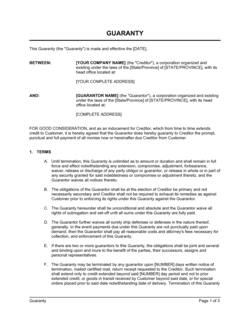
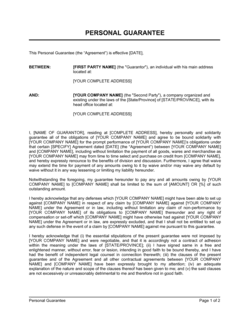
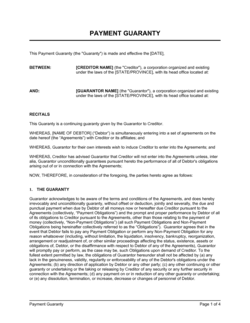
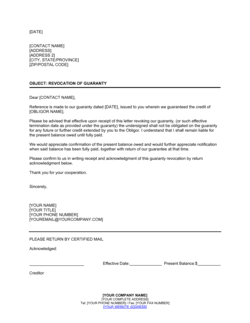
A Request Release of Personal Guaranty is a formal written letter or agreement in which a guarantor asks a lender, landlord, or creditor to discharge them from the personal liability they previously assumed under a guaranty agreement. This free Word download gives you a structured, attorney-style starting point you can edit online and export as PDF to present to any creditor.
When you need it
Use it when the underlying obligation has been substantially paid down, the primary borrower's creditworthiness has improved materially, a business has been sold or restructured, or a co-guarantor has exited the business and needs their personal exposure removed from an existing credit facility or lease.
What's inside
Identification of the parties and the original guaranty, the grounds for requesting release, a summary of current obligation status, supporting documentation references, proposed release conditions, a lender acknowledgment block, and signature lines for both the guarantor and the creditor.

What is a Request Release of Personal Guaranty?

A Request Release of Personal Guaranty is a formal legal document submitted by a guarantor to a creditor, lender, or landlord seeking a written discharge from the personal liability they assumed under a prior guaranty agreement. When a business owner, partner, or executive signs a personal guaranty, they pledge their own assets as security for a debt or lease obligation belonging to another party — typically their company. This request initiates the formal process of unwinding that personal exposure by presenting grounds for release, supporting financial evidence, and proposed conditions to the creditor, culminating in the creditor's countersigned acknowledgment of discharge.

Why You Need This Document

A personal guaranty does not expire automatically, does not transfer with a business sale, and does not dissolve when a partner leaves a company — it remains fully enforceable against the original signatory until the creditor formally releases it in writing. Without a structured, documented release request, guarantors who have sold their business, retired from a partnership, or significantly paid down the underlying debt remain personally exposed to collections, judgments, and asset seizure for obligations they no longer control. An undocumented verbal assurance from a banker or landlord has no legal standing. This template gives guarantors a credible, professionally structured request that moves through a creditor's underwriting process efficiently — identifying the right legal grounds, attaching the right evidence, and delivering the operative release language the creditor needs to execute. The difference between a request that is approved in 30 days and one that stalls for six months is almost always preparation, specificity, and documented consideration.

Which variant fits your situation?

If your situation is…Use this template
Full release from all liability under the guarantyRequest Release of Personal Guaranty (Full Discharge)
Reducing guaranty exposure from unlimited to a capped dollar amountLimited Personal Guaranty Amendment
Substituting a new guarantor in place of the departing oneGuarantor Substitution Agreement
Releasing a guaranty tied specifically to a commercial leaseCommercial Lease Guaranty Release
Releasing a guaranty after the underlying debt is fully paid offRelease and Satisfaction of Guaranty
Requesting partial release as a milestone in a loan restructuringLoan Modification and Guaranty Reduction Agreement
Documenting lender's formal written acknowledgment of releaseLender Acknowledgment of Guaranty Release

Common mistakes to avoid

❌ No quantified evidence supporting the release grounds

Why it matters: Creditors route release requests through underwriting; a letter with only qualitative claims fails the review criteria and is returned for more information, adding weeks to the process.

Fix: Attach two full years of audited financials, a current credit report for the primary obligor, and a debt-service-coverage ratio calculation before submitting.

❌ Offering no consideration for the release

Why it matters: A release is a modification of a binding contract — without consideration exchanged, courts in most jurisdictions may decline to enforce it if the creditor later attempts to reinstate the guaranty.

Fix: Propose at least a nominal exchange of value: a principal paydown, a fee, enhanced collateral, or a replacement guarantor with equivalent creditworthiness.

❌ Failing to obtain a countersignature from an authorized creditor officer

Why it matters: A release executed only by the guarantor is not a release — it is a request. Without the creditor's authorized signature, the guaranty obligation remains fully intact and enforceable.

Fix: Before treating any obligation as discharged, confirm the signatory's title and authority level, and verify that the creditor's internal approval threshold for releases was met.

❌ Using outdated financial statements as supporting exhibits

Why it matters: Underwriting teams typically require financial statements dated within 12 months — submitting older documents stalls the review and signals the guarantor has not prepared the request carefully.

Fix: Request interim financial statements or a CPA-compiled report if the most recent annual statements are more than 9 months old at the time of submission.

❌ Submitting the request without a stated response deadline

Why it matters: Without a deadline, release requests routinely sit unresolved for months in a creditor's queue, leaving the guarantor in continuing personal exposure with no clear path to resolution.

Fix: State a specific response deadline — 20 to 30 business days is standard — and specify that you will escalate to senior management or legal counsel if the deadline passes without a written response.

❌ Referencing the loan agreement instead of the specific guaranty instrument

Why it matters: The guaranty is a separate legal document from the underlying loan — citing only the loan agreement creates ambiguity about which instrument is being released, which a creditor's legal team will use to delay or deny the request.

Fix: Cite the guaranty by its exact title, execution date, and all party names as they appear on the original document, and attach a copy of the guaranty as an exhibit.

The 9 key clauses, explained

Parties and Original Guaranty Reference

In plain language: Identifies the guarantor, the creditor, the primary obligor (borrower or lessee), and cites the original guaranty agreement by date and document reference.

Sample language
This Request is submitted by [GUARANTOR FULL LEGAL NAME] ('Guarantor') to [CREDITOR NAME] ('Creditor') in connection with the Personal Guaranty dated [DATE] ('Guaranty') executed by Guarantor in favor of Creditor, relating to the [LOAN / LEASE AGREEMENT] dated [DATE] between [PRIMARY OBLIGOR NAME] and Creditor.

Common mistake: Referencing only the loan agreement rather than the specific guaranty document. A guaranty is a separate instrument and must be identified by its own execution date and document number to avoid ambiguity about which obligation is being released.

Grounds for Release

In plain language: States the specific factual and legal basis on which the guarantor believes release is warranted — paid-down balance, improved creditworthiness, business sale, or co-guarantor departure.

Sample language
Guarantor respectfully requests release on the following grounds: (a) the outstanding principal balance has been reduced from $[ORIGINAL AMOUNT] to $[CURRENT BALANCE], representing a [X]% reduction; (b) [PRIMARY OBLIGOR NAME] has maintained a debt-service-coverage ratio of [X] for the past [X] consecutive quarters; and (c) [ANY ADDITIONAL GROUND].

Common mistake: Providing only a vague statement like 'the business is doing well' without quantified evidence. Creditors evaluate release requests against underwriting criteria — specific metrics dramatically increase the probability of approval.

Current Status of the Underlying Obligation

In plain language: Summarizes the current outstanding balance, payment history, collateral position, and any covenant compliance status to give the creditor a factual snapshot.

Sample language
As of [DATE], the outstanding balance under the [LOAN / LEASE] is $[AMOUNT]. [PRIMARY OBLIGOR NAME] has made [X] consecutive on-time payments totaling $[AMOUNT]. No defaults, waivers, or forbearances are outstanding as of the date of this Request.

Common mistake: Omitting the payment history entirely. A clean payment record is the creditor's primary comfort factor; leaving it out forces the creditor to pull the file themselves, slowing the process.

Supporting Documentation Schedule

In plain language: Lists all exhibits attached to the request — audited financials, credit reports, appraisals, sale agreements, or other evidence supporting the grounds for release.

Sample language
In support of this Request, Guarantor attaches the following: Exhibit A — [PRIMARY OBLIGOR] audited financial statements for fiscal years [YEAR] and [YEAR]; Exhibit B — most recent [CREDIT BUREAU] credit report for [PRIMARY OBLIGOR]; Exhibit C — [APPRAISAL / VALUATION] of collateral dated [DATE].

Common mistake: Submitting outdated financial statements — anything older than 12 months carries little weight with underwriting teams reviewing a release request and will almost always trigger a request for more current data.

Proposed Release Conditions

In plain language: Identifies any conditions the guarantor agrees to as part of the release — a one-time fee, a partial principal paydown, a replacement guarantor, or enhanced collateral.

Sample language
In consideration of the release, Guarantor proposes the following: (a) a one-time principal reduction payment of $[AMOUNT] on or before [DATE]; and/or (b) substitution of [REPLACEMENT GUARANTOR NAME] as guarantor under the terms of the original Guaranty, subject to Creditor's approval of Replacement Guarantor's creditworthiness.

Common mistake: Offering no consideration at all. A release is a contractual concession by the creditor — without at least a nominal exchange of value, the release may be unenforceable and most creditors will decline to execute it.

Representations and Warranties of Guarantor

In plain language: The guarantor confirms that they have disclosed all material facts, that no default is known or anticipated, and that the supporting documentation is accurate and complete.

Sample language
Guarantor represents and warrants that: (a) all information provided in this Request and the attached Exhibits is true, accurate, and complete as of the date hereof; (b) Guarantor is not aware of any existing or threatened default under the [LOAN / LEASE AGREEMENT]; and (c) no material adverse change has occurred in the financial condition of [PRIMARY OBLIGOR] since the date of the most recent financial statements provided.

Common mistake: Omitting a representations and warranties clause. Without it, a creditor who later discovers undisclosed adverse information may seek to rescind the release on grounds of fraudulent inducement.

Creditor Review Period and Response Deadline

In plain language: Sets a reasonable deadline by which the creditor must respond — approve, deny, or request additional information — preventing the request from sitting unanswered indefinitely.

Sample language
Guarantor respectfully requests that Creditor review this Request and provide a written response no later than [DATE], which is [X] business days from the date of this letter. If no response is received by the deadline, Guarantor reserves the right to escalate this Request in accordance with the terms of the original Guaranty.

Common mistake: Setting no response deadline at all. Without a deadline, release requests routinely sit in a credit officer's queue for months; a stated deadline creates accountability and gives the guarantor a concrete trigger for follow-up.

Release and Discharge Language

In plain language: The operative provision — executed by the creditor — that formally discharges the guarantor from all present and future liability under the guaranty.

Sample language
Upon execution below by an authorized representative of Creditor, [CREDITOR NAME] hereby releases and forever discharges [GUARANTOR FULL LEGAL NAME] from any and all obligations, liabilities, and claims arising under the Personal Guaranty dated [DATE], effective as of [EFFECTIVE DATE]. This release is not a release of [PRIMARY OBLIGOR NAME] or any other guarantor.

Common mistake: Using release language that is limited to 'known' claims only. Phrases like 'releases all known claims' leave the door open for the creditor to assert claims that were not yet identified at the time of signing.

Governing Law and Entire Agreement

In plain language: Specifies the jurisdiction whose law governs the release and confirms that the release document supersedes all prior negotiations or agreements about the guarantor's discharge.

Sample language
This Release shall be governed by the laws of [STATE / PROVINCE / COUNTRY]. This document constitutes the entire agreement between the parties with respect to the release of Guarantor's obligations under the Guaranty and supersedes all prior discussions, representations, and agreements relating thereto.

Common mistake: Defaulting to the governing law of the original loan agreement without checking whether that jurisdiction is appropriate for the individual guarantor — particularly relevant when the guarantor has moved to a different state or country since signing.

How to fill it out

  1. 1

    Gather the original guaranty and loan documents

    Locate the exact guaranty agreement — including its execution date, parties, and document reference number — along with the underlying loan, lease, or credit agreement it supports. You will need to cite these precisely.

    💡 If you cannot locate the original guaranty, request a copy from the creditor's servicing department before submitting anything — referencing a wrong date or agreement number can delay processing significantly.

  2. 2

    Identify and document your grounds for release

    Choose the specific factual basis for your request — loan paydown, improved business financials, business sale, or departure from the entity — and gather quantified evidence for each ground.

    💡 Lead with the strongest ground first. Creditors are most receptive to release requests backed by a debt-service-coverage ratio above 1.25x for at least four consecutive quarters.

  3. 3

    Compile your supporting documentation

    Assemble audited or reviewed financial statements for the most recent two fiscal years, a current credit report for the primary obligor, any collateral appraisals, and copies of any business sale or ownership-change documents.

    💡 Financial statements must be dated within 12 months of the request date — older documents will almost always trigger a request for updated materials and reset your timeline.

  4. 4

    Draft the current obligation status summary

    Enter the current outstanding balance, the original loan or lease amount, the number and amount of on-time payments made, and confirm in writing that no defaults or waivers are outstanding.

    💡 Request a formal payoff or balance statement from the creditor's servicing team so the figures in your request match the creditor's own records exactly.

  5. 5

    Propose specific release conditions

    Determine what you are willing to offer — a lump-sum principal reduction, a replacement guarantor, enhanced collateral, or a combination — and state the terms clearly in the proposed conditions clause.

    💡 A modest principal paydown (even 5–10% of the remaining balance) signals good faith and materially increases the likelihood of approval compared to requests offering no consideration.

  6. 6

    Set a creditor response deadline

    Calculate a reasonable review period — typically 20–30 business days from delivery — and enter it as the response deadline. State clearly what action you will take if the deadline passes without a response.

    💡 Send the request by certified mail or courier and by email to the creditor's relationship manager and credit officer simultaneously to create a documented delivery record.

  7. 7

    Execute and submit with all exhibits

    Sign the request, attach all exhibits in the order listed in the supporting documentation clause, and deliver the complete package to the creditor's relationship manager and credit department.

    💡 Follow up with a brief email three business days after delivery to confirm receipt and identify the reviewing officer by name — this reduces the risk of the package sitting unassigned.

  8. 8

    Obtain the creditor's countersignature on the release block

    Once the creditor approves, ensure an authorized representative of the creditor executes the release and discharge clause with their name, title, and date. Store the fully executed copy securely.

    💡 A release that is not signed by an authorized creditor officer is not enforceable — verify the signatory's authority before treating the obligation as discharged.

Frequently asked questions

What is a request release of personal guaranty?

A request release of personal guaranty is a formal written document submitted by a guarantor to a creditor asking to be discharged from the personal liability they assumed under an earlier guaranty agreement. It identifies the original guaranty, presents the grounds for release — such as loan paydown or improved creditworthiness — attaches supporting documentation, and proposes any conditions the guarantor is willing to meet in exchange for the creditor's written discharge.

Can a creditor refuse to release a personal guaranty?

Yes. A creditor has no general legal obligation to release a guarantor before the underlying obligation is fully discharged, unless the original guaranty agreement includes a specific release trigger or the parties have negotiated a separate release agreement. However, well-documented requests supported by strong financials and a good payment history significantly increase the probability of approval. Creditors may counter with modified conditions rather than an outright denial.

What happens to a personal guaranty when a business is sold?

A personal guaranty does not automatically terminate when the underlying business is sold. The guarantor remains personally liable unless the creditor formally agrees to release them in writing. Many business sales require the buyer to provide a substitute guarantor or pay down the guaranteed debt as a closing condition. Without a documented release from the creditor, the original guarantor retains full exposure even after the sale is complete.

What evidence should I include with a release request?

The most persuasive supporting materials are two years of audited or reviewed financial statements for the primary borrower, a current third-party credit report, a statement of the current outstanding balance and payment history from the creditor's servicing system, any recent collateral appraisal, and documentation of any ownership change or business sale. The stronger the primary obligor's demonstrated ability to service the debt independently, the stronger the release request.

Is a personal guaranty release enforceable without consideration?

In most jurisdictions, a creditor's release of a guaranty requires consideration to be contractually binding — meaning the guarantor must provide something of value in exchange. A principal paydown, a fee, a replacement guarantor, or enhanced collateral all satisfy this requirement. A release signed without any consideration may be challenged and potentially rescinded by the creditor, particularly if the underlying debt later goes into default.

Do I need a lawyer to request a release of personal guaranty?

For straightforward requests — strong payment history, significant loan paydown, clear business transition — a well-structured template is typically sufficient to initiate the process. Engaging a lawyer is advisable when the guaranty amount is material (generally above $100,000), the creditor has previously denied a release, the release is tied to a business sale with complex representations, or there is any dispute about what the original guaranty covers.

What is the difference between a full release and a partial release?

A full release discharges the guarantor from all present and future liability under the guaranty. A partial release reduces the guarantor's exposure — either capping it at a lower dollar amount, releasing it from specific tranches of the debt, or converting an unlimited guaranty to a limited one. Partial releases are more commonly granted when the creditor is unwilling to remove all security but is willing to acknowledge the guarantor's improved position.

How long does it take a creditor to respond to a release request?

Response timelines vary widely by institution and loan type. Bank credit officers typically take 15–45 business days to route a release request through underwriting and credit approval. Commercial landlords often respond faster — within 10–20 business days for straightforward lease guaranty releases. Including a stated response deadline in the request and following up proactively with the relationship manager can reduce actual response time significantly.

Can a departing business partner be released from a guaranty without the lender's consent?

No. A departing partner cannot unilaterally remove themselves from a personal guaranty they signed — only the creditor can release them. Internal partnership agreements that purport to shift guaranty liability to remaining partners have no effect on the creditor's rights. The creditor's written release is the only instrument that legally discharges the departing partner's personal exposure.

How this compares to alternatives

vs Personal Guaranty Agreement

A personal guaranty agreement creates the original obligation — it is the document the guarantor signs to assume liability for another party's debt. A request release of personal guaranty is the downstream document used to exit that obligation. The guaranty creates the exposure; the release request initiates the process of removing it.

vs Release and Waiver Agreement

A general release and waiver covers a broad discharge of all claims between parties arising from a dispute or transaction. A request release of personal guaranty is narrowly targeted at a specific financial obligation and requires the creditor's active cooperation and countersignature. General releases are typically mutual; a guaranty release is unilateral from the creditor.

vs Loan Modification Agreement

A loan modification agreement restructures the terms of the underlying debt — interest rate, payment schedule, or maturity date — without necessarily altering the guaranty. A guaranty release targets the guarantor's personal liability specifically and does not change the loan terms. The two documents are often used together in a debt restructuring but serve distinct legal purposes.

vs Guarantor Substitution Agreement

A guarantor substitution agreement replaces one guarantor with another rather than eliminating the guaranty entirely. A request release of personal guaranty seeks a full discharge with no replacement. Substitution is the appropriate path when the creditor insists on maintaining personal credit support but is willing to accept a different individual with equivalent or stronger creditworthiness.

Industry-specific considerations

Commercial Real Estate

Tenants with strong multi-year payment records seek release from personal guaranty clauses in commercial leases as a condition of lease renewal or when transitioning the business to a new owner.

Banking and Financial Services

Business loan guarantors request release when the borrower's DSCR and credit profile have improved sufficiently to meet the bank's unsecured lending criteria, often as part of an annual credit review.

Franchising

Franchisees who have operated successfully for a defined period submit release requests when franchise agreements include performance-based guaranty reduction milestones or upon resale to a qualified buyer.

Manufacturing and Distribution

Owners who personally guaranteed equipment financing or supplier credit lines request release when the business's asset base and receivables are sufficient to support the obligation on a standalone basis.

Jurisdictional notes

United States

Guaranty law is primarily state-governed in the US, meaning enforceability standards, required disclosures, and consideration requirements vary by state. California, for example, requires creditors to pursue the primary obligor before enforcing a guaranty in some circumstances (anti-deficiency rules). The Statute of Frauds in all US states requires guaranty agreements — and releases — to be in writing to be enforceable. Some states, including New York, impose strict requirements on the language of commercial guaranty waivers.

Canada

In Canada, guaranty law varies by province under both common law and civil law frameworks. Ontario and most common-law provinces require guaranty agreements to be in writing under the Statute of Frauds. Quebec treats guaranties (called suretyships) under the Civil Code, which imposes distinct rules on release, including the creditor's obligation to disclose material changes to the underlying obligation. A release of guaranty in Canada should always be executed under seal or supported by documented consideration to be enforceable.

United Kingdom

In England and Wales, a guaranty is enforceable as a contract and a release requires consideration or must be executed as a deed to be binding without it. The Statute of Frauds 1677 requires guaranties to be in writing. Creditors are under no general obligation to release a guarantor before the underlying obligation is discharged, but the Consumer Credit Act may apply where guarantors are individuals acting outside a business context. Scottish law applies different principles under Scots contract law, so guaranties with Scottish connections should be reviewed by Scottish-qualified solicitors.

European Union

Guaranty and surety law varies significantly across EU member states — French law distinguishes between cautionnement simple and cautionnement solidaire, each with different release rules. German law (Bürgschaft) requires the guaranty to be in writing and imposes proportionality requirements on scope and duration. Several member states have consumer protection rules that limit the enforceability of personal guaranties given by individuals for business debts. GDPR considerations may arise when personal financial data of the guarantor is processed as part of the release review.

Template vs lawyer — what fits your deal?

PathBest forCostTime
Use the templateGuarantors with strong payment histories and documented financial improvement on obligations under $100,000Free2–4 hours to prepare the request and exhibits
Template + legal reviewGuaranty amounts between $100,000 and $500,000, business sale transitions, or first-time denial responses$300–$800 for a one-hour attorney review and redline2–5 business days
Custom draftedComplex multi-lender facilities, guaranties above $500,000, disputed obligations, or releases tied to litigation$1,500–$5,000+ depending on complexity1–3 weeks

Glossary

Personal Guaranty
A contractual promise by an individual to repay a debt or fulfill an obligation if the primary borrower or lessee defaults.
Guarantor
The individual who signs a personal guaranty and assumes secondary liability for another party's debt or performance obligation.
Creditor
The lender, landlord, or other party in whose favor the personal guaranty was originally executed.
Release of Guaranty
A formal written discharge by the creditor that extinguishes the guarantor's personal liability under the guaranty agreement.
Unlimited Guaranty
A guaranty that covers the entire outstanding balance of a debt, including principal, interest, fees, and collection costs, with no cap.
Limited Guaranty
A guaranty that caps the guarantor's personal exposure at a fixed dollar amount or a defined percentage of the total obligation.
Consideration
Something of value exchanged between parties to make a legal agreement enforceable — a release of guaranty typically requires consideration from the creditor.
Subordination
An arrangement in which one creditor agrees that its claim ranks below another creditor's claim in priority upon default or liquidation.
Recourse Debt
Debt for which the lender can pursue the borrower's personal assets — including assets pledged under a personal guaranty — if the collateral is insufficient.
Indemnification
A contractual obligation by one party to compensate another for specified losses or liabilities, sometimes included in a guaranty release to protect the creditor post-discharge.
Novation
The substitution of a new party or obligation for an existing one, extinguishing the original obligation — a guarantor substitution is a form of novation.

Part of your Business Operating System

This document is one of 3,000+ business & legal templates included in Business in a Box.

  • Fill-in-the-blanks — ready in minutes
  • 100% customizable Word document
  • Compatible with all office suites
  • Export to PDF and share electronically

Create your document in 3 simple steps.

From template to signed document — all inside one Business Operating System.
1
Download or open template

Access over 3,000+ business and legal templates for any business task, project or initiative.

2
Edit and fill in the blanks with AI

Customize your ready-made business document template and save it in the cloud.

3
Save, Share, Send, Sign

Share your files and folders with your team. Create a space of seamless collaboration.

Save time, save money, and create top-quality documents.

★★★★★

"Fantastic value! I'm not sure how I'd do without it. It's worth its weight in gold and paid back for itself many times."

Managing Director · Mall Farm
Robert Whalley
Managing Director, Mall Farm Proprietary Limited
★★★★★

"I have been using Business in a Box for years. It has been the most useful source of templates I have encountered. I recommend it to anyone."

Business Owner · 4+ years
Dr Michael John Freestone
Business Owner
★★★★★

"It has been a life saver so many times I have lost count. Business in a Box has saved me so much time and as you know, time is money."

Owner · Upstate Web
David G. Moore Jr.
Owner, Upstate Web

Run your business with a system — not scattered tools

Stop downloading documents. Start operating with clarity. Business in a Box gives you the Business Operating System used by over 250,000 companies worldwide to structure, run, and grow their business.

Free Forever Plan · No credit card required