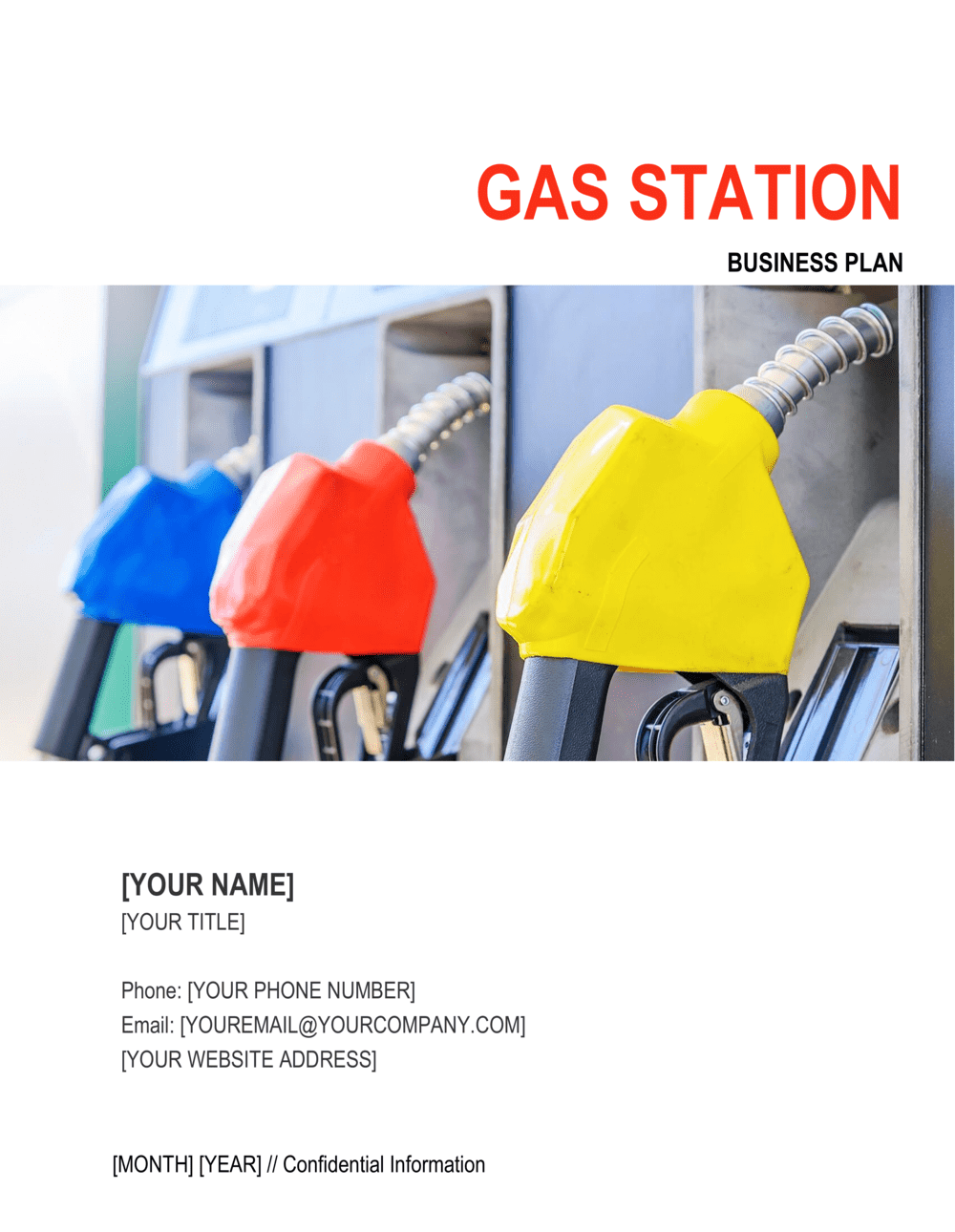
Gas Station Business Plan Template

Free Word download β€’ Edit online β€’ Save & share with Drive β€’ Export to PDF

34 pagesβ€’2h 50m – 3h 50m to fillβ€’Difficulty: Expert
Learn more ↓
FreeGas Station Business Plan Template

At a glance

What it is
A Gas Station Business Plan is a structured operational and financial document that maps out every dimension of launching or acquiring a fuel retail business β€” from site analysis and fuel supplier agreements to convenience store layout and 5-year revenue projections. This free Word download gives you a ready-to-edit framework you can customize for a single-site startup, a franchise acquisition, or an independent multi-pump operation, then export as PDF for lenders or investors.
When you need it
Use it when applying for an SBA loan or commercial real estate financing, approaching a fuel brand for a franchise or dealer agreement, or planning the acquisition of an existing station. It is also useful when seeking a partner or investor for a new fuel retail site.
What's inside
Executive summary, market and site analysis, competitive landscape, fuel and ancillary revenue model, operations plan, regulatory compliance overview, management team, and 5-year financial projections including a monthly cash flow model for Year 1.

What is a Gas Station Business Plan?

A Gas Station Business Plan is a structured operational and financial document that maps the full business case for launching, acquiring, or expanding a fuel retail operation. It covers site selection rationale, traffic and trade-area analysis, fuel throughput and margin modeling, convenience store and ancillary revenue streams, regulatory and environmental compliance obligations, staffing structure, and a five-year financial model built from the ground up on gallons-per-day assumptions. Unlike a generic business plan, this document is purpose-built for the fuel retail industry β€” incorporating the dealer supply agreements, underground storage tank compliance, and SBA 504 financing structures that lenders and fuel brand franchisors specifically look for before approving an operator.

Why You Need This Document

Without a formal gas station business plan, SBA lenders and commercial banks will not advance the financing application β€” fuel retail is a capital-intensive, environmentally regulated industry where lenders require documented evidence that the operator understands throughput economics, environmental liability, and the supply chain before committing six- or seven-figure loans. Fuel brand franchisors use the plan to evaluate whether a prospective dealer can meet volume commitments and maintain brand standards. Beyond financing, a completed plan forces you to stress-test the unit economics before you spend real money: a site that looks attractive on traffic count alone may fail the debt-service coverage test at realistic fuel margins. This template gives you the industry-specific structure to build a credible, lender-ready plan without starting from a blank page.

Which variant fits your situation?

If your situation is…Use this template
Opening a branded franchise station (Shell, BP, Chevron, etc.)Franchise Business Plan
Acquiring an existing independently owned gas stationBusiness Acquisition Plan
Adding a car wash to the station's revenue mixCar Wash Business Plan
Operating a combined gas station and full-service auto repair shopAuto Repair Shop Business Plan
Early-stage ideation or quick internal alignmentOne-Page Business Plan
Raising equity capital from investors for a multi-site roll-upInvestor Business Plan
Planning a standalone convenience store without fuelConvenience Store Business Plan

Common mistakes to avoid

❌ Overstating fuel margin projections

Why it matters: Branded stations typically earn 8–12 cents per gallon. A plan projecting 20+ cents signals either a misunderstanding of the business or undisclosed supplier terms that lenders will flag immediately.

Fix: Use actual supplier quote sheets to anchor your margin assumption and document the source. If margins are above the norm, explain the supply structure that supports them.

❌ Ignoring inside-sales revenue in the financial model

Why it matters: Fuel gross profit alone rarely covers a gas station's full operating cost structure. Inside sales at a well-run C-store can deliver 3–5Γ— the gross margin of fuel per dollar of revenue.

Fix: Model inside sales as a separate P&L line with its own gross margin (typically 25–35%), daily ticket count, and average transaction value.

❌ Omitting environmental compliance status

Why it matters: Undisclosed UST remediation liability or a lapsed SPCC plan can halt a loan closing or trigger EPA penalties that exceed the station's annual net income.

Fix: Include a regulatory compliance section listing every active permit and the Phase I/II environmental assessment status. Attach the Phase II summary if one exists.

❌ Using county-level demographics instead of a drive-time trade area

Why it matters: Fuel customers decide in seconds based on convenience and price. County data overstates the addressable market and produces inflated capture-rate assumptions that undermine the site analysis.

Fix: Use a mapping tool to define a 1-to-3-minute drive-time polygon and pull census data only for that area. Document the AADT for the specific intersection from the state DOT.

The 10 key sections, explained

Executive Summary

Company Overview and Ownership Structure

Market and Site Analysis

Competitive Analysis

Products, Services, and Revenue Streams

Operations Plan

Regulatory and Environmental Compliance

Management Team

Financial Projections

Funding Requirements and Use of Funds

How to fill it out

  1. 1

    Complete the company overview and ownership structure

    Enter your legal entity name, state of organization, ownership percentages, and the dealer or franchise relationship. Clarify whether you are acquiring an existing site or constructing a new one.

    πŸ’‘ Confirm with your fuel supplier whether you will operate as a lessee-dealer, open dealer, or direct-supply account β€” each has different margin and branding implications that flow through the entire plan.

  2. 2

    Conduct and document your site and traffic analysis

    Pull AADT (Annual Average Daily Traffic) data from your state DOT, define a 1-to-3-minute drive-time trade area, and document the nearest competing station's pump count, brand, and fuel price.

    πŸ’‘ Request a fuel volume history from the seller if acquiring an existing site. Actual GPD history is more credible to lenders than projected figures alone.

  3. 3

    Map all revenue streams with realistic unit assumptions

    List every revenue line β€” fuel by grade, inside sales, car wash, ATM, lottery β€” and assign a daily volume and margin assumption to each. Tie fuel volume directly to the traffic count and your estimated capture rate.

    πŸ’‘ A capture rate of 1–3% of passing traffic is realistic for a new entry; use 0.5% as a downside case in your sensitivity analysis.

  4. 4

    Build the operations plan around your staffing model

    Define shift structure, FTE count, hourly wages, and the daily wet-stock reconciliation process. Include your POS system, ATG (automatic tank gauge) brand, and fuel ordering cadence.

    πŸ’‘ Labor as a percentage of total revenue typically runs 8–12% for a well-managed fuel-and-convenience operation β€” flag anything outside that range and explain it.

  5. 5

    Document regulatory and environmental compliance

    List every permit, license, and federal/state requirement applicable to your site β€” UST registration, SPCC plan, fire marshal permit, fuel retail license, and any environmental assessment status.

    πŸ’‘ If the site has a prior Phase II environmental assessment, attach the summary as an appendix. Lenders will order one anyway; providing it upfront shortens the approval timeline.

  6. 6

    Build the three-statement financial model from GPD up

    Start with your GPD assumption and fuel margin to calculate fuel gross profit, then add inside-sales gross profit. Layer in operating expenses (labor, utilities, rent/debt service, supplies) to reach EBITDA, then model cash flow and balance sheet.

    πŸ’‘ Run a scenario at 70% of projected GPD β€” if the station still covers debt service at that volume, the plan is fundable. If it cannot, adjust the capital structure before submitting.

  7. 7

    State the funding ask with an itemized use-of-funds table

    List the total project cost by line item (land, building, equipment, canopy, USTs, working capital, closing costs) and show the proposed financing split between SBA, conventional, and owner equity.

    πŸ’‘ SBA 504 loans are the most common structure for gas station real estate β€” confirm your lender's experience with fuel retail before submitting, as not all SBA lenders are familiar with UST collateral.

  8. 8

    Write the executive summary last

    Pull the site's traffic count, projected GPD, Year 1 revenue, blended gross margin, funding amount, and projected DSCR into a 1–2 page summary. It should be readable as a standalone document.

    πŸ’‘ If a lender reads only the executive summary and the Year 1 P&L, they should have enough to decide whether to schedule a site visit. Test it with someone unfamiliar with the project.

Frequently asked questions

What is a gas station business plan?

A gas station business plan is a structured document that defines the site, market, operations, regulatory framework, and financial projections for a fuel retail business. It is used to secure SBA or commercial financing, obtain a branded fuel supplier agreement, or evaluate the viability of a new or acquired station. A complete plan covers fuel and inside-sales revenue models, staffing, environmental compliance, and a 5-year financial model.

How much does it cost to open a gas station?

Total startup costs for a new-build gas station typically range from $250,000 to $2 million or more, depending on land cost, canopy size, number of USTs, and whether a convenience store or food-service program is included. Acquiring an existing station can range from $150,000 to $1.5 million depending on throughput, real estate ownership versus lease, and brand affiliation. SBA 504 financing covers up to 90% of eligible project costs for owner-occupied fuel retail real estate.

What financing options are available for a gas station?

SBA 504 loans are the most common structure for owner-occupied gas station real estate, providing long-term fixed-rate financing for land, building, and major equipment including USTs and canopy. SBA 7(a) loans cover working capital and acquisition costs. Conventional commercial real estate loans are available for experienced operators with strong financial history. Most lenders require 10–20% owner equity injection and 2+ years of fuel retail management experience.

How do gas stations make money?

Gas stations generate revenue from two primary sources: fuel sales and inside sales (convenience store, food service, car wash, ATM, and lottery). Fuel margins are thin β€” typically 8–18 cents per gallon depending on brand, supply agreement, and local competition. Inside sales carry gross margins of 25–35% and often account for the majority of a station's total gross profit. Stations that combine fuel with a strong food-service program (quick-service restaurant or branded deli) typically achieve the highest blended margins.

Do I need a business plan to buy a gas station?

Yes β€” virtually every commercial lender, SBA lender, and fuel brand franchisor requires a formal business plan as part of the approval process. The plan must include a site analysis, competitive landscape, operating model, regulatory compliance overview, and a full financial model with monthly cash flow projections for at least Year 1. Acquisitions of existing stations also require historical fuel volume and inside-sales data from the seller.

What makes a gas station site a good investment?

The four primary site quality indicators are AADT (annual average daily traffic count), ease of ingress and egress, proximity to a residential or commercial demand driver (apartment complex, office park, highway interchange), and absence of a same-brand competitor within a 1-mile radius. A site with 15,000+ AADT at a signalized intersection with no direct brand competitor is considered strong. Fuel volume history on an existing site is the most reliable predictor of future throughput.

What environmental requirements apply to gas stations?

Gas stations with underground storage tanks are regulated under EPA 40 CFR Part 280, which requires secondary containment, leak detection systems, spill and overfill prevention equipment, and financial assurance for cleanup liability. State UST programs add registration, inspection, and operator training requirements that vary by state. A Spill Prevention, Control, and Countermeasure (SPCC) plan is required for sites above EPA storage thresholds. Phase I and Phase II environmental site assessments are standard requirements for any acquisition financing.

What is a realistic fuel margin to project in a business plan?

Branded lessee-dealers typically earn 8–12 cents per gallon after supplier costs. Unbranded open-dealer stations can achieve 12–18 cents depending on supply contract terms and local price competition. Margins above 18 cents per gallon for a new site are difficult to substantiate without a documented supplier agreement and should be supported by actual quote sheets in the plan's appendix. Lenders benchmark projections against regional fuel margin data from OPIS or Platts.

How long does it take to write a gas station business plan?

A complete gas station business plan β€” including site analysis, competitive research, operations detail, and a three-statement financial model β€” typically takes 3–6 weeks for a first-time writer working from a structured template. The financial model alone requires 10–20 hours if built from scratch. Using a purpose-built template cuts the structural work by roughly 60%, concentrating your time on the site-specific data and financial assumptions that lenders actually scrutinize.

How this compares to alternatives

vs Convenience Store Business Plan

A convenience store business plan models inside-sales revenue, inventory turns, and store layout without a fuel component. A gas station business plan adds fuel throughput, margin-per-gallon modeling, UST compliance, and canopy infrastructure. Use the convenience store plan if you operate a C-store without fuel pumps; use this plan if fuel is a primary revenue and regulatory driver.

vs Car Wash Business Plan

A car wash business plan focuses on wash throughput, chemistry cost, equipment depreciation, and membership revenue. A gas station plan treats the car wash as one ancillary revenue line within a broader fuel-and-convenience operation. If the car wash is the primary business with fuel as a secondary add-on, the dedicated car wash plan provides more appropriate depth.

vs Auto Repair Shop Business Plan

An auto repair shop plan covers bay utilization, technician labor rates, parts markup, and warranty liability β€” none of which appear in a standard gas station plan. A combined fuel-and-repair operation needs elements of both documents. Start with the gas station plan for the fuel and compliance framework, then incorporate the repair sections for the service bay component.

vs General Business Plan

A general business plan template covers strategy, market, and financials in a format applicable to any industry. It lacks gas station-specific sections: GPD modeling, fuel margin analysis, UST compliance, dealer supply agreement structure, and SBA 504 financing schedules. A fuel retail lender or supplier will expect industry-specific content that a general template does not provide.

Industry-specific considerations

Fuel Retail

Wet-stock reconciliation, fuel margin by grade, GPD throughput modeling, UST compliance, and branded versus unbranded dealer economics.

Convenience Retail

Inside-sales gross margin by category (tobacco, packaged beverages, foodservice), average transaction value, and loyalty program integration with the fuel canopy.

Food & Beverage

Quick-service restaurant or branded deli attached to the station β€” food cost percentage, labor model, and incremental traffic lift from the food program.

Commercial Real Estate

Site acquisition and build-out cost modeling, SBA 504 financing structure, canopy and UST capital expenditure, and environmental due-diligence requirements.

Template vs pro β€” what fits your needs?

PathBest forCostTime
Use the templateExperienced fuel retail operators applying for SBA loans up to $1M or approaching a single branded supplierFree3–6 weeks (60–100 hours)
Template + professional reviewFirst-time gas station owners, multi-site acquisitions, or any plan where the financial model needs third-party validation$1,000–$3,000 for a fuel retail consultant or SBA-specialist CPA review4–7 weeks
Custom draftedMulti-site roll-ups, equity raises above $1M, or sites with complex environmental remediation history$5,000–$15,000 for a specialist business plan writer with fuel retail experience6–10 weeks

Glossary

Fuel Margin
The difference between the retail price per gallon and the dealer cost, expressed in cents per gallon β€” the primary revenue driver for the fuel side of the business.
Gallons Per Day (GPD)
The volume of fuel sold daily at a station, used as the base metric for projecting fuel revenue and sizing pump infrastructure.
Dealer Supply Agreement
A contract between a fuel retailer and a branded or unbranded supplier that sets fuel pricing mechanisms, volume commitments, and brand obligations.
Canopy
The covered overhead structure over the fuel pump islands β€” its size determines the number of fueling positions and directly affects throughput capacity.
Inside Sales
Revenue generated within the convenience store or attached food-service operation, as distinct from fuel sales at the pump.
Wet Stock
Fuel inventory held in underground storage tanks, measured and reconciled daily to detect losses from leaks, evaporation, or theft.
Underground Storage Tank (UST)
A tank buried below grade that holds fuel; USTs are federally regulated under EPA rules covering installation, leak detection, and decommissioning.
Throughput
Total fuel volume pumped at a station over a defined period β€” a key capacity and efficiency metric used in site valuations.
Cigarette Carton Equivalent (CCE)
A convenience-industry benchmark that normalizes diverse product margins into a single comparable unit for store performance analysis.
Drive-Time Trade Area
The geographic catchment zone β€” typically a 1-to-3-minute drive radius β€” from which a gas station draws the majority of its fuel customers.

Part of your Business Operating System

This document is one of 3,000+ business & legal templates included in Business in a Box.

  • Fill-in-the-blanks β€” ready in minutes
  • 100% customizable Word document
  • Compatible with all office suites
  • Export to PDF and share electronically

Create your document in 3 simple steps.

From template to signed document β€” all inside one Business Operating System.
1
Download or open template

Access over 3,000+ business and legal templates for any business task, project or initiative.

2
Edit and fill in the blanks with AI

Customize your ready-made business document template and save it in the cloud.

3
Save, Share, Send, Sign

Share your files and folders with your team. Create a space of seamless collaboration.

Save time, save money, and create top-quality documents.

β˜…β˜…β˜…β˜…β˜…

"Fantastic value! I'm not sure how I'd do without it. It's worth its weight in gold and paid back for itself many times."

Managing Director Β· Mall Farm
Robert Whalley
Managing Director, Mall Farm Proprietary Limited
β˜…β˜…β˜…β˜…β˜…

"I have been using Business in a Box for years. It has been the most useful source of templates I have encountered. I recommend it to anyone."

Business Owner Β· 4+ years
Dr Michael John Freestone
Business Owner
β˜…β˜…β˜…β˜…β˜…

"It has been a life saver so many times I have lost count. Business in a Box has saved me so much time and as you know, time is money."

Owner Β· Upstate Web
David G. Moore Jr.
Owner, Upstate Web

Run your business with a system β€” not scattered tools

Stop downloading documents. Start operating with clarity. Business in a Box gives you the Business Operating System used by over 250,000 companies worldwide to structure, run, and grow their business.

Free Forever PlanΒ Β·Β No credit card required