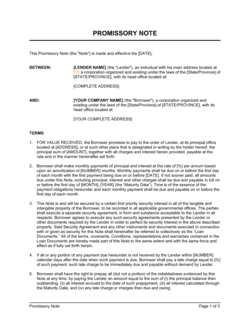
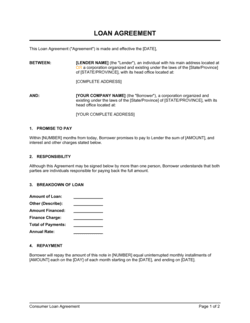
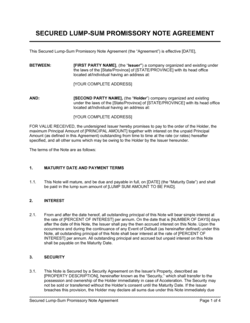
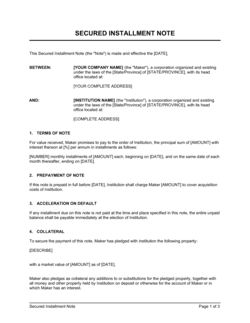
Financial Agreement Template

Free Word download • Edit online • Save & share with Drive • Export to PDF

10 pages30–40 min to fillDifficulty: ComplexSignature requiredLegal review recommended
Learn more ↓
FreeFinancial Agreement Template

At a glance

What it is
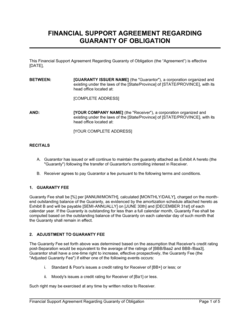
A Financial Agreement is a legally binding contract that documents the financial obligations, payment terms, and conditions agreed upon between two or more parties — typically a lender and a borrower, or two businesses exchanging capital or extending credit. This free Word download lets you customize repayment schedules, interest rates, default provisions, and security terms, then export as PDF for signature.
When you need it
Use it when lending or borrowing money, extending credit to a business partner, restructuring a debt obligation, or formalizing any arrangement where one party owes another a defined financial sum under agreed conditions. It is essential any time a handshake or informal promise is not sufficient legal protection for the amounts involved.
What's inside
Party identification, the principal amount and disbursement terms, interest rate and calculation method, a repayment schedule with due dates, default and cure provisions, security or collateral terms, representations and warranties, governing law, and signature blocks for all parties.

What is a Financial Agreement?

A Financial Agreement is a legally binding contract that formalizes the financial obligations between two or more parties — most commonly a lender and a borrower — by documenting the principal amount, interest rate, repayment schedule, default conditions, and any collateral securing the arrangement. Unlike a simple invoice or informal promise, a financial agreement creates enforceable legal obligations on both sides, defines the consequences of non-payment, and gives each party a clear written record of exactly what was agreed. It functions as both a payment instrument and a risk management tool, giving the lending party a documented basis to pursue remedies if the borrowing party fails to perform.

Why You Need This Document

Without a written financial agreement, a loan or credit arrangement rests entirely on trust — and trust provides no legal remedy when a payment is missed, disputed, or ignored. Oral agreements for money are notoriously difficult to enforce: courts require evidence of the amount, the rate, the terms, and the parties' intentions, and conflicting recollections routinely produce expensive, uncertain litigation. A missing acceleration clause means pursuing missed installments one at a time; a missing default definition means proving breach under general contract law rather than enforcing express contractual rights. Beyond disputes, an undocumented financial arrangement creates tax and accounting problems — the IRS and CRA treat undocumented loans between related parties as taxable gifts or distributions. This template gives you a complete, jurisdiction-aware starting point that covers every material term, protects both the lender and the borrower, and holds up under scrutiny from a court, an auditor, or a counterparty's lawyer.

Which variant fits your situation?

If your situation is…Use this template
Lending a fixed sum with a defined repayment schedule and interestLoan Agreement
Documenting a short-term loan between individuals or small businessesPromissory Note
Restructuring or reducing an existing debt owed by a businessDebt Settlement Agreement
Formalizing installment payments for goods or services already deliveredPayment Agreement
Securing a loan against a specific asset or propertySecurity Agreement
Agreeing to defer or restructure payments temporarily during hardshipForbearance Agreement
Setting capital contribution and profit-sharing terms in a joint ventureJoint Venture Agreement

Common mistakes to avoid

❌ No specified interest calculation method

Why it matters: Stating only an annual rate without specifying simple vs. compound interest and the day-count convention means the parties will calculate different payoff amounts, leading to disputes at maturity or refinancing.

Fix: Add a one-sentence calculation clause: 'Interest is calculated on a simple-interest basis using a 365-day year on the actual outstanding Principal balance.'

❌ Vague or missing default definition

Why it matters: Without a defined default clause, the lender must pursue breach-of-contract remedies through general contract law, which requires proving damages — a far slower and more expensive process than enforcing an express default provision.

Fix: List every trigger event explicitly, including missed payments, insolvency, material misrepresentation, and unauthorized transfer of collateral, with a specific cure period for each.

❌ Setting an interest rate above the state usury ceiling

Why it matters: Usury violations can void the entire interest obligation, require the lender to refund interest already paid, and in some states expose the lender to criminal penalties — even for unintentional violations.

Fix: Research the usury limit in the governing state before finalizing the rate. For loans between businesses, the limit is often higher or absent; for consumer loans, it is typically 10–24% depending on the state.

❌ Omitting disbursement documentation

Why it matters: A borrower who later claims they never received the funds — or received a different amount — can challenge the entire debt if no disbursement record is attached to or referenced in the agreement.

Fix: Attach a wire confirmation, bank transfer receipt, or cleared-check copy as an exhibit to the executed agreement, and reference it in the principal clause.

❌ No acceleration clause

Why it matters: Without acceleration language, a lender whose borrower stops paying can only sue for each missed installment as it comes due — potentially requiring multiple lawsuits over the loan's life.

Fix: Include a standard acceleration clause permitting the lender to declare the full remaining balance immediately due upon an uncured default.

❌ Collateral described too broadly

Why it matters: A security interest in 'all assets of the borrower' without a specific description or a corresponding security agreement may be unperfected or subordinated to a prior lender who filed a proper UCC-1 covering the same assets.

Fix: Describe collateral with sufficient specificity — asset type, serial numbers, or property description — and file a UCC-1 financing statement within 5 business days of execution.

The 10 key clauses, explained

Parties and recitals

In plain language: Identifies the lender and borrower by their full legal names and entity types, and states the background context for entering the agreement.

Sample language
This Financial Agreement is entered into as of [DATE] by and between [LENDER LEGAL NAME], a [STATE] [ENTITY TYPE] ('Lender'), and [BORROWER LEGAL NAME], a [STATE] [ENTITY TYPE] ('Borrower').

Common mistake: Using trade names instead of registered legal entity names. If the lender name on the agreement differs from the name on bank accounts or corporate filings, enforcing the debt or filing a lien becomes procedurally complicated.

Loan amount and disbursement

In plain language: States the exact principal amount being lent, the currency, and how and when the funds will be transferred to the borrower.

Sample language
Lender agrees to lend Borrower the principal sum of $[AMOUNT] USD ('Principal'), to be disbursed by [wire transfer / check] to Borrower's account ending in [XXXX] on or before [DATE].

Common mistake: Failing to specify the disbursement method and date. Disputes over whether funds were actually delivered are the leading cause of financial agreement litigation — a clear disbursement record eliminates the ambiguity.

Interest rate and calculation

In plain language: Defines the annual interest rate, whether it is fixed or variable, the calculation method (simple or compound), and the basis for computing accruals.

Sample language
The outstanding Principal shall bear interest at the rate of [X]% per annum, calculated on a [simple / compound] basis using a 365-day year. Interest shall begin accruing on the Disbursement Date.

Common mistake: Omitting the calculation basis entirely. 'Interest at 8% per annum' means different amounts depending on whether you use simple interest, monthly compounding, or daily compounding — the omission creates a dispute at payoff.

Repayment schedule

In plain language: Sets out the number of installments, their amounts, due dates, and the method by which payments must be made to be considered received.

Sample language
Borrower shall repay the Principal and accrued interest in [NUMBER] equal monthly installments of $[AMOUNT], due on the [DAY] of each month commencing [START DATE], with a final balloon payment of $[AMOUNT] due on [MATURITY DATE].

Common mistake: Using relative dates like 'due within 30 days of each invoice' without an anchor date. Without a fixed starting point, parties routinely disagree on when each payment is due.

Prepayment

In plain language: States whether the borrower may repay all or part of the principal ahead of schedule, and whether any penalty applies for doing so.

Sample language
Borrower may prepay all or any portion of the outstanding Principal at any time without penalty, provided that any partial prepayment is applied first to accrued interest and then to Principal.

Common mistake: Saying nothing about prepayment. Silence is interpreted differently in different jurisdictions — some courts read silence as permitting penalty-free prepayment; others do not. State the rule explicitly.

Default and cure

In plain language: Defines what constitutes a default — missed payment, insolvency, breach of representation — and gives the defaulting party a cure period before remedies are triggered.

Sample language
Borrower shall be in default if: (a) any payment is not received within [10] days of its due date; (b) Borrower files for bankruptcy or becomes insolvent; or (c) Borrower breaches any material term of this Agreement and fails to cure within [30] days of written notice.

Common mistake: No cure period for payment defaults. Courts in most jurisdictions expect lenders to give at least 10–15 days notice before accelerating — without it, the acceleration may be challenged as premature and unenforceable.

Remedies and acceleration

In plain language: Describes what the lender may do upon an uncured default — accelerate the full balance, charge a default interest rate, pursue legal action, or enforce security interests.

Sample language
Upon an uncured Event of Default, Lender may, at its sole discretion: (a) declare the entire outstanding Principal and accrued interest immediately due and payable; (b) apply a default interest rate of [X]% per annum from the date of default; and (c) exercise any rights against Collateral under applicable law.

Common mistake: Failing to specify a default interest rate. Without one, the lender is limited to the contract rate on the overdue balance — not the higher-rate compensation that reflects the added risk of default.

Security and collateral

In plain language: Identifies any asset pledged as security for repayment, describes how the security interest is perfected, and states the lender's rights upon default.

Sample language
As security for repayment, Borrower hereby grants Lender a first-priority security interest in [COLLATERAL DESCRIPTION]. Borrower shall execute a UCC-1 financing statement, if applicable, within [5] business days of signing.

Common mistake: Describing collateral vaguely — 'all business assets' — without a specific description or reference to a security agreement. An unperfected or vaguely described security interest may be subordinated to a later creditor or rendered unenforceable in bankruptcy.

Representations and warranties

In plain language: Each party confirms that they have legal authority to enter the agreement, that no other debt or obligation conflicts with it, and that the information they have provided is accurate.

Sample language
Each party represents and warrants that: (a) it has full legal authority to enter this Agreement; (b) this Agreement does not conflict with any other obligation or restriction binding on it; and (c) all information provided in connection with this Agreement is true and complete.

Common mistake: Omitting representations entirely for smaller private loans. Without them, a borrower who was insolvent at signing — and knew it — faces no contractual liability for that concealment beyond the debt itself.

Governing law and dispute resolution

In plain language: Specifies which jurisdiction's law governs interpretation of the agreement and how disputes will be resolved — court litigation, arbitration, or mediation.

Sample language
This Agreement shall be governed by and construed in accordance with the laws of the State of [STATE], without regard to conflict-of-law principles. Any dispute arising hereunder shall be resolved by binding arbitration in [CITY, STATE] under the rules of [AAA / JAMS], except that either party may seek injunctive relief in any court of competent jurisdiction.

Common mistake: Choosing a governing law state with no real connection to either party. Several states — including California and New York — have debtor-protection statutes that apply regardless of what the contract says, so the chosen law should be one the lender has actually researched.

How to fill it out

  1. 1

    Identify both parties with full legal names

    Enter the lender's and borrower's complete registered legal names, entity types (LLC, corporation, sole proprietor, individual), and principal addresses in the opening recitals block.

    💡 Pull the borrower's exact legal name from a current secretary-of-state filing — not from a business card or website — to ensure the agreement binds the right legal entity.

  2. 2

    Set the principal amount, currency, and disbursement date

    Enter the exact dollar amount being lent, specify the currency explicitly (USD, CAD, GBP), and state how and when funds will be transferred — bank wire, ACH, or check — with the target disbursement date.

    💡 Retain a wire confirmation or cleared-check image as your disbursement record. Attach it to the executed agreement as Exhibit A.

  3. 3

    Define the interest rate and calculation method

    State the annual interest rate as a fixed percentage or, for variable rates, define the index (e.g., prime rate plus 2%) and adjustment frequency. Specify whether interest is simple or compound and the day-count convention (365 or 360 days).

    💡 Check the usury ceiling in the governing state before setting the rate — consumer loans in some states cap at 10–18% per annum, and exceeding the limit voids the interest entirely.

  4. 4

    Build the repayment schedule with fixed due dates

    List each installment amount, the specific calendar date it is due, and the application order for payments (interest first, then principal). For amortizing loans, attach a full amortization table as a schedule.

    💡 Include a statement of the total repayment amount — principal plus total interest at the contract rate — so both parties can verify the math before signing.

  5. 5

    Address prepayment and late-payment fees

    State explicitly whether prepayment is permitted without penalty and, if a prepayment fee applies, how it is calculated. Define any late fee — typically 1.5–5% of the overdue installment — and the grace period before it triggers.

    💡 Keep late fees below the usury ceiling; courts routinely treat excessive late fees as disguised interest and void them alongside the interest clause.

  6. 6

    Define default events and the cure period

    List every event that constitutes a default — missed payment, insolvency filing, breach of warranty, transfer of collateral without consent — and give a specific cure period (10–30 days) for each type before remedies are triggered.

    💡 Separate payment defaults (short cure period, 10 days) from non-payment defaults (longer cure period, 30 days) — this mirrors standard commercial lending practice and is more likely to withstand judicial scrutiny.

  7. 7

    Describe collateral and security perfection steps

    If the loan is secured, identify the collateral with specific detail — vehicle VIN, property legal description, or equipment serial numbers — and specify the steps required to perfect the security interest (UCC-1 filing, deed of trust recording, pledge agreement).

    💡 File the UCC-1 within 5 business days of signing — financing statements lapse after 5 years and must be renewed, so calendar a renewal reminder at execution.

  8. 8

    Execute with dated signatures before disbursement

    Both parties must sign and date the agreement before any funds are transferred. For entities, the signer must be an authorized officer — confirm signing authority in the representations clause and attach a corporate resolution if required.

    💡 Use dated electronic signatures with an audit trail if signing remotely — a timestamp showing signature before disbursement is your first line of defense in any default dispute.

Frequently asked questions

What is a financial agreement?

A financial agreement is a legally binding contract that documents the terms under which one party provides money or credit to another — including the principal amount, interest rate, repayment schedule, default conditions, and any collateral securing the obligation. It creates enforceable payment obligations and gives both parties a clear written record of what was agreed, reducing the risk of disputes over amounts, timing, or conditions.

When should I use a financial agreement instead of a promissory note?

A promissory note is a simplified, unconditional promise to pay a fixed sum and is best for straightforward, short-term loans between individuals or small businesses. A financial agreement is more appropriate when the transaction involves collateral, complex repayment structures, default and cure provisions, representations and warranties, or ongoing obligations — such as maintaining insurance on pledged assets. Use a financial agreement any time the loan amount or the relationship warrants more than a single-page promise to pay.

Does a financial agreement need to be notarized?

Notarization is generally not required for a financial agreement to be enforceable between businesses or individuals. However, if the agreement involves a mortgage or deed of trust securing real property, notarization and recording are typically required by state law. Some lenders request notarized signatures as an additional fraud-prevention measure, and certain jurisdictions require notarization for agreements above specified dollar thresholds. When in doubt, consult a lawyer familiar with your governing state.

What interest rate can I charge on a private loan?

The maximum permissible interest rate depends on the type of loan, the borrower (business or consumer), and the governing state. Most states impose usury ceilings ranging from 10% to 25% per annum on consumer loans; business-to-business loans are often exempt from these caps or subject to higher limits. Charging above the usury ceiling can void the interest clause, trigger refund obligations, and in some states constitute a criminal offense — verify the applicable limit before finalizing the rate.

How do I secure a financial agreement with collateral?

Identify the collateral in the agreement with specific detail — asset type, serial numbers, or property legal description — and include a security interest grant. For personal property (equipment, inventory, receivables), file a UCC-1 financing statement with the secretary of state in the borrower's jurisdiction within 5 business days of signing to perfect the security interest. For real property, record a mortgage or deed of trust with the county recorder. An unperfected security interest may be subordinated to later creditors or avoided in bankruptcy.

What happens if the borrower defaults?

Upon default, the lender's remedies depend on what the agreement provides. A well-drafted agreement allows the lender to trigger the cure period, then — if uncured — accelerate the full remaining balance, charge a higher default interest rate, and enforce any security interest against collateral. Without an express default and acceleration clause, the lender is limited to suing for each missed installment individually under general contract law, which is slower and more expensive.

Can a financial agreement be amended after signing?

Yes — parties can modify a financial agreement by executing a written amendment signed by all original parties. Oral modifications are generally unenforceable when the original agreement contains an integration clause requiring written amendments. Common amendments include interest rate reductions, payment deferrals, and maturity date extensions. Always document any modification in writing, reference the original agreement by date, and have all parties sign before the modified terms take effect.

Do I need a lawyer to draft a financial agreement?

For straightforward loans between businesses with standard terms and amounts below $50,000, a high-quality template is typically sufficient. Engaging a lawyer is advisable when the loan amount is large (above $100,000), the arrangement involves real-property collateral, the borrower is a consumer subject to Truth in Lending Act (TILA) disclosures, the transaction is cross-border, or the parties are in a relationship (employer/employee, family) where conflicts of interest may arise. A one-hour legal review typically costs $200–$400 and is worthwhile for any secured or high-value arrangement.

What is the difference between a financial agreement and a loan agreement?

The terms are often used interchangeably, but a loan agreement typically refers specifically to a lending arrangement — one party advances money and the other repays it over time. A financial agreement is a broader term that can cover loans, credit extensions, deferred payment arrangements, capital contribution obligations, and other financial commitments between parties. In practice, a financial agreement template that includes interest, a repayment schedule, and default provisions functions identically to a loan agreement for most business purposes.

How this compares to alternatives

vs Promissory Note

A promissory note is a brief, unconditional written promise to repay a fixed amount — ideal for simple, short-term loans where the only terms needed are the amount, rate, and due date. A financial agreement covers the same ground but adds collateral provisions, default and cure procedures, representations and warranties, and detailed remedies. Use a promissory note for straightforward small loans; use a financial agreement when the transaction is secured, complex, or involves ongoing obligations.

vs Loan Agreement

A loan agreement is a specific type of financial agreement focused entirely on a lending transaction — advancing funds and repaying them with interest. A financial agreement is a broader instrument that can cover credit extensions, deferred payment structures, capital contributions, and other financial obligations not strictly structured as a loan. For pure lending transactions the documents are functionally equivalent; the financial agreement template is more flexible when the arrangement doesn't fit a standard loan structure.

vs Debt Settlement Agreement

A debt settlement agreement documents a negotiated reduction of an existing debt — the creditor agrees to accept less than the full amount owed in exchange for immediate or structured payment. A financial agreement creates the debt obligation in the first place or modifies its terms going forward. Use a debt settlement agreement only after a debt already exists and both parties agree to compromise the balance.

vs Payment Agreement

A payment agreement sets up an installment plan for an existing obligation — typically a past-due invoice or service fee — without creating new debt or involving interest in a lending sense. A financial agreement is a broader contract that includes interest calculations, security interests, default events, and representations appropriate for a formal lending or capital arrangement. For simple installment plans on past-due balances, a payment agreement is sufficient; for anything involving interest-bearing capital, use a financial agreement.

Industry-specific considerations

Real estate

Seller-financed transactions, private mortgage arrangements, and bridge loans secured by property require detailed collateral descriptions, deed-of-trust cross-references, and compliance with state lending disclosure requirements.

Professional services

Law firms, accounting practices, and consultancies use financial agreements to formalize client payment plans for large engagements and to document partner capital loans and capital account contribution obligations.

Manufacturing and wholesale

Suppliers extending trade credit or equipment financing to buyers rely on financial agreements to set credit limits, payment terms, default triggers, and UCC-1-backed security interests in inventory or equipment.

Technology / SaaS

Startup founders document bridge loans, convertible debt arrangements, and founder capital contributions through financial agreements before a formal equity round closes, with conversion triggers and interest accrual terms keyed to a financing milestone.

Healthcare

Medical practices use financial agreements for patient payment plans, equipment financing from private lenders, and inter-entity loans between affiliated practices — all subject to state fee-splitting and anti-kickback compliance considerations.

Retail and e-commerce

Retailers use financial agreements to formalize inventory financing arrangements with private lenders, buy-now-pay-later structures with wholesale clients, and franchise-fee installment plans — often requiring compliance with consumer lending regulations.

Jurisdictional notes

United States

Usury limits vary sharply by state — California caps most consumer loans at 10% per annum, while commercial loans between businesses are often exempt. Federal Truth in Lending Act (TILA) disclosures apply to consumer credit transactions above $50,000 as of 2024 thresholds. UCC Article 9 governs perfection of security interests in personal property in all 50 states; real-property security requires a mortgage or deed of trust recorded at the county level. Some states — including Texas and Florida — offer homestead exemptions that effectively block certain security interests in a primary residence.

Canada

The federal Interest Act prohibits compound interest on certain mortgage loans unless expressed as an annual rate with a specific formula. Provincial consumer protection statutes — including Ontario's Consumer Protection Act and Quebec's Consumer Protection Act — impose disclosure requirements, cooling-off periods, and interest-rate caps for consumer loans. Quebec's civil law framework (Civil Code of Quebec) governs secured lending differently from common-law provinces; hypothec registration replaces UCC-style filing. Quebec agreements must be available in French for consumer transactions.

United Kingdom

Consumer credit agreements are regulated by the Financial Conduct Authority (FCA) under the Consumer Credit Act 1974, requiring specific disclosure of the total amount repayable and APR. Business loans between companies are less regulated but must still avoid unfair contract terms under the Unfair Contract Terms Act 1977. Security over company assets is registered at Companies House via a charge; failure to register within 21 days of creation renders the charge void against a liquidator and unsecured creditors. The late payment of commercial debts carries a statutory interest rate of 8% above the Bank of England base rate under the Late Payment of Commercial Debts Act 1998.

European Union

The EU Consumer Credit Directive (2008/48/EC, updated by 2023/2225) mandates pre-contractual information disclosures, a standardized European Standard Information Sheet, and a 14-day withdrawal right for consumer credit agreements. GDPR requirements apply to any personal financial data processed in connection with the agreement — including credit assessment data — and require a lawful basis and data retention policy. Interest rate caps and usury rules are set at the member-state level; France, Germany, and Italy impose strict ceilings that can be below market rates for certain loan types. Cross-border EU lending must also consider whether the lender requires a credit institution licence in the borrower's member state.

Template vs lawyer — what fits your deal?

PathBest forCostTime
Use the templateUnsecured business-to-business loans under $50,000 with standard repayment terms between parties who have an existing relationshipFree30 minutes
Template + legal reviewSecured loans, amounts between $50,000 and $250,000, cross-state arrangements, or any loan involving a consumer borrower subject to TILA disclosures$300–$7001–3 days
Custom draftedLoans above $250,000, real-property collateral, complex convertible structures, multi-party arrangements, or regulated lending requiring specific disclosures$1,500–$5,000+1–3 weeks

Glossary

Principal
The original sum of money lent or owed, before any interest or fees are added.
Interest Rate
The percentage charged on the outstanding principal balance over a defined period, typically expressed as an annual rate (APR).
Amortization
The process of spreading loan repayments across a series of scheduled payments that cover both principal reduction and interest.
Default
The failure of a borrower to meet a payment obligation or comply with a material term of the agreement by the required date.
Cure Period
A defined window — typically 5 to 30 days — during which a defaulting party may correct the breach before the lender exercises remedies.
Collateral
An asset pledged by the borrower to secure the loan, which the lender may seize and liquidate if the borrower defaults.
Acceleration Clause
A provision that makes the entire outstanding loan balance immediately due and payable upon a defined event, such as default or insolvency.
Usury
The practice of charging an interest rate that exceeds the maximum rate permitted by law in the applicable jurisdiction.
Guarantor
A third party who agrees to repay the debt if the primary borrower fails to do so, providing the lender additional security.
Prepayment Penalty
A fee charged to the borrower for repaying the loan balance earlier than the scheduled maturity date, compensating the lender for lost interest income.
Promissory Note
A written, unconditional promise by one party to pay a specific sum to another party on demand or at a defined future date.

Part of your Business Operating System

This document is one of 3,000+ business & legal templates included in Business in a Box.

  • Fill-in-the-blanks — ready in minutes
  • 100% customizable Word document
  • Compatible with all office suites
  • Export to PDF and share electronically

Create your document in 3 simple steps.

From template to signed document — all inside one Business Operating System.
1
Download or open template

Access over 3,000+ business and legal templates for any business task, project or initiative.

2
Edit and fill in the blanks with AI

Customize your ready-made business document template and save it in the cloud.

3
Save, Share, Send, Sign

Share your files and folders with your team. Create a space of seamless collaboration.

Save time, save money, and create top-quality documents.

★★★★★

"Fantastic value! I'm not sure how I'd do without it. It's worth its weight in gold and paid back for itself many times."

Managing Director · Mall Farm
Robert Whalley
Managing Director, Mall Farm Proprietary Limited
★★★★★

"I have been using Business in a Box for years. It has been the most useful source of templates I have encountered. I recommend it to anyone."

Business Owner · 4+ years
Dr Michael John Freestone
Business Owner
★★★★★

"It has been a life saver so many times I have lost count. Business in a Box has saved me so much time and as you know, time is money."

Owner · Upstate Web
David G. Moore Jr.
Owner, Upstate Web

Run your business with a system — not scattered tools

Stop downloading documents. Start operating with clarity. Business in a Box gives you the Business Operating System used by over 250,000 companies worldwide to structure, run, and grow their business.

Start free · No credit card required