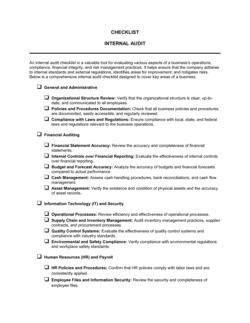
Financial Risk Assessment Template

Free Word download • Edit online • Save & share with Drive • Export to PDF

4 pages25–35 min to fillDifficulty: ComplexSignature requiredLegal review recommended
Learn more ↓
FreeFinancial Risk Assessment Template

At a glance

What it is
A Financial Risk Assessment is a formal document that systematically identifies, quantifies, and assigns mitigation responsibilities for the material financial exposures facing a business — including credit, liquidity, market, operational, and compliance risks. This free Word download gives you a structured, board-ready starting point you can edit online and export as PDF for presentation to lenders, investors, auditors, or senior leadership.
When you need it
Use it before closing a funding round, applying for a significant credit facility, preparing for an external audit, onboarding a major counterparty, or completing an annual enterprise risk review required by your board or regulators.
What's inside
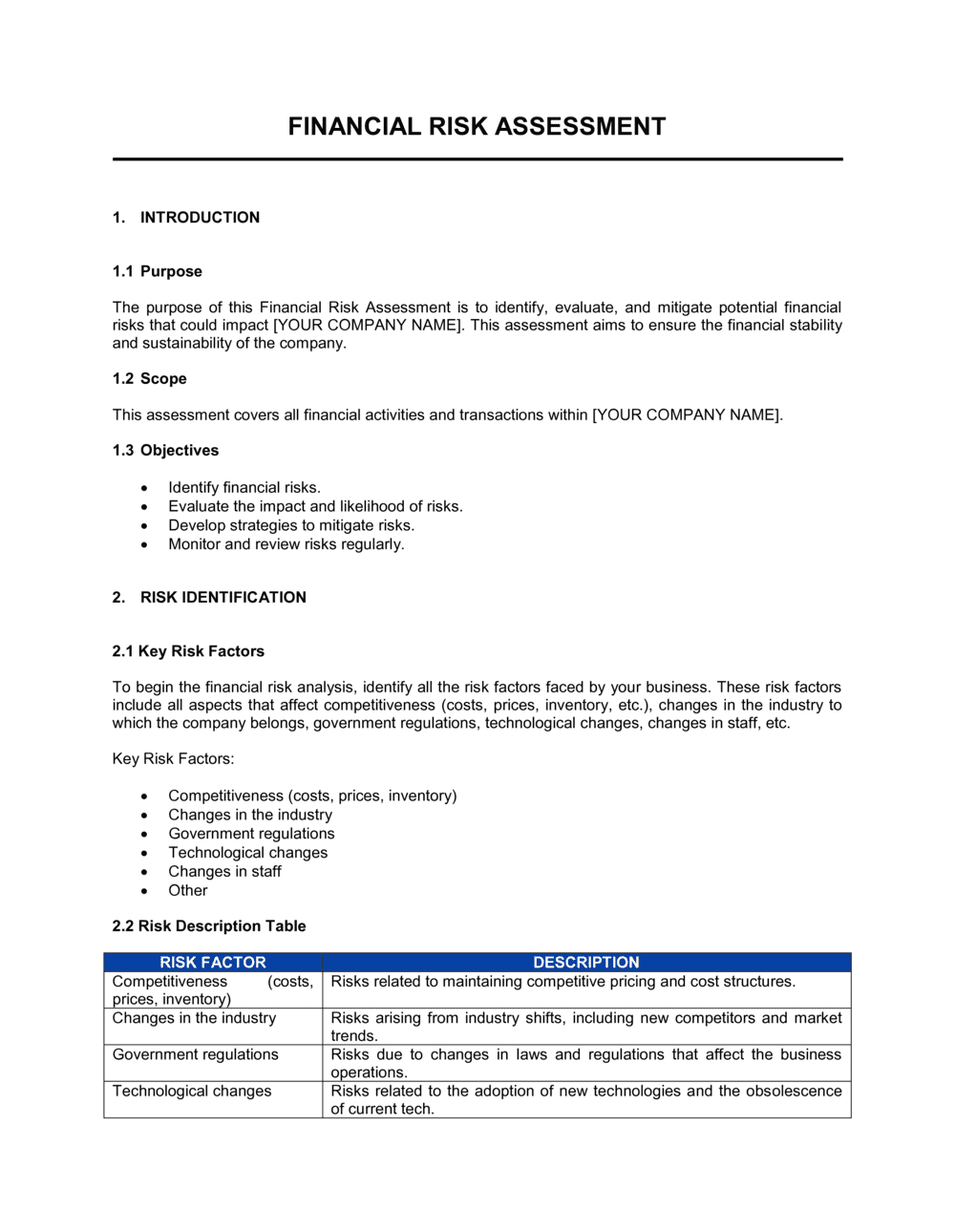
Risk identification register, probability and impact scoring matrix, inherent versus residual risk ratings, control descriptions, responsible owner assignments, mitigation action plans with deadlines, and a sign-off block for accountable executives.

What is a Financial Risk Assessment?

A Financial Risk Assessment is a formal governance document that systematically identifies, scores, and assigns mitigation responsibility for every material financial exposure facing an organization — spanning credit, liquidity, market, operational, and compliance risk categories. It combines a structured risk register with a probability-and-impact scoring matrix, an evaluation of existing internal controls, a residual risk calculation, and a named-owner action plan for risks that exceed the organization's tolerance threshold. Unlike a financial forecast, which models expected performance, a financial risk assessment explicitly documents what could go wrong, how likely it is, what it would cost, and who is responsible for preventing it.

Why You Need This Document

Without a documented financial risk assessment, your board has no formal record of the exposures it has reviewed, your lenders have no evidence that management has stress-tested the business, and your risk owners have no written accountability for the controls they are supposed to maintain. When a risk is realized — a major customer defaults, a currency moves 15% against you, or a fraud goes undetected for six months — the absence of a prior assessment is treated by auditors, regulators, and courts as evidence that governance was inadequate. Lenders increasingly require a completed risk assessment as a condition of credit approval; institutional investors expect one before committing capital at Series B and beyond. This template gives you the structure to produce a board-ready, audit-defensible assessment in a fraction of the time it takes to build one from scratch — and the sign-off blocks ensure the document functions as an accountability record, not just an analytical exercise.

Which variant fits your situation?

If your situation is…Use this template
Evaluating a specific investment or capital allocation decisionInvestment Risk Assessment
Assessing risks for a defined project with a fixed budget and timelineProject Risk Assessment
Documenting operational and process risks across the businessOperational Risk Assessment
Meeting ISO 31000 or COSO framework requirementsEnterprise Risk Management Framework
Preparing a risk section for a bank loan or SBA applicationBusiness Plan with Risk Analysis
Assessing a vendor or counterparty's financial stability before contractingVendor Risk Assessment
Conducting a post-incident financial impact reviewIncident Financial Impact Report

Common mistakes to avoid

❌ Scoping out subsidiaries and off-balance-sheet exposures

Why it matters: Guarantees, special-purpose vehicles, and subsidiary debt that are excluded from the assessment remain real financial exposures. Auditors and lenders will find them; regulators treat their omission as evidence of inadequate governance.

Fix: Conduct an entity mapping exercise before populating the risk register. Include every legal entity where the parent bears economic exposure, even if it is not consolidated for accounting purposes.

❌ Assigning mitigation actions to teams instead of named individuals

Why it matters: Collective accountability defaults to no accountability. When a mitigation deadline passes without action, there is no named person to hold responsible and no clear escalation path.

Fix: Every mitigation action in the plan must carry a single named owner with a job title, a specific deadline, and a defined escalation contact if the deadline is not met.

❌ Overstating control effectiveness without testing evidence

Why it matters: Rating a control as strong when it has not been tested in 18 months produces an artificially low residual risk rating. If a risk is realized, the gap between stated and actual control effectiveness becomes an audit finding or legal exhibit.

Fix: Require documentary evidence of testing — internal audit report, system log, or management attestation — for every control rated strong. Untested controls must be rated moderate or weak.

❌ No version history or review dates on the document

Why it matters: A financial risk assessment with no version control cannot demonstrate when a risk was first identified, what controls were in place at a given point, or whether management responded adequately to emerging exposures. This becomes critical in regulatory investigations and litigation.

Fix: Maintain a version log on the cover page with date, reviewer name, version number, and a plain-language summary of material changes. Store prior versions in a document management system for at least seven years.

❌ Setting KRI thresholds without linking them to impact scores

Why it matters: An alert threshold that fires at 45 days DSO for a business where the impact score only becomes material at 90 days creates monitoring noise and causes teams to ignore the KRI system entirely.

Fix: Calibrate each KRI threshold to the point where the residual risk rating would change — for example, the alert fires when the next score boundary is 30 days away, giving lead time to act before the rating breaches.

❌ Obtaining board approval before the mitigation plan is complete

Why it matters: Board approval of an incomplete assessment creates a false record that due diligence was completed. If a risk is realized and the mitigation section was blank at the time of approval, directors may face personal liability for rubber-stamping an inadequate process.

Fix: Make board approval contingent on a complete mitigation action plan for every above-threshold risk. Use a staged approval if necessary — board reviews the risk register first, approves the mitigation plan at a second meeting once populated.

The 10 key clauses, explained

Scope and Objectives

In plain language: Defines which entities, business units, time periods, and risk categories are covered by the assessment, and states the purpose — regulatory, audit, investor, or internal.

Sample language
This Financial Risk Assessment covers the operations of [ENTITY NAME] for the period [START DATE] to [END DATE]. It encompasses credit, liquidity, market, operational, and compliance risk categories across [BUSINESS UNITS]. The assessment is prepared for [PURPOSE: e.g., annual board review / lender submission].

Common mistake: Scoping the assessment too narrowly — excluding subsidiaries, foreign operations, or off-balance-sheet arrangements — which creates blind spots that surface during audits or due diligence.

Risk Identification Register

In plain language: A structured list of every material financial risk identified, categorized by type, with a plain-language description of the exposure and its potential trigger events.

Sample language
Risk ID: [FRA-001] | Category: [CREDIT] | Description: Concentration of accounts receivable in [CUSTOMER / SECTOR] representing [X]% of total receivables. Trigger: Customer default, sector downturn, or payment terms renegotiation.

Common mistake: Listing risks at too high a level of abstraction — writing 'credit risk exists' without naming specific counterparties, concentrations, or trigger events makes the register unusable for mitigation planning.

Probability and Impact Scoring

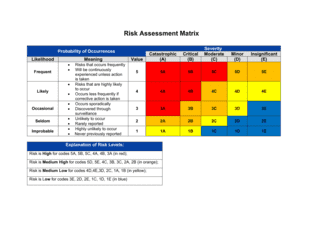
In plain language: Assigns a numerical likelihood score (e.g., 1–5) and a financial impact score (e.g., 1–5) to each identified risk, producing an inherent risk rating used to prioritize mitigation efforts.

Sample language
Probability: [3 — Possible: >20% chance of occurrence in the next 12 months]. Impact: [4 — Major: estimated financial loss of $[X] to $[Y]]. Inherent Risk Rating: [HIGH (12/25)].

Common mistake: Assigning identical probability and impact scores to every risk to avoid difficult conversations — this collapses the prioritization matrix and renders the assessment useless for resource allocation.

Existing Controls Description

In plain language: Documents the internal controls, policies, and procedures currently in place to reduce the probability or impact of each identified risk, and rates their effectiveness.

Sample language
Control: Monthly accounts-receivable aging review by CFO; credit limit approvals required for balances exceeding $[X]; [CREDIT INSURANCE POLICY / FACTORING FACILITY] in place for top-10 customers. Control Effectiveness: [MODERATE — partially mitigates concentration but does not cover customers below the credit limit threshold].

Common mistake: Describing controls in aspirational terms — writing what the policy says rather than what actually happens. Overstating control effectiveness produces an artificially low residual risk rating that misleads decision-makers.

Residual Risk Rating

In plain language: Recalculates the risk rating after accounting for the effectiveness of existing controls, producing the net exposure that requires management attention or further mitigation.

Sample language
Post-Control Probability: [2 — Unlikely]. Post-Control Impact: [4 — Major]. Residual Risk Rating: [MEDIUM (8/25)]. Variance from Inherent: [−4 points]. Accepted / Requires Further Action: [REQUIRES ACTION — exceeds risk tolerance threshold of 6/25].

Common mistake: Failing to compare residual risk against the organization's stated risk tolerance. A residual rating that exceeds the tolerance threshold must trigger a mitigation action — leaving it unaddressed creates audit findings and potential liability.

Mitigation Action Plan

In plain language: For each risk rated above the tolerance threshold, specifies the actions required to reduce exposure further, assigns a named owner, and sets a completion deadline.

Sample language
Action: Implement customer concentration policy limiting single-customer AR exposure to [X]% of total receivables. Owner: [NAME, CFO]. Deadline: [DATE]. Success Metric: Concentration ratio below [X]% by [QUARTER / YEAR]. Escalation Path: Report to Audit Committee if not resolved by [DATE].

Common mistake: Assigning mitigation actions to a team or department rather than a named individual. Shared accountability produces the same result as no accountability — deadlines pass without action.

Key Risk Indicators and Monitoring Schedule

In plain language: Defines the quantitative metrics that will signal when each residual risk is approaching or breaching its tolerance, and establishes the frequency and reporting path for monitoring.

Sample language
KRI: Accounts-receivable days outstanding (DSO). Threshold: Alert at [X] days; Breach at [Y] days. Monitoring Frequency: Monthly. Reported to: [CFO / Audit Committee]. Escalation: Automatic email to [NAME] when DSO exceeds alert threshold in the ERP system.

Common mistake: Setting KRI thresholds without tying them to the impact scores in the probability-impact matrix — resulting in alerts that fire too early (causing noise) or too late (providing no lead time to act).

Risk Owner Acknowledgment and Sign-Off

In plain language: Requires each named risk owner to confirm they have reviewed the assessment, accept accountability for their assigned risks and mitigation actions, and understand the escalation obligations.

Sample language
I, [RISK OWNER NAME], [TITLE], acknowledge that I have reviewed the risks and mitigation actions assigned to me in this Financial Risk Assessment dated [DATE], and accept accountability for executing the actions described by the deadlines specified. Signature: _______________ Date: _______________

Common mistake: Obtaining a single executive signature on behalf of all owners rather than individual sign-offs. If a mitigation deadline is missed, individual acknowledgment is the evidentiary basis for accountability — a single co-signature defeats this purpose.

Board or Senior Management Approval

In plain language: Documents formal approval of the completed assessment by the board, audit committee, or senior management, confirming the organization's accepted residual risk positions and risk appetite.

Sample language
This Financial Risk Assessment has been reviewed and approved by [BOARD / AUDIT COMMITTEE / SENIOR MANAGEMENT] on [DATE]. Accepted residual risk positions are documented in Schedule A. The next scheduled review date is [DATE]. Approved by: [NAME, TITLE]. Signature: _______________ Date: _______________

Common mistake: Treating approval as a formality and obtaining it before the mitigation action plan has been populated. Board approval of an incomplete assessment provides no governance value and exposes directors to personal liability if risks are subsequently realized.

Review and Version Control

In plain language: Records the document version, the date of each review, the name of the reviewer, and the nature of any material changes — creating an audit trail of how the risk picture evolved over time.

Sample language
Version: [2.1] | Review Date: [DATE] | Reviewer: [NAME, TITLE] | Changes: Updated DSO threshold from [X] to [Y] days following Q[X] actuals review; added new FX exposure risk FRA-014 following expansion into [MARKET].

Common mistake: Maintaining a single undated document with no version history. When a regulatory inquiry or litigation arises, the inability to show when a risk was identified and what action was taken is treated as evidence of inadequate risk governance.

How to fill it out

  1. 1

    Define the scope, purpose, and assessment period

    Enter the legal entity name, the business units covered, the time period under review, and the stated purpose — regulatory filing, board review, lender submission, or investor due diligence. Be explicit about what is excluded and why.

    💡 A clearly stated scope prevents scope creep during the review process and sets the auditor's or investor's expectations before they read a single risk entry.

  2. 2

    Identify all material financial risks by category

    Work through each risk category — credit, liquidity, market, operational, and compliance — and list every specific exposure at the transaction, counterparty, or process level. Pull data from your accounts-receivable aging, cash flow forecasts, debt covenants, and management accounts.

    💡 Involve at least one person from finance, one from operations, and one from the business unit being assessed — risks identified by a single function routinely miss the exposures other teams consider obvious.

  3. 3

    Score probability and impact for each risk

    Assign a 1–5 probability score based on historical frequency or forward-looking likelihood, and a 1–5 impact score based on estimated financial loss in dollar terms. Multiply to produce the inherent risk rating.

    💡 Anchor impact scores to specific dollar ranges agreed in advance — for example, score 3 = $50K–$500K loss, score 4 = $500K–$2M — so ratings are comparable across risk types and reviewers.

  4. 4

    Document existing controls and rate their effectiveness

    For each risk, describe what is actually in place today — policies, system controls, insurance, hedges, or manual processes — and rate effectiveness as strong, moderate, or weak based on the last time the control was tested or triggered.

    💡 If a control has not been tested in the past 12 months, rate it as weak by default and flag it for testing in the mitigation action plan.

  5. 5

    Calculate residual risk and compare to tolerance

    Recalculate probability and impact scores after applying control effectiveness, produce the residual rating, and compare it against your organization's stated risk tolerance threshold. Flag every risk that exceeds the threshold.

    💡 If your organization has not formally defined a risk tolerance, set a provisional threshold — for example, any residual score above 9/25 requires a mitigation action — and have the board ratify it when approving the assessment.

  6. 6

    Build the mitigation action plan for above-threshold risks

    For every risk exceeding the tolerance threshold, write a specific action, assign it to a named individual (not a team), set a completion deadline, and define a measurable success metric.

    💡 Deadlines longer than 90 days should be broken into interim milestones — a single 12-month deadline creates no accountability pressure and is rarely met.

  7. 7

    Define KRIs and the monitoring schedule

    Select one to three measurable indicators for each high and medium residual risk, set alert and breach thresholds, and establish the reporting frequency and escalation path.

    💡 KRIs should be available from existing systems — ERP, banking portal, or accounting software — without manual data collection. If you cannot automate the data pull, the KRI will not be monitored consistently.

  8. 8

    Obtain individual risk-owner sign-offs and board approval

    Circulate the assessment to each named risk owner for individual acknowledgment, then present the completed document to the board or audit committee for formal approval before filing or distributing externally.

    💡 Schedule the board approval meeting before distributing the assessment to lenders or investors — an unapproved draft shared externally creates governance risk and may breach confidentiality obligations.

Frequently asked questions

What is a financial risk assessment?

A financial risk assessment is a formal document that systematically identifies, evaluates, and prioritizes the financial exposures facing an organization — including credit, liquidity, market, operational, and compliance risks. It assigns probability and impact scores to each exposure, documents existing controls, calculates residual risk after controls, and specifies mitigation actions with named owners and deadlines. It is used for board governance, regulatory compliance, lender submissions, and investor due diligence.

Who is required to complete a financial risk assessment?

Publicly listed companies, regulated financial institutions, and government contractors are typically required by law or regulation to complete formal financial risk assessments on an annual basis. Private companies and small businesses are not universally required to do so but typically need one when applying for significant credit facilities, raising institutional capital, undergoing an external audit, or onboarding a counterparty with contractual risk-management requirements.

What is the difference between inherent risk and residual risk?

Inherent risk is the raw level of exposure before any controls or mitigation measures are considered — it reflects what could go wrong in the absence of any safeguards. Residual risk is what remains after existing controls are applied. The gap between the two represents the value delivered by the organization's current risk management framework. Residual risks that still exceed the organization's tolerance threshold require additional mitigation action.

How often should a financial risk assessment be updated?

At minimum, annually — aligned to the fiscal year and the board's governance calendar. In practice, material changes to the business should trigger an interim update: entering a new market, taking on significant new debt, losing a major customer, or experiencing a relevant control failure. For regulated entities, the update frequency is typically specified in the applicable regulation or supervisory guidance and may be quarterly.

Does a financial risk assessment need to be signed?

Yes. For the document to function as a governance record, individual risk owners should sign to acknowledge their assigned mitigation responsibilities, and the board or a delegated audit committee member should sign to confirm formal approval of the accepted residual risk positions. A document with no signatures is an analytical exercise, not a governance record — it provides limited protection in an audit or regulatory review.

What risk categories should a financial risk assessment cover?

A complete assessment covers at least five categories: credit risk (counterparty default and receivables concentration), liquidity risk (inability to meet short-term obligations), market risk (interest rate, foreign exchange, and commodity price exposures), operational risk (internal process failures, fraud, and system outages), and compliance risk (regulatory penalties, tax liabilities, and covenant breaches). Industry-specific categories — such as insurance risk for insurers or commodity price risk for manufacturers — should be added as applicable.

Can I use a template, or do I need a risk consultant?

A well-structured template handles the framework, scoring methodology, and documentation requirements for most small and mid-sized businesses. Engage a risk consultant or internal audit firm when the business operates in a regulated industry (banking, insurance, healthcare), when the assessment is required to meet a specific regulatory standard such as SOX, Basel III, or Solvency II, or when the exposure being assessed involves derivatives, structured products, or complex counterparty arrangements. For a standard commercial loan or board governance requirement, a completed template typically suffices.

What is the difference between a financial risk assessment and a financial audit?

A financial audit is a retrospective, independent verification of the accuracy of historical financial statements. A financial risk assessment is forward-looking — it identifies and evaluates potential future financial losses and the controls in place to prevent them. The two documents complement each other: auditors review the prior year's financials; the risk assessment governs how management is protecting the next year's. External auditors often review the risk assessment as part of their engagement, particularly when assessing internal control environments.

How is risk tolerance different from risk appetite?

Risk appetite is the board-level strategic statement of how much total financial risk the organization is willing to accept in pursuit of its objectives — typically expressed qualitatively (e.g., "low appetite for liquidity risk, moderate appetite for market risk"). Risk tolerance is the operational translation of that appetite into specific quantitative thresholds for individual risks — for example, "no single customer may represent more than 25% of accounts receivable." In the assessment, risk tolerance thresholds are the benchmarks against which residual risk ratings are compared to determine whether mitigation action is required.

How this compares to alternatives

vs Project Risk Assessment

A project risk assessment is scoped to a single initiative with a defined budget, timeline, and set of deliverables. A financial risk assessment covers the organization's entire financial risk profile across all ongoing operations and balance-sheet exposures. Use a project assessment for a specific capital project; use a financial risk assessment for enterprise-wide governance, board reporting, or lender submissions.

vs Business Continuity Plan

A business continuity plan defines how operations will be maintained or restored after a disruptive event. A financial risk assessment identifies and quantifies financial exposures before they are realized. The two documents work together — the risk assessment identifies which scenarios the continuity plan must address — but serve distinct governance purposes.

vs Internal Audit Report

An internal audit report provides retrospective assurance that specific controls operated effectively over a past period. A financial risk assessment is forward-looking, projecting potential losses and rating the adequacy of controls going forward. External auditors use both documents together when assessing the internal control environment.

vs Financial Projections

Financial projections model the expected financial performance of the business under a base-case scenario. A financial risk assessment explicitly addresses what could deviate from that base case and with what financial consequence. A risk assessment without a financial model lacks dollar-denominated impact scores; a financial model without a risk assessment has no documented downside analysis.

Industry-specific considerations

Financial Services

Regulatory capital adequacy requirements, counterparty credit exposure, interest-rate sensitivity on loan books, and AML compliance risk demand highly granular, frequently updated assessments.

Manufacturing

Commodity price volatility, supplier concentration, foreign-exchange exposure on export revenues, and capital-intensive asset impairment risk are the dominant financial risk categories.

SaaS / Technology

Concentration of ARR in a small number of enterprise customers, burn-rate and runway risk, SaaS-specific revenue recognition compliance, and vendor lock-in on cloud infrastructure.

Healthcare

Reimbursement rate changes from payers, compliance penalties under HIPAA and billing regulations, and significant accounts-receivable days outstanding driven by insurance claim cycles.

Retail / E-commerce

Inventory obsolescence, seasonal liquidity gaps, payment-processor concentration risk, and foreign-exchange exposure on imports are the most material financial risk categories.

Professional Services

Client concentration in receivables, professional indemnity liability exposure, billing-rate pressure from market competition, and key-person dependency risk affecting revenue continuity.

Jurisdictional notes

United States

Publicly traded companies must maintain documented internal controls over financial reporting under the Sarbanes-Oxley Act (SOX), with Section 404 requiring annual management and auditor assessments. Private companies are not subject to SOX but may face financial risk assessment requirements under loan covenants, SBA program rules, or state-level regulations for specific industries such as insurance. The COSO Enterprise Risk Management framework is the dominant methodology for US-based assessments.

Canada

The Canadian Securities Administrators require annual MD&A disclosure of material risks for public issuers, which typically requires a formal risk assessment process. Provincially regulated financial institutions must comply with OSFI guidelines, which mandate documented financial risk assessments and board-approved risk appetite frameworks. The CPA Canada Risk Management Handbook provides guidance for private companies seeking a recognized methodology.

United Kingdom

The UK Corporate Governance Code requires boards of listed companies to confirm they have carried out a robust assessment of the company's emerging and principal risks. The FCA requires regulated firms to maintain documented risk assessments and risk appetite statements under ICAAP or ORSA requirements, depending on sector. Post-Brexit, UK firms no longer follow EU EBA guidelines directly but many have maintained equivalent practices for consistency with European counterparties.

European Union

The EU Non-Financial Reporting Directive (NFRD), now being replaced by the Corporate Sustainability Reporting Directive (CSRD), requires large companies to disclose material financial and non-financial risks in their annual reports. Financial institutions must comply with EBA guidelines on Internal Capital Adequacy Assessment Process (ICAAP) and document risk appetite frameworks approved by the management body. GDPR imposes additional obligations on financial risk assessments that process personal data, including records of processing activities.

Template vs lawyer — what fits your deal?

PathBest forCostTime
Use the templateSmall and mid-sized businesses completing a board governance review, internal risk register, or standard commercial lender requirementFree1–3 days to complete
Template + legal reviewBusinesses in regulated industries, organizations with complex counterparty exposures, or assessments submitted to institutional lenders above $1M$500–$2,500 for a CFO advisor or risk consultant review3–7 days
Custom draftedPublicly listed companies, regulated financial institutions, entities subject to SOX, Basel III, or Solvency II, or assessments required for a capital raise above $5M$5,000–$25,000+ for a specialist risk advisory firm or external auditor2–6 weeks

Glossary

Inherent Risk
The level of risk that exists before any controls or mitigation measures are applied — the raw exposure.
Residual Risk
The risk that remains after existing controls are factored in — the net exposure the organization accepts or must further mitigate.
Risk Appetite
The total level of financial risk an organization is willing to accept in pursuit of its strategic objectives, formally approved by the board.
Risk Tolerance
The acceptable variation around a specific risk target — a narrower, operational expression of the broader risk appetite.
Credit Risk
The risk that a borrower, customer, or counterparty fails to meet a financial obligation, resulting in loss of principal or expected cash flow.
Liquidity Risk
The risk that an organization cannot meet its short-term financial obligations because assets cannot be converted to cash quickly enough.
Market Risk
Exposure to losses from movements in market prices — including interest rates, foreign exchange rates, commodity prices, and equity values.
Operational Risk
Financial losses caused by failures in internal processes, people, systems, or external events — including fraud, system outages, and human error.
Probability-Impact Matrix
A scoring grid that rates each identified risk on likelihood of occurrence and magnitude of financial impact, producing a heat-map prioritization.
Control Effectiveness
An assessment of how reliably an existing internal control reduces the probability or impact of a given risk.
Key Risk Indicator (KRI)
A measurable metric that provides early warning when a risk is approaching or exceeding its tolerance threshold.
Risk Owner
The named individual accountable for monitoring a specific risk, implementing mitigation actions, and escalating when tolerance limits are breached.

Part of your Business Operating System

This document is one of 3,000+ business & legal templates included in Business in a Box.

  • Fill-in-the-blanks — ready in minutes
  • 100% customizable Word document
  • Compatible with all office suites
  • Export to PDF and share electronically

Create your document in 3 simple steps.

From template to signed document — all inside one Business Operating System.
1
Download or open template

Access over 3,000+ business and legal templates for any business task, project or initiative.

2
Edit and fill in the blanks with AI

Customize your ready-made business document template and save it in the cloud.

3
Save, Share, Send, Sign

Share your files and folders with your team. Create a space of seamless collaboration.

Save time, save money, and create top-quality documents.

★★★★★

"Fantastic value! I'm not sure how I'd do without it. It's worth its weight in gold and paid back for itself many times."

Managing Director · Mall Farm
Robert Whalley
Managing Director, Mall Farm Proprietary Limited
★★★★★

"I have been using Business in a Box for years. It has been the most useful source of templates I have encountered. I recommend it to anyone."

Business Owner · 4+ years
Dr Michael John Freestone
Business Owner
★★★★★

"It has been a life saver so many times I have lost count. Business in a Box has saved me so much time and as you know, time is money."

Owner · Upstate Web
David G. Moore Jr.
Owner, Upstate Web

Run your business with a system — not scattered tools

Stop downloading documents. Start operating with clarity. Business in a Box gives you the Business Operating System used by over 250,000 companies worldwide to structure, run, and grow their business.

Free Forever Plan · No credit card required