1
Identify the parties, purpose, and forecast period
Enter the company's full legal name, entity type, and jurisdiction. State the intended recipient and purpose — loan application, investor disclosure, or internal board use. Set the exact start and end dates of the forecast period.
💡 Match the entity name exactly to your certificate of incorporation or articles of organization — mismatches delay processing at banks and regulatory bodies.
2
Select and document the accounting basis
Decide whether projections are on an accrual or cash basis and apply that basis consistently across all three statements. State the basis and currency explicitly in the header of the document.
💡 Accrual basis is expected by institutional lenders and most investors — use cash basis only for very early-stage businesses or when explicitly requested.
3
Build the revenue forecast from the bottom up
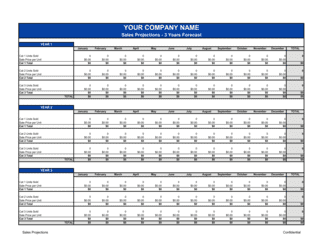
Break revenue into product lines or service categories. For each, estimate unit volume and average price, multiply to get revenue, and apply a documented growth rate for Years 2 and 3. Reference your assumptions register for every rate used.
💡 Cross-check your bottom-up revenue total against a top-down market share estimate — they should land within 25% of each other, or flag the gap and explain it.
4
Project cost of goods sold and gross margin
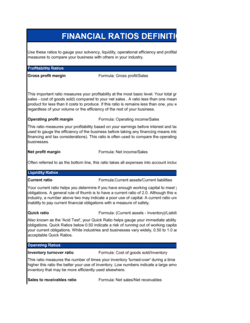
List each direct cost component (materials, direct labor, third-party fulfillment) as a percentage of revenue. Project how each component changes over the forecast period and tie any margin improvement to a specific operational action.
💡 A gross margin that improves by more than 5 percentage points year-over-year without a documented driver will be questioned — document the reason explicitly.
5
Complete the operating expense budget
List every overhead category — salaries, rent, marketing, technology, insurance, and G&A — with Year 1 dollar amounts and annual growth rates for Years 2 and beyond. Tie headcount additions to specific hires by role and timing.
💡 Add a contingency line of 3–5% of total OpEx for unplanned expenses — reviewers treat a projection with no contingency as overly optimistic.
6
Compile the projected P&L, cash flow, and balance sheet
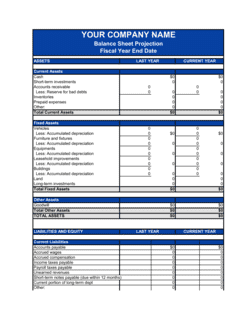
Pull revenue and expense figures into the P&L, apply the tax provision, and derive net income. Build the cash flow statement by adjusting net income for depreciation, working capital changes, and capex. Close the balance sheet and confirm it balances.
💡 Verify mathematical integrity by tracing closing cash from the cash flow statement to the cash line on the balance sheet — if they do not match, find the error before submission.
7
Complete the assumptions register
Number every material assumption — growth rates, cost percentages, headcount, pricing, and timing — and document the source or rationale for each. Place the register immediately before or after the financial statements.
💡 Label assumptions by statement and line — e.g., 'P&L Assumption 3: Marketing spend' — so reviewers can trace each figure back to its source without asking.
8
Sign the certification clause
Have the authorized officer or preparer review the completed document, confirm the assumptions are reasonable, and sign the certification section with their name, title, and date.
💡 If an external accountant prepared the projections, both the preparer and the authorized officer should sign — dual certification increases credibility with institutional lenders.